Advancing the Turfgrass Industry in New Jersey and the World
|
|
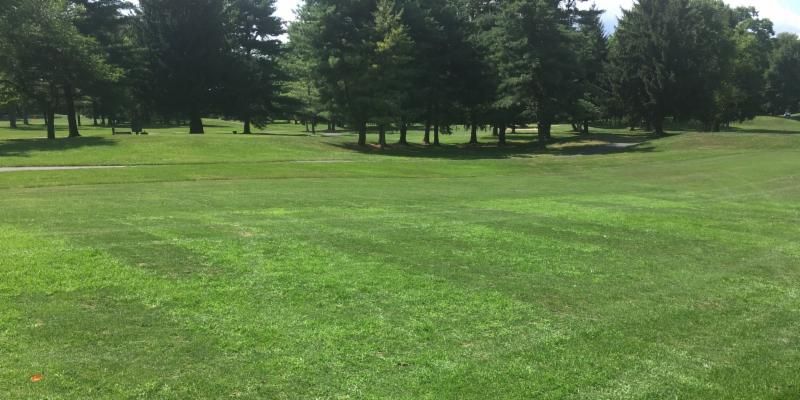
Photo of Rutgers' goosegrass trials at NJ golf course
|
|
FUNDING TURF ADVANCEMENTS #8:
Rutgers' Goosegrass Control Research
|
|
The New Jersey Turfgrass Association (NJTA) is proud to support the Rutgers Center for Turfgrass Science by financially backing research on goosegrass control measures.
|
|
Unsightly, goosegrass (
Eleusine indica
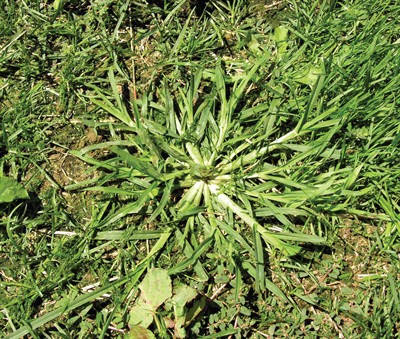
) grows flat against the ground with thick blades extending out of a white center like spokes of a wagon wheel. Mostly found in short cut areas of turf that are subject to high traffic, goosegrass seems to affect athletic fields the most.
“This weed has only become a major problem in the Northeast in the past five to ten years,” said Dr. Matthew Elmore, a Weed Science Extension Specialist at Rutgers University. “Because it is relatively new to the region, there has not yet been a lot of work done to understand the pest.” To learn how to better control the weed, Rutgers is now working to learn more about its life cycle.
Thanks in part to NJTA funding, Dr. Elmore is leading a team of Rutgers staff and students in a study to determine if goosegrass has evolved to be resistant to the currently used pre-emergence herbicides and/or if the weed germinates so late in the season that the pre-emergence herbicides have already worn off.
|
|
Trying A Different Mode of Action
There are few herbicide options available for pre-emergence weed controls. Using the same herbicides annually has not caused any trouble for crabgrass control, but goosegrass seems to be more prone to evolving resistance. “We are evaluating the products that have been used for the past twenty to thirty years to see if resistance is in fact one of the reasons goosegrass is becoming a more prevalent problem,” said Dr. Elmore.
When a weed becomes resistant to an herbicide, you must switch to another chemical that has a different mode of action. Scientists must find something else that interrupts a different biological process or enzyme in the plant. Whether it is a root growth, photosynthesis, or aromatic amino acid synthesis inhibitor affecting normal plant growth and development, once resistance has developed, an herbicide with a different mode of action must be utilized to be effective.
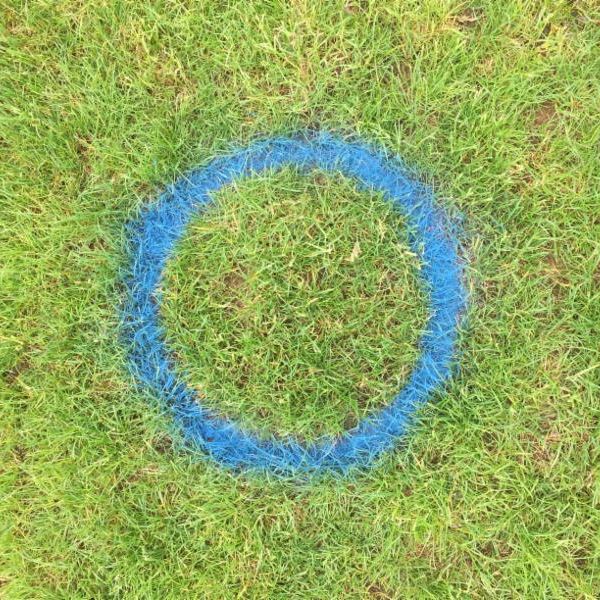
“We are currently evaluating the effects of an herbicide that utilizes a mode of action that is not typically used in the Northeast,” said Dr. Elmore. “We have test plots at the Rutgers horticulture research farm, as well as at a few golf courses at which we suspect herbicide resistance.”
|
|
Studying Germination One Seedling at a Time
The backbone of any weed control program, pre-emergence herbicides are designed to block the growth of weeds before they germinate. Because goosegrass tends to germinate much later in the season and for a longer period of time than other weeds, it seems to appear after the applied pre-emergence herbicides have lost their luster.
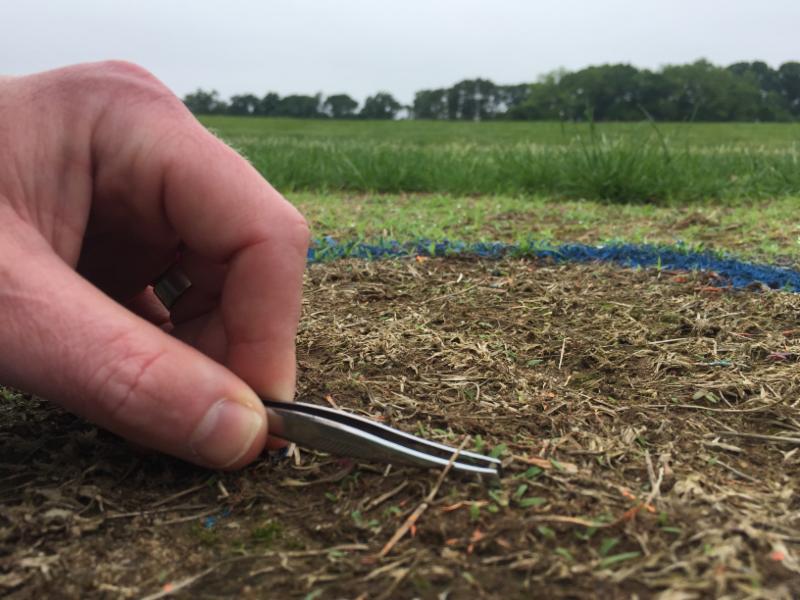
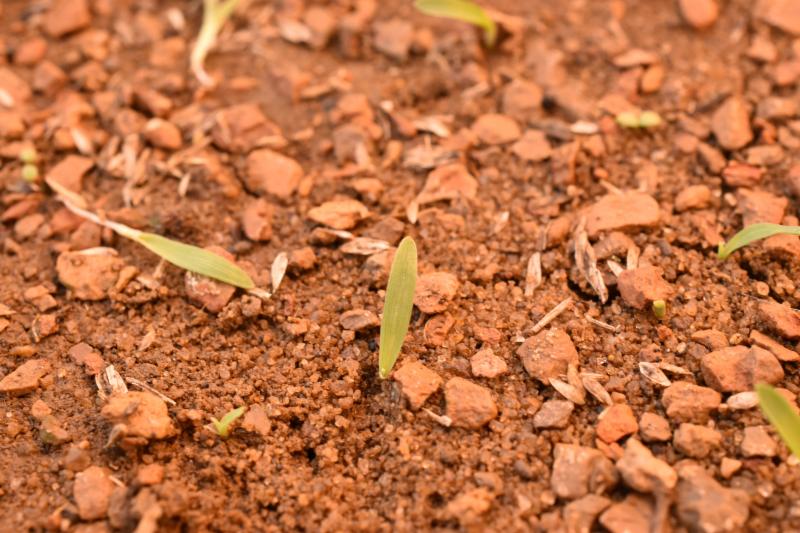
To test this theory, Rutgers is studying when goosegrass seeds germinate throughout the summer and into the fall. How? Teams of researchers literally kneel next to each test plot circle and use tweezers to pick through the grass. They pluck out and count how many seedlings have grown each week, sometimes multiple times a week. A dozen sensors in the ground track and record soil temperatures.
|
|
“Last year, we counted almost 20,000 goosegrass seedlings,” said Dr. Elmore. “All of this data will help us to better predict when this plant is going to germinate, so that we can develop a better herbicide program and guidelines for cultural practices.”
Thanks to support from the NJTA, a lot of thought, time, effort, space, and turf tweezing have gone into the Rutgers goosegrass control research. Results and suggestions coming soon!
|
|
FUNDING TURF ADVANCEMENTS is Brought to You By:
YOU & ALL Members of the NJTA
The NJTA New Jersey Turfgrass Association exists solely to promote the turfgrass industry in the Garden State through education, professionalism, and leadership. Thanks to the support of members like you, the NJTA is able to subsidize some of the research needs of the Rutgers University Center for Turfgrass Science.
|
|
NJTA membership benefits include savings on NJTA events (Green Expo, Turfgrass Research Field Days, Golf Classic), access to turfgrass research and education, opportunities to earn pesticide applicator license credits and NJ fertilizer ProFACT credits, the ability to market your products/services to the green industry, and much more. If you haven't already, please
Renew Your NJTA Membership
.
|
|
|
|
|
|
|