NOTE: For those who are not NHC members, we have extended access to our Member Brief for a limited time. If you’re not a member and would like to continue receiving our Member Brief, as well as other NHC member benefits, please click here to join today. | | Weekly update from the National Housing Conference | | News from Washington | By Brittany Webb | | |
President’s budget request released
The White House released its Presidential Budget request for FY27. The request includes significant reductions in funding, or wholesale eliminations of, critical programs that help Americans access affordable housing and credit, once again branding many programs as “woke” and “DEI”. While the proposal does not constitute what final funding amounts will be enacted, it signals the start of congressional appropriations negotiations.
At a high level, the budget requests $73.5B in discretionary budget authority for the U.S. Department of Housing and Urban Development (HUD), a 13% decrease from the FY26 enacted level. It proposes eliminating the Community Development Block Grant program, the HOME Investment Partnerships Program, PRO Housing program, the Family Self Sufficiency Program, and housing counseling. It also eliminates the Continuum of Care (CoC) program and redirects some of the funds into Emergency Solutions Grants. The request ends the Native Hawaiian program within the Native American Programs and Native Hawaiian Housing Block Grant program, asserting that “Native Hawaiians are not a tribal nation but a racial group.” In addition, it reduces funding for fair housing by $60M and eliminates the Fair Housing Initiatives Program.
The budget makes modest increases to tenant based rental assistance to fund renewals, while reducing project based rental assistance by 5%. However, it does not go as far as last year’s budget request, which called for eliminating the program and creating a state block grant program.
Outside of HUD, there are similar cuts to key programs and priorities. It eliminates NeighborWorks® America and the U.S. Interagency Council on Homelessness. At the Treasury, the budget proposes cutting the CDFI Fund by $204.5M and restructures the program, requiring 60% of funds go to rural communities. More than $1 billion in already-appropriated federal funding for the CDFI Fund, Capital Magnet Fund, and Emergency Capital Investment Program remains unused. A dozen community development organizations sent a letter to National Economic Council Director Kevin Hassett asking for the release of these funds.
At the U.S. Department of Agriculture (USDA), it eliminates the Rural Housing Voucher program, makes modest increases to the Rural Rental Assistance program, decreases funding for Section 502 direct and guaranteed loans, and eliminates the section 502 Single-Family Native American Relending pilot.
More program and account-specific details can be found in the appendix for all agencies, and a helpful guide for understanding and navigating the technical aspects of these documents can be found here.
| | | |
ONLY A FEW SEATS REMAIN
On April 8, NHC will host its Solutions for Housing Communications convening at the National Press Club in Washington, DC.
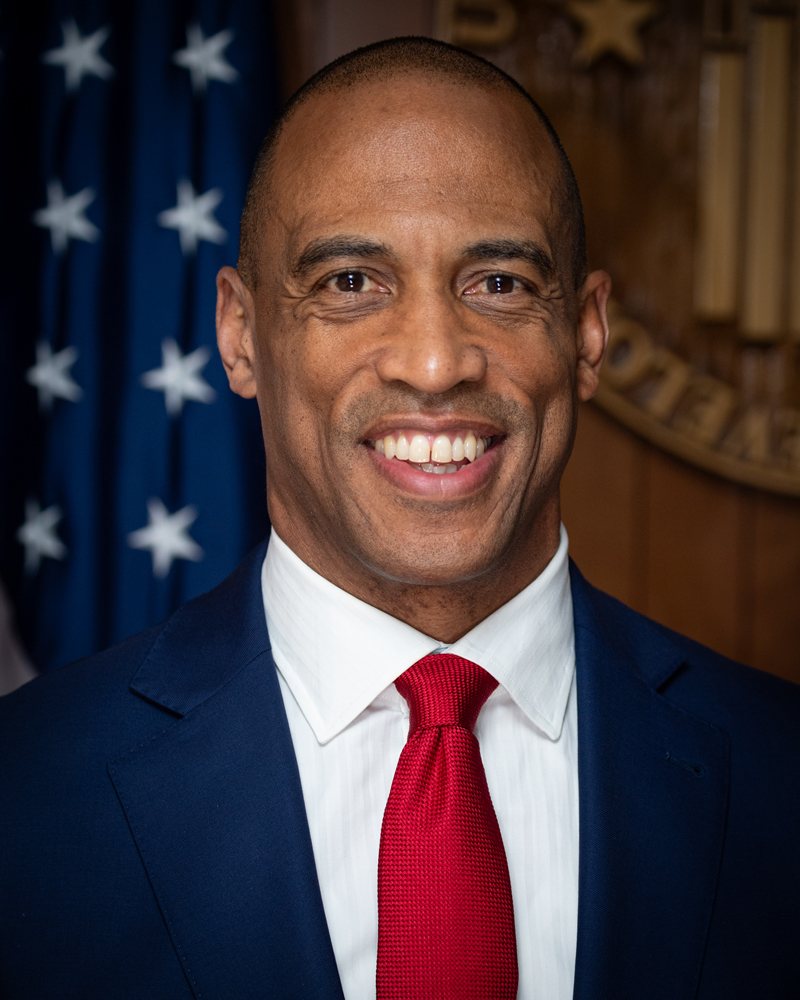
HUD Secretary Scott Turner will deliver keynote remarks highlighting HUD’s current priorities, outline the agency’s strategic approach to addressing the nation’s housing challenges, and discuss opportunities for collaboration across the public, private, and nonprofit sectors.
HUD Assistant Secretary for Fair Housing and Equal Opportunity Craig Trainor will participate in a fireside chat with NHC President and CEO David Dworkin to discuss America’s civil rights legacy as the nation approaches its 250th anniversary, as well as the Administration’s current priorities for fair housing and civil rights enforcement.
| | HUD Secretary Scott Turner | | |
HUD Assistant Secretary
for Fair Housing and Equal Opportunity
Craig Trainor
| | We’re proud to feature an outstanding lineup of speakers, including leading housing advocates, top journalists, communications strategists, and policy experts from across the country. Their insights and real-world experience will offer valuable perspectives you won’t find anywhere else—making this a must-attend event for anyone working at the intersection of housing and communications. | | |
Veterans facing rapid foreclosures, lack of homelessness prevention referrals
Recent research highlights dual ongoing challenges within the U.S. Department of Housing and Urban Development (HUD) and the Department of Veterans Affairs’ (VA) housing programs, raising concerns about foreclosures for veteran homeowners and homelessness risks from failed servicing.
The Government Accountability Office (GAO) published a study on the HUD-Veterans Affairs Supportive Housing (HUD-VASH) program, which is jointly operated by HUD and the VA and the largest program to address veterans homelessness. GAO found that from 2020-2024, 174,000 veterans did not receive a referral to the HUD-VASH program despite being eligible, and nearly 90% of those cases had no reason documented for the failure to refer. A shortage of case managers, among broader hiring challenges, was cited as a chief cause. The GAO notes that the lack of a comprehensive dataset to track outcomes across program servicing options limits the agencies’ ability to assess program effectiveness.
Further, veterans are facing foreclosures at the highest pace in a decade according to new reporting from NPR based on ICE Mortgage Technology data. The VA Servicing Purchase (VASP) program, established in 2024, offered a loss mitigation framework for veteran borrowers with loans backed by the VA. It was allowed to end in May 2025 after policymakers expressed concerns about the program’s cost, despite notable mortgage industry pushback. Since then, NPR reported that over 10,000 veterans lost their homes, and 90,000 more are behind on their mortgage or in the process of foreclosure. Veterans have faced ongoing uncertainty around VA servicing options since the COVID-19 pandemic, as policies have been introduced, phased out, paused for replacement, and ultimately terminated across administrations. As a result, there is a lack of adequate mortgage servicing options for veterans with VA loans. The VA has stated it is working on a new program to replace VASP, but details on when it will be available remain unclear.
"Per federal law, VA's home loan program is based on the premise that while Veterans may need some assistance, they must generally be able to make their mortgage payments,” stated VA press secretary Pete Kasperowicz.
| |
Judge rules CoC Builds funds must be awarded
Homelessness service providers prevailed in a court battle with HUD over program grants that were locked in limbo after the Trump administration applied new restrictions to $75 million of grantee awards, marking a moment of celebration during multiple ongoing court battles with HUD regarding homelessness program funding. Trump-appointed U.S. District Judge Mary McElroy ruled that HUD’s rewrite of the Notice of Funding Opportunity (NOFO) for the Continuum of Care (CoC) Builds program was unlawful, calling it a “slapdash imposition of political whims” and ordering HUD to scrap the new policy.
The lawsuit, National Alliance to End Homelessness & Women’s Development Corporation v. Turner, was filed in September 2025 after HUD’s revised NOFO conditioned eligibility to new requirements such as enforcement of anti-camping laws, cooperation with federal immigration enforcement, and applicant attestations affirming ideological positions on gender. HUD issued the same grant opportunity three times, even after awards had already been announced to Congress, each time layering in new criteria. The plaintiffs argued the repeated reshuffling would “irreparably injure qualified applicants” and the communities they serve.
“This ruling is a victory for people across this nation who have overcome homelessness and stabilized in HUD’s permanent housing programs,” said Ann Oliva, CEO of the National Alliance to End Homelessness. “Today’s news reinforces a fundamental truth: that the work to end homelessness is not partisan, and never should be interfered with for political means. On behalf of the people and providers we serve, the National Alliance to End Homelessness pledges to continue fighting back against efforts to dismantle homeless response in America.”
The decision is one in a series of court losses for the administration related to homelessness funding. On April 2, the 1st U.S. Circuit Court of Appeals also upheld a separate injunction blocking HUD’s overhaul of the broader CoC program, warning the changes “would be immediately destabilizing and disastrous.” That case is ongoing.
HUD has not indicated whether it will appeal either decision, but has stated it “remains committed to reforming the misguided ‘Housing First’ approach.
| |
Bipartisan Senate letter urges USDA to reverse rural homeownership program changes
A bipartisan group of ten U.S. senators sent a letter to USDA Secretary Brooke Rollins, calling on the agency to rescind recent changes to the Section 502 Direct Loan Program—a critical homeownership tool for rural families. The letter was signed by Senators Angus King, Jr. (I-Maine), John Curtis (R-Utah), Mike Crapo (R-Idaho), Mazie Hirono (D-Hawaii), James Risch (R-Idaho), Tim Kaine (D-Va.), Thom Tillis (R-N.C.), Lisa Blunt Rochester (D-Del.), Susan Collins (R-Maine), and Alex Padilla (D-Calif.).
The senators’ concerns center on revisions to the Section 502 Direct Loan Handbook, issued by USDA Rural Development on February 10 and effective immediately. Among the most significant changes, the loan limit was reduced from 80% to 60% of the HUD Section 203(b) limit, and new rules prohibit loans when a home’s appraised value exceeds that limit. The letter flags this combination as particularly harmful for families participating in USDA’s Mutual Self-Help housing program, where participants contribute their own labor to build or renovate their homes, lowering their loan amount but increasing the appraised value of the property. Under the new rules, families who reduce risk to the federal government through their own sweat equity could nonetheless be disqualified. The senators also objected to new bureaucratic requirements, including a two-stage state director review process for every loan and a sharp reduction in packaging fees for nonprofit partners.
The letter argues that these changes are fundamentally misaligned with current housing market realities, where home values remain elevated due to persistent inflation and high construction costs. “We fear that reducing loan limits without exception will render the 502 Direct program inaccessible to countless rural households,” the senators wrote, calling on USDA to work with Congress and the public before making future revisions to ensure changes reflect both the statutory intent of the program and the realities of rural housing markets.
| |
Trump adds to building materials tariffs
The Trump administration announced it is increasing tariffs on imported steel, aluminum, and copper, framing the move as part of a broader effort to bolster domestic manufacturing and address national security concerns tied to reliance on foreign metals. Administration officials say the updated structure is intended to ensure tariffs reflect the full value of imported goods and to standardize how Section 232 duties are applied. However, housing groups are concerned of the impact that increased costs will have on affordability.
“With the nation facing a housing-affordability crisis, NAHB urges the president to exempt building materials as part of his tariff strategy because tariffs raise construction costs, impede supply chains and result in market and business uncertainty that make it difficult for builders to price their homes,” stated Bill Owens, chairman of the National Association of Home Builders.
Under the new policy, products made entirely or nearly entirely of steel, aluminum, or copper will face a 50% tariff on their full value, while derivative goods containing substantial amounts of those metals will be subject to a 25% tariff. Certain industrial and electrical grid equipment will pay a 15% rate through 2027, and products made abroad using entirely U.S.-produced metals will be taxed at 10%. Items with 15% or less of metal content will be exempt from these tariffs.
| | | |
Commissioner Cassidy takes personal leave
HUD Assistant Secretary for Housing and Federal Housing Commissioner Frank Cassidy has taken a leave of absence, citing personal family matters. The leave is expected to last for “the foreseeable future,” according to reports, though some sources indicate it may be limited to 30 days. Joseph Gormley, President of Ginnie Mae, will lead the Federal Housing Administration during his absence.
“Mr. Gormley brings years of experience in mortgage finance, specifically in FHA lending, and under his leadership the office will continue to make homeownership more accessible for Americans,” a spokesperson said.
| |  | |
HMDA data published
The Consumer Financial Protection Bureau (CFPB) released its Home Mortgage Disclosure Act (HMDA) Modified Loan Application Register (LAR) data for 2025. The LAR dataset is now available online, streamlining the past process where agencies had to request the data from specific institutions. HMDA data is one of the primary sources of data for housing research. Earlier this year, the CFPB also adjusted the threshold for HMDA data collection requirements from banking institutions from a minimum asset thresholds of $58 million to $59 million for the 2026 calendar year.
| | | |
Homeowner Assistance Fund reached the most vulnerable borrowers
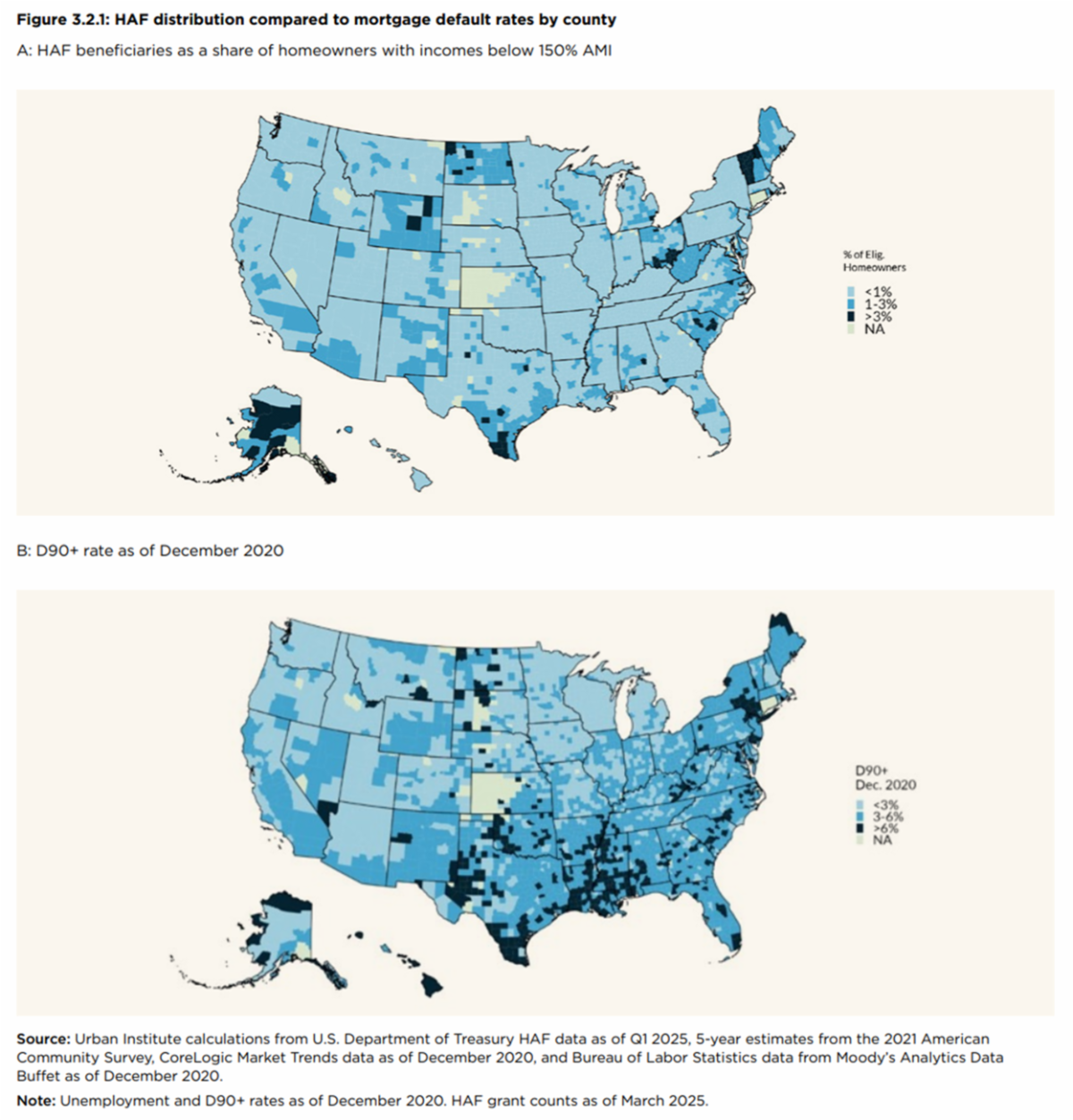
The Mortgage Bankers Association’s Research Institute for Housing America (RIHA) published a report examining how the $10 billion federal Homeowner Assistance Fund (HAF) served homeowners who fell outside the reach of traditional loss mitigation tools. The report, “Stabilizing Vulnerable Homeowners in a Time of Crisis: Insights from the Homeowner Assistance Fund,” presents side-by-side county-level maps comparing HAF beneficiaries as a share of income-eligible homeowners (below 150% AMI) against serious mortgage delinquency rates (D90+) as of December 2020, and the geographic overlap between the two panels is notable. Counties with the highest concentrations of HAF recipients—particularly across the South and parts of Alaska, and scattered counties in the Midwest—broadly mirror the counties where 90-plus day delinquency rates were most elevated at the height of the pandemic. The authors argue this geographic alignment reflects the program functioning largely as designed, concentrating targeted relief in places where borrowers were least able to resolve defaults through standard forbearance alone. NHC led a diverse coalition of more than 350 groups in sending a letter to congressional leaders urging that the homeowner funding be included in the COVID-19 relief package that was ultimately signed into law.
| | |
AP News reports that the Build America, Buy America Act, which mandates domestically produced materials in federally funded affordable housing projects, has created a significant bottleneck as HUD's waiver approval process has ground to a near standstill amid staff cuts. Developers are absorbing hundreds of thousands of dollars in additional compliance costs, with some scaling back unit counts or restructuring projects to avoid federal funding thresholds altogether.
A proposed HUD rule targeting mixed-status households, families where at least one member is undocumented, but others legally qualify for housing assistance, could displace far more eligible Americans than the undocumented immigrants it aims to remove, according to an article published by Moneywise News. The Center on Budget and Policy Priorities estimates that nearly 80,000 people, including over 52,000 eligible citizens and 35,000 citizen children, could lose rental assistance if the rule takes effect—despite mixed-status households representing only about 20,000 of the millions of households in HUD programs.
An article from HousingWire reports that while housing demand remains positive year-over-year despite mortgage rates at 6.64%, regional data reveals growing friction beneath the surface. More deals are falling through, sellers are pulling listings rather than adjusting prices, and pricing behavior is diverging sharply across markets. The uneven picture ranges from markets like Nashville, where more than one in four listings has returned to market after failing to close, to more affordable metros like El Paso and Oklahoma City where competition is still pushing prices higher.
| | |
Monday, April 6
No events posted.
Tuesday, April 7
No events posted.
Wednesday, April 8
2026 Rural Rental Housing Preservation Academy | Enterprise, 11 – 12:30 PM MT
NHC's Solutions for Housing Communications, 9 AM - 5 PM ET
Thursday, April 9
WHF BYOL HMDA Update 2026, 12 – 1 PM ET
Bridging the Gap: Explaining Financial and Math Concepts to Older Homeowners, 2 PM – 3:30 PM ET
Low-Income Families, High-Income Taxpayers, and a Looming Fiscal Crisis: A Tribute to Len Burman, 2 PM – 5 PM ET
Friday, April 10
Living Together by Design: Housing to Connect Generations, 1 – 5 PM ET
| | The National Housing Conference is a diverse continuum of affordable housing stakeholders that convene and collaborate through dialogue, advocacy, research, and education, to develop equitable solutions that serve our common interest. | | Defending Our American Home since 1931 | | Copyright © 2024. All Rights Reserved. | | | | |