Weekly update from the National Housing Conference |
|
In this issue
January 16, 2023
Issue 92-2
· House Ways and Means Committee adds new members
· Wells Fargo focuses on racial equity in home lending
· Enterprise, Wells Fargo Foundation launch housing affordability challenge
· HUD RFI supports green building
· Ginnie Mae reports record end-of-year balance
· OCC updates Fair Lending Booklet
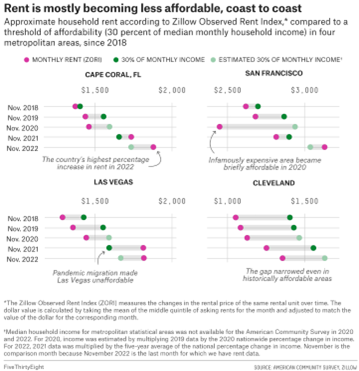
Chart of the week: Rent prices remain higher than before pandemic amidst ending assistance programs
|
|
The Legacy of Fair Housing
By Bryan Greene, Vice President of Policy Advocacy at the National Association of REALTORS® and Cy Richardson, Senior Vice President for Programs at the National Urban League
Today marks Martin Luther King Jr. Day, a federal holiday celebrating the birthday of the most renowned leader of America’s modern Civil Rights Movement–a movement led by many across the United States challenging systemic racial segregation and discrimination.
When Dr. King began his advocacy, the American dream of homeownership, to build wealth and provide safety and community for one’s family and children, was literally only a dream for many Black families and others historically marginalized by housing and racial discrimination. Government sanction of housing discrimination denied people of color the opportunity to buy and sell property within certain neighborhoods and relegated them to communities that became isolated, impoverished slums. Denial of the opportunity for housing also meant exclusion from high-quality education, healthcare, employment, and the benefits of other private and public resources.
Dr. King’s move to Chicago in 1966 marked a pivotal moment in the campaign to achieve fair housing in one of the most racially segregated cities in the nation. Known as the Chicago Freedom Movement, this, along with his famous ‘Other America’ speech in 1967 which highlighted disparities among Black and White Americans and called on Congress to pass fair housing legislation, was catalytic and instrumental to the eventual passing of the 1968 Fair Housing Act outlawing racial discrimination in the private housing market.
Dr. King’s legacy remains a force that continues to animate a new generation that presses for fair access to housing today. Today, the Black homeownership rate has fallen to levels prior to the signing of the Fair Housing Act of 1968. This is why the Black Homeownership Collaborative was launched. more...
|
|
News from Washington | By Brittany Webb
|
|
House Ways and Means Committee adds new members
The House Ways and Means Committee added new Republican members. The new members include U.S. Rep. Blake Moore (R-UT), U.S. Rep. Randy Feenstra (R-IA), U.S. Rep. Brian Fitzpatrick (R-PA), U.S. Rep. Mike Carey (R-OH), U.S. Rep. Claudia Tenney (R-NY), U.S. Rep. Michelle Fischbach (R-MN), U.S. Rep. Michelle Steel (R-CA), U.S. Rep. Nicole Malliotakis (R-NY), U.S. Rep. Greg Steube (R-FL), and U.S. Rep. Beth Van Duyne (R-TX).
Many of the new committee members cosponsored the Affordable Housing Credit Improvement Act (AHCIA). Moore, Feenstra, Fitzpatrick, Carey, and Tenney all cosponsored AHCIA. Fitzpatrick and Malliotakis also cosponsored the Neighborhood Homes Investment Act. U.S. Rep. Jason Smith (R-MO) is now the Committee Chair. Smith was an original cosponsor of the AHCIA and has cosponsored it several times since.
“Ways and Means Republicans are ready to get to work delivering on our commitment to build a stronger economy that gives the American people greater opportunity to build a prosperous future for themselves and their families,” said Smith in a statement. “We will partner with the American people in our work by hitting the road and holding hearings outside of Washington to hear directly from folks on the ground in our communities about their struggles and their ideas to create more jobs, increase wages, and build a more secure future for their families.”
|
|
 |
Wells Fargo focuses on racial equity in home lending
Wells Fargo announced a new strategic direction for its home lending business, focusing on racial equity. The company is exiting the correspondent business and reducing the size of its mortgage portfolio, a significant step away from the U.S. multitrillion-dollar mortgage market. Wells Fargo will now focus primarily on bank customers and underserved communities. In addition, the company announced an additional $100 million investment to advance racial equity in homeownership through partnerships with nonprofit organizations and community engagements and broadening its current $150 million investment in special purpose credit programs.
“Mortgage is an important relationship product, and our goal is to continue to be the primary mortgage lender to Wells Fargo bank customers as well as minority homebuyers. We are making the decision to continue to reduce risk in the mortgage business by reducing its size and narrowing its focus,” said Kleber Santos, Wells Fargo CEO of Consumer Lending. “As the largest bank lender to Black and Hispanic families for the last decade, we remain deeply committed to advancing racial equity in homeownership.”
|
|
|
|
|
Enterprise, Wells Fargo Foundation launch housing affordability challenge
Enterprise and the Wells Fargo Foundation announced a new grant competition called The Housing Affordability Breakthrough Challenge for identifying and implementing innovative ideas that “transform current practices and reimagine access to affordable homes.” Applicants compete for grants of $1 million, $2 million, and $3 million and will also receive two years of technical assistance to help scale and implement their ideas. The competition has three focus areas: financing, construction, and access and resident support. Submissions must also focus on racial equity and environmental sustainability, where applicable.
Applications open on Jan. 31, 2023, and submissions are due by March 3, 2023.
|
|
|
|
HUD RFI supports green building
HUD published a Request for Information for a contractor to support the agency’s Green and Resilient Retrofit program implementation. The program provides funding for rehabilitating properties to make them more energy and water efficient. HUD will ask the chosen contractor to develop recommendations to ensure the program can achieve its target objective. In addition, HUD is developing a Quality Assurance Surveillance Plan to provide oversight on the specified performance requirements. Comments are due by Jan. 20, 2023.
|
|
|
|
|
Ginnie Mae reports record end-of-year balance
Ginnie Mae reported that its mortgage-backed securities (MBS) portfolio outstanding grew to $2.28 trillion by Dec. 31, 2022, a new record end-of-year balance. The portfolio registered a $19 billion net growth for the year. The announcement also notes $31.14 billion of MBS issuance in December, which financed more than 107,000 households and included 49,000 first-time homebuyers. Throughout 2022, Ginnie Mae supported the pooling and securitizing of over 730,000 first-time homebuyer loans.
|
|
|
|
OCC updates Fair Lending Booklet
The Office of the Comptroller of the Currency (OCC) issued a revised version of the Fair Lending booklet. The booklet provides information for OCC examiners to assess fair lending risk and compliance with the Fair Housing Act, the Equal Credit Opportunity Act (ECOA), and Regulation B. The revisions include clarified details and risk factors for differing examination scenarios and reflect changes to laws and regulations since the booklet was last published.
“Ensuring compliance with fair lending laws will help put an end to discriminatory lending practices that create and exacerbate inequity in the federal financial sector,” said Acting Comptroller of the Currency Michael Hsu. “The OCC’s revised ‘Fair Lending’ booklet is an important tool to promote equal access to credit for all consumers. It frames our supervisory approach applicable to each OCC-supervised bank that engages in lending, and provides additional guidance for examiners in this critically important area.”
|
|
|
|
Rent prices remain higher than before pandemic amidst ending assistance programs
The FiveThirtyEight blog reported on data from the Zillow Observed Rent Index (ZORI) that measures rental price changes and their impacts on rent affordability. According to Zillow’s data, rents began increasing in the years leading up to the pandemic, starting in 2015, by an average of 4 percent year-over-year. Vacation-home markets like Cape Coral, Florida, and Las Vegas experienced some of the nation’s highest rent increases, making the markets unaffordable for many. Long-term rent increases also impacted cities such as Cleveland, although rent price growth showed signs of slowing at the end of 2022. In addition, many COVID-19 relief programs that supported new and existing renters have depleted funds with the threat of recession looming, putting housing at further risk for communities nationwide.
|
|
An article by the Joint Center for Housing Studies of Harvard University titled How Can Design Improve Affordable Housing on Tribal Lands explores current housing conditions and design practices in Native areas. Based on research conducted under the Gramlich Fellowship, the article notes the importance of community participation and cultural awareness to foster support for socio-cultural norms and practices while bringing understanding to alternative models for Native communities.
An NPR article discusses the impacts a tight housing market and access to wealth creation might have on homebuyers. Many homebuyers face rising inflation and interest rates today, and competition with cash buyers leaves many potential homebuyers feeling stuck. The story highlights prospective homeowners, discusses wealth building, and a reimagining of the American dream.
The New York Times highlights the instability of Congress’ current legislative process and how heightened partisanship in Congress is causing gridlock. The article highlights targeted political ads attacking federal spending bills during the appropriations process as “leading both parties to restrict the opportunity to propose amendments to save their members from taking tough votes.” The article says a move for Congress to overhaul its legislative process becomes increasingly necessary in a struggle to find common ground.
A CNN Business article provides an overview of what to expect in the housing market for 2023. Calling 2022 a “wild ride” with doubled mortgage rates, high inflation, and deteriorating housing demand- the article offers perspectives from a group of housing experts with predictions on home prices, mortgage rates, and seasonality of the market.
|
|
Tuesday, January 17
Wednesday, January 18
Thursday, January 19
|
|
The National Housing Conference is a diverse continuum of affordable housing stakeholders that convene and collaborate through dialogue, advocacy, research, and education, to develop equitable solutions that serve our common interest. |
|
Defending Our American Home since 1931 |
|
Copyright © 2022. All Rights Reserved. |
|
|
|
|
|
|