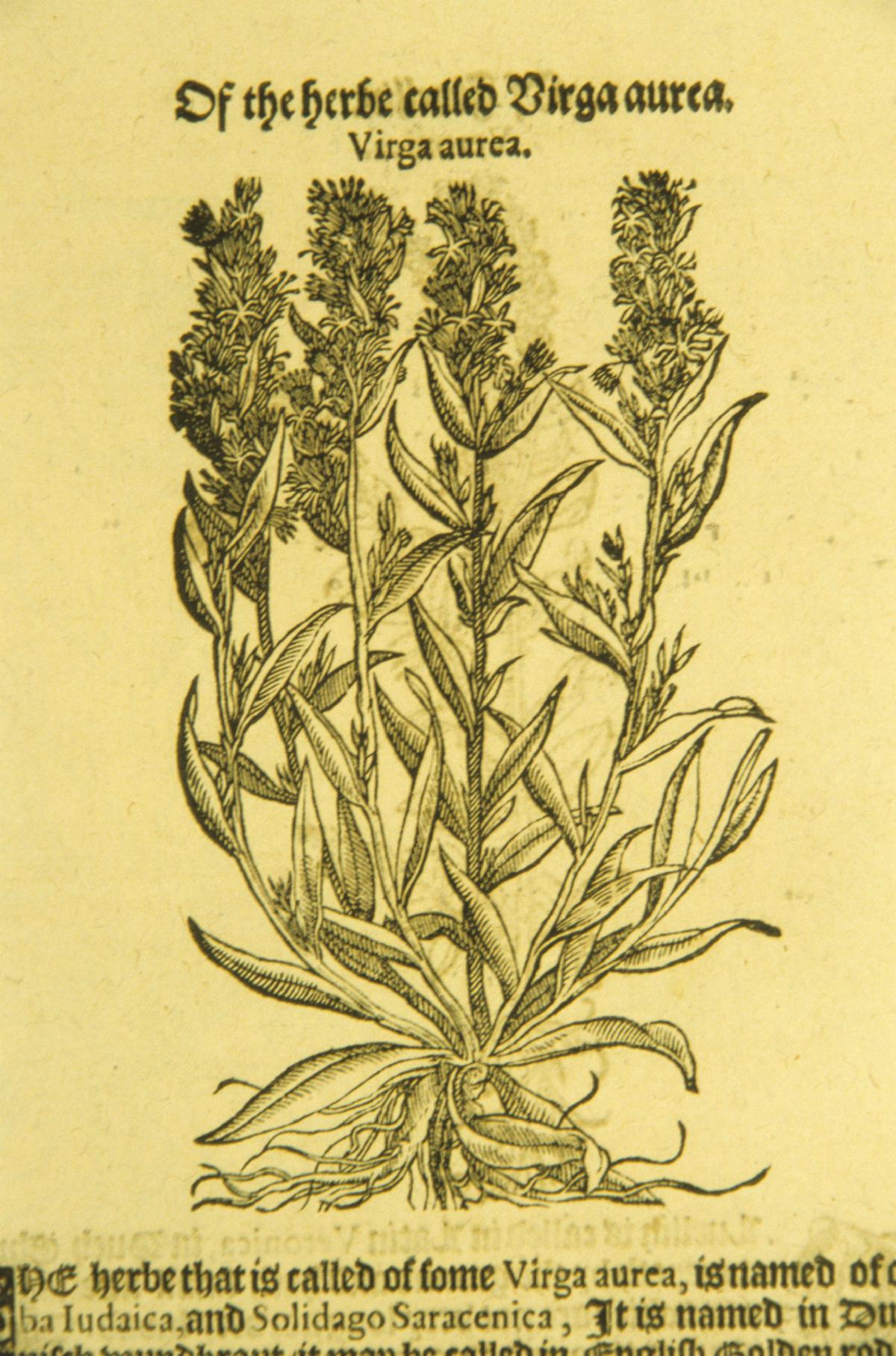
"Of the herbe called Virga aurea." Woodcut from William Turner, The First and Seconde Partes of the Herbal (Cologne: heirs of Arnold Birckman, 1568). National Library of Medicine. | | |
Of the Flower Called Goldenrod
A brief tour of the plant everyone in Woodstock is looking at right now, and the one they're actually sneezing at.
If you've driven anywhere in the last two weeks, you've seen it: roadsides, field edges, the unmowed corner of every parking lot, all gone the color of egg yolk. This is goldenrod, genus Solidago, from the Latin solidare, to make whole, on account of a long medicinal résumé we won't get into here (it involves kidneys). It is also, every September, the wrongly accused in one of the great cases of mistaken identity in American botany.
Here is the whole trial. Goldenrod pollen is heavy, sticky, and built to ride on the leg of a bee; it does not travel by air, which means it cannot get into your nose unless you put it there. Ragweed, which blooms at exactly the same time, produces pollen that is light, dry, and airborne by the billion, and it does this from a green, unremarkable plant that nobody notices because nobody is looking at it. One of these plants is beautiful and blameless; the other is invisible and responsible. Guess which one got the reputation.
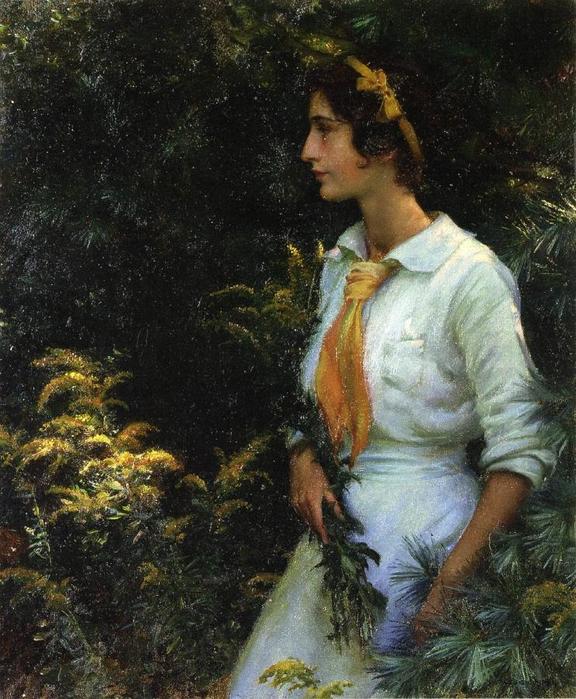
| | Charles Courtney Curran, Goldenrod, ca. 1910, oil on canvas. | | |
If you'll allow me a quick trip north: for most of the 1800s hay fever was considered a disease of refinement, something that happened to people with money and sensitive nervous systems, and the treatment was to leave. By the turn of the century, New York's sufferers were decamping every August to Lake Placid, where the town oiled its streets against dust and pulled up every stalk of goldenrod within the limits, along with the ragweed, on the theory that you couldn't be too careful. In 1915 the Empire State branch of the United States Hay Fever Association held its first meeting there under Melvil Dewey, the decimal-system guy, who had come north for his sinuses in 1895 and stayed to build the Lake Placid Club, which he promoted as a pollenless paradise. (It was less in other ways too: the club's printed rules barred Jews by name, and Black people and others under a blanket race clause, and the public outcry over that policy forced Dewey out as State Librarian in 1905.)
At the same moment, a few hours south, Charles Courtney Curran was setting young women in white dresses in front of the stuff and painting it as the most beautiful thing in New York, which it may be (I've always thought so); the painting above is one of his, and Curran spent forty summers at Cragsmoor, in this very county, so he'd have known the plant.
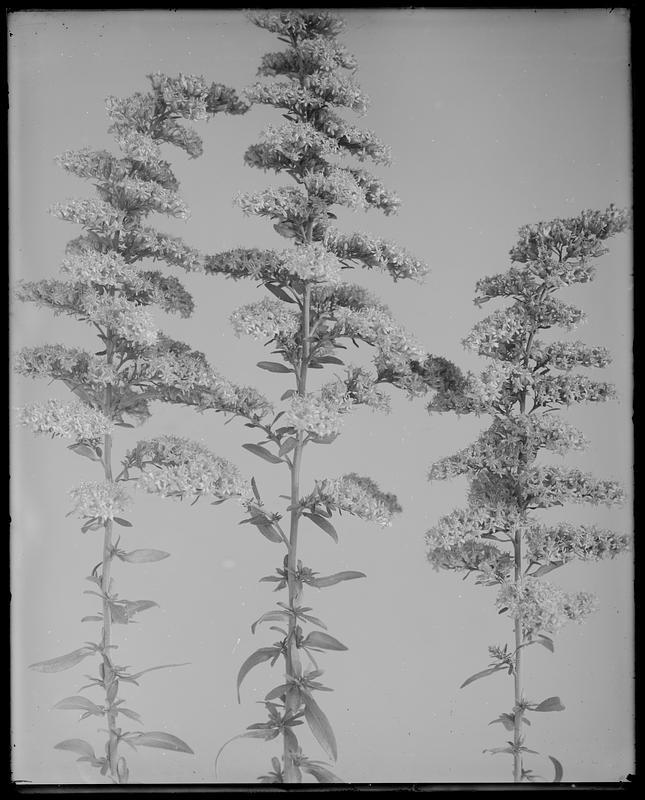
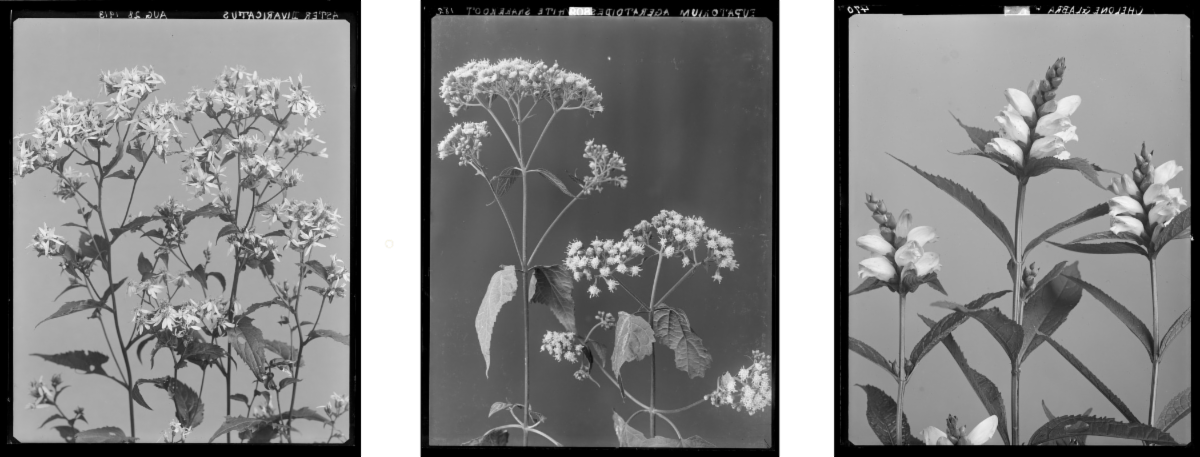
| | Goldenrod (Solidago). Glass negative by Edwin Hale Lincoln, ca. 1890–1937. | | What goldenrod is actually doing in September is holding the whole late-season economy together. Miranda points out (correctly) that there isn't one goldenrod but many; New York has more than two dozen native species, and they bloom in relays, one clocking out as the next clocks in, from August into the first frosts of October. For a monarch trying to make Mexico, or a bumblebee queen fattening up before she goes underground for the winter, this is not decoration. This is the last open restaurant on the highway. We have a modest stand of it at Zena; the rest of the county has it in embarrassing abundance. | | Left to right: white wood aster (Aster divaricatus, now Eurybia divaricata), white snakeroot (Eupatorium ageratoides, now Ageratina altissima), and white turtlehead (Chelone glabra). Glass negatives by Edwin Hale Lincoln, ca. 1890–1937. | | |
Three to look for at Sloan Gorge
The goldenrod gets the headlines, but the woods have their own late show, and Melissa says the next few weeks are the time to catch it.
White wood aster. Small, starry, and everywhere along the trail once you start seeing it; this is the aster that carpets the shade after nearly everything else has quit. (Botanists broke up the old genus Aster in the 1990s and this one got moved to a genus called Eurybia; it did not consent, and the bees did not notice.)
White snakeroot. Fluffy white clusters, waist high, blooming in the open woods. Also, quietly, one of the more consequential plants in American history: cows that graze on it pass a toxin into their milk, and in 1818 milk sickness killed Nancy Hanks Lincoln in Indiana, leaving a nine-year-old Abraham to figure things out on his own. (Edwin Hale Lincoln, whose photographs you've been looking at, is, as far as anyone has established, no relation.) The bees, again, are unbothered. Admire it, don't eat it, don't let your cow eat it.
White turtlehead. The one worth the hike. It grows with its feet wet, along the seeps and creek edges, and the flower is shaped exactly like its name, a shut turtle mouth that only a bumblebee has the shoulders to shove open (you can watch this happen; the bee disappears entirely, and the flower looks briefly like it's chewing). It is also the plant the Baltimore checkerspot butterfly most wants to lay her eggs on, so where there's turtlehead and a checkerspot colony within reach, you are looking at next summer's butterflies, currently the size of a grain of rice and huddled together in a web for the winter.
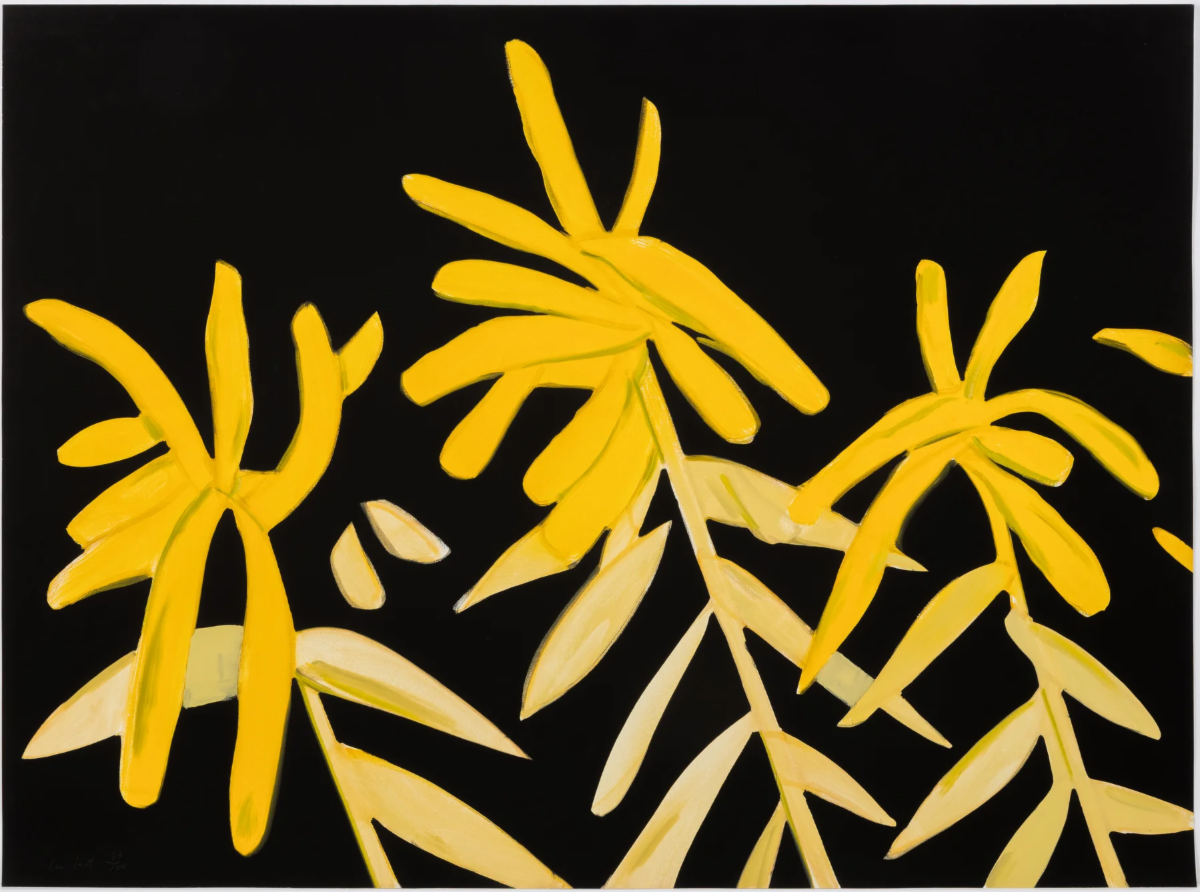
| Alex Katz, Goldenrod, 2021. Archival pigment print, edition of 100, published by Lococo Fine Art Publisher, St. Louis. © Alex Katz | |
What to do about it
Nothing, mostly, which is the good news. If you have goldenrod on your property, leave it standing; the seed heads feed the goldfinches through November, and the dead stems are where a good number of native bees will chew their way in and spend the winter. Cut it back in spring, if you must, and not before. The best thing you can do for the last pollinators of the year is the thing you were going to do anyway, which is not get around to the yard work.
The other thing you can do is come look at the bees while they're still working. This Saturday, September 12, 2–4 pm, the Woodstock Pollinator Pathway is hosting Chris Layman, Master Beekeeper at Fox Farm Apiary, at the Thorn Preserve on John Joy Road to talk about the wild and domestic bees of late summer, what they're doing to get ready for winter, and the plants holding them up while they do it. There's a short walk to see the honey bees and the wild ones side by side in the September bloom, and light refreshment from Fox Farm afterward, which we assume involves honey. Free. RSVP to reserve your spot, and read more about Thorn Preserve and Fox Farm Apiary.
| | | | |