Nonprofit Policy Update of the North Carolina Center for Nonprofits

August 15, 2025

In this week's issue... 

This week’s policy update begins with details of a recent Executive Order from President Trump that could create challenges for nonprofits with federal grants. We share the latest on several new court filings encouraging a federal court to allow churches to make political endorsements. And we highlight a helpful toolkit from You Can Vote to help nonprofits get the word out to their communities about local elections this fall.

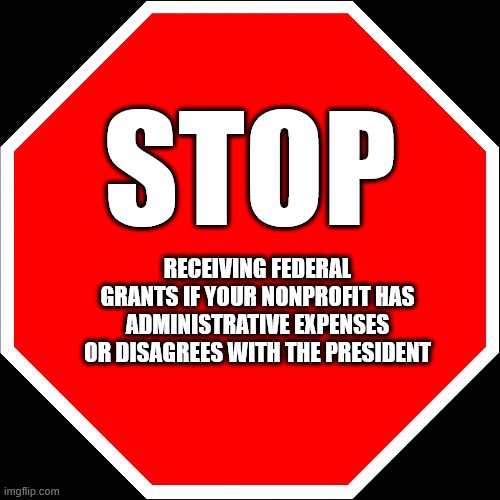
Stop sign meme. Text reads 'STOP receiving federal grants if your nonprofit has administrative expenses or disagrees with the president.'

New Executive Order Could Create New Barriers for Federal Grants to Nonprofits


Last week, President Donald Trump issued an Executive Order (EO 14332) making several significant changes to the process by which federal agencies award, oversee, and terminate federal grants, including grants to nonprofits. The Executive Order was published on the Federal Register this week. Several of these changes could have significant implications for nonprofits that currently have federal grants and for those applying for federal grants in the future. Major changes include:

  • Requiring that each agency have a political appointee responsible for oversight of its grant process. That political appointee will have broad authority to develop a process for reviewing grant applications and to ensure that grants are “consistent with agency priorities and the national interest.”
  • Prohibiting federal grants for a variety of purposes that are inconsistent with President Trump’s priorities. Specifically, competitive federal grants could not be awarded to nonprofits that use racial preferences, including “proxies for race” in employment or program participation decisions. A recent memo from the U.S. Department of Justice (DOJ) on “unlawful discrimination” for recipients of federal funds provides guidance on what the Trump Administration considers as “proxies” for racial discrimination. These “proxies” include the use of criteria like “cultural competence,” “lived experience,” “overcoming obstacles” narratives, and targeting programs and services to specific geographic areas based on their racial or ethnic composition. 
  • Prohibiting federal grants for a variety of other purposes that are inconsistent with President Trump’s priorities. Competitive grants also could not be awarded to nonprofits that do not acknowledge “the sex binary in humans or the notion that sex is a chosen or mutable characteristic.” They also could not be awarded to nonprofits serving undocumented immigrants, and for “any other initiatives that compromise public safety or promote anti-American values.”
  • Giving priority to nonprofits with lower indirect cost rates in competitive grant application processes. 
  • Requiring the Office of Management and Budget (OMB) to revise its Uniform Guidance to require all federal grant agreements to include provisions allowing for “termination for convenience” by federal agencies, meaning that political appointees of federal agencies will have the discretion to terminate federal grants to nonprofits for almost any reason.
  • Requiring OMB to revise its Uniform Guidance to “appropriately limit the use of discretionary grant funds for costs related to facilities and administration.” Potentially, this could mean that OMB may soon make changes to last year’s major improvement of the Uniform Guidance that included a de minimis 15% indirect cost rate on federal grants, for which the Center and many other nonprofits have successfully advocated for nearly a decade.

U.S. Department of Education Expected to Propose New Rule on PSLF Eligibility


This morning, the U.S. Department of Education released the text of a proposed new rule on eligibility for the Public Service Loan Forgiveness Program (PSLF). Under PSLF, student loan borrowers who work in public service jobs – including positions with 501(c)(3) nonprofits – for 10 years while paying off their student loans are eligible to have the remainder of their federal student loans forgiven. PSLF has enabled many young professionals to afford careers in the nonprofit sector.


The proposed new rule would exclude employers – potentially including some 501(c)(3)s – from being eligible employers for PSLF if they are engaged in “substantial illegal purposes.” The proposed regulations would define “substantial illegal purposes” to include:

  • Aiding or abetting violations of federal immigration laws;
  • Supporting terrorism;
  • Engaging in chemical or surgical castration or mutilation of children;
  • Engaging in child trafficking;
  • Engaging in a pattern of aiding and abetting illegal discrimination in violation of federal anti-discrimination laws (see the first item in today’s policy update for more details on how this could be construed broadly in way that could affect many nonprofits); and
  • Engaging in a pattern of violating state laws.


The Center is concerned that this proposed rule could affect PSLF eligibility for some nonprofit employees. 


The proposed rule, which would take effect on July 1, 2026, is scheduled to be published on the Federal Register next Monday. Once published, nonprofits and other interested groups or individuals will have 30 days to submit public comments on the proposal. The Department of Education will then review the public comments and potentially make changes based on the submitted comments. The Center plans to submit public comments, and we will share information next week on how other nonprofits and nonprofit employees can submit public comments also.

Oprah Winfrey during her talk show era holding a mic and with her arms outstretched. Text reads 'And you get an amicus brief!'

Advocacy Groups on Motions in Encouraging Federal Court to Allow Churches to Make Political Endorsements


Last month, the Internal Revenue Service filed a motion in a federal court in Texas asking a judge to issue a consent judgment that would allow two churches to make political endorsements to members of their congregations. Like other 501(c)(3) tax-exempt organizations, churches may not “participate in, or intervene in (including the publishing or distributing of statements), any political campaign on behalf of (or in opposition to) any candidate for public office.” Essentially, through last month’s court filing, the IRS is interpreting the nonpartisanship requirement (sometimes known as the Johnson Amendment) as having a narrow exemption for communications from churches and other houses of worship to their congregations “through [their] customary channels of communication on matters of faith in connection with religious services.”


This week, five sets of organizations filed amicus curiae (translation from Latin: “friend of the court”) briefs to attempt to influence the court’s decision on whether to grant the joint motion for entry of a consent judgment. The organizations filing the amicus briefs included churches, advocacy organizations, and a nonprofit that is seeking 501(c)(3) status that plans to make political endorsements. Among other things the five new amicus briefs argue that:

  1. The nonpartisanship provision in Section 501(c)(3) of the Internal Revenue Code violates the First Amendment rights of churches (and potentially of other charitable nonprofits that wish to engage in partisan political intervention).
  2. Churches that endorse candidates or make partisan political expenditures would still be subject to federal campaign finance reporting requirements.
  3. The IRS “selectively” enforces the law. Ironically, both the plaintiffs and the IRS have made the point that the IRS doesn’t actually enforce the law at all.
  4. The IRS’s guidance on what constitutes partisan political intervention – notably Revenue Ruling 2007-41 – is vague and unclear. Note that the Center’s experience has been that this IRS guidance has been quite helpful for nonprofits. 


These five new amicus briefs are in addition to two amicus briefs that had been filed previously, including one from two churches that made similar arguments to those mentioned above. The other amicus brief was filed by three advocacy organizations that work on campaign finance, ethics, and election issues that oppose the consent judgment because it would allow religious 501(c)(3) organizations to become a conduit for undisclosed political contributions, undermining federal campaign finance laws.


In addition to the amicus filings, Americans United for Separation of Church and State (AU), a left-leaning advocacy group, has filed a motion to intervene in the case, effectively arguing that it has a legal interest in the case and that none of the parties to the case adequately represent its interest. If the court grants the motion to intervene, AU would have the right to appeal the consent judgment. AU also filed an amicus brief last month arguing that that court should not grant the consent judgment.


As the Center explained in a recent blog post with more analysis of the case, the IRS’s action last month could have implications for all 501(c)(3) nonprofits. Several nonprofits have asked the Center what, if anything, they should do in light of the IRS’s recent action. As we note in the blog post, our main advice is that charitable nonprofits should continue to refrain from engaging in any type of partisan political engagement. 

You Can Vote logo

Your 2025 Local Elections Toolkit is Live


You Can Vote (YCV), a trusted partner of the Center, launched its 2025 local elections toolkit this week. Your nonprofit can empower your community by sharing the emails, posts, and graphics in the toolkit from now through Election Day. Now more than ever, voters need fact-based information from trusted messengers to make their vote count. Sign up to download this resource and become a YCV Voting Rights Champion! Champions receive updates when the law changes or new information needs to be distributed. Sign up today and spread the word!

NC General Assembly Scheduled to Return to Raleigh in Two Weeks


The NC General Assembly is scheduled to return to Raleigh on August 26-28 for a three-day mini-session. During this mini-session, lawmakers could take up votes on a state budget (if legislators are able to agree on the details of one), veto overrides, election law changes, and a few other matters.


During this month’s mini-session, the NC House of Representatives and NC Senate will likely vote to override Governor Josh Stein’s veto of a bill (H.B. 87) that would enable North Carolinians to receive a federal tax credit of up to $1,700 per year for contributions to 501(c)(3) nonprofits that qualify as “scholarship granting organizations.” The tax credit was included in the One Big Beautiful Bill Act that President Trump signed into law last month, and requires states to opt in. The new federal law provides rules for how nonprofits that support K-12 students would qualify as “scholarship granting organizations.” If the recently vetoed state bill becomes law in North Carolina, the new tax credit would take effect for contributions made beginning in 2027. North Carolina would be the first state to opt in to the program. 


As part of General Assembly’s adjournment resolution (S.J.R. 772), legislators will have additional mini-sessions on: 

September 22-25

October 21

November 18

December 16

January 13

February 10

March 10

April 7


Lawmakers will then begin the 2026 short session on Tuesday, April 21, 2026.

North Carolina Center for Nonprofits
Facebook  LinkedIn

Nonprofit Policy Update is the North Carolina Center for Nonprofits' weekly newsletter of state and federal policy issues that affect all 501(c)(3) nonprofits. Learn about the Center's public policy agenda or contact David Heinen, Vice President for Public Policy and Advocacy, for more information.


Current Center Member? Access your benefits or create your account.

Not a Center Member? Join now.

If a colleague forwarded this message to you, sign up for our emails.


©2025 North Carolina Center for Nonprofits