|
News of the week
June 17, 2026
| | |
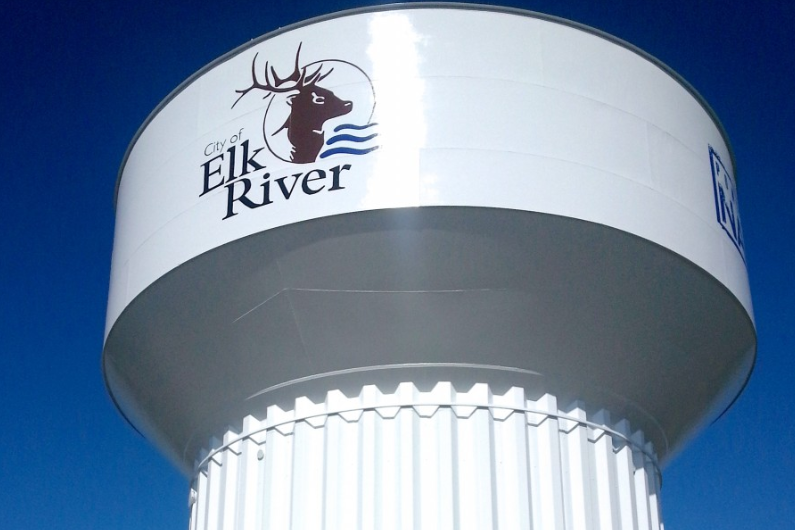
Proposed Elk River data center draws resident concerns
A proposed 33‑megawatt data center in Elk River is facing strong opposition from residents, who raised concerns about environmental impacts during a recent public meeting.
The project would convert an existing industrial building into a 24/7 facility, bringing an estimated 40 jobs. However, residents cited potential impacts related to noise, water use, and electricity demand, urging city officials to reject the proposal.
Elk River Municipal Utilities leaders said the system has the capacity to serve the project and that the developer would cover the cost of connecting to infrastructure. A noise study is underway. Additional public hearings will be held on June 23 and July 6, with a final city council decision possible in early August.
Read more here.
| | |
Utilities propose major transmission upgrades in southeast Minnesota
PowerOn Midwest held two rounds of meetings in Kasson, Minnesota, on Thursday, June 11, to gather public input on the major electric transmission upgrades in southeast Minnesota. These upgrades are part of a broader multi-state effort to improve the regional grid.
The proposal includes new high-voltage transmission lines that would connect southern Minnesota with surrounding Midwest states and expand system capacity. The project is being developed by a group of utilities, including Xcel Energy, Great River Energy, and ITC Midwest.
Public meetings are underway to gather input, with routing, permitting, and regulatory review expected to continue over the next several years.
Read more here. (paywall)
| | |
Red Lake solar project advances tribal energy independence
Red Lake Nation has broken ground on a 3‑megawatt solar project near Blackduck that is expected to power roughly 500 homes.
The Makwa Solar Array, developed by Indigenous-led Solar Bear, will be fully owned by the tribe and aims to reduce electric costs for members while generating revenue for community programs. Tribal leaders say the project has been more than a decade in the making and represents a key investment in long-term energy resilience.
Read more here.
| | |
The Community Microgrid Assistance Partnership (C-MAP)
This program provides funding and technical assistance to energy providers and partners to build, operate, and enhance microgrid systems that improve the affordability, reliability, and security of electricity in remote areas of the United States.
Details
-
Deadline to apply: July 2, 2026
- Grant award range: $200,000 to $575,000
- Total funding available: $2M in funding ($1M in technical services)
- Technical assistance: up to 24 months of no-cost technical support from DOE national laboratories
- Funding agency: US Department of Energy, Office of Electricity
- Funding type: competitive grant program
Eligibility
- Non-profit entities such as energy cooperatives
- State and local governments
- Federally recognized American Indian and Alaska Native Tribes and villages
- Topic area (below): US businesses with the required registrations
- Areas of the US with no more than 10,000 people where electricity prices are high
For funding and technical support from DOE national laboratories to energy providers and partners to build, operate, and enhance microgrid systems that improve the affordability, reliability, and security of electricity in remote and isolated communities, and industrially important regions in the US, including Tribes.
The project must include one of these five areas:
- Microgrid coordination: Supporting regional collaboration to improve reliability, resilience, security, and affordability for community-based microgrids
- Microgrid integration with large load energy consumers: Providing resources to allow local utilities to work more closely with consumers who have high energy needs
- Microgrid development: Assisting detailed design efforts for major upgrades of new or existing microgrid energy systems
- Microgrid transformation: Providing direct support for the implementation of innovative microgrid improvements
- Microgrid assessment for industrial or other large energy consumers: Assisting large energy consumers in considering the implementation of an advanced microgrid energy system.
Email stacey@pathconsulting.org for questions and more information.
| | |
FEMA grant announcement: $1 billion for hazard mitigation projects
The Federal Emergency Management Agency (FEMA) has announced a funding opportunity for the fiscal years 2024 and 2025 Building Resilient Infrastructure and Communities (BRIC) program. Through this program, FEMA is making $1 billion in federal funding available to states, local governments, territories, and Tribal Nations for hazard mitigation activities that protect their communities from potential disasters.
The BRIC program has a renewed focus on infrastructure-related hazard mitigation projects and empowering state and local leaders, and it is specifically designed to:
- Prioritize infrastructure resilience by funding construction projects that are ready to implement and incentivizing the adoption of the latest hazard-resistant building codes.
- Move money faster by eliminating phased projects, simplifying the National Competition scoring system, and removing subapplication scoring by the National Review Panel.
- Shift responsibility and authority to states, territories, and Tribal Nations by removing funding for hazard mitigation planning and non-financial direct technical assistance provisions. FEMA notes that this will maximize state and local responsibility for resilience and risk reduction rather than federal investment in a wide range of activities.
Eligible applicants include states, the District of Columbia, US territories, and federally recognized Tribal Nations. Eligible subapplicants include local governments, communities, special districts, and Tribal Nations applying through a state or territory.
For the fiscal years 2024–25 funding cycle, the following funding categories are available:
- $112 million for states and territories (up to $2 million in federal cost share per applicant).
- $50 million Tribal Set-Aside (up to $2 million federal cost share for each applicant).
- $56 million for State or Territory Building Code Plus-Up (up to $1 million federal cost share per applicant) and $25 million for Tribal Nation Building Code Plus-Up to carry out eligible building code adoption and enforcement activities.
- $757 million for National Competition (up to $20 million federal cost share per subapplication).
No single applicant may receive more than 15 percent of the total available funding across all BRIC categories, which includes the combined total of all funding category requests.
The deadline to submit applications is July 23, 2026.
Interested applicants and subapplicants may review the Notice of Funding Opportunity on Grants.gov.
For more information on the BRIC program, applicants should contact their FEMA Regional Office or visit this site.
| | |
Community Connect Grant program
USDA’s Community Connect Grant Program is offering funding to help expand high-speed broadband access in rural communities lacking reliable service. The program supports the construction, acquisition, or improvement of broadband infrastructure, with a focus on connecting homes, businesses, and critical community facilities such as schools, health care providers, and public safety offices.
Eligible applicants include local governments, utilities, nonprofits, and Tribal entities serving rural areas without sufficient internet access. In addition to infrastructure, projects may include equipment, digital literacy training, and free community access points.
This funding opportunity aims to strengthen economic development, improve access to essential services, and enhance quality of life in underserved communities. Utilities and local partners interested in broadband expansion are encouraged to review eligibility requirements and consider applying.
View this PDF for more information.
| |
Critical thinking for effective decision making
Thursday, June 18, 2026
10:00 am–12:00 pm
Webinar
This course strengthens participants’ ability to analyze information objectively, recognize assumptions and bias, and make sound decisions in complex workplace situations. Using practical tools, participants will apply critical thinking strategies that support effective decision making, communication, and leadership performance.
This is an elective course for those enrolled in the DUEL™ program and counts for one DUEL credit. Not a DUEL participant? No problem. You can register for this stand-alone course to gain knowledge and skills specific to this topic.
For more information or to register, visit the link below.
| |
Utility Leaders' Legislative Debrief: Interacting on the Issues
June 25: Rochester
Last year’s post-legislative session regional discussions with commissioners and utility leaders were key to developing this year’s MMUA policy agenda. This month, Kent Sulem, Bill Black, and MMUA CEO Karleen Kos are back on the road, talking about the latest issues and taking members' direction for the road ahead.
The MMUA Government Relations team looks forward to connecting with you to talk through the implications of new laws, identify your needs and perspectives, and carry forward your commitment to protecting, promoting, and strengthening hometown utilities. We encourage you to invite your commissioners and city council members to join you and MMUA in these important conversations.
We hope to see you there!
There is no cost to attend, however, we ask that you register for planning purposes. Please click the link below for more information or to register.
| |
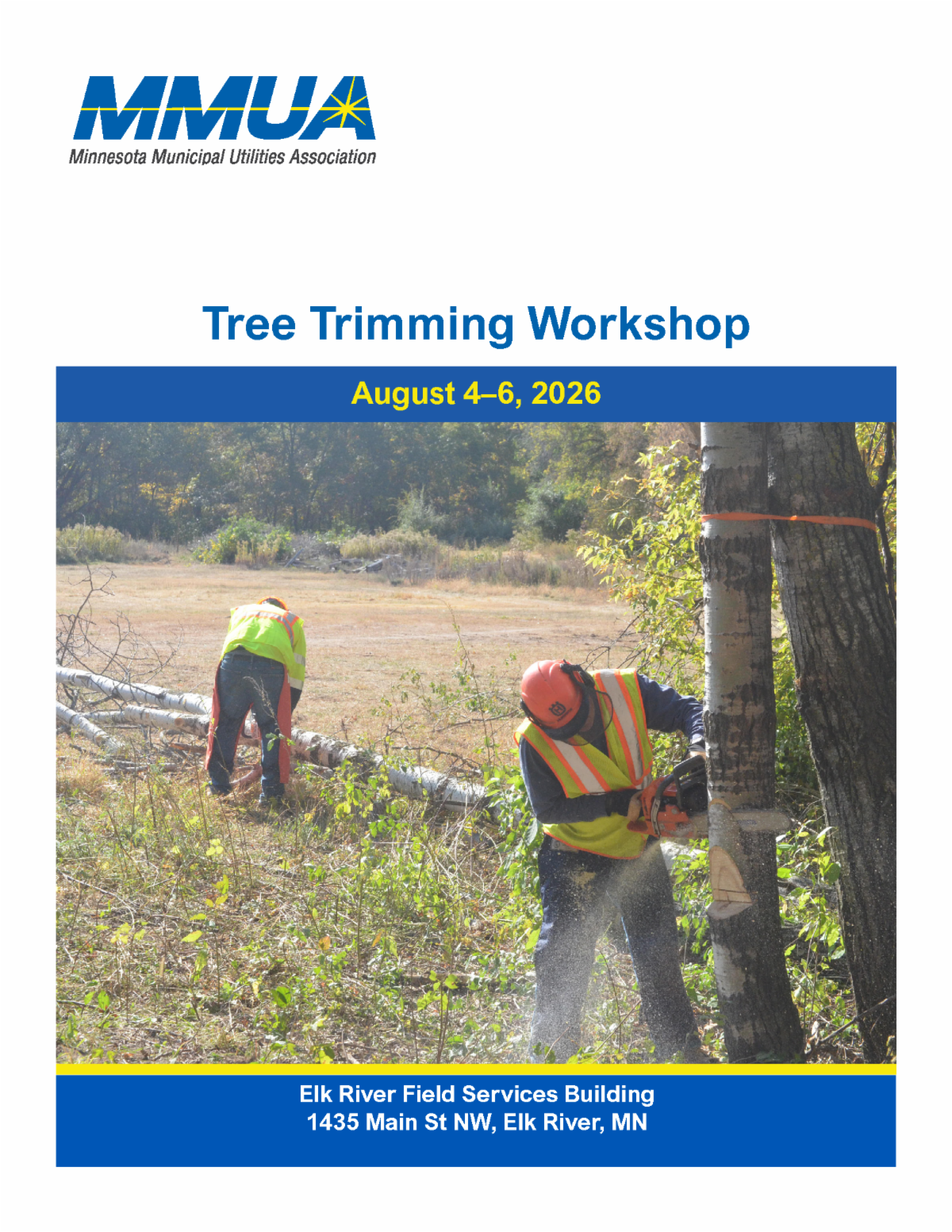
Tree Trimming Workshop
August 4–6, 2026
Elk River Municipal Utilities Field Services Building
Elk River, MN
This workshop is intended for any municipal employee responsible for tree work.
Instruction will be led by MMUA's Jake Kuntz, a certified arborist and a licensed Minnesota tree inspector. Topics to be covered:
- Review of OSHA and ANSI safety standards
- Chainsaw safety and maintenance
- Overview of tree species; best time of year to cut
- Best practices to prevent the spread of disease
- Tree cuts and felling
- How to be an effective team and work safely
- And more!
To learn more about this unique training opportunity or to register, visit the link below.
Register by July 3 for the best rate.
| |
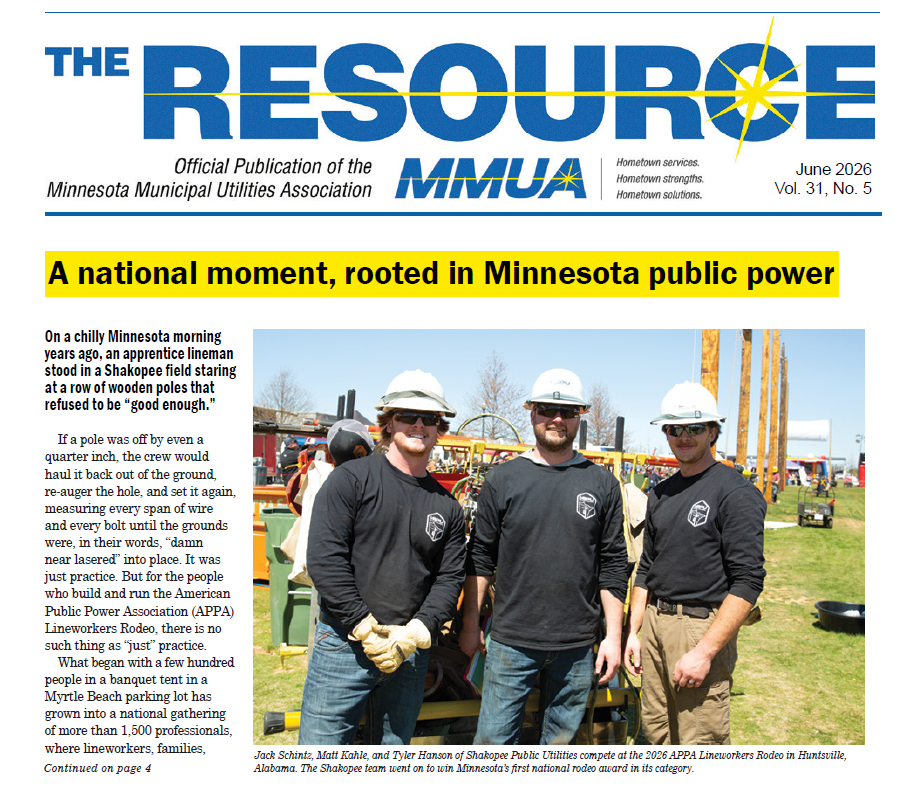
The Resource
Did you know that you can read our newsletter online? Access the latest edition of The Resource to read news related to water, gas, and electricity matters in Minnesota. Our newsletter covers the activities of members, as well as local, regional, national, and international utility news.
| |
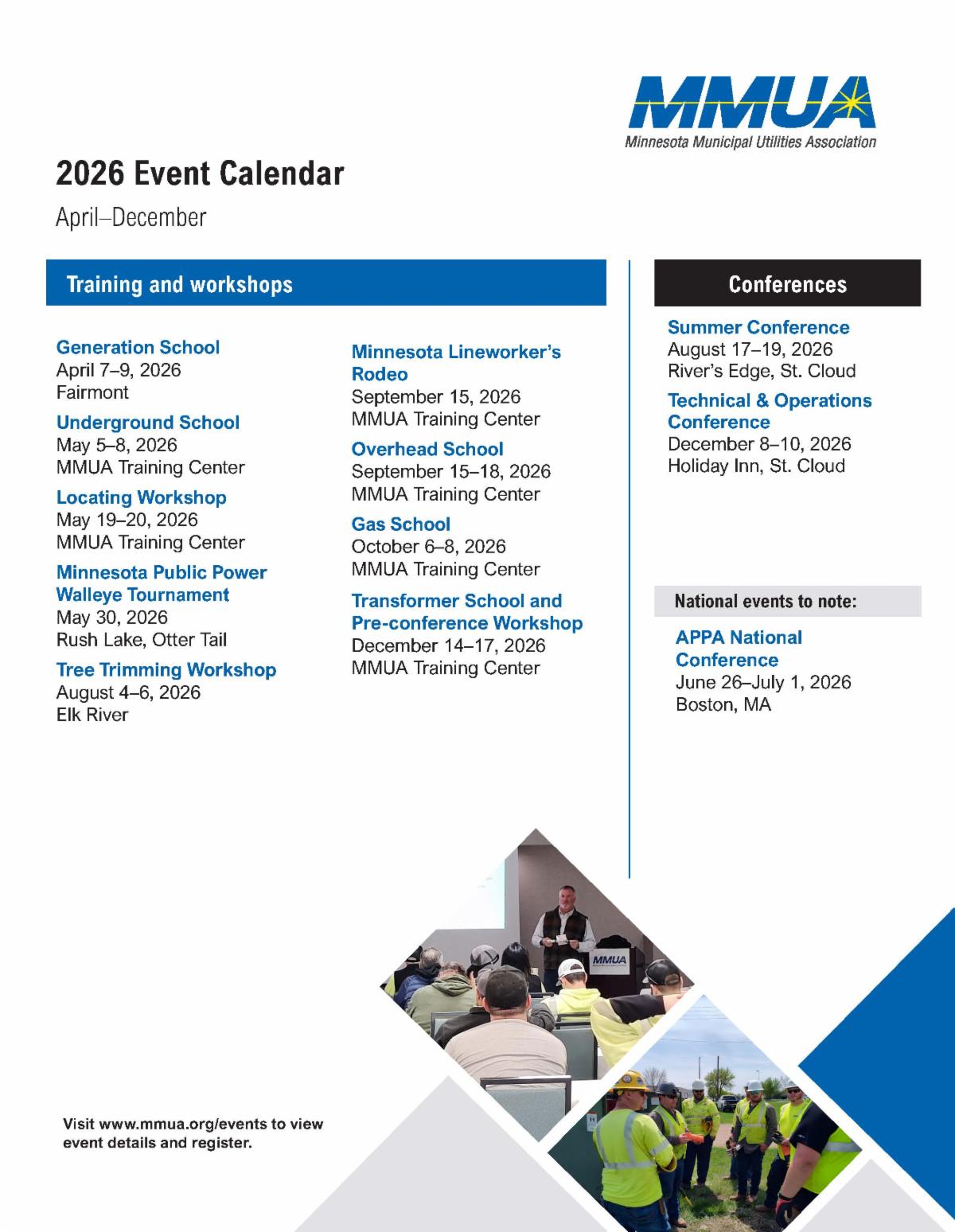
MMUA events calendar for 2026
The 2026 calendar lists enrichment and training opportunities that can help individuals enhance their skills and knowledge in the utility industry. Watch for emails with event-specific information. Download the calendar here.
| | |
As always, thank you for your association with MMUA and your commitment to delivering excellent service through locally owned utility assets in your community. Have a great week!
Libby Simpson
Communications Coordinator
Direct: 763-746-0702 / Cell: 612-368-3308
lsimpson@mmua.org | www.mmua.org
| | Hometown services. Hometown strengths. Hometown solutions. | | | | |