|
A Land Before Names
The establishment of Nevada as a territory and, ultimately, a state is a dramatic and often overlooked story, filled with ambition, hardship, and reinvention. Long before Nevada was known as the Battle Born State, it was a place people passed through, feared, misunderstood, and occasionally fell in love with. Its history reads like a roll call of the American West itself.
Long before maps, borders, or territorial claims, Nevada belonged to its first residents. For thousands of years, Indigenous peoples thrived across the Great Basin, adapting to an arid landscape that outsiders would later deem uninhabitable. Archaeological evidence suggests humans occupied the region nearly 10,000 years ago, leaving behind grinding stones, tools, and campsites that reveal a deep understanding of the land’s rhythms.
Over time, more settled cultures emerged. Among the most remarkable were the Puebloan peoples, whose presence in southern Nevada flourished between 1,000 and 1,500 years ago. Their most famous settlement, Pueblo Grande de Nevada, later dubbed the Lost City, stood near present-day Overton. Excavated after its discovery in 1924, the site revealed a sophisticated community of as many as 20,000 people who farmed, hunted, traded, and mined. The ruins included more than 120 structures, some with dozens of rooms, offering a rare glimpse into a complex desert society.
That glimpse was short-lived. With the completion of Hoover Dam in 1936, Lake Mead rose and submerged the Lost City beneath its waters. Anticipating the loss, the National Park Service constructed the Lost City Museum, which still stands today as a testament to Nevada’s earliest known population centers. By the time Europeans arrived, the land was home primarily to the Shoshone, Northern and Southern Paiute, and Washoe tribes, each deeply tied to specific regions of the state.
| |
The Spanish Reach North
The first Europeans to encounter Nevada’s Indigenous peoples came not seeking gold or land ownership, but connection. In the late 1700s, Spanish explorers and missionaries pushed northward from Mexico, intent on linking New Mexico and California while reinforcing Spain’s imperial claims. Their approach, familiar throughout the Americas, mixed religious zeal with military authority.
In 1776, Father Francisco Garcés followed ancient Mojave trade routes through what is now southern Nevada, becoming one of the first Europeans to cross the region. His journey marked the beginning of documented exploration, though it was far from easy. The land was unforgiving, water scarce, and distances vast. Trails forged by Native traders and travelers became the foundation for Spanish routes, which later Americans would adapt for their own purposes.
These early paths, including what would become known as the Old Spanish Trail, were never meant for wagons or mass migration. They twisted through canyons, deserts, and mountains, suitable only for pack animals and the most determined travelers. Still, they established Nevada not as an empty void, but as a known, if daunting, corridor between worlds.
| |
The Mountain Men Era
Nevada’s next wave of outsiders arrived not under flags or crosses, but with traps and rifles. Following Mexico’s independence from Spain in 1821, American and British fur traders flooded westward in search of beaver pelts, driven by global fashion trends that prized beaver-felt hats.
The mountain men who entered Nevada were a rough, resourceful lot. They traveled light, lived off the land, and ranged across enormous distances. Figures like Jedediah Strong Smith left an indelible mark. Literate, methodical, and fearless, Smith mapped rivers, cataloged plants and animals, and documented Native cultures across the Great Basin. His journals became foundational texts for later explorers and settlers.
Competition between American fur companies and the British Hudson’s Bay Company was fierce. To outmaneuver rivals, Hudson’s Bay trader Peter Skene Ogden led expeditions into northeastern Nevada during the late 1820s, systematically trapping rivers to exhaustion. His goal was not just profit, but strategic denial, leaving nothing for American trappers to exploit. The result was near-extinction of beaver populations across much of the state.
Though the fur trade burned brightly, it burned briefly. By the early 1840s, depleted wildlife and changing fashion tastes ended the era. Yet the mountain men left behind something more valuable than pelts: knowledge. Their trails, maps, and hard-earned experience transformed Nevada from an unknown wilderness into a place that could, at least theoretically, be crossed.
| |
Explorers, Emigrants, and Hard Lessons
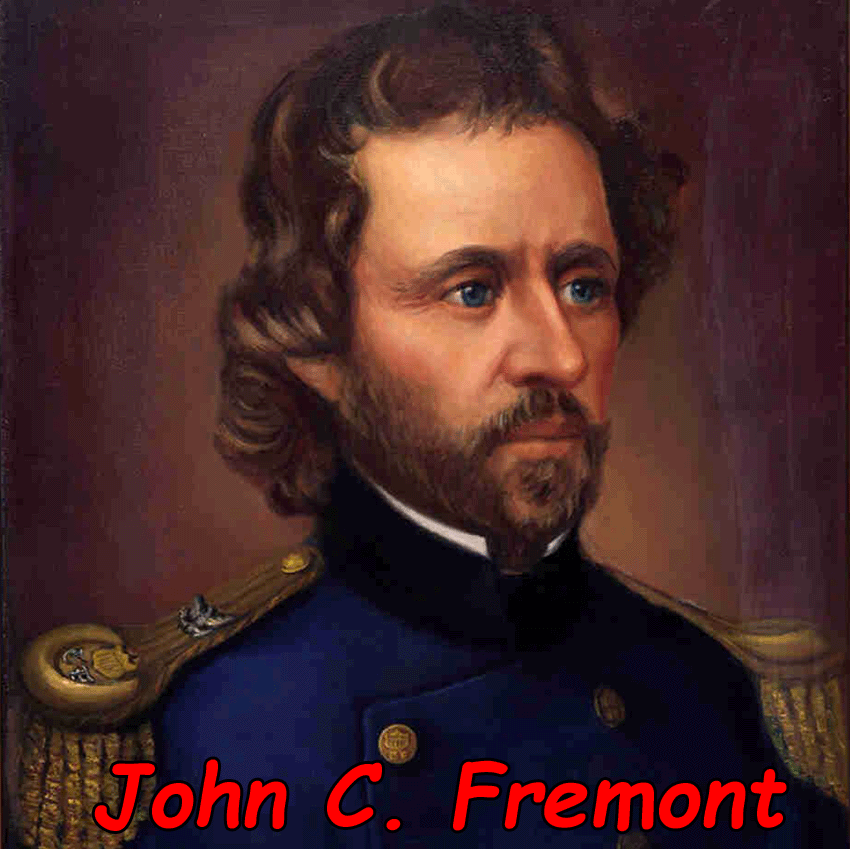
As the United States embraced Manifest Destiny, Nevada became a focus of official exploration. Army engineers and government-sponsored expeditions set out to map routes, assess resources, and prepare the land for expansion. No name looms larger in this phase than John C. Fremont.
During expeditions in the 1840s, Fremont charted rivers, named landmarks, and formally defined the Great Basin as a region of interior drainage. He recorded Pyramid Lake, followed the Truckee and Carson Rivers, and was the first American to describe Lake Tahoe in writing. His detailed maps, printed in unprecedented numbers, guided thousands of emigrants westward.
Not all who followed those maps fared well. Early emigrant parties often lacked experience and underestimated Nevada’s challenges. The California Trail, while eventually refined, was littered with abandoned wagons, animal carcasses, and graves. Shortcut schemes like Lassen’s Cutoff proved disastrous, luring travelers into waterless deserts and impassable terrain. Letters from survivors warned loved ones back East to stay home, describing scenes of suffering and death that bordered on the unimaginable.
The most infamous tragedy, the Donner Party, unfolded just west of Nevada’s border, but its roots lay in the same desperation for faster routes and better odds. These stories etched Nevada into the national consciousness as a place that tested human limits.
| |
From Crossroads to Statehood
By the 1850s, attention turned from trails to rails. Surveyors crisscrossed Nevada searching for a viable transcontinental railroad route, enduring the same brutal landscapes that had humbled trappers and emigrants. Though no immediate solution emerged, their work laid the groundwork for future infrastructure.
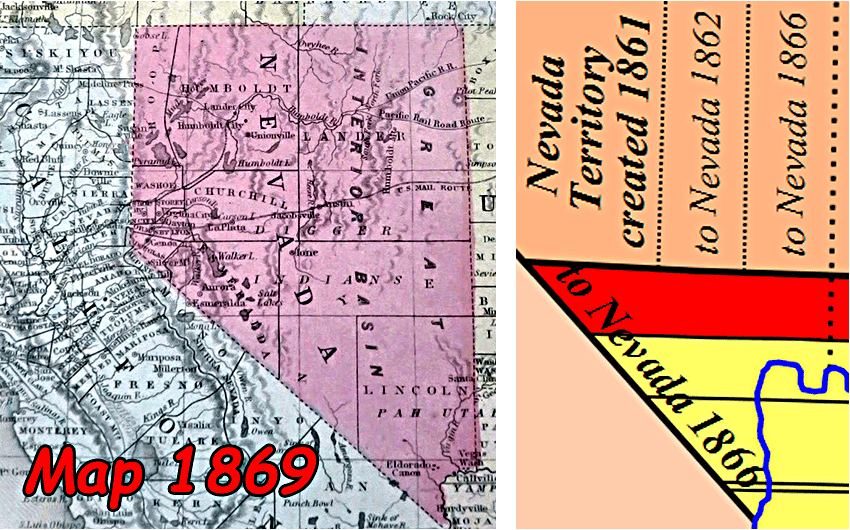
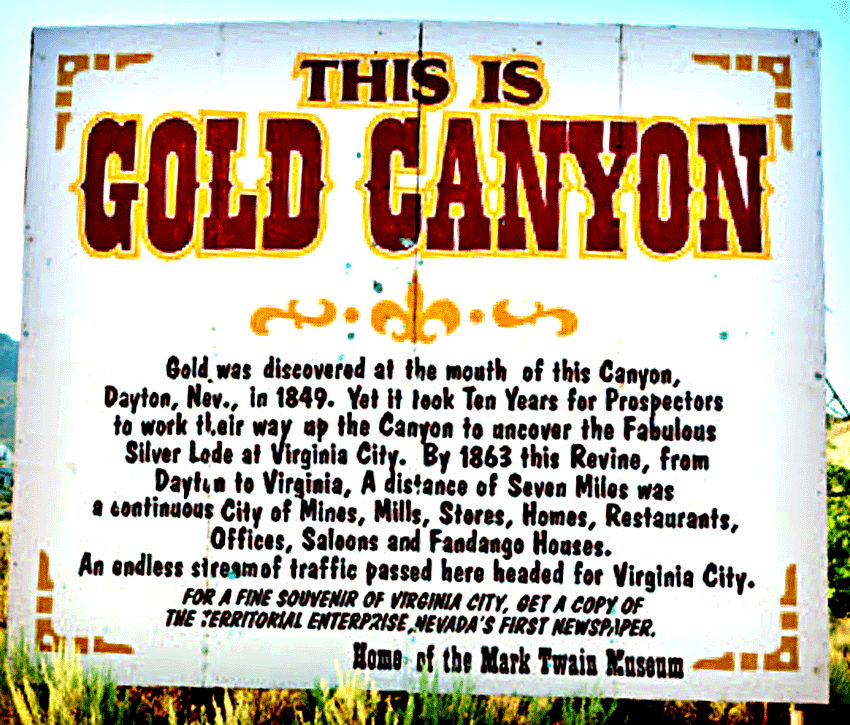
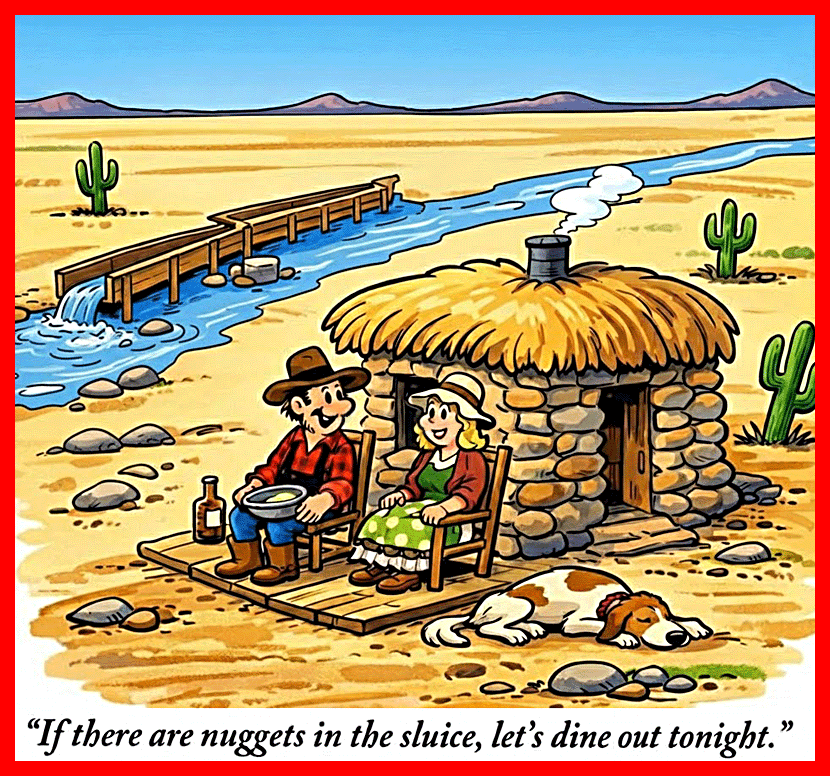
Everything changed with mining gold and silver. The discovery of silver in the Comstock Lode transformed Nevada almost overnight. Boomtowns erupted, populations surged, and strategic importance skyrocketed. During the Civil War, Nevada’s mineral wealth and political loyalty made it invaluable to the Union. In 1864, with remarkable speed, it was admitted as a state, earning the enduring nickname “Battle Born.”
Nevada’s early history is not a single story, but many overlapping ones. It is the story of peoples who thrived long before outsiders arrived, of explorers chasing faith, fashion, or fortune, of travelers misled by hope and dreams, and of a land that resisted easy conquest. Once dismissed as an unknown territory, Nevada became a proving ground, shaping and being shaped by every type of western character imaginable. In that struggle, it found its identity.
| |