|
Market Pulse
October 2026
| | |
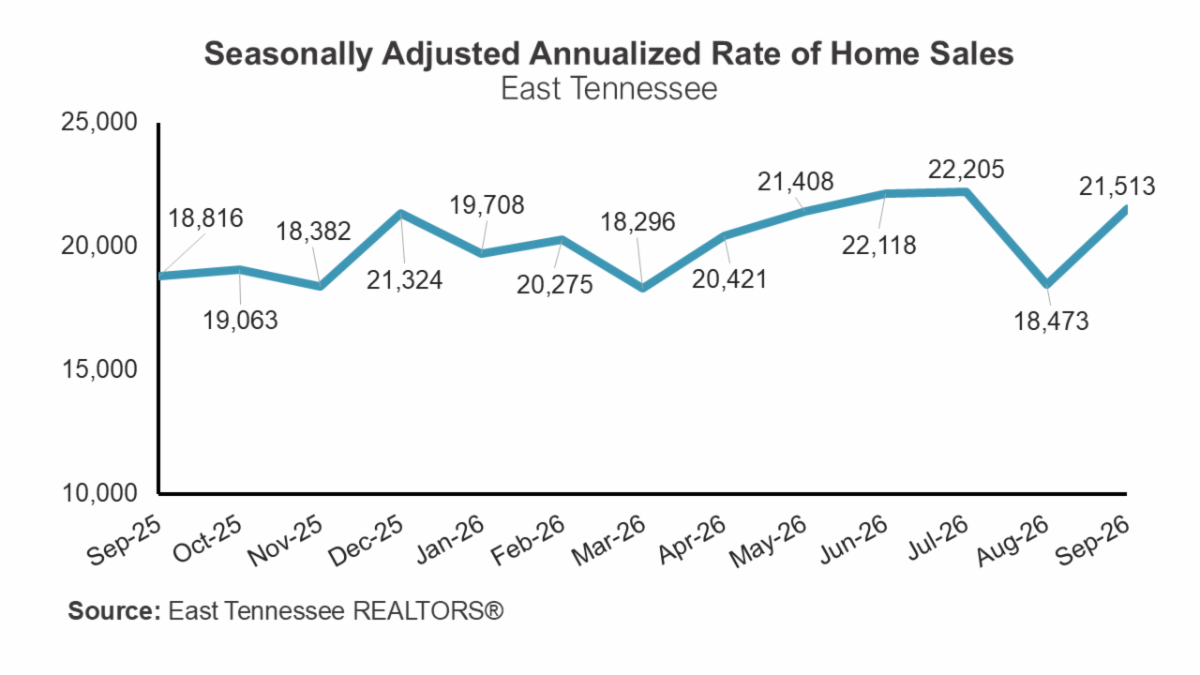
In September, East Tennessee home sales recovered from a brief August slowdown with double digit growth over 2025.
While consumers appear to have been temporarily shocked by rising interest rates in August, September's sales quickly returned to the trend of steady market recovery for the year.
Pending sales for October were also up 4% over the same month last year, indicating that the rest of the fall could continue on a similar trajectory.
If you see a headline about the national housing market, take a beat to check the local numbers. Despite nationwide slowdowns, East Tennessee home sales are still growing.
| | |
Home Sales Report
September 2026
-
East Tennessee home sales increased 10.9% in September from 2025.
-
The median sale price was $375,000, down 1.3% from the previous year.
-
Total housing inventory is up 7.5% from 2025.
-
Half of the homes sold were under contract in 32 days or less, up just 1 day from one year ago.
-
36.8% of homes sold for the asking price or above, with 16.4% selling for more than the asking price. 6.7% sold for at least $10,000 over asking and 2.2% sold for at least $25,000 over asking price.
-
The sale-to-list price ratio held steady at 98.4%, up about 0.2% from last year.
-
New construction dropped to only 9.6% of total home sales, down from 14% in 2025 and the new lowest monthly percentage of total sales since 2022.
| | East Tennessee REALTORS® reports home sales data using a seasonally adjusted annualized rate (SAAR). This method takes into account seasonal fluctuations in the real estate market, such as increased home sales during the spring and summer, by adjusting the data to provide an annualized rate representing the projected number of homes that would be sold over a year if the current sales pace were to continue. | | |
What's the outlook?
After a slow August, September sales picked back up where the summer left off with 10.9% growth over the same month last year, bringing the year's total residential home sales growth to 7.2%. Pending sales were up 4% from September 2025, indicating a more normal October as well.
Real estate industry members and the public alike may be thrown off by the recent rate rollercoaster and many breaking news headlines, but overall the market continues on a trajectory for steady recovery.
In 2022, the market survived a drastic drop in sales. Since then, home sales in East Tennessee have recovered from double digit negative sales growth to +1.8% in 2024, +4.7% in 2025 and forecasted 6%+ growth for 2026. Barring any severe shocks, our January forecast is right on track with current numbers.
We continue to see varied market activity across different types of residential inventory, making it more important than ever to apply nuanced strategy for sellers and buyers.
For example, sales over $1 million represented just 4.6% of total home sales in September, with an average of 45 days on market and a sale-to-list ratio of 95.6%.
Homes priced under $350,000 have been flying out the door and comprised nearly 45% of sales in September, with an average of 31 days on market and a sale-to-list ratio of 98.42%.
We also tracked another notable drop in percentage of new builds sold, at a total of just 9.6% of September sales; the lowest ratio since 2022. This follows national trends. The National Association of Home Builders reported in October that builder sentiment has reached a 14-year low, attributed to multiple hurdles including rising interest rates, increased cost of materials, labor supply challenges and financing.
As we head into the final stretch of the year and sales slow for the winter, a couple of quiet months might be just what the market needs. In order to fully recover, inventory must have time to build up in preparation for the next busy season.
| | |
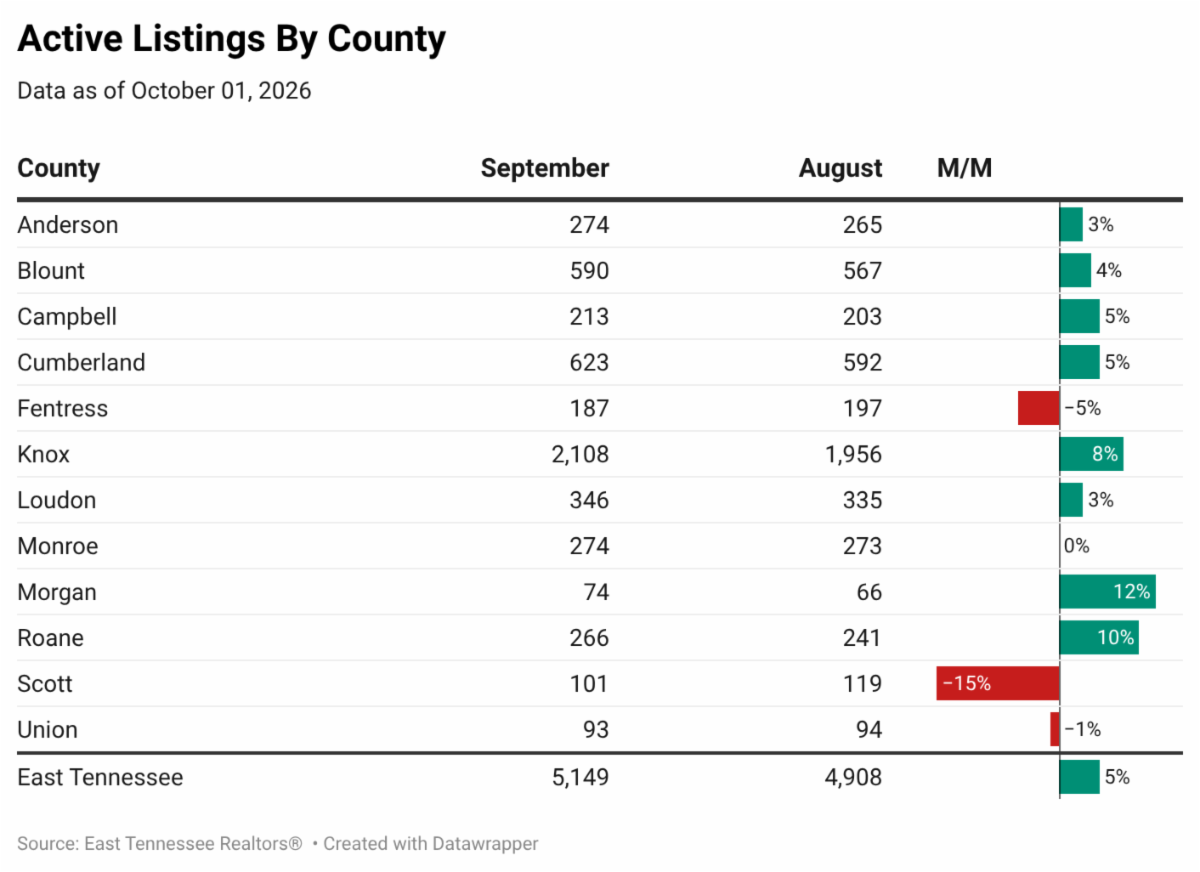
Inventory by county
Out of the 12 counties in the East Tennessee REALTORS® footprint, 8 marked measurable increases in active listings month-over-month. Overall, regional inventory increased month-over-month by 5%.
| | East Tennessee is growing. What's the plan for housing? | |
At a recent business breakfast, Governor Lee celebrated major economic strides achieved for the state and hinted at the possibility of East Tennessee's selection for the much-anticipated national nuclear innovation campus.
In addition to billions of dollars of investment, this campus would come with the potential to add a projected 25,000 jobs over the next few years. Various estimates from the University of Tennessee and others have predicted that nearly 17,000 of those employees could be new residents. Where will they live?
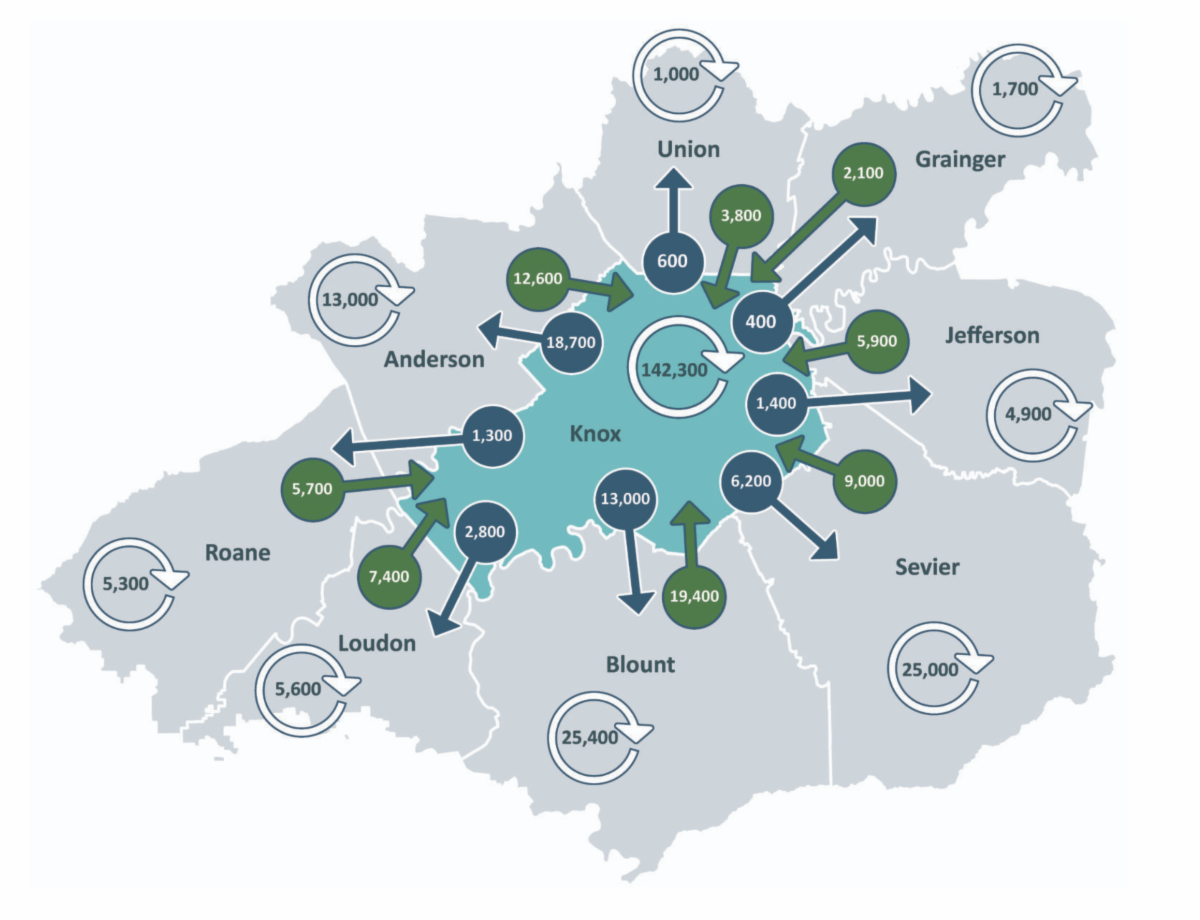
While all eyes are on Anderson and Roane County as they eagerly welcome many nuclear-adjacent new businesses, we know that employees will spread out across East Tennessee as they search for the right mix of lifestyle and cost of living. East Tennessee has become a commute-heavy region as residents push farther and farther out from the population centers in search of affordability.
The Knoxville Regional Transportation Planning Organization provides many useful data points to understand how this dynamic is happening now. For example, approximately 34,000 people commute into Anderson County each day for work, and about 16,000 live in Anderson County and commute into neighboring counties for work.
| |
Some counties have ramped up building; Knox County issued more than 5,800 residential unit permits last year. However, other neighboring counties have intentionally slowed their housing supply in an unfortunately-timed panic over continued growth.
For example, Blount County Commission recently voted to move forward a severe moratorium on multifamily housing, apartments and any subdivision over 10 homes. The moratorium has been passed to the Planning Commission to refine and propose details. Loudon County is nearing the end of its second year with a similar moratorium.
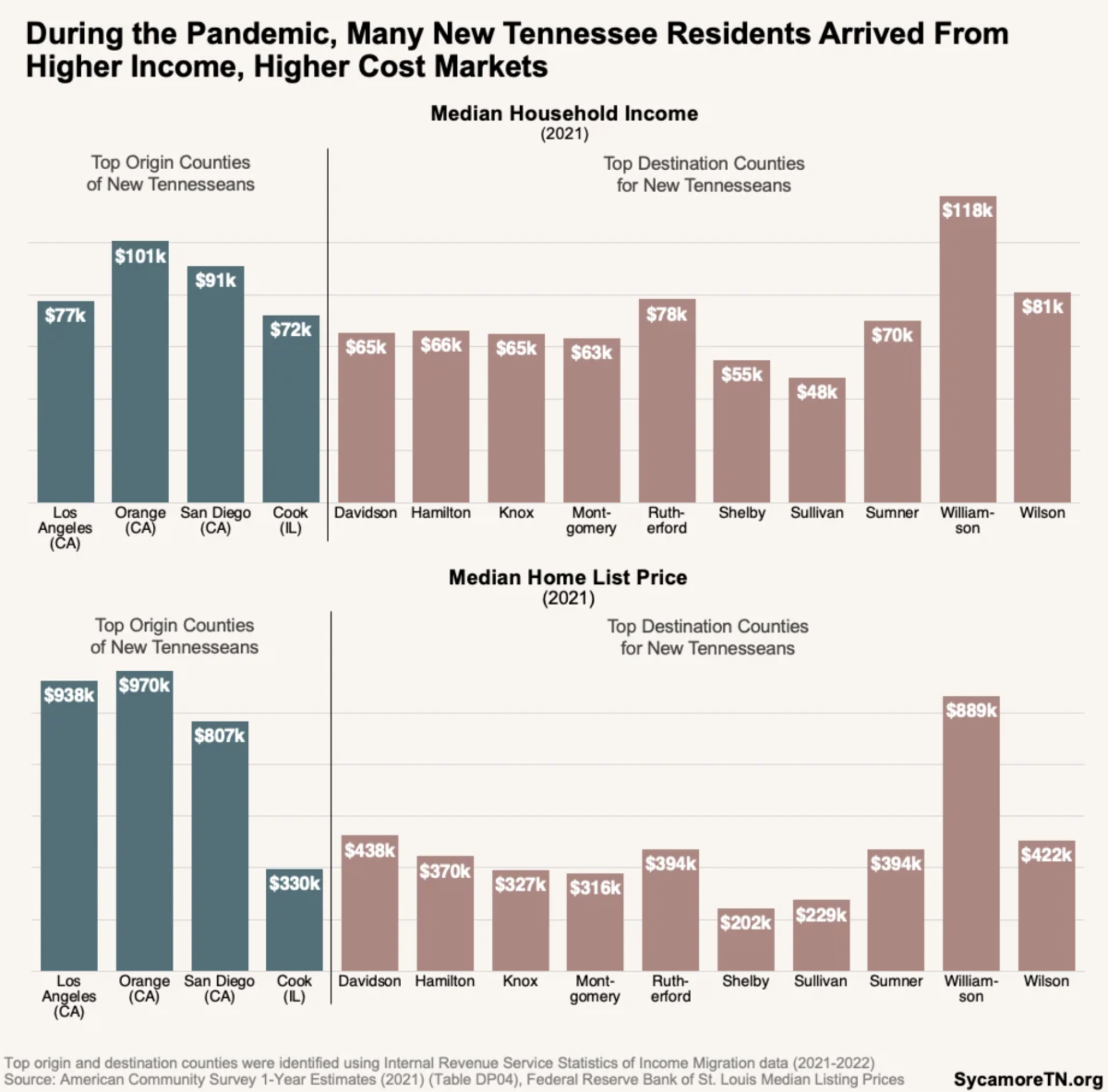
Understandably, many counties feeling the brunt of growth are concerned about how to pay for infrastructure and implement services for more residents. But as they turn to solutions aimed at "pausing" growth, residents are increasingly displaced by higher-income newcomers, and the housing supply and affordability issues then spill over into neighboring counties.
The Sycamore Institute recently compiled reporting that illustrates this effect.
| | |
A regional plan is clearly needed to coordinate knowledge, planning and resources as East Tennessee looks forward to the growth that results from a bright economic outlook.
Regional planning organizations such as the East Tennessee Development District, Middle Tennessee State University (MTSU) and the University of Tennessee's Municipal Technical Advisory Service (MTAS) are studying and attempting to plan for the growth to expand to rural counties.
Advocacy organizations like East Tennessee REALTORS®, local, regional and state chambers, homebuilders and more have teamed up to push for better understanding, funding and proactive policies. And the state has begun to allocate more resources.
On October 27th, the Tennessee Department of Economic and Community Development (TNECD) announced the next round of its county-specific housing assessments to help local governments prepare for growth, similar to its efforts in West Tennessee during planning for the Blue Oval project.
Carter, Clay, Cocke, Cumberland, Dickson, Greene, Marshall, Overton, Putnam, Sequatchie, Scott, Sullivan, Sumner and Unicoi will receive housing assessments and visits with a state-hired consultant to help them understand their current status and possible strategies moving forward.
THDA also recently announced the parameters for a new Community Workforce Housing Innovation Pilot Program, created by the state legislature during the last session after broad support from the Governor and housing advocacy organizations.
The pilot allocates $20 million across the three grand divisions, intended to support the construction and rehabilitation of workforce housing for sale and rental. East Tennessee will receive $7 million for approved projects. The funding would function as a very low-interest loan to boost financing for these projects, and the legislature may consider creating a recurring program if the pilot is successful.
Housing supply remains a serious challenge across most of the state, and urgently in East Tennessee as our region continues to attract economic development building on recent successes. Solutions will need to include policy action at the state and local levels, funding to subsidize workforce housing and innovation, and market acceleration through incentives and deregulation.
We can make progress on this challenge if we start from the same foundation of understanding: For East Tennessee to continue enjoying economic success, a proactive, regional approach to increase housing supply and attainability is urgently needed now.
| | Rent remains flat, but supply challenges loom | |
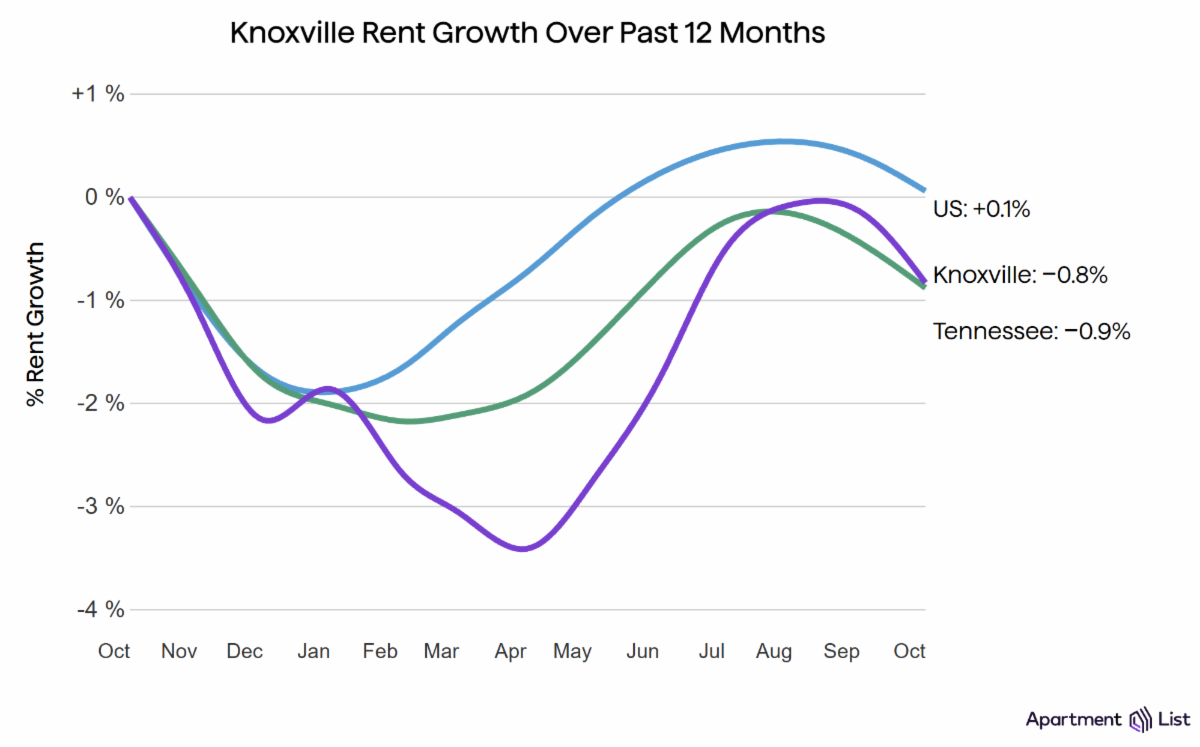
Rent in the East Tennessee area has remained largely flat over the last year, especially when accounting for seasonality.
As of October 2026, Knoxville rent is down nearly 1% from the previous year according to Apartment List.
Occupancy is steady around 95.6%, still slightly elevated over what is traditionally considered a "balanced" market at 93-94%.
The softest market is in Class A rentals, often classified as luxury, with 93.8% occupancy as of the end of Q2. This is certainly not overbuilt, and would generally be considered a balanced supply.
The tightest market is in Class C rentals, the most affordable stock, with 97.5% occupancy at the end of Q2 - extremely constrained.
| |
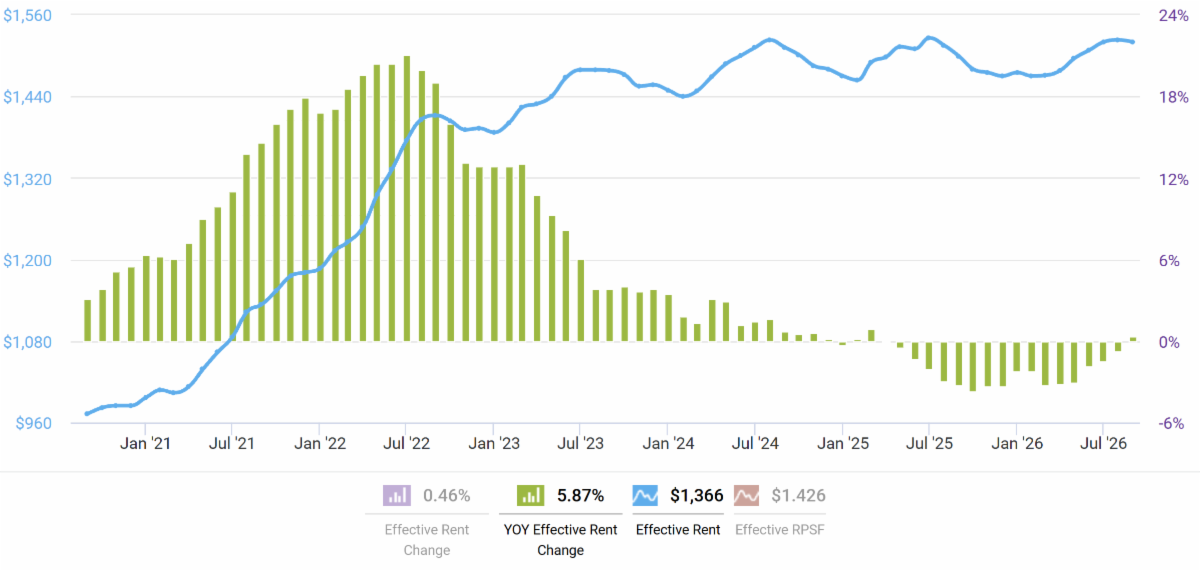
It's important to zoom out and take prior increases into account when considering affordability; since 2020, an average renter may be paying around $400-600 more per month. While rents may have decreased overall over the last year, this is mostly a whole-market measure and it is unlikely that renter households would see any discounts over the term of their lease.
The below graphic illustrates the growth rate of effective rent (green bars) versus the actual rent being paid (blue line). While the growth rate slows in mid-2022, the actual average rent increase was so high in the first few post-pandemic years that it remains extremely elevated now. Rents increased by nearly 60% over a 2-year period, and have not measurably declined.
| |
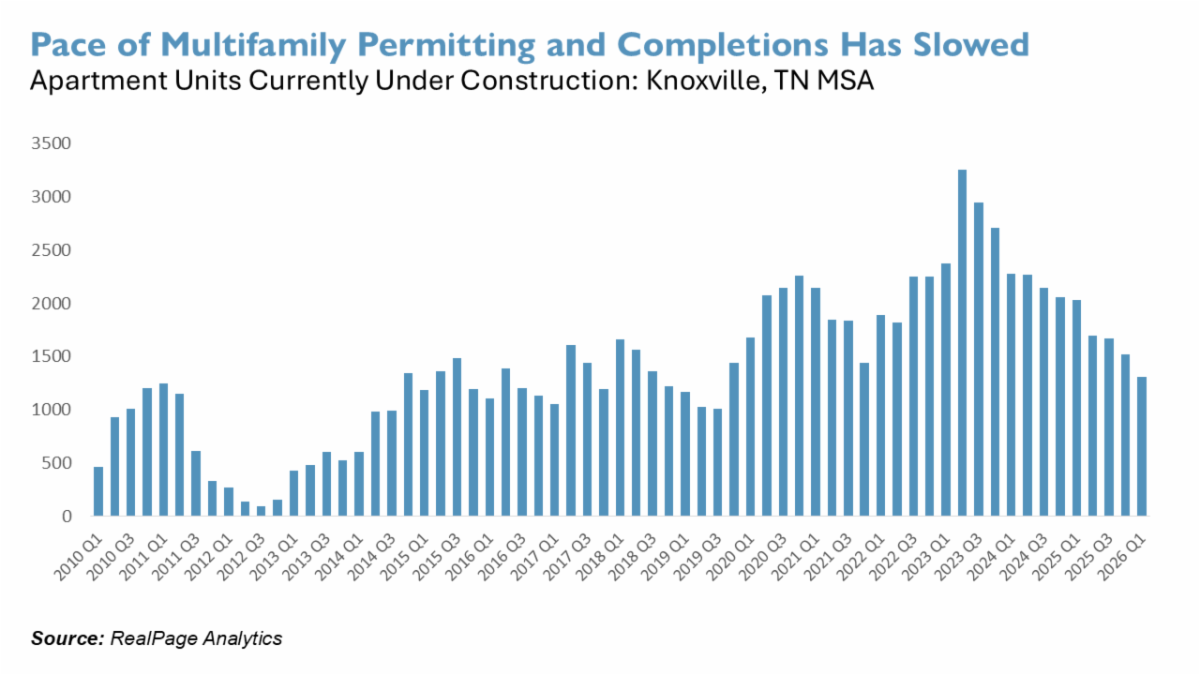
Multifamily building also reached a peak in 2022-2023, as low interest rates had spurred significant commercial investment.
Over the 12-month period ending in January 2024, East Tennessee delivered nearly 3,000 rental units. While many of these were related to the expansion of the University of Tennessee student population, the additional capacity nevertheless helped balance rental demand.
As of the close of Q2 2026, however, multifamily completions have slowed dramatically. Currently, there are only 633 rental units in construction in Knoxville and immediately surrounding counties, and less than 400 of these are scheduled to be delivered in the next 12 months.
We checked our understanding of this trend with several multifamily builders in our area. They cited cited various challenges in the regional market, including increased interest rates, increased costs associated with materials and transportation, a local municipal policy environment that is increasingly unfriendly to multifamily building, and less available financing particularly for workforce units.
If this trend continues, the region could see rent begin to rise alongside occupancy as early as Q1 2027.
| |
National pending home sales decline as mortgage rates fluctuate
National contract signings fell 7.3% month-over-month in September and were down 11.3% from a year ago. All four regions saw declines, with the South reporting an 8.2% drop in pending home sales.
Growing inventory and more price reductions have given buyers additional options, but rising mortgage rates continue to make affordability a challenge. Despite job growth and rising incomes, many buyers and sellers are holding off as borrowing costs remain high.
NAR Chief Economist Lawrence Yun expects mortgage rates to remain elevated, saying he considers "rates in the 7% range to be the new norm."
– Dr. Lawrence Yun, Chief Economist for the National Association of REALTORS®
Read the full analysis here.
| | |
Mortgage Rate Update
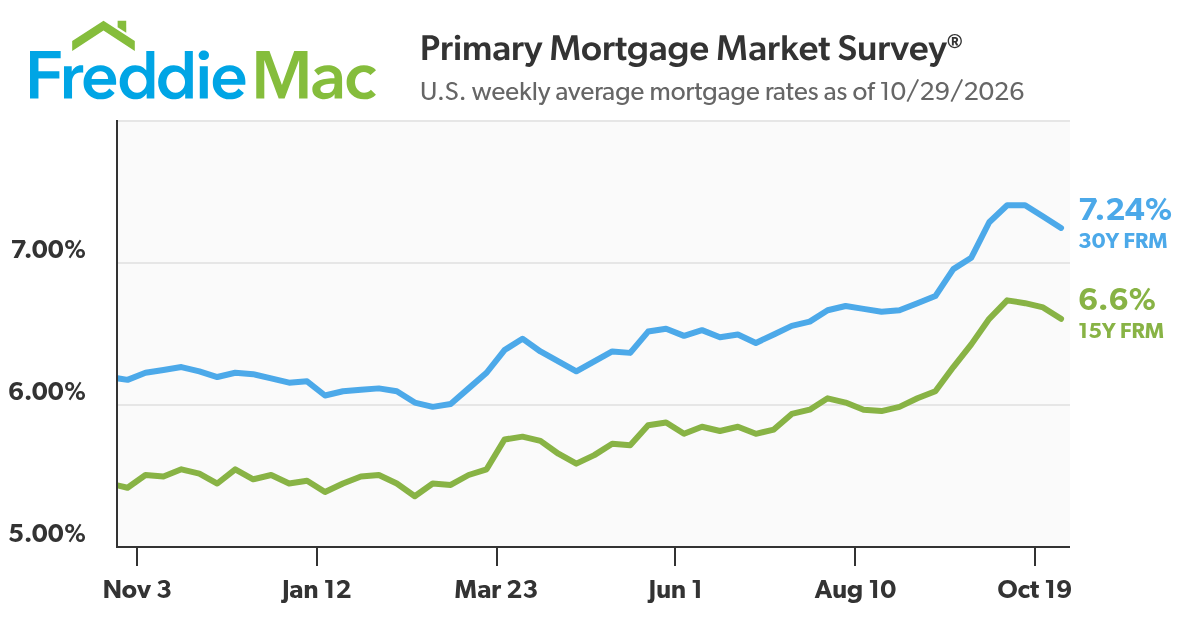
The average 30-year fixed mortgage rate (30Y FRM) has remained in the mid-7 percent range in October, ending the week of October 29 at 7.24% after a slight drop.
| | |
Mortgage data for September has thus far preceded cooling real estate sales, with purchase applications dropping 14% from the same week last year according to the MBA Weekly Mortgage Applications Survey.
Refinancing activity has been hit much harder by the raising rates, with activity down 56% this week over the same period last year.
Experts are aligned that it is unlikely rates will drop this year, unless a major unexpected event affects the market. Central bank policy has leaned toward continued tightening, with the Fed voting to keep rates stable in October but experts warning of potential rate hikes potentially as early as December.
| | Stay up to date with the most recent information about East Tennessee's housing and real estate market. Here's the latest from local media: | | |
Harvard University Joint Center for Housing Studies |October 29, 2026
| | |
Pew Charitable Trusts | October 29, 2026
| | Market Pulse is a monthly research newsletter providing a rundown of the latest housing and economic research and analysis across East Tennessee. | | Was this email forwarded to you? Subscribe here. | | | | |