The Ohio Water Resources Center Newsletter
Issue 7 | Volume 6 | August 2024
| |
|
The Ohio Water Resources Center (WRC) is seeking research pre-proposals to address current water resources issues in Ohio. This annual competition for in-state researchers is made possible through the Water Resources Research Institute 104(b) Program. The aim of these grants is to stimulate water-related research relevant to Ohio to the point where a highly competitive external proposal can be developed.
The Ohio WRC will accept any pre-proposal related to Ohio water resources issues but expects to give priority to proposals that address water technology, water resilience and security, water quality, and water reuse and the circular blue economy. Projects that also incorporate concepts of water equity — such as identifying causes and impacts of water-related disparities, developing or evaluating tools or strategies to improve water quality or evaluate environmental justice or providing scientific information to benefit underserved communities — are also sought.
The application deadline for Ohio pre-proposals is 11:59 PM, Thursday, September 26, 2024. Pre-proposal decisions and an invitation to submit a full proposal will be announced the week of October 28, 2024. Full proposals will be due December 12, 2024 at 11:59 PM and funding decisions are expected the week of March 10, 2025. Funding is anticipated to begin on September 1, 2025.
Click here for the official request for proposals and detailed submission instructions.
| |
Understanding hyporheic exchange dynamics in a headwaters stream impacted by urban karst | |
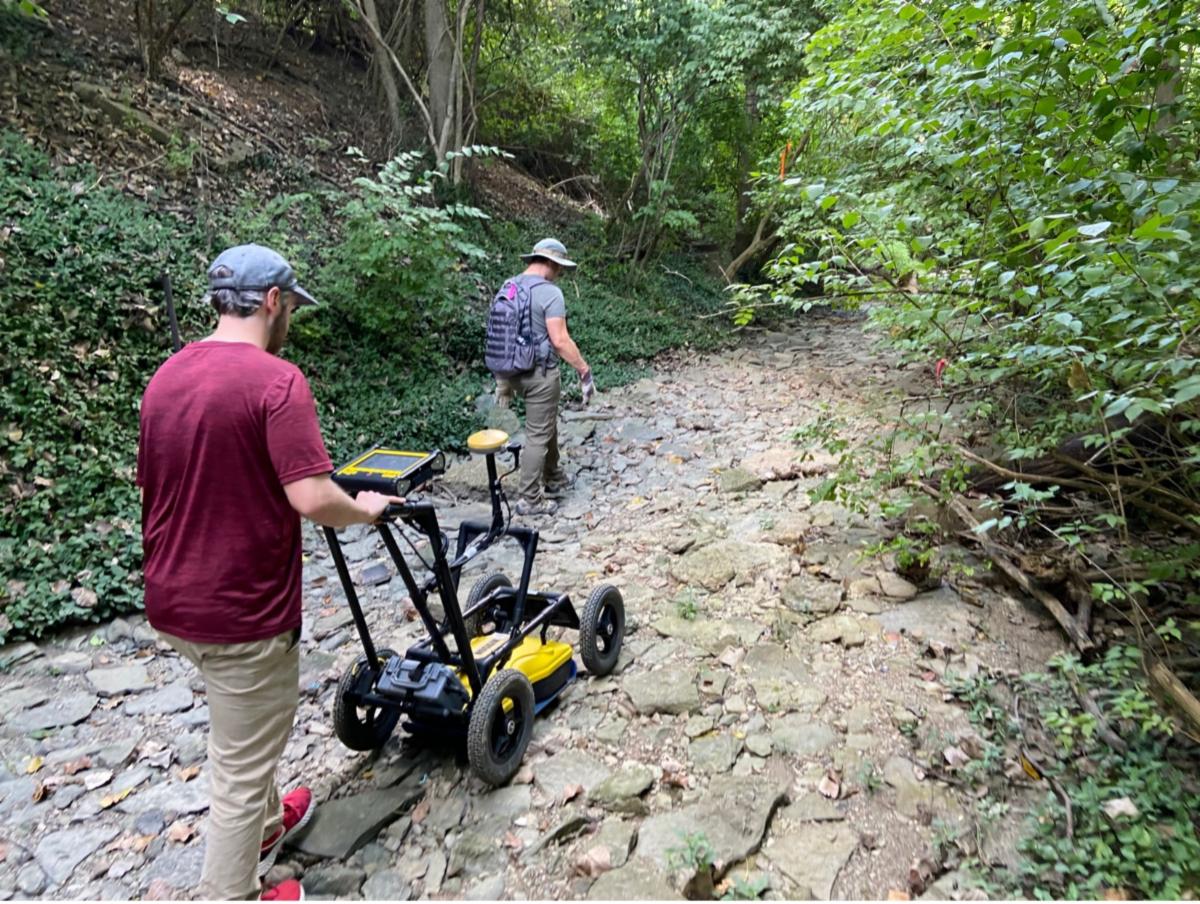
Dr. Dylan Ward, an associate professor at the University of Cincinnati, completed an Ohio Water Resources Center funded project via a 104B subaward. In small headwaters streams, water quality is strongly impacted by seasonal baseflow. Climate projections have shown a declining baseflow in southwestern Ohio headwaters streams. The transient dynamics of groundwater-surface water exchange and subsurface transient flow in bedrock streams in urban environmental are not well understood and are difficult to monitor. The goal of Dr. Ward’s project was to apply near-surface geophysical methods to characterize differences in the subsurface hydraulic behavior of a bedrock stream at a location of possible stream losses to urban karst in Cincinnati, OH. Urban karst is known as a collection of fast flow pathways that alter the exchange of groundwater and surface water in streams.
From fall 2022 through summer 2023, Dr. Ward and his team characterized the subsurface using electromagnetic induction and electrical resistivity tomography. These surveys were analyzed to determine if there were changes in temperature and salinity in the subsurface which aid in assessing the dynamics of groundwater flow at different times. Additional data collected included that from ground penetrating radar and seismic refraction.
Results showed that time lapse resistivity provided subsurface profiles with sufficient detail to resolve contrasting behavior through flow events between areas of soil, alluvium, known trench fill, and adjacent bedrock. The results advance the understanding of techniques to monitor groundwater and baseflow conditions in fractured bedrock with urban karst and provide important data toward understanding stream water-groundwater exchange in altered, complex catchments.
| | | |
Dragonflies reveal surprising insights into mercury pollution | |
Natural and anthropogenic mercury sources contaminate the globe. Mercury accumulates in organisms and becomes more concentrated as it moves up the food chain. The toxin can alter brain development in the young as well as affect the overall health and reproductive systems of adults.
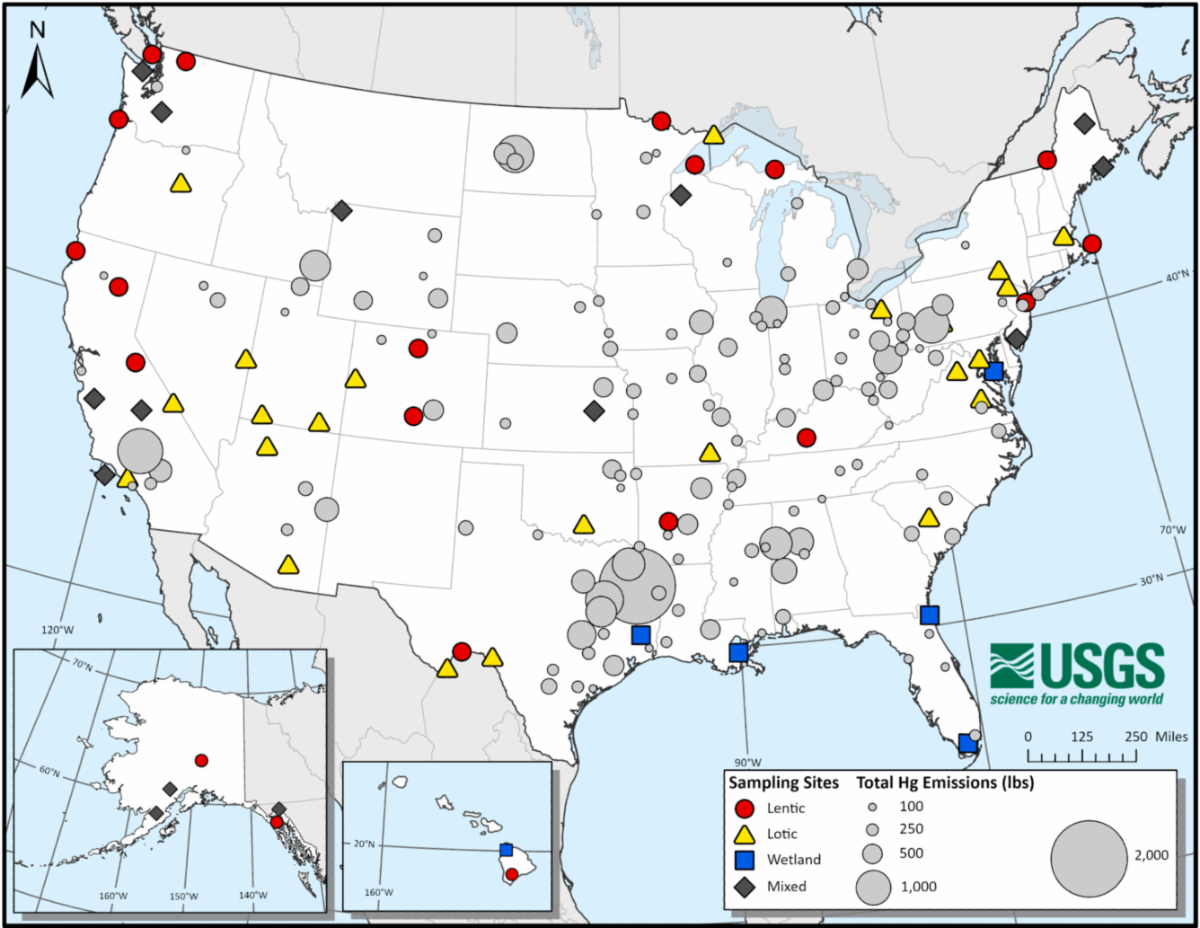
Recent research by the USGS, National Park Service, the Appalachian Mountain Club, and public participants discovered that mercury can be deposited through rain and snow in drier regions while in wetter, forested areas, gaseous mercury sticks to leaves that eventually fall and carry the toxin to the ground. Most research uses fish and birds to assess mercury concentrations, but dragonfly larvae were used as the indicator in the study. The use of dragonfly larvae is advantageous because it is more cost effective, accessible, and widespread as the larvae are found in most aquatic habitats.
The Dragonfly Mercury Project, lead by the USGS and National Park Service, works with the public to collect dragonfly larvae for mercury analysis. Dragonfly larvae were collected from more than 750 sites and analyzed by using an instrument that detected different types of mercury revealing how mercury reached the area. The results from this research will inform resource management decisions and increase public knowledge on environmental issues.
| | | | |
|  |
|
EPA, City of Galion partner to accelerate lead pipe replacement
Via EPA, July 25, 2024
Climate change is hurting Lake Erie. Ohio is training workforce to help
Via The Ohio Newsroom, July 22, 2024
Ohio receives millions from the government to plug abandoned oil, natural gas wells
Via The Columbus Dispatch, July 21, 2024
How to determine if your water service line is lead in Columbus
Via NBC4i, July 19, 2024
| | |
|
Ohio EPA: Source Water Monitoring Rules
Ohio EPA Division of Drinking and Ground Waters (DDAGW) reviewed the rules governing Source Water Monitoring to satisfy the five-year rule review. DDAGW is seeking comments from stakeholders during the Early Stakeholder Outreach review period. Comments are due by August 11, 2024. The fact sheet and rules can be found here. Comments can be submitted to DDAGW_Comments@epa.ohio.gov.
Ohio EPA: Laboratory Certification Rules
Ohio EPA Division of Drinking and Ground Waters (DDAGW) reviewed the rules governing Laboratory Certification Rules to satisfy the five-year rule review. DDAGW is seeking comments from stakeholders during the Early Stakeholder Outreach review period. Comments are due by August 11, 2024. The fact sheet and rules can be found here. Comments can be submitted to DDAGW_Comments@epa.ohio.gov.
Ohio EPA: Asset Management Rules
Ohio EPA Division of Drinking and Ground Waters (DDAGW) is soliciting comments on rules within Chapter 3745-87 of the Ohio Administrative Code. The rules have been reviewed to satisfy the five-year rule review. DDAGW is seeking comments from stakeholders during the Interested Party Review comment period. Comments are due by August 12, 2024. The fact sheet and rules can be found here. Comments can be submitted to DDAGW_Comments@epa.ohio.gov.
Ohio EPA: Water Pollution Control Loan Fund
Ohio EPA Division of Environmental and Financial Assistance is requesting stakeholder input on the five-year review of rules in Ohio Administrative Code (OAC) Chapter 3745-150. Prior to generating draft rule language, Ohio EPA is asking for input/suggestions from potentially affected parties. Comments are due by August 22, 2024. The fact sheet and rules can be found here. Comments can be submitted to amanda.payton@epa.ohio.gov.
Ohio EPA: Water Quality Standards Variances Rule
Ohio EPA is soliciting input on the Agency's draft rule in Ohio Administrative Code (OAC) Chapter 3745-1 for the Water Quality Standards Rule 3745-1-38. OAC 3745-1-38 covers variances from water quality standards for point sources. The Agency is planning on making amendments to the rule. Comments are due by August 23, 2024. The fact sheet and rules can be found here. Comments can be submitted to dsw_rulecomments@epa.ohio.gov.
Ohio EPA: Stormwater Rules
Ohio EPA is soliciting input on the Agency's draft rule in Ohio Administrative Code (OAC) Chapter 3745-39 for the Water Quality Standards Rule 3745-39-01 through 3745-39-04 which covers stormwater. The Agency is planning on making amendments to the rule. Comments are due by August 30, 2024. The fact sheet and rules can be found here. Comments can be submitted to dsw_rulecomments@epa.ohio.gov.
| |
|
Request for Proposals: Water Resources Research Institute 104(b) Program
The Ohio Water Resources Center (WRC) will be seeking research pre-proposals to address current water resources issues in Ohio. Priority is expected to be given to proposals that address water technology, water resilience and security, water quality, water reuse and the circular blue economy. Proposals from early career investigators will also be given priority. Pre-proposals are due September 26, 2024.
Request for proposals: Ohio EPA, Water Reuse
The Ohio EPA is requesting applications for the National Priorities: Occurrence and Implications of De Facto Water Reuse on Drinking Water Supplies grant. The solicitation seeks to address knowledge gaps associated with human risks associated with de facto water reuse and mitigation strategies as well as developing a holistic understanding of the national impact of de facto reuse. Applications are due August 21, 2024.
| | |
|
Request for proposals: The Water Research Foundation
The RFP has been released for four projects funded through the Research Priority Program. The Water Research Foundation addresses broadly relevant water sector topics, challenges, and opportunities. Utilities interested in participating in the research project can volunteer to serve as test facilities, respond to surveys, provide samples, loan equipment, or share staff expertise. Proposals are due by August 29, 2024 at 3 pm MT.
Call for Abstracts: Second Annual Interdisciplinary Water Research Symposium
The Second Annual Interdisciplinary Water Research Symposium is an event organized by students with the aim of fostering collaboration and knowledge exchange in the field of water resources. Abstract submission for student oral presentations, lightning talks, and poster presentations can be found here. The deadline to apply is September 20, 2024. Registration is open.
| | |
|
Webinar: Freshwater Science - Investigating hypoxia dynamics in Lake Erie
August 20, 2024 • Virtual
Hosted by Ohio Sea Grant, Stone Lab and the Harmful Algal Bloom Research Initiative, Dr. Fasong Yuan will discuss his research investigating the dynamics and long-term changes in the lake's hypoxic zones to help inform policy makers, stakeholders, and resource managers. Register in advance to attend the webinar.
Conference: 2024 AWRA/UCOWR/NIWR Water Resources Conference
September 30-Octobter 2, 2024 • St. Louis, MO
Hosted by the American Water Resources Association (AWRA), the Universities Council on Water Resources (UCOWR), and the National Institutes for Water Resources (NIWR), the conference will be held in St. Louis, MO focusing on water-related research, management, extension, and education topics. Registration is open.
Conference: 2024 Understanding Algal Blooms - State of Science Conference
September 4, 2024 • Toledo, OH
Hosted by Ohio Sea Grant, the conference will highlight current scientific knowledge related to algal blooms. The event will be held in-person and will be livestreamed. Register by September 2, 2024.
Symposium: Interdisciplinary Water Research Symposium
Nov 8, 2024 • Nationwide & Ohio Farm Bureau 4-H Center, OSU, Columbus, OH
The Second Annual Interdisciplinary Water Research Symposium is an event organized by graduate students with the aim of fostering collaboration and knowledge exchange in the field of water resources. Registration and abstract submission for student oral and poster presentations can be found here.
| |
|
Get in Touch
Email: OhioWRC@osu.edu
Website: https://wrc.osu.edu
Address: 473 Hitchcock Hall
2070 Neil Avenue
Columbus, OH 43210
| | |
| | | |