|
|
NFFV Action Alert
Legislation on Immigration
| |
| |
Federalism?
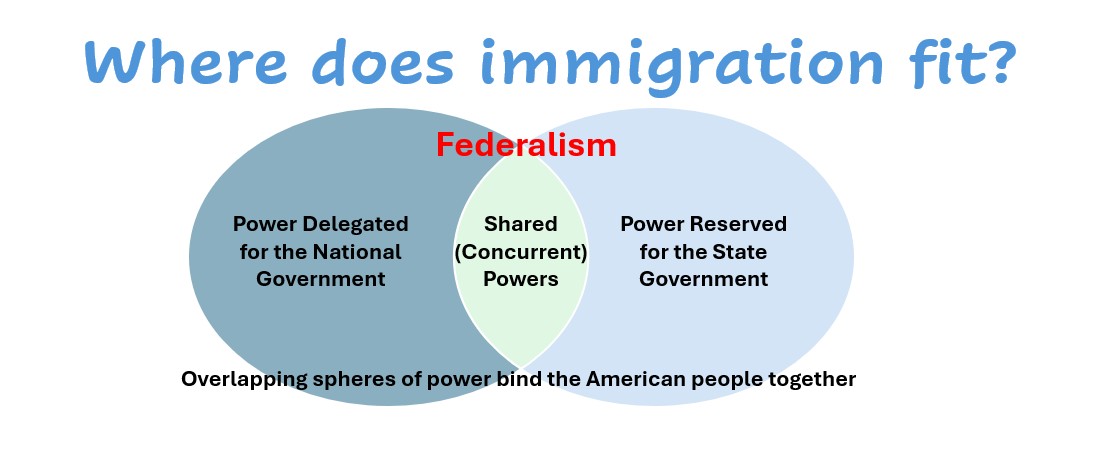
Federalism is United State's governance, representing the relationship between Federal and State power. It was created by our Founders and placed in the Constitution to divide powers between federal and state governments to protect liberty. To understand American Federalism one must understand:
-
Express powers - powers explicitly granted to the federal government
-
Implied powers - not explicitly listed but necessary and proper to carry out expressed powers and
-
Supremacy Clause - federal laws are "the supreme Law of the Land" overriding conflicting state laws.
Articles I-III of the Constitution establish the powers of the three branches of the federal government. Article 1 Section 8 of the Constitution "To establish a uniform Rule of Naturalization" gives immigration authority to the federal government. Specifically, immigration falls under Congress to make the laws and the Executive Branch to enforce them.
| | |
Concurrent Powers
Concurrent powers or shared powers under federalism are powers granted to both the federal and state governments. Examples of concurrent powers are the ability to levy taxes, borrow money, administer courts, make laws and enforce laws. When laws conflict with federal law the supremacy clause takes affect.
Each state is subject to the supremacy clause. In Nebraska, executive and judicial officers, and members of the Legislature are required, before assuming their duties, to take and subscribe an oath in writing:
"I, .........., do solemnly swear that I will support and defend the Constitution of the United States and the Constitution of the State of Nebraska, against all enemies, foreign and domestic; that I will bear true faith and allegiance to the same;"
By taking this oath, each elected official reaffirms the supremacy clause.
How does this apply to immigration? There are several federal laws that outline the U.S.'s immigration policy as it relates to violations.
Unlawful Presence /Overstay (Civil Violation) - 8 U.S.C. § 1182(a)(9)(B) (INA § 212(a)(9)(B)) — "Aliens unlawfully present after previous immigration violations" or accrual of unlawful presence. Civil removal proceedings under 8 U.S.C. § 1227(a)(1)(B) ("Present in violation of law") — any alien present in violation of immigration laws is deportable. This is enforced through administrative (civil) immigration court, not criminal court.
Improper Entry / Illegal Entry (Criminal Offense) - 8 U.S.C. § 1325 — "Improper entry by alien." First offense — misdemeanor (fine and/or up to 6 months imprisonment). Subsequent offenses — up to 2 years imprisonment.
Illegal Reentry (Criminal Offense) -8 U.S.C. § 1326 — "Reentry of removed aliens." If someone was previously deported/removed and then reenters or is found in the U.S. without permission, it's a felony (up to 2 years base, higher if prior crimes).
If these are the supreme laws of the land as it relates to immigration, shouldn't all states be required to enforcement them?
| | |
Enforcement
Enforcement is another part of Federalism. State and local governments can choose not to assist in the enforcement of federal law to include immigration. States have dual sovereignty, though they surrendered many of their powers to the federal government, they retained "a residuary and inviolable sovereignty". The Supreme Court established through various cases what is known as the Anti-commandeering Doctrine which supports this choosing. Printz v. United States (1997) is one of the more prevalent ones.
This case covered a portion of the Brady Handgun Violence Prevention Act passed in 1993. The Act required the federal government to establish a national instant background check system for handgun purchases by 1998. The Act also required Chief Law Enforcement Officers (CLEO's), such as sheriffs and police chiefs, to conduct background checks on gun buyers within five business days. Jay Printz (Montana) and Richard Mack (Arizona) both CLEOs sued the federal government arguing the mandate violated the Tenth Amendment, which protects state sovereignty. The Supreme Court agreed in a 5-4 ruling that forcing state and local officials to conduct background checks was indeed unconstitutional. Justice Scalia, writing for the majority, held that Congress cannot commandeer state officials to administer federal regulatory programs.
The decision reinforced the anti-commandeering doctrine stating:
"The Federal Government may neither issue directives requiring the States to address particular problems, nor command the States’ officers, or those of their political subdivisions, to administer or enforce a federal regulatory program."
There are limits however. States cannot intentionally obstruct federal enforcement or they cannot create their own immigration laws.
| | |
Where does that leave us?
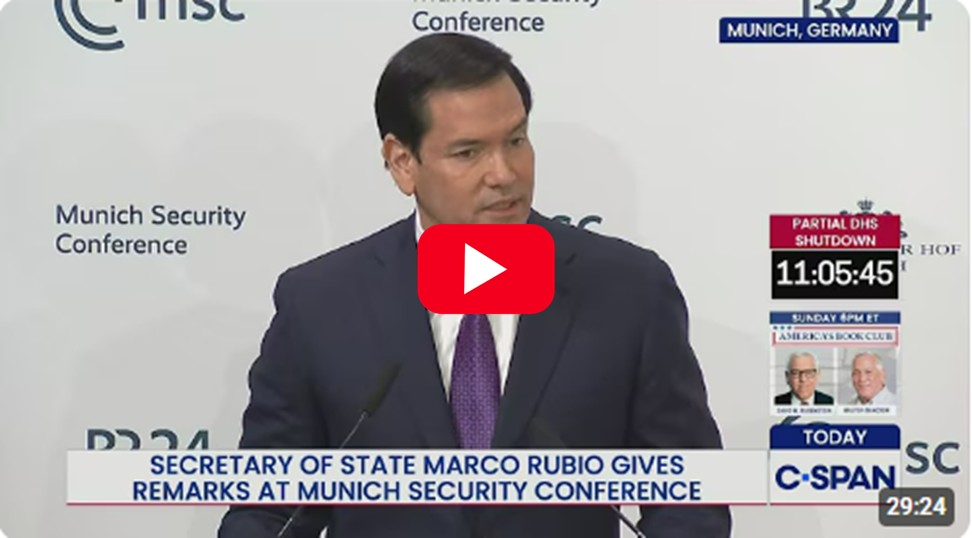
How many of you had the chance to listen to Secretary of State Marco Rubio's speech at the Munich Security Conference? He talked about how the U.S. is a child of Europe, built by settlers who carried "memories, traditions, and the Christian faith" from the old world and creating a new one. He also discusses how the world embraced the dangerous delusion
"that the rules-based global order, an overused term, would now replace the national interest. And that we would now live in a world without borders where everyone became a citizen of the world. This was a foolish idea that ignored both human nature and it ignored the lessons of over 5,000 years of recorded human history."
| | |
Though Secretary Rubio didn't specifically list the lessons of human history, we will touch on five that were implied.
Human nature is tribal, not universal: People naturally organize into distinct groups. You have friends, families, communities, states, nations and so on. People seek belonging, meaning, and security, not just material gain. Groups assimilate based on language, culture, religion, and territory. Attempts to erase or ignore these boundaries lead to conflict and collapse rather than harmony.
Civilizations rise and fall based on cohesion, identity, and defense of shared values: Nations that lose cultural unity or moral purpose decline. From ancient Mesopotamia, Egypt, and Rome great powers weakened when mass influxes of outsiders eroded shared values, cohesion, and loyalty.
Successful integration requires assimilation into a dominant national culture: History shows that waves of migrants thrive when they adopt the host society's core values, language, and norms. Uncontrolled mass migration, without integration, creates parallel societies, resentment, and instability.
Nationhood and boarders are not outdated: The idea of a "borderless world" contradicts millennia of human organization around sovereign communities. Nationhood and boarders are historical constants that provide stability.
Nationalism is the natural and durable organizing principle: Nations have been the most stable and prosperous units when they defend their borders, culture, and people.
| | |
Scripture supports these lessons
There are many verses throughout Scripture that support the historical lessons Secretary of State Marco Rubio touched on. Following are just of few:
Human nature is tribal:
Acts 12:26 From one man he made all the nations, that they should inhabit the whole earth; and he marked out their appointed times in history and the boundaries of their lands.
Deuteronomy 32:8 When the Most High gave the nations their inheritance, when he divided all mankind, he set up boundaries for the peoples according to the number of the sons of Israel.
Civilization Rise and fall based on cohesion:
Psalms 106:35-36 but they mingled with the nations and adopted their customs. They worshiped their idols, which became a snare to them.
Jeremiah 10:2 This is what the LORD says: “Do not learn the ways of the nations...."
Integration requires assimilation
Exodus 12:48-49 A foreigner residing among you who wants to celebrate the LORD’s Passover must have all the males in his household circumcised; then he may take part like one born in the land. No uncircumcised male may eat it. The same law applies both to the native-born and to the foreigner residing among you.
Nationalism - taking care of our family, community, country and then others
1 Timothy 5:8 Anyone who does not provide for their relatives, and especially for their own household, has denied the faith and is worse than an unbeliever.
Galatians 6:10 Therefore, as we have opportunity, let us do good to all people, especially to those who belong to the family of believers.
There are, of coarse, verses that command against mistreating or oppressing the foreigner. Pastor Jack Hibbs thoughts on this are along the line of - we are not called to love the world more than we love our own families and our own nation. That is not biblical love — that’s foolishness. If you would like to hear more of his thoughts on immigration, listen to his March 6, 2025 podcast "Immigration: Love Thy Neighbor". In this podcast, Pastor Jack explains “Love thy neighbor” does NOT mean open borders, lawlessness, or emotional compassion without wisdom. True biblical love is ordered and the Bible clearly supports strong borders, national sovereignty, and legal immigration with assimilation.
| | |
Putting it all together
We learned the U.S. has always allowed immigration through a naturalization process established by Congress. This process respects the lessons of history as well as the lessons of Scripture. Mass illegal immigration violates both historical lessons and Scriptural teachings. It also violates the established immigration laws. Laws intended to protect citizens, the nation, and even the foreigner from the many harms of illegal and mass migration.
In Nebraska, elected officials take and subscribe to an oath to support and defend the Constitution, which implies they should be supporting and defending immigration laws. However, as the number of anti-ICE and immigration bills suggest, there are some legislators who want to turn a blind eye to immigration; a blind eye to the lessons learned through time. History does repeat itself for those who don't head it's warnings.
| | If you liked the content provided in this Minuteman, consider donating to NFFV. You can donate by clicking the button below or by mailing a check made to Nebraska for Founders' Values. | | |
Nebraskans for Founders' Values
PO Box 255
Walton, NE 68461
| |
| |
NEBRASKANS FOR FOUNDERS' VALUES
Board of Directors Team
www.nffv.org
| | | | |