Greetings!
Once you have completed your Foundation Training getting going with LSP does require some level of support, persistence and perseverance. If you feel like a "lonely guy" it can be even harder. Experiences show that one of the most effective ways of having both practical and moral support is to stay connected to the group you trained with. In this issue of the TOF Gazette one training group share their story about how they have helped each other getting going with LSP.
Making honey - a brief history of the Bumblebees by Ellen Johansen
 What do bumblebees and LEGO SERIOUS PLAY (LSP) have in common? More than you might think. In February 2017, a disparate group of academics, consultants, trainers and facilitators came together in London to learn about LSP from Robert. Thirteen of us from Portugal, Spain, Ireland, Germany and the UK attended a four-day workshop to become LSP facilitators. Towards the end, Robert asked us to build our shared aspirational identity and I thought of us as Bumblebees, cross-pollinating the world with the insights and joy we gained from LSP. So I built a model of a giant bumblebee.
Soon after, we decided collectively to call ourselves the Bumblebees and that was the start of a strong bond between the group. The metaphor of the bumblebee allowed everyone to be part of something bigger than themselves and work towards a common goal.
Applying our Simple Guiding Principles
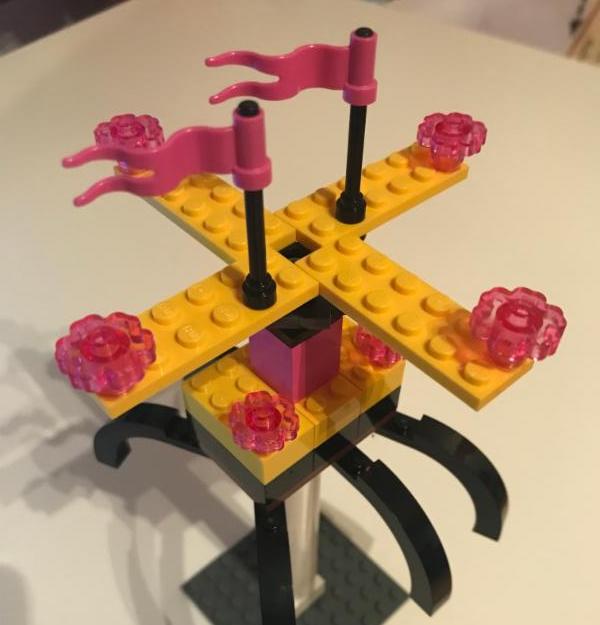 Our Simple Guiding Principles (SGP) were important for keeping the group together and working as a unit after the course ended. Our SGPs and our name were more important and had more impact on our cohesion and generosity as a group than we anticipated. For most of us, a sense of belonging and a shared mission are the most important thing about the group:
 Move on and collaborate
Some of us work together on client projects - Esther and Nuno; Ellen and Alison; Alex and Ellen; Leigh, Rosaline, Alex and Julie; Esther and Alex (with Franc Mas too) - or meet at conferences or on city visits. For example, in th last two years, Nuno, Alex, Mags and Ellen visited Esther and Franc in Barcelona.
Trust in our unconscious potential
Some of us started designing and leading LSP workshops immediately after London workshop, while others followed months or years later. Everyone was encouraged to try out LSP by the connection and inspiration that flowed through the WhatsApp group we formed after Robert's workshop.
Remember not to jump ahead and plan too quickly
A good workshop needs preparation. We frequently ask the group for help when preparing a session (checking plans, giving advice on questions, debriefing and offering positive feedback when it looks good). It's important to take time to reflect on things.
Remember to look from above
This isn't easy, but some of us try to get a high-level view of our industry or problem and then find interesting ways to use LSP to solve them. Alex, our "doctor of play", has successfully used LSP in areas of his university that he wouldn't have thought about previously, such as for serious senior staff, research groups and students in the classroom.
Make sure we are not strikers in the goal
We think of this in several ways, but it generally means that, even though you bring your experience as a facilitator, you're not the game-maker. Participants need to be guided, but not told what to do. This can be very difficult, but you need the question to be "sufficiently vague" (as Robert says) to ensure you don't influence participants' answers too much.
Use speed and focus to move forward
Timing during a workshop is key. Sometimes things go better if they are constrained by time to preventing over-thinking. Robert reminded us: "Don't have a meeting with yourself." He also used the wrap-up phrase: "Can we live with it?" Alex has tested this many times as he has limited time in meetings, workshops and teaching. He's found that AT1-3 can be done within one to two hours with some focus.
Trust in ourselves and really talk through the models (also on WhatsApp)
With some clients, I bring the Window Exploration Bags and we start building instead of talking. Mags says that when participants start describing the models in detail, their natural storytelling ability emerges, which strengthens their ability to communicate and trust in one another. It's great for team-building workshops.
Trust our hands but plan as well
Building is really important, but planning is too. Without a good plan, participants can easily lose the flow and be distracted from the task. Getting them back on track is difficult, but this can be avoided with a good plan.
Think with our hands
When I am thinking through something, I go for a walk and then I grab my bricks. This helps me see things more clearly.
See through the models
This is about using the models as a way into people's deeper meaning/feelings. At the London session, Nuno built a model for this concept. He says the visual of the model keeps popping up or buzzing around during his LSP sessions and it helps keep him focused.
Read all about the Bumble Bees' personal experiences getting going with LSP by staying in touch. Click on image to download article.
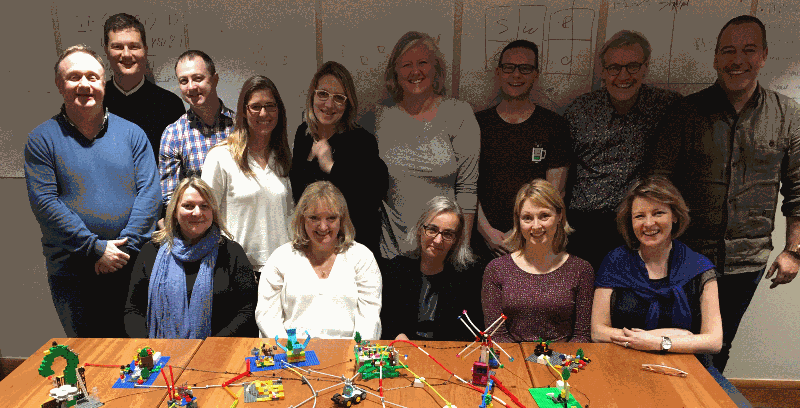
What's the recipe for a successful group after LSP training?
Take a bunch of curious people with different backgrounds and experience and add:
* A nice training environment
* An exciting, collaborative training atmosphere among participants
* A strong aspirational group identity
* Some meaningful co-created SGPs
* An online platform to which everyone has access
* At least one person online who needs help on a serious topic that you can work on as a group, harnessing everyone's different backgrounds and experience
* The celebration of success
* Upcoming projects, events or conferences that are big enough so that group members can participate in a number of ways
* Some private contact and meet-ups from time to time
A big thank you to the Bumble Bees for taking the time and effort to share your insights with all of us. You are a great source of inspiration.
Best Regards

phone: EU +45 27642350 US +1 8606568190
