View as Webpage


Hi everyone!


Solemn opening to this Capitol Corner. Our hearts are with the family of Laterria Smith and Jayden Perkins. All systems failed this mother and son. Please, when we say believe survivors, believe survivors. We continue on in an effort to create safety for all survivors. We hope to honor them by moving forward. Please take a minute, and hold them in your thoughts; thank you. 


We partnered with Professor Debra Stark at University of Illinois Chicago Law School on the Summary for Human Rights for Safer Homes Act. The bills (SB3652 and HB5550) both have moved out of committees unanimously and are on their way to the floor for debate. We expect votes and debate on both bills in each chamber in the next few weeks.


ICADV is seeking stories from survivors who have dealt with the consequences of being in a community with a crime free nuisance ordinance. This can include threats of eviction for calling the police, trying to enforce a protection order or more. Please see the below request with the link to all the communities across the state that have such an ordinance. We see this as a front door issue, and we can close this front door by passing this bill. 


Please take a look at the new report from Women’s Justice Institute (WJI) and ACLU-Illinois written by Alexis Mansfield (WJI) and Emily Werth (ACLU-IL), Expecting Justice. This report summarizes the responses received to requests made under the Illinois Freedom of Information Act to all 102 counties in the state. The report documents the current policies and practices in jails in many counties that are inadequate to meet the reproductive health needs of individuals in their custody consistent with legal standards and best practices. We encourage you to participate in WJI’s Alliance for Criminalized Survivors, and you can sign up here. For more information contact me. 


As a reminder, the Advocacy, Funding and Accountability (AFA) Committee of ICADV agreed to not pursue any funding increases this year in the state line item for the Department of Human Services domestic violence services. This is to continue to demonstrate coalition and support for the ICASA funding increase from $12 to $20 million. We demonstrate our solidarity with ICASA by not seeking any funding increases and stepping back. All this funding comes from the same source within the Department of Human Services. 


We still have slots open to sign up for an Advocacy Wednesday. If you would like to sign up contact me. Coming to Springfield and meeting your legislators at the Capitol is important for on-going advocacy efforts. These meetings have to be coordinated with ICADV given the newest ethical legislation that passed the General Assembly - it is in your interest to have a registered lobbyist with you during these meetings. It is important that we demonstrate "One Mission, One Voice" publicly.

In Peace,


Christine Raffaele

Director of Policy and Systems Advocacy

STATE POLICY UPDATES


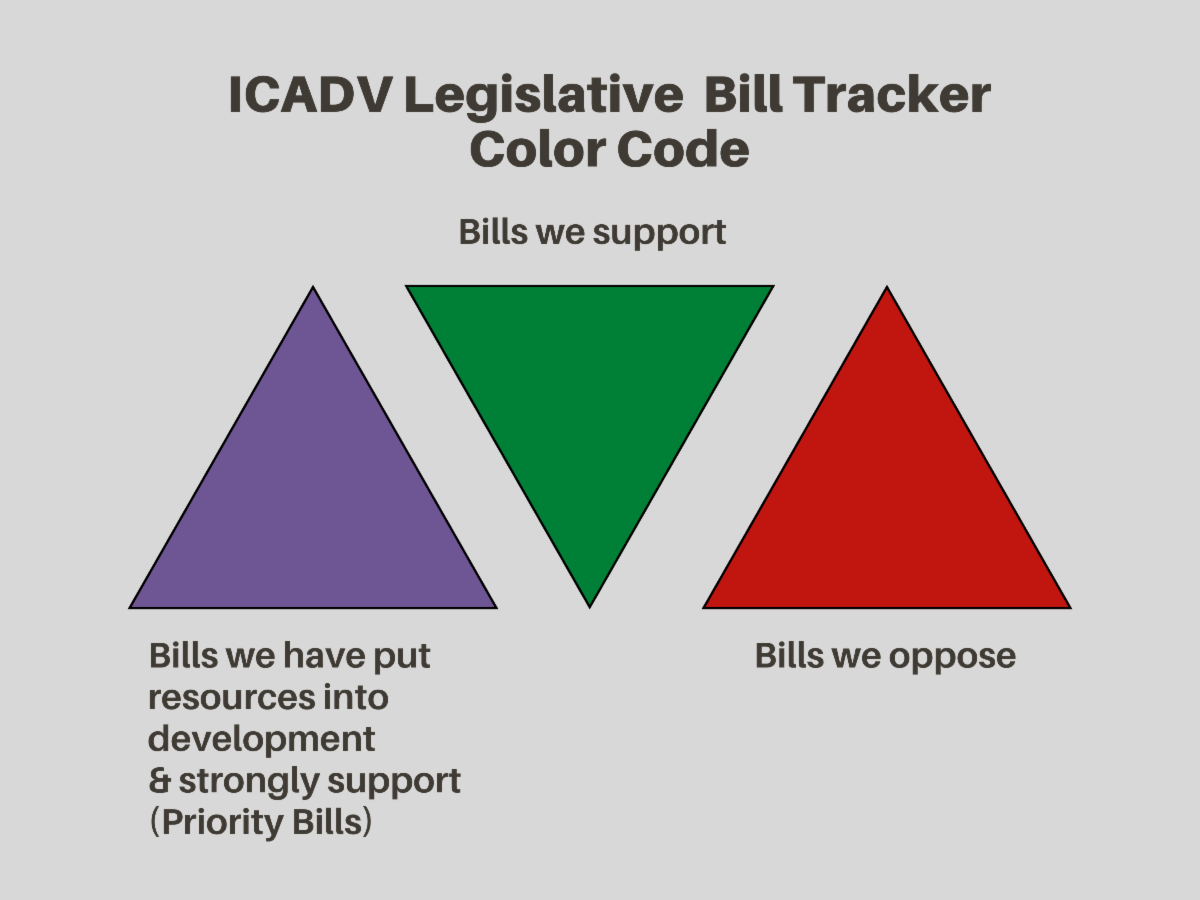
Here is the latest edition of the ICADV Web Bill Tracker. This is regularly updated, but this most recent version was linked as of March 29, 2024. The color code remains the same so see below. This list also includes references to the policy platform pillars. If you have questions about accessing the list, please reach out to Christine. You can subscribe to the list and get daily or weekly updates for the bills on the list, or you can create a free account to track individual bills. You can learn more here.  A reminder for the color code: purple are bills we have put resources into development and strongly support, green are bills that we support, and red are bills we oppose. 


BILL UPDATES

The Summary of Rights for Safer Homes Act

HB5550 and SB3652 both passed out of committees in their respected chambers and both are headed for floor debate shortly. The deadline for bills to have third reading and debate are April 12, 2024 in the Senate and April 19, 2024 in the House. We thank everyone who was able to submit witness slips in support of both bills this month. The survivor who testified was amazing and we are so grateful she added her voice to this issue. Factsheet here.

The Community Safety Through Stable Homes Act (Crime Free Nuisance Ordinance (CFNO) Bill) (HB5432 Rep. Gong-Gershowitz, SB3680 Sen. Villa)

The Community Safety through Stable Homes Act once implemented will prevent discrimination, help people contact law enforcement without fear, and focus on better responses to crime while also keeping families in their homes. CFNOs harm vulnerable community members seeking law enforcement assistance, such as those experiencing domestic violence or mental illness. CFNO enforcement is frequently concentrated in Black and Latinx communities, reinforcing long standing patterns of residential segregation. The collaborative group has been working with Illinois Realtors on an amendment that was filed to SB3680. Factsheet here. If you would like more information, please reach out to Christine.


If you would like to endorse the Community Safety Through Stable Homes Act you can do so here.

Seeking Survivor Stories

We are currently seeking any survivor stories related to threats of eviction for calling law enforcement for things such as having the abuser arrested for the incident, to enforce a protection order, or anything regarding domestic violence. It has come to our attention that in the last few years, many communities have nuisance ordinances that require the landlord at threat by law enforcement to evict or threaten to evict survivors for calling law enforcement in these types of circumstances. If you have a survivor story and would like to share it please contact Christine. Here is a list of all the communities in Illinois to our knowledge that have such ordinances - please review and see if you have survivors in these communities who might be willing to come forward with a story.


Please also contact Christine if one of these ordinances have been used to keep you from locating shelter or housing in a community. ICADV would like to hear more about this situation. Thank you! 

Gender-Based Violence Re-Sentencing (SB3285-Sen. Peters, HB5646-Rep. Cassidy)

Allows for a challenge of a conviction based on a negotiated plea agreement under post judgment relief provisions that require evidence of forcible felony, domestic violence, and gender-based violence. These bills are in response to the Wells case.


The Illinois Supreme Court issued an opinion in People v. Wells, 2023 IL 127169, which undermined the intention behind SB2260, PA 103-403, the Gender Based Violence Re-sentencing bill.  The Illinois Supreme Court held that Section 2-1401(b-5) is sentencing relief, but this relief was not available to the survivor because she had entered into a fully negotiated guilty plea. The Court relied on precedence that fully negotiated plea agreements are not subject to sentence reductions. The Court also held that under the plain language of the statute there is no exception for proceedings under (b-5) and the plain language does not allow the survivor to seek withdrawal of her guilty plea based upon new evidence of domestic violence. Therefore, this code section does not apply to the survivor’s fully negotiated guilty plea, she could not state a viable claim for relief, and the premature dismissal of her petition was harmless beyond a reasonable doubt. To read more, Quick Take on Illinois Supreme Court Opinion Issued Thursday November 30, 2023, page down to People v. Wells, a pdf of the opinion is linked in this article. To sign on to support the bill please us this link.


If you are interested in supporting both SB3600, Senator Edly-Allen, and HB5431, Representative Kelly Cassidy on not shackling or using electronic monitoring devices on pregnant individuals. You can sign on to support those bills here.

Karina’s Bill

The Network: Advocating Against Domestic Violence is continuing to move Karina’s Bill forward in the Senate. The newest factsheet can be found here. The bills are: HB4469 and SB2633. ICADV is continuing to support Karina’s Bill as it will finally bring much-needed cleanup to remedy 14.5 protecting survivors. 

Children-Abuse Reporting SB3630, (Sen. Lightford)

This bill set forth certain protections that must be provided to the parent or guardian of a child at the center of an abuse or neglect investigation whenever the Department of Children and Family Services refers a child to a medical professional (rather than a board-certified child abuse pediatrician). It provides that the medical professional must explain to the parent or guardian of child, whenever the medical professional is involved for the purpose of providing an opinion to the Department regarding whether the child’s injury or condition is suspicious for child maltreatment. 


HB5164 Name Change-Pub Change Fees

  • Amends the Clerks of the Court Act.
  • Provides that filing fees for a petition for change name may not exceed $25, and the court may waive this fee for good cause shown.
  • Amends Name Change Article of the Code of Civil Procedure.
  • Deletes the requirement that a petitioner must reside in this State for 6 months before the petitioner may file a petition under this Article.
  • Allows a petitioner to request that the court file be impounded if public disclosure may be a hardship and have a negative impact on the petitioner's health or safety to include, but not be limited to, if the person is transgender, an adoptee, a survivor of domestic or intimate partner abuse, a survivor of gender-based violence, a survivor of human trafficking, a refugee, has been granted special immigrant status by the United States Citizenship and Immigration Service, or has been granted asylum in this country. The petitioner may attach to the statement any supporting documents including relevant court orders.
  • Allows the petitioner to request that his or her address be omitted from court documents if it would put the petitioner or petitioner's family at risk.
  • Repeals the requirements to publish a notice of a petition to change a name.


ICADV supports this bill as it includes survivors of gender-based violence access to this name change provision which reduces the petition cost and allows for the court file to be impounded.

HB5507 Gender-Identify-Correct Info

  • Amends the Code of Civil Procedure.
  • Creates a process that Illinois residents may use to seek an Illinois judicial order making findings of fact to change a government-issued document from another state or country so that they may petition the issuing jurisdiction to change such a document.


ICADV supports this bill because it makes the process for changing a government issued document much easier. 


FEDERAL POLICY UPDATES


FFY (Federal Fiscal Year) 24 Updates

From the National Network to End Domestic Violence:

During the last few weeks, the House and Senate have been working on what they are calling “minibus bills” for the FFY24 budget. The first minibus passed earlier this month. This package included the Commerce, Justice, and Science (CJS) funding levels as well as the T-HUD funding levels. 


Victims of Crime Act (VOCA)

In the first minibus, Victims of Crime Act (VOCA) is funded at $1.353 billion, which will constitute a roughly $630 million cut to VOCA grants compared to FY 23.

This is a hard-won $153 million over the initial funding levels in the proposed President’s Budget and earlier versions of the House and Senate budgets ($1.2 billion). Congress did not include language to use funds from the False Claims Act (FCA), otherwise sent to the Treasury, to bolster VOCA. Additionally, of the $153 million over the initial proposals, $80 million of it is transferred to OVW/VAWA programs.

Illinois will see VOCA cuts in about 2 years given how VOCA is administered in Illinois. We have time to continue to advocate for VOCA increases. See below for the plans for the FFY25 budget. 


Violence Against Women Act (VAWA), Office on Violence Against Women Programs 

VAWA was increased by $8 million. Specifically, in terms of our top priorities, the bill provides:


  • SASP: $78.5 million (level to FY 23)
  • Transitional Housing: $50 million (level to FY 23)
  • Culturally Specific: $11 million (level to FY 23)
  • Legal Assistance for Victims: $55 million (level to FY23)


Housing 

The package includes level funding for the HUD DV/SA bonus housing funds - at $52 million. 


Last, week the second minibus for FFY24 passed the House and Senate. This package includes the Defense; Financial Services and General Government; Homeland Security; Labor, Health and Human Services, and Education; Legislative Branch; and State, Foreign Operations and Related Programs bills. 


Our priority programs at HHS in the Office of Family Violence Prevention Services and the CDC were all level funded. This includes FVPSA funding and other related funding at OFVPS, including a the culturally specific services program, the DELTA prevention grants and the Rape Prevention and Education program (RPE).  


The President signed the funding bills.


FFY25 Federal Funding

National Network to End Domestic Violence 

The President's proposed FFY25 budget reflects the importance of responding to the VOCA crisis. The budget appears to infuse $7.3 billion in VOCA over several years, including $2 billion added to VOCA each year. Details are not yet available. See more about the President’s proposal here and here.


Congressional funding requests are due at the end of the week. Christine will be working on the requests to the Illinois delegation this week. 


The National Network to End Domestic Violence released their 2024 Domestic Violence Counts Report, you can find the Illinois Report here, and the national report, here. We are so grateful for all of you for submitting your data back in September that drive this report! We had 59 out of 59 providers respond! Review the report, some very helpful information is contained in the report. 


IMPORTANT CASE LAW


Johnson v. Grants Pass

The United States Supreme Court agreed to hear the case in January, 2024. This case will decide whether cities are allowed to punish people for things like sleeping outside with a pillow or blanket even when there are no safe shelter options. At it is core is the United State’s Constitution protection from Cruel and Unusual Punishment (the Eighth Amendment).  The premise of the case is that unless everybody has access to shelter that meets their needs, they cannot be arrest, ticketed, or otherwise punished for sleeping outside. The case started in Grants Pass, Oregon when the city began issuing tickets to people sleeping in public even though there are not enough safe accessible shelter beds.  Grants Pass enacted these code sections for the specific purpose of pushing unhoused people out of the city. The Grants Pass code allows for fines for up to several hundred dollars per violation and can result in bans from public property and criminal prosecution for trespass. The case arose out of class action of those who were ticketed and fined by the city. The appeal to the United States Supreme Court is from the 9th Circuit. ICADV signed on to the National Housing Law Project and Sexual Violence Law Center brief supporting the unconstitutionality of these types of ordinances from the unique perspectives of survivors who are often forced into homelessness due to systems failing to support them. 


You can find more information here and here.


ARTICLES & RESOURCES


Facebook  Instagram  X  LinkedIn
 

Wait! Don't unsubscribe yet!

ICADV values timely and consistent communication with members. We ask that you carefully consider before unsubscribing to ICADV emails. Unsubscribing from a certain campaign might result in you not receiving important information and notifications that are sent using that same group in the future. If you have questions or wish to unsubscribe from a particular type of email campaign, please contact Christina.