|
When you picture a deputy at the Pinellas County Sheriff’s Office (PCSO), the first things you may envision are the star and the gun. Carrying a firearm – whether as a civilian or a law enforcement officer – is an incredible responsibility. The recruits at the Academy will be expected to solve problems and save lives, so it is imperative that they not only have the technical skills that will enable them to send rounds where they’re supposed to go, but the good judgement to know when to use their firearm.
Their training begins before they even have a real gun in their hand, using either blue prop guns, or training guns that fire simunition to run through a wide variety of scenarios. Some are very typical of calls they might find on their first shift: an alarm goes off in a closed business, and they have to clear the building. They learn the basics, like how to stack, where their guns should be pointed, and where the danger zones are. They have to be prepared for anything, even though most alarms are the result of mistakes or malfunctions, not malfeasance. Following the training motto of crawl-walk-run, after they’re comfortable with the basic techniques they throw in some surprises in the form of a barricaded subject, an active shooter, a fleeing victim, or a suicidal person.
The theory of responding to a crisis is easy. Anyone can calmly pick the best solution in a tabletop exercise or hypothetical situation. Even the actual shooting is comparatively easy to learn, with endless repetitions of drawing, loading, and dry firing before they move to the range and practice target shooting. “The coaches say it all the time,” said Recruit William Hartwick. “They can teach anybody to hit a target when they’re standing still.”
The thing that’s much harder to teach is how to react under stress to dynamic conditions. “When there’s stress involved, or you have to run, or the target is moving, it can be very difficult if you don’t have a lot of training and practice,” Hartwick said.
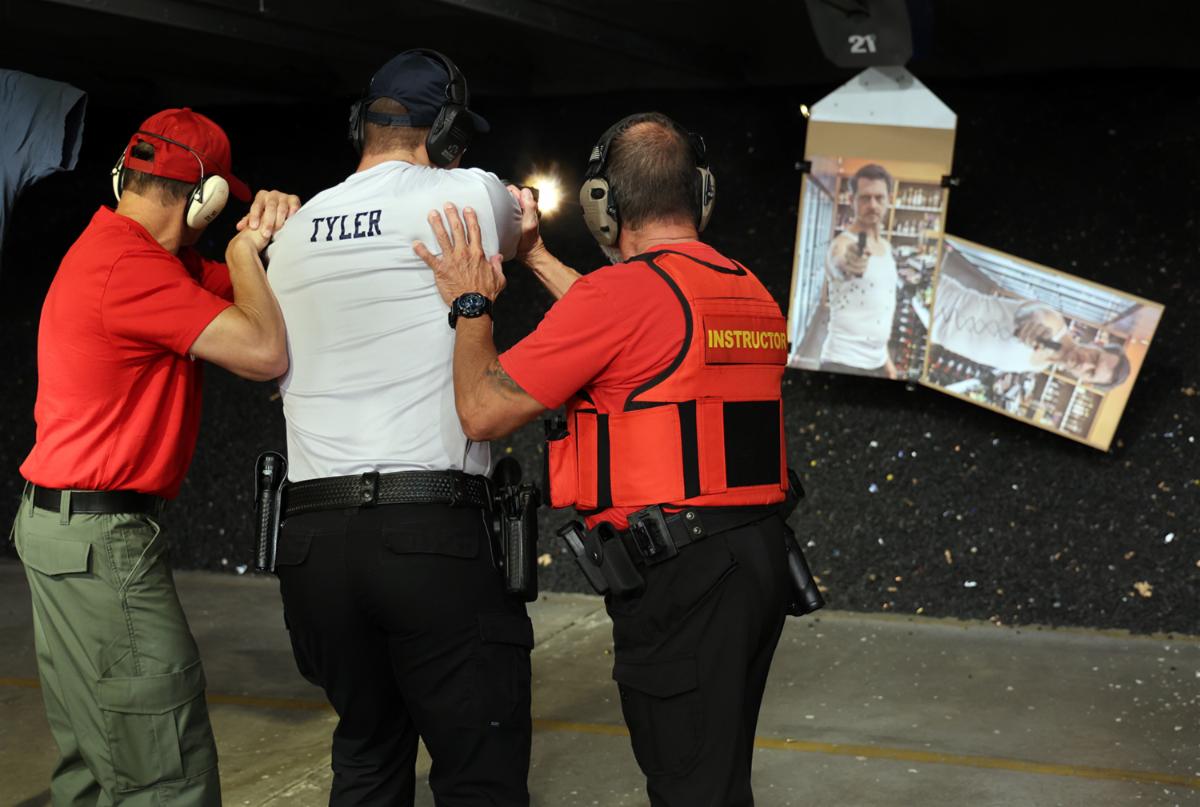
There’s only so much you can do to mimic the high-stress conditions of a high-stakes call, but the Academy coaches get creative to get as close as they can. In an active shooter drill, a sound-making device creates the pop-pop of distant gunfire while the coaches yell like panicked victims. In another drill, recruits have to bring their gun up on target as they’re being grabbed and jostled. They shoot as they move closer to the bad guy, and continue to engage the target as they fall. Some drills have them firing while lying on their side, sprawled on their back, or using their off hand.
In the classroom they talk about the physiological effects of stress, then in the drills they get to experience it firsthand. It might not be as intense as it would be in a real event, but getting this taste early on helps them know how they’ll react. After this training they can anticipate the auditory exclusion, tunnel vision, and loss of fine motor skills that can happen in stressful situations, and understanding it will help them combat it.
The recruits need to know that no matter how much they prepare, things won’t always go according to plan, and it never looks like it does in the movies. To that end the coaches run what they call the John Wick drills – not to make them as skilled as the character, but to teach them that what he does isn’t real. They get to really test their limits in these speed and precision exercises. The reloading, malfunction clearing, decision making, and double tap drills at increasing distance improve their skills but also show them that they can’t overestimate their speed and accuracy. They don’t have the luxury of lining up their sights perfectly, taking a breath, and slowly squeezing the trigger. These are point-and-shoot drills with both eyes open, the kind of shot they would most likely have to take in real life.
A part of law enforcement training they might not have thought about before is the need for a good imagination. The job has a strange dichotomy – most of the calls they’ll wind up going to are virtually identical, but at any moment something wildly unexpected can happen. The false alarm is suddenly an armed intruder, the verbal domestic is suddenly a hostage situation, the call to report a burglary is actually an ambush. They can’t overreact to a simple call, or underreact to a dangerous one. The coaches help the recruits prepare for anything, but there’s a limit to how much they can train. To fill in the gaps, they’re encouraged to imagine what could happen in any given situation and plan for how they’ll respond to it.
“These situations that they’re putting us through, they’re really trying to get into our head that this could happen,” said Recruit Caleb Kocher. “It gets you ready for what this job will put you through every single day. They’re giving us real life scenarios that they’ve been through personally. They’re giving us the stress early on, so we know how to handle the situation once we get out on the road.”
The coaches don’t just teach rules, laws, and techniques, but possibilities. Instruction is full of anecdotes to make them think more deeply. If an active assailant call comes over the radio, do you head straight there as fast as you can, or pause to grab your rifle and medical bag first? If you encounter an active shooter off duty, how do you ensure that uniformed responders know you’re the good guy? The training isn’t always giving them hard and fast answers about what to do in any situation, but rather teaching them that situations are fluid and sometimes chaotic, and they need confidence in the basics, the flexibility to adapt, and the imagination to anticipate anything.
One particular training scenario seemed to have the biggest impact on the recruits. One at a time they’re taken from the classroom, out of sight of the other recruits, and the coach pulls a black hood over their head and explains the scenario.
“We know nothing else besides the fact that we’ve been hit in the face, knocked out, and we’re coming to,” said Recruit Callin Groome. “They rip the hood off, and next thing you know you’re getting shoved from behind and someone is saying that they’re going to kill you.” They go from the daze of unconsciousness to a life or death situation as they’re sprawled on the ground, confused and blinking under the harsh overhead light while a figure with a (fake) knife looms over them. What do they do next? In the chaos of the attack, do they even see the knife? They’ve had tactical stand-ups drilled into them for weeks, so some of them want to get off their backs and on their feet as fast as they can, but that gives the attacker a chance to get in close. Others fend off the attacker with their legs from the ground, keeping them at bay and taking cuts on their boots or shins instead of vital organs. They all eventually manage to draw their simunition gun and stop the threat, but not a single recruit escapes without a slash or two from the blade.
“It taught me how I react in a situation where it’s your life or theirs, and you have to make that split second decision,” Recruit Groome said. “We have to make sure that we, as candidates to become a law enforcement officer, can handle that stress and also incapacitate a threat if need be.”
It’s not a job for everyone. One of the coaches said they have recruits who walk right out and quit after the active shooter simulations, realizing the job isn’t for them. “We like quitters,” he said. “I’d rather know now than three years down the road whether or not you can do this job. I don’t want to be at an active shooter incident, look behind me, and wonder where my backup went.” So far, all of the PCSO recruits are succeeding, and dedicated to a career in law enforcement.
|