|
Immigrant Coverage
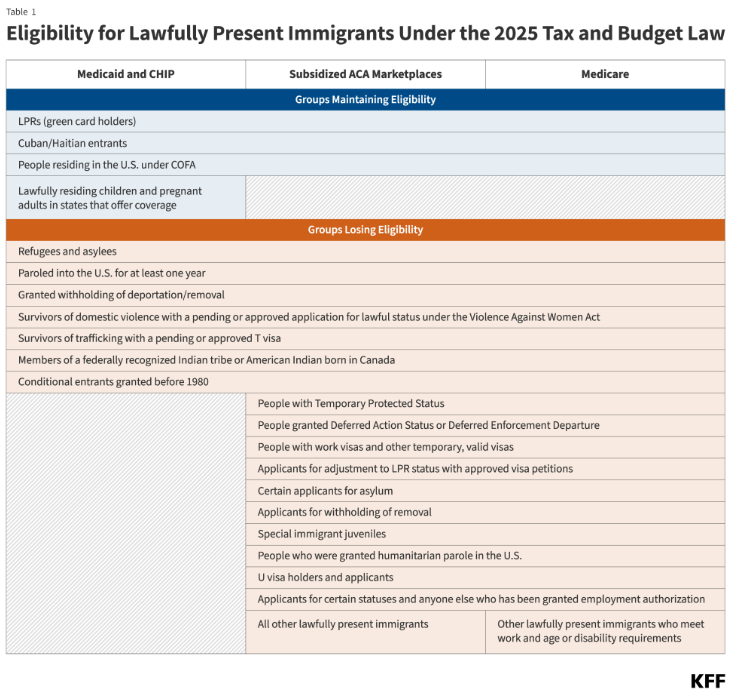
The Commonwealth Fund's recent explainer, What Recent Policy Changes Mean for Immigrant Health Coverage, clarifies health coverage programs available to immigrants and changes because of the 2025 reconciliation law (H.R. 1) and recent rule changes at the Department of Health and Human Services (HHS).
- Beginning in October 2026, H.R. 1 changes the definition of “eligible alien” which will end eligibility for certain groups of lawfully present immigrants including asylees, refugees, and survivors of domestic violence and trafficking. The Congressional Budget Office (CBO) estimates 100,000 people in Medicaid and 100,000 people with Medicare will lose coverage because of the new definition.
- Emergency departments are required to provide stabilizing care for patients with an urgent medical condition, regardless of citizen status. Emergency Medicaid reimburses hospitals for providing this care to low-income immigrants who except for their immigration status would qualify for Medicaid. Starting in October 2026, H.R. 1 limits the federal matching payment (FMAP) for Emergency Medicaid for these individuals from 90% to as low as 50%.
These and other changes discussed in the explainer are expected to result in more than one million more people becoming uninsured, putting a strain on community health centers, hospitals, and all those accessing healthcare. Additional information and resources on immigrant coverage can be found at Beyond the Basics.
| | |
Change to IHCP Call Center Hours
Beginning Monday, October 27, 2025, the IHCP Customer Assistance call center (800-457-4584) hours will be reduced by one hour. New hours are Monday through Friday 8 am to 5 pm (formerly 6 pm).
| |
Marketplace Re-Enrollment Process
Marketplace 2026 open enrollment will kick off on November 1, 2025. There are many changes to Marketplace included in the 2025 reconciliation law (H.R. 1), but not all take place immediately.
- Automatic re-enrollment occurs on December 16, 2025 if consumers have not chosen a new plan. Consumers are highly encouraged to update their information and choose a plan that best meets their needs. Last year, more than half of enrollees let Marketplace automatically re-enroll them. With a significant rise in premiums expected, consumers may first realize what this means for them when they receive their January premium bill.
- Consumers need to take extra care in 2026 to avoid owing back some or all of the premium tax credit on their tax return. 2026 will be the first year without a limit on what is owed.
- New in 2026, HealthCare.gov will NO longer move people who would otherwise be automatically re-enrolled in a Bronze plan to a Silver plan with Cost Sharing Reductions (CSR) because their information shows they would be eligible for CSR. Consumers must actively select a Silver plan to receive CSR.
- Certain consumers are not eligible for auto-redetermination of financial help without taking action to update their information. This includes consumers who auto-renewed for the past two years without updating their information and for whom there is no IRS information on income, and consumers who are enrolled but not currently receiving APTC and/or CSR.
-
Individuals who received APTC in 2023 and 2024 but did not file taxes or filed but did not reconcile APTC, will need to update their information by December 15, 2025 to receive financial assistance in 2026. Starting in 2028, failure to reconcile for one year will block an individual from receiving APTC.
- If automatically re-enrolled, consumers have until December 31, 2025 to cancel their plan without owing the January premium. This is important to know for people who lose their APTC and will now owe a much larger premium. They will have up to January 15, 2026 to make changes but that doesn’t change what they could owe for January and possibly February.
Note: Starting with 2028 open enrollment, H.R. 1 gets rid of auto renewals. For more information on this topic and many others, visit Beyond the Basics.
| | |
Investing in Primary Care
Nurse practitioners (NPs) now comprise 47% of all US primary care clinicians. Decades of research confirms the safety, quality, and effectiveness of care provided by NPs, and patients’ approval of them. Yet it’s challenging to recruit and retain NPs in primary care.
In addition to barriers reported by other primary care clinicians, NPs face:
- variation in state practice regulations and institutional policies;
- inadequate reimbursement rates from Medicare and many private insurers; and
- a lack of federal financing for training, support, and mentoring.
In this new report, the authors assess these barriers and identify opportunities to fully realize the potential of NPs to provide high-quality and effective team-based primary care.
| |
|
Overdose Deaths
Overdose deaths are falling nationwide—with Florida reporting a 35% drop in fentanyl fatalities and Chicago seeing a 37% overall decline—as expanded naloxone access, treatment programs, and real-time drug surveillance contribute to local progress. Experts caution that sustaining these gains will require continued investment in harm reduction and community-based supports.
For information about trends in Indiana overdose deaths, see Indiana Overdose Data Reports and Briefs.
| | |
Help with Medicare
Medicare open enrollment is from October 15th – December 7th annually. Hoosiers who need assistance during open enrollment and the rest of the year, can contact the State Health Insurance Assistance Program (SHIP) at 800-452-4800. SHIP provides free and impartial counseling to help consumers make decisions regarding health insurance options related to Medicare. SHIP volunteer counselors complete intensive training and are certified by the Indiana Department of Insurance.
| | |
Start the Conversation Training
Join Action for Healthy Kids for Start the Conversation, a free, 90-minute virtual workshop designed for parents and caregivers of youth ages 11–24. Practical, youth-informed strategies are presented to build trust and talk with young people about health choices, including vaping and other substance use.
Parents and trusted adults do not have to be an expert to talk with teens about vaping and nicotine. These talks can feel intimidating, but with the right tools, an open, honest, and meaningful conversations about vaping and nicotine is possible.
Upcoming session: November 5, 2025 at 4 p.m. EST on Zoom.
| | TOBACCO PREVENTION & CESSATION | | |
What is Zyn and What are Oral Nicotine Pouches?
Oral nicotine pouches, such as the brand Zyn, are small white pouches placed between the lip and gum. These pouches contain nicotine powder and flavorings rather than tobacco leaf, making them different from traditional smokeless tobacco. Use of these pouches has surged in recent years among young adults, aided by high-nicotine concentrations, youth-appealing flavors, easy concealability, and targeted marketing. Though these pouches can deliver nicotine, the long-term health effects are not yet fully known. Nicotine exposure during adolescents is unsafe because it can disrupt brain development and increase the risk of addiction. The article below emphasizes regulatory gaps, noting that only Zyn products currently hold authorization from the U.S. Food and Drug Administration while many other oral nicotine pouches remain unregulated. The Truth Initiative calls for stronger oversight to prevent youth initiation and misuse.
| | | |
|
IHCP Membership
Total Membership decreased in September. With 1,751,014 members, there were 18,562, or 1.5%, less members in September 2025 than in August 2025.
In the last six months, IHCP membership dropped by nearly 220,000.
| | | | | |