Rail & Labor News from RWU
| | Weekly Digest Number 27 - July 7, 2026 | | Welcome to the RWU Rail & Labor News! This news bulletin is produced and emailed out each Tuesday morning. We hope you find each week's news and information useful. If so, please share with co-workers, friends, and colleagues. If you like, you can sign them up to get all the news from RWU HERE. Or forward them the link. Got a hot tip? Please forward the article and a link to raillabornews@gmail.com. Note: If you read over this news bulletin each week, you will be sure to never miss the important news of what is going on in the railroad world from a worker's perspective! | | THIS WEEK'S RAIL AND LABOR NEWS | |
Trains Magazine / June 29th
Workers at OmniTRAX short line Northern Ohio & Western Railway have voted to join the Brotherhood of Locomotive Engineers and Trainmen, the union has announced.
The National Mediation Board certified the election on June 16. The union says it is the 16th instance of a short line voting to join the BLET since 2023. Work will now begin to appoint a grievance committee and negotiate the railroad’s first labor agreement.
The Northern Ohio & Western is a 25-mile short line southeast of Toledo, connecting Woodville and Tiffin, Ohio, and interchanging with CSX at both endpoint communities and with Norfolk Southern at Maple Grove, Ohio.
| |
Trains Magazine / June 29th
A conductor for the operator of a BNSF Railway facility in Richmond, Calif., was likely killed during a switching move because he went in between railcars without establishing proper protection, the National Transportation Safety Board said in its investigation report released today (June 29).
Contributing to the April 4, 2025, fatality at the Automotive Distribution Facility in Richmond was “ineffective” communication between the ConGlobal conductor and locomotive engineer, the NTSB said. BNSF owns the facility but leases it to American Auto Works Railroad, a subsidiary of national intermodal switching company ConGlobal.
The incident occurred about 9:17 a.m. and saw the conductor pinned between two railcars during a shoving move by a train of two locomotives and five cars. The train’s crew was attempting to address misaligned couplers.
| | Editor's Note: In recent months, numerous freight train derailments have had the additional cost of delaying or totally eliminating passenger/commuter train schedules, blocking highways and shutting down city streets. Thankfully, most freight train derailments do not result in injury or loss of life or toxic chemical releases, but they often result in delays, detours, and general inconvenience to motorists and rail passengers. | |
Trains Magazine / July 1st
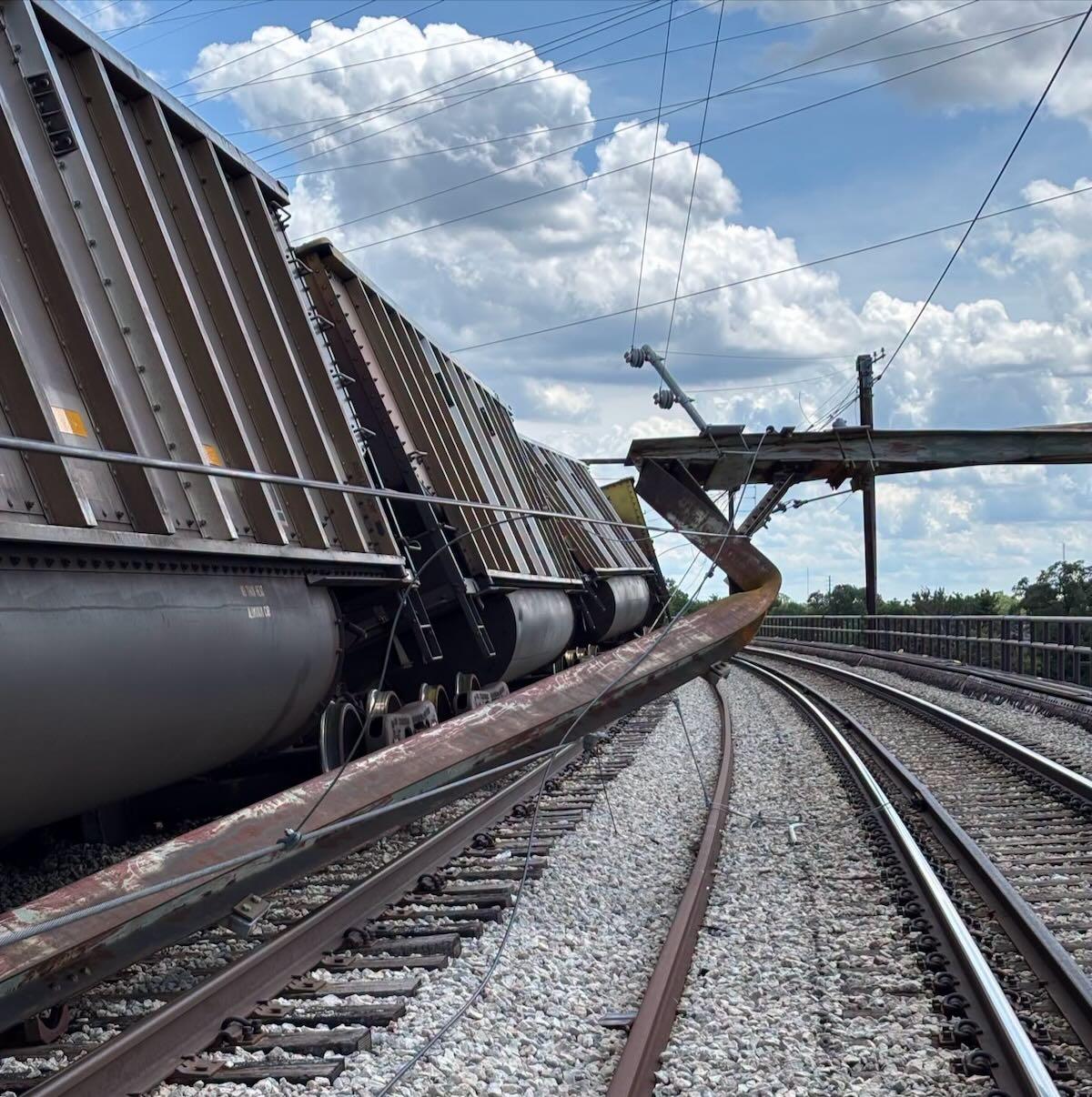
The South Shore Line’s effort to fully restore service following a coal train derailment last week hinges on replacing custom catenary support structures that were damaged in the June 24 incident.
In a Facebook post on Thursday, June 30, the Northern Indiana Commuter Transportation District says that because the 13-car freight train derailment occurred on the Grand Calumet River Bridge, the catenary supports and their mounts “are specific to that location and are attached directly to the bridge.
“NICTD is working with its partners to design, manufacture, and install the replacement structures as quickly as possible. After those structures are in place, crews can reinstall the overhead power wires and restore regular train service.”
|
| Editor's Note: While it is always welcome when a government body finds in favor of the union, this is just a partial victory. As noted by the union official quoted, the process is very slow, which in a strike situation always favors management, in this case CP-KC. | |
Trains Magazine / July 1st
The Canada Industrial Relations Board has ruled that CPKC’s use of a contractor during a strike by signal workers violates anti-replacement worker laws, its first ruling on a series of complaints filed by International Brotherhood of Electrical Workers System Council No. 11.
The decision prohibits the railroad from using contractor PNR Railworks in an area specified by the ruling for the duration of the strike.
CPKC, in a statement on its website, said the CIRB also ruled that use of a particular management worker was not in contravention of the Canada Labour Code. It says the decision on Monday, June 29, “does not contain the CIRB’s reasoning in support of the order and thus it is not yet clear the rationale for or the extent of the finding of non-compliance.”
| | Editor's Note: Despite Union Pacific's disingenuous pledge that "every union worker will have a job after the merger," it does not quite appear to be the case. Curious that the job elimination information is listed as "highly confidential." It is becoming clearer as the process develops that - while every worker may have a job for life - that job might be hundreds if not thousands of miles away from the worker's current residence and in a different craft altogether. | |
Trains Magazine / July 2nd
A coalition of labor unions has asked the Surface Transportation Board to make public information about the Union Pacific-Norfolk Southern merger’s impact on workers, saying that it does not involve commercially sensitive information that would justify its designation as “highly confidential” by the railroads.
While a summary of the impacts was included in the revised merger application accepted by the board in May, the seven unions seek specific information in two appendices that address specifics of the number and location of positions to be abolished, created, or transferred.
The unions note similar information has been public in prior merger applications, including the Canadian Pacific-Kansas City Southern merger application filed in 2021, as well as Canadian National’s application for purchase of the Elgin, Joliet & Eastern in 2007.
| | Editor's Note: Just another article documenting and lamenting the lack of passenger rail in the U.S. due to a lack of investment, coupled with the fact that the rails are owned and operated for private profit by big freight rail corporations who are not interested in passenger trains, and are in fact hostile to them. | |
Deutsche Welle / July 5th
Historically overlooked, train travel in the US is having a moment. Passenger numbers have hit new records for the past two years. With aviation fuel and gas prices still running well above pre-Iran war levels, even more travelers may be looking to passenger rails to avoid costly airfare and trips to the gas pump this summer travel season.
But those unfamiliar with the country's train network may be disappointed. Many cities don't have good rail connections, or the kind of high-speed services common in European and East Asian countries.
And there's a paradox here, because the US actually has more railroads than anywhere in the world. So where is the disconnect?
| | Editor's Note: Here we go again! The unexpected rail freight volume increase - especially intermodal dues to the trucking industry's multiple crises - cannot properly be handled by the nation's big railroads. Things are starting to slow down considerably. How ironic, that such a positive development; i.e. a shift in freight traffic from the highway to the rails, could result in disaster if it keeps up. | |
Freight Waves / July 1st
The big four U.S. Class I railroad intermodal networks are slowing down amid a volume surge that’s been driven by shippers turning to rail amid high fuel prices and spikes in trucking rates.
“The renewed surge in intermodal loads at the four U.S. Class I’s since Memorial Day is having the predictable effect on network fluidity, with average intermodal train speed falling to multi-year lows in some cases,” independent analyst Rick Paterson wrote in his June 26 State of the Rails report. “The rails can handle anticipated increases in volumes, which this isn’t.”
Intermodal volume growth, based off last week’s traffic reports, looks like this for the second quarter and the week ending June 21:
- BNSF up 9.5%, including up 15% in the week ending June 21.
- CSX up 8.3% and 14%, respectively.
- Norfolk Southern, up 5.1% and 12%.
- Union Pacific, up 3.3% and 13%.
| | Editor's Note: RWU members Nick Wurst and Chuck Abbate were interviewed in Chicago at the 10th Biennial Convention of RWU for their thoughts on private vs. public ownership of the nation's railroads. | |
Labor on the Line / June 30th
Privately owned railroads have been run into the ground, chasing profit while making workers and ordinary people pay the price. These railroad workers are demanding public rail now to defend and expand this critical infrastructure as a public good for all.
| | Editor's Note: Yet another freight train derailment in which tank cars were breached, spilling their load. The NTSB has issued endless recommendations that older and more vulnerable tank cars such as the DOT-111's be taken out of service or retrofitted to withstand wrecks. | |
Trains Magazine / June 30th
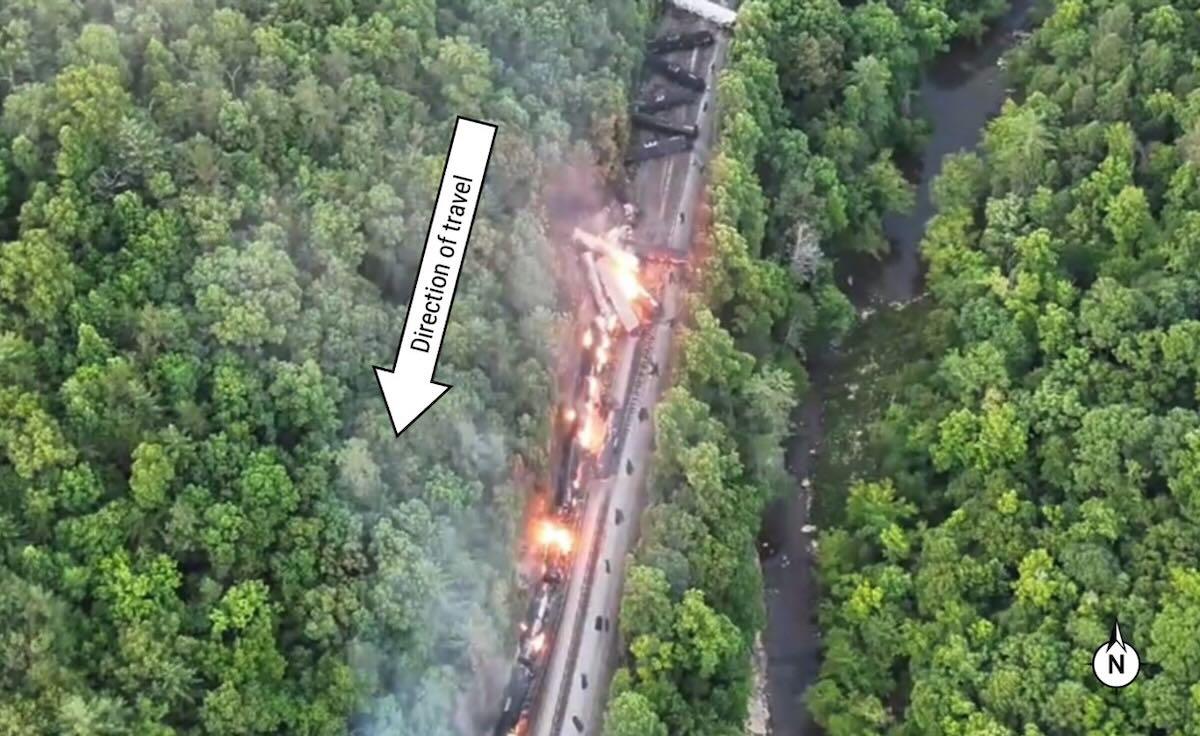
Ten tank cars released part of their loads of alcohol, leading to a fire that burned for three days, in the June 11 derailment of a Norfolk Southern train near Wartburg, Tenn., the National Transportation Safety Board says in its preliminary report on the incident.
No injuries were reported in the incident that occurred about 3:24 p.m. at milepost 243.7 on the South Subdivision of NS’ Cincinnati, New Orleans & Texas Pacific Railway and led to establishment of a 1-mile evacuation zone for about 6½ hours [see “Norfolk Southern derailment, fire …,” Trains.com, June 12, 2026]. Damage was estimated at approximately $5.3 million.
The train involved, NS 197T610, was en route from Fort Wayne, Ind., to Chattanooga, Tenn. It consisted of two locomotives and 114 railcars, 67 of them loaded, including 23 tank cars of hazardous materials. The train was traveling at about 32 mph when 29 railcars, including 19 of the hazardous-material tank cars, derailed near the front of the train.
| | Editor's Note: One can only say, "It's about time!" It has been nearly 40 years since the Canadian government updated regulations for training and certification of railroad workers. In some ways, the Canadians are simply catching up with their counterparts south of the border. In others, the new rules appear to be an improvement over what the U.S. is doing. We are curious to see the full set of regulations. | |
Trains Magazine / July 3rd
The Canadian government this week published new regulations regarding training and certification for railway employees, which will take effect in two years and replace regulations in force since 1987.
The new Railway Personnel Training and Qualifications Regulations were published in the Canada Gazette, Part 2, and are part of the Railway Safety Act. Transport Canada says in a press release that the changes will help reduce the risk of workplace injuries, improve operational safety, and reduce the number of rail incidents and accidents.
Significant provisions of the new regulations include:
- The addition of remote-control locomotive operators and rail traffic controllers to the list of positions designated as critical for safe railway operations. The designation had previously covered locomotive engineers, conductors, transfer hostlers, and yard workers.
- An expansion and clarification of training requirements for workers to be certified for a safety-critical position.
- A requirement for railroads to maintain records of each person’s training, examinations, and evaluations.
- A requirement that any worker with less than two years of experience in a safety-critical position has access at all times to someone certified for the same position who has more experience and expertise.
- The addition of Crew Resource Management, a set of practices to ensure safe operations, to required training for all rail workers.
| | Editor's Note: While rail workers and environmentalists both support taking trucks off of the highway and putting them on the rail, there are cases where the environmental degradation can be acute in a place such as Barstow, where the air quality may suffer enormously. The solution? Electrification! This heavily trafficked region of Southern California might just be the proving ground for what could be the grand start of modern electrified railroading in North America. Read on! | |
Trains Magazine / July 3rd
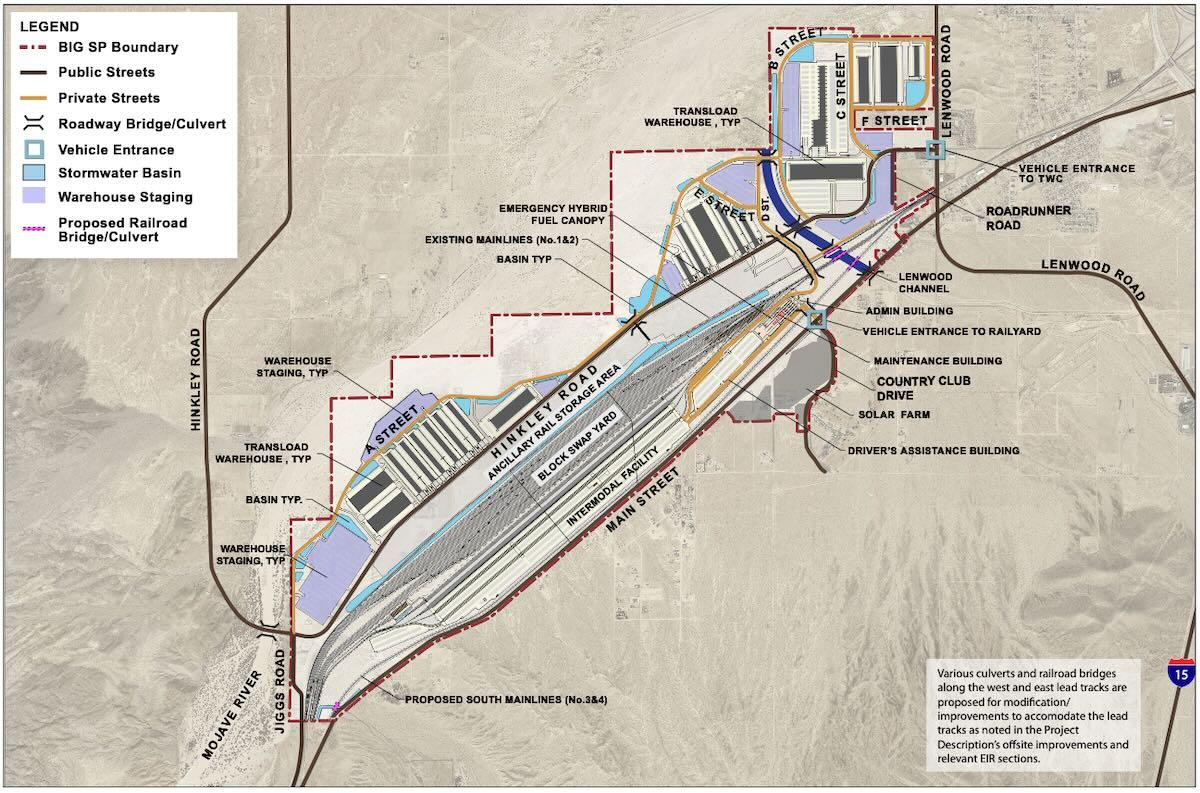
A coalition of environmental groups has filed suit to overturn the City of Barstow’s approval of BNSF’s Barstow International Gateway, citing what they say are deficiencies in the city’s environmental assessment that understate the project’s impact.
“It’s unconscionable that a city in this day and age would allow a giant industrial project that will result in so much increased diesel pollution, which is damaging to people and the environment,” Seth Alston, an attorney at the Center for Biological Diversity, said in a press release.
The 4,500-acre, $4 billion Barstow International Gateway will enable containers to move by rail from the ports of Los Angeles and Long Beach to Barstow, where they will be organized into trains heading east. Among other features, the project will also include facilities allowing international cargo to be transloaded into larger domestic containers.
| | Editor's Note: At the recent Convention of Railroad Workers United (RWU) in June, a workshop was conducted which featured a number of rail and community activists concerned about rail safety, and the disastrous effects upon communities when freight trains derail. In this webinar below, a number of these people are interviewed about their work and discuss the potential for rail workers and communities to link up and fight back against the devastation and neglect of impacted communities - such as East Palestine, Ohio - becoming known as "sacrifice zones." | |
The Real News Network / July 1st
From the explosion of AI data centers to the increasing number of toxic spills, explosions, and industrial disasters happening across the country, corporations and the government are turning the USA into one giant “sacrifice zone.” In “red” states and “blue” states, in rural areas and urban areas, poor and working people are suffering the toxic effects of a crisis that has resulted from decades of deregulation, corporate capture of government, and the protection of private profits over the lives and health of the public.
No one is coming to save us, and nothing is going to change unless residents of different sacrifice zones and poisoned communities, workers and unions on the front lines of the industries poisoning us, environmental justice groups, community and faith organizations, scientists, journalists, and all others who have a stake in this fight start coming together, working together, and fighting back together. In this special panel discussion, recorded at the 2026 Railroad Workers United convention in Chicago, Illinois, we speak with a panel of guests who are part of a new coalition that is doing just that.
| |
Trains Magazine / June 24th
Intramotev, the technology company building autonomous railcars, participated in a technology assessment at Operation Sentinel Justice, the largest training exercise in the history of the U.S. Army Reserve.
The assessment took place from June 9 through June 17 at Camp Shelby Joint Forces Training Center. Soldiers operated Intramotev’s TugVolt autonomous railcar throughout the event.
Partnering with the U.S. Army Reserve Command’s 75th Innovation Command, the 377th Theater Sustainment Command, the Deployment Support Command (DSC) and its 757th Expeditionary Rail Center (ERC), and the Mississippi Army National Guard, Intramotev deployed its TugVolt autonomous railcar to serve as a switcher for multiple DODX railcars, moving them between rail spurs for loading and unloading without a locomotive.
| | NEWS FROM AROUND THE LABOR MOVEMENT | | Each week, RWU includes a few articles about advances and developments in the larger labor movement that are of interest to railroad workers. Got an artcile to submit for possible inclusion next week? Email it along to raillabornews@gmail.com. Thank you! | |
Labor Notes / Event on July 15th
Fighting grievances isn’t only about how well you argue your case. It’s also about organizing members to build pressure on management. This workshop will focus on how to win creatively without going to arbitration—or sometimes without even filing a grievance.
Join Labor Notes for an online workshop for shop stewards on supercharging your grievances. Hear from stewards about how they've used grievances to organize their coworkers, and talk with other labor activists about how to handle sticky situations.
When: Wednesday, July 15 | Time: 8 to 9:30 p.m. Eastern (5 to 6:30 p.m. Pacific) | Where: Online via Zoom.
Registration is $10 - no one will be turned away for lack of funds.
| | Editor's Note: Big news for union activists including those of us in rail! RWU has been conducting our biennial Convention in conjunction with the Labor Notes conference for 18 years. Great news that the conference will be moving to a larger venue to accommodate increasing demand by union workers from all industries. | |
Labor Notes
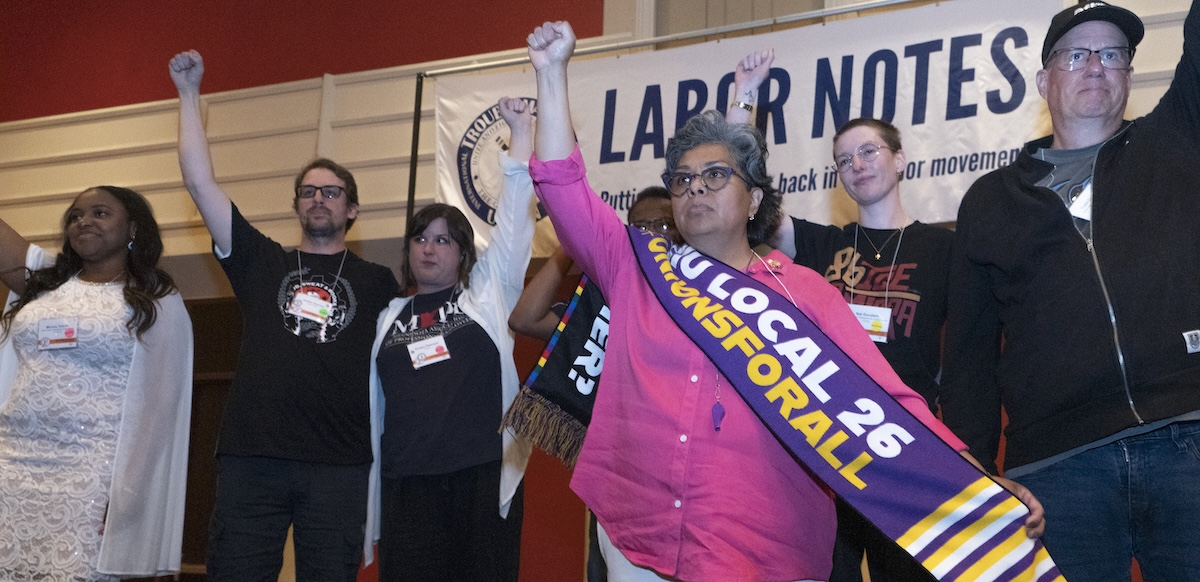
More than 4,400 workers joined the 2026 Labor Notes Conference this month, exchanging stories of campaigns, discussing strategies, and building up their connections and resolve in a time of extraordinary attacks against working people.
We hold the conference every two years. In 2028, we're moving to a bigger space, in downtown Chicago. This venue will allow us to accommodate thousands more attendees, so we hope you’ll bring more members from your unions and local labor movements.
We expect registration to open in the fall of 2027. We'll share more details as the conference approaches. For now, save the date: March 24-26, 2028.
| | |
Labor Notes / July 2nd
In a time when there’s real cause for fear and despair—and when the Trump administration is pushing hard to divide us—the Labor Notes Conference June 12-14 in Chicago was an oasis of inspiration and solidarity.
In every hallway you could feel the electric buzz of conversation, of strategies in the making. Labor Notes gives workers a rare chance to come together across unions, sectors, and identities. Conferencegoers packed into sessions on overcoming division: “Organizing in the Multiethnic Workplace,” “Building Unity Across Job Classifications,” “Overcoming Generational Divides.”
Friday night’s plenary audience rose to its feet in a prolonged ovation for the Minnesota unionists who fought to defend their families, students, and neighbors last winter when anti-immigrant federal troops occupied the Twin Cities.
| | WEEKLY DERAILMENT DEPARTMENT | | Each Tuesday in this news bulletin, RWU does our best to present a picture of what has been happening over the course of the previous week in terms of derailments in North America, and investigation determinations of previous accidents. NOTE: This list is by no means comprehensive. Smaller and less consequential mishaps are generally not reported here. If the wreck results in injury or fatality, or is especially damaging/extreme, a full article will appear as a feature in the dozen or so rail articles above. Know of a train wreck? Please feel free to forward a link to raillabornews@gmail.com for possible inclusion next week. Thanks! |
| | | |