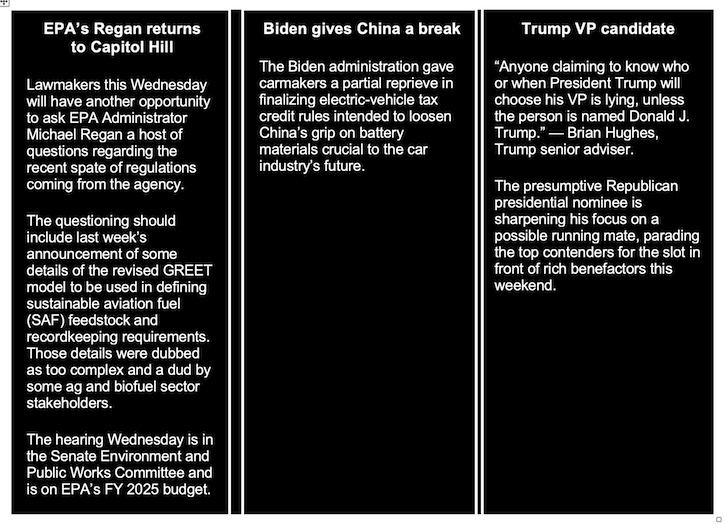

EPA’s Regan to Testify Again Wednesday as Ag/Biofuel Sector Disses on SAF Info
USDA WASDE Friday | More farm bill news expected | STEO Tuesday | Motion to vacate
Washington Focus
The House and the Senate are in session this week.
— New farm bill activity accelerated last week with the release of the most important sections of both House and Senate proposals. House Ag Chair G.T. Thompson (R-Pa.) and staff this week will issue several papers explaining the reasoning behind some of the farm bill proposals which attracted immediate opposition from Democrats.
While Senate Ag Chair Debbie Stabenow (D-Mich.) released what some say is a more detailed summary of her bill, via a 94-page document. The text of the House version has been over at USDA awaiting technical assistance on several matters, most of which has been sent back to the Ag panel. Stabenow provided no Congressional Budget Office (CBO) scores of her farm bill provisions, with stakeholders wanting to see how much funding is provided regarding her favor topics of food and nutrition (SNAP and Thrifty Food Plan) and conservation/climate-smart details — also the apparent Senate’s continued tapping of USDA CCC funding for various topics.
Thompson will be meeting this week in separate sessions with Stabenow and Senate Ag panel ranking member John Boozman (R-Ark.), who is working on a Senate farm bill alternative that features many of the same ideas contained in the House GOP farm bill proposals. It is unclear when Boozman will release his and his GOP colleagues’ ideas.
GOP response to Stabenow. Sen. Roger Marshall (R-Kan.), a member of the Senate Ag Committee, issued the following statement after Stabenow (D-MI) released the Democrats' farm bill framework unexpectedly without Republicans input, according to Marshall:
“Putting pen to paper on the farm bill is long overdue and is welcomed by our farmers and ranchers as the next step in negotiations. As you might expect, the proposal, in its current form, largely reflects the Democrat priorities of more spending in the nutrition title and the addition of many new climate change provisions. Unfortunately, it doesn't put the ‘farm’ back in the farm bill and falls short on the crop insurance and commodity reference price needs of the farmer," Sen. Marshall said. "We generally support nutrition programs, but they have grown from $60 billion a year under the last farm bill (2018) to a staggering $180 billion yearly, with minimal accountability. On the other hand, while farmers have seen exploding input costs, high-interest rates, and a record drop in farm income, it appears my colleagues across the aisle still did not include a modest $400 million a year request to help the farmer."
Marshall continued: "We are more than willing to negotiate, but we need a partner that wants to focus on the full-time farm family and comes to the table to discuss our shared priorities. Beyond these issues, there remains overly prescriptive conservation policies that will block many producers from using successful programs like EQIP. We've got work to do, and I have confidence we can succeed, but I want a bill that will best support producers for the next five years.”
— Focus on House GOP farm bill proposals on the Thrifty Food Plan (TFP) and SNAP.
SNAP: Among other feeding and commodity distribution efforts, Title IV, Nutrition houses the Supplemental Nutrition Assistance Program (SNAP), a program meant to provide additional financial resources to low-income individuals and families. Since its more contemporary roots, established in 1977, SNAP has ballooned to serving over 40 million individuals at an annual cost of $113 billion.
SNAP is considered a mandatory appropriated entitlement, but the House Ag Committee holds the opportunity to assert Congress’ oversight and authorization of SNAP in the 2024 Farm Bill. No action means the program and its expenditures remain untouched and unchecked.
House GOP Committee leaders say Title IV of the 2024 Farm Bill will be "pro-work, pro-health, and pro-integrity." They note labor force participation is a widespread problem, and able-bodied, childless SNAP recipients remain on the sidelines. Recipients also suffer from the highest instances of diet-related, chronic disease; disability claims among the SNAP population are climbing, leading to additional costs in both SNAP and Medicaid. Lastly, House Ag Republicans believe both USDA and States have failed at ensuring SNAP is executed with the full respect of the generosity of the American taxpayer.
The coming House GOP farm bill Title IV plan, proponents say, is also responsive to and reflective of the politics and priorities of the diverse Republican membership of the 118th Congress. Hence, the title will include targeted investment in programs and policies that have shown proven impact on communities in need.
The Thrifty Food Plan (TFP) introduced in 1975 by USDA serves as the basis for determining the maximum allotment of SNAP benefits. Mandated by the 2018 Farm Bill, the TFP is periodically updated to reflect current food prices, consumption patterns, and dietary guidance. However, the 2021 re0evaluation, accelerated under President Biden's Executive Order, faced criticism for its rushed process and lack of transparency.
The re-evaluation led to a significant increase in the farm bill baseline, violating the Congressional Review Act and raising concerns about its trillion-dollar impact. Despite gathering external input, opponents say USDA's decision-making lacked transparency, with key decisions not meeting standards for economic analysis. This lack of transparency, they add, hinders understanding and reproducibility, affecting both policymakers and the public.
The House 2024 Farm Bill plan aims to address these concerns by reinstating a cost-neutral process for future TFP updates, ensuring transparency through public engagement and maintaining regular reevaluations. Contrary to claims, House GOP says the proposal does not cut SNAP benefits but rather ensures annual inflationary adjustments and prevents future administrations from altering the TFP methodology.
Democratic critics and food policy activists argue that the House GOP proposal would cut benefits and disregard scientific evidence in TFP updates. The most recent argument, made by the left-leaning Center on Budget and Policy Priorities, is that “the plan would cut SNAP benefits and ignore scientific evident in [future] TFP updates.” The paper, released and authored by a former Stabenow staff person, discusses how the Biden administration’s short cuts “lifted people out of poverty” and how the Committee’s proposal would “likely” cut benefits for specific groups of individuals, and other distribution programs. The paper goes on to say the Committee’s proposal would “force USDA to ignore scientific evidence.” GOP sources note that interestingly, and in response to the Chairman’s recent opinion piece that mentioned how, minus a statutory fix, any administration could indiscriminately expand or decimate the benefit, the paper states “It does not give the Secretary free rein to ignore the government’s career nonpartisan nutrition and economics experts and set the value of the TFP arbitrarily.” But the Deputy Secretary of the Food and Nutrition Service, a former CBPP staff person herself, did exactly that.
Bottom line: Change proponents highlight the importance of using Congressional Budget Office methodologies to support families in the present, emphasizing that past updates have successfully incorporated scientific evidence while maintaining cost neutrality.
— NCBA supports House Ag Committee farm bill framework. As noted, the House and Senate Agriculture Committees released their Farm Bill Frameworks last week. NCBA says the House framework focuses on voluntary conservation programs that are increasingly popular with cattle producers, animal health provisions that protect the U.S. cattle herd, and investments in food security that support our broader national security. “Unfortunately, the Senate Agriculture Committee’s framework contains provisions that would be detrimental to cattle producers and are in direct contrast to NCBA member-driven policy including requirements to conduct pseudo-science studies on methane emissions from cattle.”
NCBA is very pleased with the House farm bill framework, and “it is clear that direct input from cattle producers helped to positively shape this legislation. NCBA cannot support the Senate’s farm bill framework because it is riddled with policies that would hurt producers and ignores the conservation benefits of cattle production. This is just the start of a long, public process to pass the farm bill and negotiations are certain to change the legislative text many times before final passage. NCBA will continue to push for provisions that help producers and work to eliminate the provisions that will negatively target the cattle industry.”
— Is it always Green(er) on the other side of the Hill? Here we go again, but this time with a likely different result. House lawmakers are gearing up for another vote to potentially remove the current House Speaker, Mike Johnson (R-La.), prompted by Rep. Marjorie Taylor Greene (R-Ga.) citing growing frustration with him. This move echoes a previous attempt led by Rep. Matt Gaetz (R-Fla.), which successfully ousted Kevin McCarthy (R-Calif.) as speaker. However, unlike McCarthy, Johnson is expected to retain his position, at least for now, for several reasons, according to the Wall Street Journal (link):
Bottom line: While there is discontent within the Republican Party regarding Johnson's leadership, factors such as fatigue from previous upheavals, Trump's endorsement, Johnson's strategic decisions, and the absence of clear alternatives are likely to secure his position as House Speaker for the time being. Many Republicans do not want to see the House GOP Conference devolve into disarray as it did after former Speaker McCarthy was ousted in a historic and unprecedented vote last year.
— The outbreak of bird flu, specifically the H5N1 strain, in U.S. cattle has escalated concerns among governments and health agencies due to its potential to contaminate meat and dairy products and transmit to humans. As reported by the CDC, the virus has spread across 36 cattle herds in nine states, and traces of the virus have even been found in retail milk samples. Despite pasteurization processes that kill the pathogen, the presence of the virus in cattle and possibly dairy products has prompted extensive surveillance and precautionary measures.
Health officials, including those from the CDC, are advocating for increased protective measures for farm workers and have initiated discussions with farms to participate in epidemiological studies to better understand and control the spread. The public health risk from this outbreak is currently deemed low by the CDC, with only one mild case of animal-to-human transmission reported.
Efforts are underway to prepare for potential wider transmission, including the rapid development and distribution of bird flu vaccines. The U.S. anticipates having the first batches of a new vaccine ready within weeks if needed, while the EU has already approved a vaccine with others potentially being updated.
The economic impact is also significant, with cattle futures experiencing volatility and restrictions placed on the movement of infected cattle across state borders. Concerns exist about the tension between public health and agricultural economic interests, highlighting the challenges of managing such zoonotic threats effectively.
— Kansas delegation and 67 other colleagues send letter urging USDA to restore NASS surveys. The Kansas Delegation and 67 of their congressional colleagues penned a letter to USDA Secretary Tom Vilsack urging him to reverse USDA’s decision to cancel or discontinue several National Agricultural Statistics Service (NASS) reports. “The reports slated for discontinuation are highly valuable to the entire U.S. agricultural sector, and particularly for cattle, cotton, and grain. For example, the July Cattle report offers producers and market analysts key insights into herd size, calf crop, and heifer retention, all of which are paramount to making sound business and marketing decisions,” the members wrote in the letter. “Losing access to this report in 2016 would have sparked uncertainty in the livestock markets, and the same result would occur today. This would be especially unwelcome given the current period of cyclical herd contraction within the cattle industry.”
NASS identified budgetary constraints as justification for the decision to discontinue publication of these reports. “While we recognize that NASS has seen a modest year-over-year appropriations reduction, we hold that the costs to industry will be more adverse than the cost savings NASS may realize through cessation of these reports,” the members wrote. “We ask that you work with Congress and industry stakeholders to seek alternative means of cost-cutting and urge the continued publication of the July Cattle report, Cotton Objective Yield Survey, and County Estimates for Crops and Livestock.”
The letter is supported by various groups including the National Grain and Feed Association, National Cattlemen’s Beef Association, National Cotton Council, American Farm Bureau Federation, Livestock Marketing Association, Beef Alliance, and Livestock Marketing and Dealers Association.
What it matters: NCBA notes the July Cattle report is an important metric in estimating the 2024 calf crop and heifer retention and the County Estimates are immensely valuable for quantifying the damages from natural disasters such as recent wildfires in Texas and Oklahoma.
Of note: NASS on Wednesday (1 p.m. EDT) will host a free, public Agricultural Data Webinar to spotlight available data for recently discontinued programs. Data from other NASS products as well as from USDA’s Farm Service Agency and Risk Management Agency will be discussed. Attendees will have the opportunity to submit questions during the Q&A section. Register to attend at this link.
— Negotiators from Taiwan and the U.S. concluded discussions last week focusing on the second phase of their trade deal. The talks, which are a follow-up to a previously signed phase dealing with trade facilitation and regulatory practices, delved into more contentious issues like labor rights, environmental concerns, and agricultural practices.
One of the primary sticking points is the operation of Taiwan's distant-water fishing fleet, which has been criticized for labor violations and environmental impacts such as overfishing. The U.S. has urged Taiwan to improve labor conditions on these vessels and enforce stricter environmental regulations. Moreover, Taiwan's regulatory approach to agricultural imports, particularly the past restrictions on pork imports due to health concerns over the feed additive ractopamine, was also discussed, with Taiwan having lifted its ban on ractopamine in pork in 2021.
The negotiations are proving to be complex, with significant challenges in aligning the diverse interests and regulatory standards of both parties. The economic stakes are high, with two-way trade between the U.S. and Taiwan totaling $116.8 billion last year. Despite these challenges, the potential benefits of the trade agreement are substantial, promising increased access for American products in Taiwanese markets.
The geopolitical context adds another layer of complexity. The ongoing tension between Taiwan and mainland China, which views Taiwan as part of its territory, influences the dynamics of the trade talks. The U.S.'s support for Taiwan, especially in terms of defense and economic ties, continues to be a point of contention with Beijing.
Bottom line: The discussions ended without a final agreement, indicating that further negotiations will be necessary to tackle the more difficult aspects of the trade relationship. This situation highlights the intricate balance of economic interests, domestic politics, and international relations that defines U.S./Taiwan trade talks.
— Biden will allow the undocumented U.S. residents known as “Dreamers” to access health insurance under ObamaCare, a change that comes as the president’s campaign looks to make inroads with Latino communities.
— Texas Democratic Representative Henry Cuellar and his wife were indicted on charges they accepted approximately $600,000 in foreign bribes to influence U.S. policy in favor of Azerbaijan. Cuellar denied all allegations. They were released on a $100,000 bond.
The 14-count criminal indictment includes charges of bribery, money laundering, wire fraud and failing to register as a foreign agent. Cuellar is stepping down from his post as ranking member of the Homeland Security Appropriations Subcommittee “while this matter is ongoing,” House Minority Leader Hakeem Jeffries’ spokesperson Christie Stephenson said in a statement.
Cuellar vowed to seek re-election. He still does not know who his opponent will be — the GOP primary is going to a May 28 runoff between Jay Furman and Lazaro Garza Jr. (Cuellar ran unopposed in the Democratic primary for the first time in six years.)
Of note: Crystal Ball House rating change: “Rep. Cuellar moves from Likely Democratic to Leans Democratic. Could see Toss-up in future, clearly lots of moving pieces.”
— The Biden administration is in talks about leading a group of allies that would give as much as $50 billion in aid to Ukraine, with the massive outlay being repaid with the windfall profits from frozen Russian sovereign assets.
|
|
|
Other Events & Hearings
Monday, May 6
Tuesday, May 7
Wednesday, May 8
Thursday, May 9
Friday, May 10
Economic Reports and Events for the Week
Several Federal Reserve officials will speak this week and Fedspeak will likely be all over the map as usual.
Monday, May 6
Tuesday, May 7
Wednesday, May 8
Thursday, May 9
Friday, May 10
Key USDA & international Ag & Energy Reports and Events
Friday brings the monthly deluge of USDA reports. USDA will update old-crop use in the May 10 Supply & Demand Report, but the main feature will be the first official 2024-25 balance sheets. USDA is expected to project new-crop ending stocks to be plentiful for corn, soybeans and wheat.
In the oil sector, BP, Saudi Aramco and Occidental are among the major energy companies that will report first-quarter earnings in the coming week. On Tuesday, EIA releases its monthly Short-Term Energy Outlook, or STEO.
Monday, May 6
Ag reports and events:
Energy reports and events:
Tuesday, May 7
Ag reports and events:
Energy reports and events:
Wednesday, May 8
Ag reports and events:
Energy reports and events:
Thursday, May 9
Ag reports and events:
Energy reports and events:
Friday, May 10
Ag reports and events:
Energy reports and events:
|
KEY LINKS |
WASDE | Crop Production | USDA weekly reports | Crop Progress | Food prices | Farm income | Export Sales weekly | ERP dashboard | California phase-out of gas-powered vehicles | RFS | IRA: Biofuels | IRA: Ag | | Russia/Ukraine war, lessons learned | | SCOTUS on WOTUS | SCOTUS on Prop 12 pork | New farm bill primer | | Gov’t payments to farmers by program | Farmer working capital | USDA Ag Outlook Forum |