Weekly Digest Number 32 - August 10, 2021 |
|
CONTACT CONGRESS TO HAVE RULE OF 2 INCLUDED IN SENATE INFRASTRUCTURE BILL |
|
You’ve probably heard in the news over the past few days that the U.S. Senate has agreed on a new bipartisan infrastructure package. This article is to provide facts, highlight the ongoing differences between the House’s infrastructure bill and the Senate’s infrastructure bill, show where we stand and what can be done to step up as we fight for public and worker safety and for the Rule of 2 — a certified conductor and engineer in the cab of freight locomotives.
- The bipartisan infrastructure bill is a product of the Senate, where a bill needs a simple majority to pass — that means 51 votes. However, unless a bill has 60 senators in solid support, it is vulnerable to a filibuster by any who oppose the bill and thus cannot pass. This bipartisan bill has been a big deal in the news because something is being done about the nation’s infrastructure as some senators from both parties came up with a bill by working together after a long, long period of partisan gridlock on Capitol Hill. Let’s remember that this Senate bill has only been in existence since last Sunday, Aug. 1 — about three days — and things can change quickly.
-
While the news of this Senate bill is good in some ways because of its increased funding for Amtrak and transit and protections of bus members, the bill lacks the two-person crew provision that appeared in the INVEST in America Act that we worked to get passed by the U.S. House in July.
-
The House gets a chance to make additions, subtractions, and changes to anything the Senate passes in what is known as the conference process. Be assured that our allies in the House will fight to have portions of their bill reinstated that were left out of this Senate bill, but, as it was when we first passed two-person crew legislation out of the House in 2020, the divided Senate remains an obstacle. Already, we have come farther than we did last year, and this is thanks to involvement from our membership as well as how we improved conditions for success in November 2020.
-
So the door is NOT CLOSED on a legislative solution from Congress coming through with this bill. A senator could amend the bill to add the two-person crew provision before a vote. The conference process also takes time, and we have strong allies in the U.S. House in Transportation Chairman Peter DeFazio and Rail Subcommittee Chairman Donald Payne who worked to get the 2PC provision in the INVEST Act both times it passed the House. But it’s not DeFazio, Payne or the U.S. representatives who already voted in favor of the INVEST Act’s two-person crew provisions that we need to convince. Republican senators who helped to craft the “bipartisan” Senate bill didn’t include the provision in accordance with the wishes of their railroad industry allies.
|
|
AAR, APTA Commend Latest Version of Bipartisan Infrastructure Package |
|
The Association of American Railroads (AAR) is praising the bipartisan group of U.S. senators that worked with President Biden's administration to reach a comprehensive infrastructure package, the text of which was unveiled yesterday.
The deal includes a full surface transportation reauthorization and makes historic investments in modernizing the nation’s water infrastructure, transit, highway, bridges and roads, AAR officials said in a prepared statement.
"This forward-looking legislation will make long-overdue investments in modernizing the nation's public infrastructure, improving safety and supporting economic growth well into the future," said AAR President and Chief Executive Officer Ian Jefferies....
... The infrastructure bill includes $66 billion in new funding for rail to address Amtrak’s maintenance backlog and upgrade the Northeast Corridor. It also proposes several changes to Amtrak's legal mission, The New York Times reported yesterday.
The bill would change Amtrak's goal to "meet the intercity passenger rail needs of the United States" rather than achieving "a performance level sufficient to justify expending public money." It would also add language that prioritizes service in rural areas in addition to urban ones, the paper reported.
"That is a really significant change because implicit in that is that we’re not trying to make Amtrak into a profit-making venture," said Jim Mathews, the chief executive of the Rail Passengers Association, in the NYTimes report. "We’re using it to create services that are needed by the taxpayers of the country."
|
|
Ford Truck Toughness No Match for Train Derailment |
|
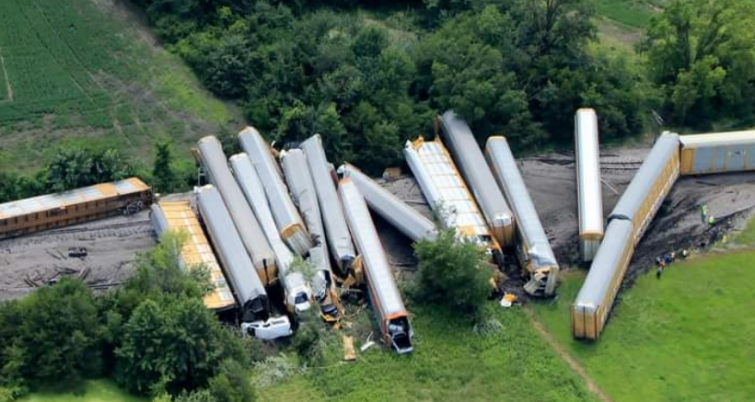
First came the semiconductor chip shortage, which has been following by the Great Ford Truck Derailment of 2021. A Norfolk Southern train carrying Ford F-150 trucks and vans suffered a derailment earlier in the week, and according to the Class 1 company several vehicles were a total loss. The accident happened in Ralls County, Mo., about 100 miles northwest of St. Louis. It marks the third derailment in the region in six weeks. Another NS train left the tracks on June 24 in Monroe County, Mo., and a BNSF derailment happened on July 8. The Missouri State Highway Patrol does not know what is causing the accidents. Aerial photos of the most recent derailment show vehicles out of train cars and smashed. A total of 46 cars left the tracks.
|
|
Editor's Note: The author of the piece below provides wise counsel to "go slow" to rail carriers in the implementation of single person crews. Good advice indeed. But we must remember that single person crews are not inevitable. Long before PTC, before the decline of coal and before "trip optimizer", the Class One rail carriers were pushing for single person crews. And we have stopped them now for nearly 17 years! And if we remain united and steadfast, we can continue to resist their efforts... |
|
Single-Person Crews: Go Slow, I Say |
|
So, although I’ve never bought into the argument that multiple crew members are inherently safer for train operations than solo operations, I would urge the executive leadership of the railroads now empowered to bargain with the unions now compelled to bargain to “go slow.” Take it very slowly. The transition to a solo crew member has dramatic implications for the simple mechanics of train operations:
• Operation of hand-thrown switches.
• Opening and locking of switches on main tracks.
• Yarding of trains.
• Operating when grade crossing apparatus is reported inoperative.
• Copying and repeating back a mandatory directive.
• Working with a utility conductor.
• Application of rules pertaining to the inspection of passing trains and one’s own train
• Losing digital radio communication in PTC territory, etc., etc.
Yes, crew size reduction is inevitable, and yes the inevitability has to be managed. Labor organizations will (possibly) insist on limitations to train length and tonnage for solo operations. That must be negotiated, intelligently.
Labor organizations will (possibly) insist that solo operations be restricted to locomotives and the portions of the railroad where PTC is operative. Those must be negotiated intelligently, and thus, carriers should be prepared to produce the records of PTC reliability, the failure rates of PTC to initialize, and the rate of enroute failures and cut-outs.
The carriers will have to negotiate what will occur if the PTC apparatus on the locomotive fails enroute. How, when and where will the solo locomotive engineer receive a supplementary crew member? And what happens when a system outage of PTC occurs, impacting multiple main track train movements, or when a single assignment includes operation over PTC and non-PTC main track territory?
My free advice is go slowly, for many reasons ...
|
|
Transport Canada Updates Canadian Rail Operating Rules |
|
The changes are the result of Ministerial Order (MO) 20-09 issued in September 2020, requiring the railway industry “to adopt new practices designed to improve safety and prevent uncontrolled movement while conducting switching operations, and to ensure that equipment is properly secured while switching,” according to Transport Canada. (That order was issued following the Transportation Safety Board of Canada’s investigation into a 2017 fatal accident at CN’s Melville Yard in Saskatchewan.)
The rules—announced July 30—now prescribe:
• when air brakes must be used during switching operations “to ensure a consistent approach across the railway system.”
• measures to ensure that stationary equipment is secured during switching operations to prevent uncontrolled movements.
• speed restrictions when switching is conducted with a remote control locomotive.
|
|
Let Policymakers Know about these Pro Rail Strategies |
|
Our friends at Climate Rail Alliance have coordinated a Letter Campaign to policymakers in DC, and Solutionary Rail is an enthusiastic supporter! Will YOU help Congressmembers see how rail is a solution for so many of the 21st Century crises facing us?
Please take 3 minutes and use the Action Network Tool to take action for rail advocacy by communicating with your representatives. The text of the letter is below the link.
Quickly send a letter to your Senators and Representative by clicking HERE:
TEXT OF LETTER:
Thank you for your advocacy for infrastructure and policy that fights climate change! I am contacting you to encourage you to put rail development at the top of your list for transportation, energy, and climate solutions. Rail transportation must be an essential part of an effective climate strategy. Our nation is on the threshold of a paradigm shift in how we transform industry while reducing climate emissions. Development of a modern, accessible, efficient rail network must provide a crucial missing link by upgrading our current corridors for near-future benefit as well as building new corridors for longer-term benefit. The following are some basic facts about the importance of rail transportation:
|
|
Seven passenger groups form coalition to push for Chicago-New York rail improvements |
|
ERIE, Pa. — Seven passenger rail advocacy groups have formed a coalition to push for improved rail service between Chicago and New York City.
The Erie Times-News reports the Lakeshore Rail Alliance will combine All Aboard Erie, All Aboard Ohio, the Empire State Passenger Association, the Chicago-based High-Speed Rail Alliance, the Indiana Passenger Rail Association, the Northern Indiana Passenger Rail Association, and the Northwest Ohio Passenger Rail Association. The groups announced the new organization at a Tuesday press conference in Erie.
All Aboard Erie will host the coalition because of its central location. Erie’s Michael Fuhrman, previously director of economic and regional issue agency Destination Erie, will be the executive director.
On its website, the group calls for at least four daily Amtrak round trips between Chicago and New York as an interim step until a high speed rail line can be built. Its sample timetable shows how this could improve service for all major cities on the corridor.
|
|
What’s in the Senate’s Bipartisan Infrastructure Bill?
Senate Majority Leader Chuck Schumer (D-NY) teed up a procedural vote to wrap up debate on the $550 billion bipartisan infrastructure package, setting up a make-or-break vote for this weekend. The bill includes $66 billion in guaranteed funding for passenger rail and Amtrak, with another $36 billion in authorized funding -- a potentially transformative investment in the U.S. passenger rail network.
Rail Passengers is still working to improve this bill through the amendment process:
The Senate is set to adjourn after this weekend’s vote, joining the House in August recess. It’s unlikely that the House will take up the bill before September, although House Majority Leader Steny H. Hoyer told reporters last week that he may call the House back into session in August if leadership feels it’s required.
Regardless of the timing, Rep. Peter DeFazio (D-OF), Chair of the Transportation & Infrastructure Committee, has publicly stated there needs to be an opportunity for the House to have a say in the final shape of the bill before final passage. While it’s unclear whether this will happen, it could provide another opportunity to improve some of the rail-related policies in the final bill.
|
|
A Fight for Shareholder Approval |
|
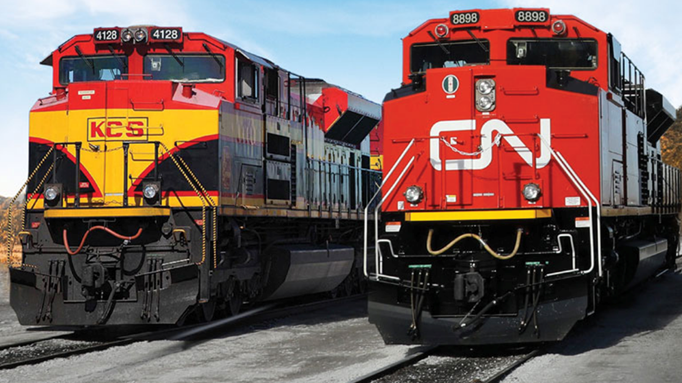
Canadian Pacific, CN and Kansas City Southern have been battling for votes in KCS’s upcoming shareholder vote on August 19 to approve or reject the CN transaction. CP has been actively telling investors to vote no, while KCS and CN have been pushing for approval. It remains uncertain if there will be a decision from the STB on a CN/KCS voting trust prior to the shareholder vote. We continue to believe that there is a 60% chance of approval for the voting trust, but remain wary of the political climate.
The Aug. 19 KCS special shareholders meeting vote is the next known catalyst in these merger activities. KCS shareholders will vote on the $325 merger proposal from CN. There is a growing school of thought that this vote may come closer than previously anticipated, given the growing uncertainty surrounding the STB’s stance on the trust. A decision from the STB may come, at a minimum, after the shareholder vote.
|
|
Editor's Note: RWU condemns this and other individual acts that profess to "save the world." RWU has worked for years now to build alliances with responsible environmental organizations to the ends of maintaining/creating good jobs AND a safe and sustainable environment. Irresponsible acts of this nature serve to discredit our work! That said, placing a shunt on a track is hardly an act of "terrorism." Rail management have historically used shunts to stop trains during the course of routine "efficiency tests". And tracks are often inadvertently "shunted" by all sorts of things; e.g. excessive rain, chemicals, archaic wiring, broken rail, etc., all of which cause the signals to undesirably "drop" to red. |
|
Woman Pleads Guilty to Terror Charge on Train Tracks |
|
The BELLINGHAM, Wash. (AP) — A Bellingham woman has pleaded guilty in federal court to a terrorist attack and violence against Burlington Northern Santa Fe Railway in northwestern Washington that investigators have suggested was motivated by opposition to the construction of a natural gas pipeline across British Columbia.
Samantha Frances Brooks and Ellen Brennan Reiche were each indicted with one count of terrorist attacks and other violence against a railroad carrier Dec. 9, 2020, in U.S. District Court for the Western District of Washington in Seattle.
They’re accused of putting a shunt on tracks near Bellingham in late November. Such devices consist of a wire strung across the tracks, mimicking the electrical signal of a train. The devices can cause trains to automatically brake and can disable railroad crossing guards, investigators have said.
Brooks pleaded guilty July 9, and a federal judge accepted her plea last week, The Bellingham Herald reported. In her plea agreement, Brooks admitted to helping another person install a shunt on the railroad tracks and that they acted with “the intent to cause BNSF trains to delay operating,” according to federal court records.
|
|
NTSB Investigating MBTA Train Collision |
|
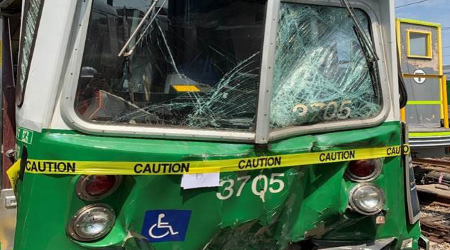
The National Transportation Safety Board's (NTSB) investigation of last week's collision of two Massachusetts Bay Transportation Authority (MBTA) light-rail trains continues as investigators gather information and evidence, according to an NTSB update.
On July 30, a westbound MBTA Green Line train collided with the rear of a MBTA Green Line train that was also heading westbound on the track ahead.
As a result of the collision, two cars on the leading train and one car on the trailing train derailed. Twenty-seven people, including MBTA personnel, were transported to a hospital with non-life threatening injuries.
Investigators secured data from the event recorder from the operating car of the striking train. A preliminary review indicated the train that was hit was traveling at about 10 mph, NTSB officials said in a news release.
The striking train overtook the other train while traveling at about 30 mph.
|
|
Editor's Note: While this is encouraging news, the numbers are pretty dismal. Employment has not even recovered to last year's pandemic levels. Meantime, trains are being held for crews, containers are stacking up on the west coast, the railroad is extremely congested, while the current workforce is "turning and burning", suffering from overwork, fatigue, and exhaustion. |
|
Class I Workforce Rose Slightly in June from May's Level |
|
U.S. Class Is as of mid-June employed 115,931 people, a 0.37% increase from May’s level but a 0.17% decrease from June 2020’s count, according to Surface Transportation Board data.
Four of six workforce categories posted gains in June versus May totals: executives, officials and staff assistants, up 0.88% to 7,342 employees; transportation (train and engine), up 0.85% to 47,444; transportation (other than train and engine), up 0.64% to 4,751; and professional and administrative, up 0.48% to 10,090.
The two categories that posted decreases between May and June were maintenance of equipment and stores, down 0.42% to 17,659 people; and maintenance of way and structures, down 0.16% to 28,645.
On a year-over-year basis, five of the six categories registered the following percentage decreases: maintenance of equipment and stores, 11.64%; transportation (other than train and engine), 7.48%; maintenance of way and structures, 5.68%; professional and administrative, 4.01%; and executives, officials and staff assistants, 3.28%.
The transportation (train and engine) workforce logged a 11.54% year-over-year increase.
|
|
Editor's Note: In this article, it is clear the Class One's are happy to not pay demurrage charges to these private rail car companies. Yet in the next article (see button), the CEO of CSX explains why the Class One's must gouge container companies with demurrage charges to keep the system fluid. In neither case does the railroad want to take any responsibility for delays, backlogs, or other impediments to expedited movement. When we know that they - and their PSR operations model - are one of the biggest factors in the transportation debacle today. |
|
Railcar Owners Say Demurrage Charges Could Reduce Delays of Private Railcars |
|
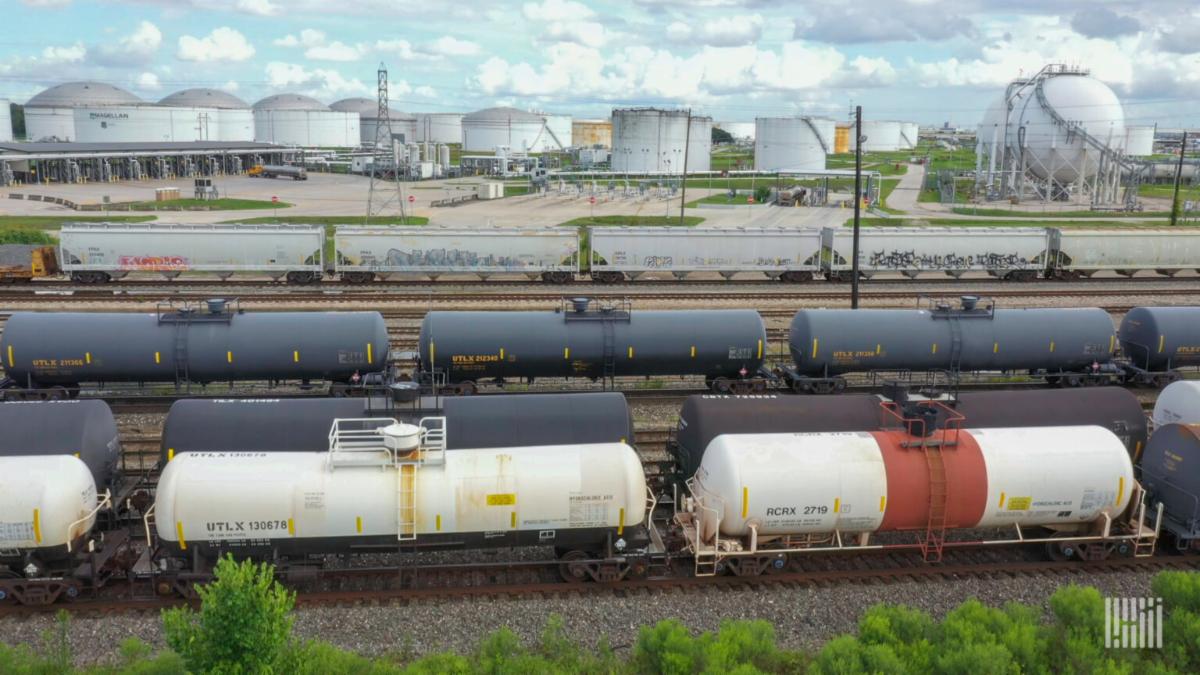
Four shipper associations want the Surface Transportation Board to allow demurrage charges to be assessed on privately owned railcars as an incentive for freight railroads to move those railcars more efficiently through their networks.
The associations say the goal is to promote the efficient use of private railcars without unduly infringing on railroads’ freight operations.
Railroads transport privately owned railcars as part of their service agreements with shippers. Demurrage is a means of applying financial penalties when a party doesn’t load or unload railcars within a set time frame.
But when delays occur or when the freight railroad delivers too many or too few railcars, there is little recourse for the railcar owners, they contend. Assessing demurrage and accessorial charges on freight railroads for those privately owned railcars would enable private railcar owners to protect their investments, especially since they also have to consider how to size their fleets to match inflow and outflow rates at their production plants, according to the petition.
“The non-railroad entities who supply Private Railcars to railroads have collectively invested tens of billions of dollars to acquire the railcars through lease or purchase and they incur additional significant ongoing costs to maintain them, in large part for their use by the Class I railroads to provide railroad freight service,” according to a July 26 petition from attorneys representing the four associations.
|
|
|
|
|
|
|