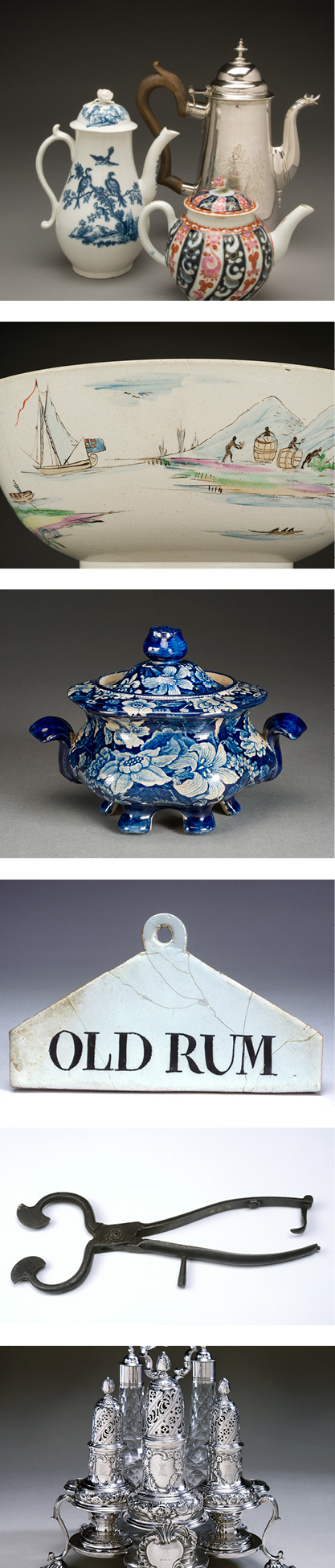
Sugar is a sweet part of our everyday lives, but one with a bitter history. The insatiable demand for sugar transformed the global economy, generated new sources of commercial wealth, and fueled an unprecedented human diaspora. Domesticated in New Guinea more than 10,000 years ago and first processed in India and the Middle East, sugar emerged as a New World commodity in the 15th century. At first a rare and expensive luxury restricted to the elite, demand for sugar as an indispensable product increased exponentially during the 17th and 18th centuries in tandem with the rising popularity of the tea, coffee, chocolate, and punch it sweetened.
Grown and processed by enslaved Africans in the Caribbean, sugar formed one of the three legs of the trans-Atlantic triangular trade that flourished from the 16th through the 19th centuries. New England merchants sent barrel staves, building materials, provisions, and livestock to the West Indies enabling plantation owners to convert every available acre to sugar cultivation. Ships carried sugar and molasses from the plantation colonies of the Caribbean to New England rum distilleries. Merchants then shipped rum to Africa in exchange for ever-larger numbers of enslaved people carried back to the Caribbean to produce more and more sugar.
This one-day forum brings together a diverse group of historians, curators, and archaeologists to focus on the material culture and history of sugar in New England, including issues of wealth, power, refinement, status, social justice, and politics.
Dr. Mark Peterson’s
lecture will discuss how the rise of large-scale sugar production in Barbados rescued the New England colonies from economic collapse and provided a basis for its dynamic growth through the colonial period.
Brandy S. Culp
will explore the material world fueled and shaped by this commodity, encompassing the history of the sugar trade and its human impact to the goods generated around its use. This story is particularly relevant to the history of Connecticut and to understanding New England’s place within the larger trans-Atlantic world in the 17th to 19th centuries.
Justin DiVirgilio’s
presentation explores how rum was produced and the social and political context in which a distillery operated. Using the case study of a rum distillery in mid-18th-century Albany, he will discuss the archeological excavation and research of this remarkably well preserved site to illuminate an industry once important throughout coastal New England.
The day concludes with a hands-on object workshop and open hearth cooking demonstration. This workshop, led by Curatorial Department Director and Curator of Historic Interiors, Amanda Lange, and Assistant Curator, Daniel Sousa, will explore the objects associated with the preparation and presentation of sugar in 18th-century New England households, including metal and ceramic tea, coffee, and chocolate wares – bitter beverages made palatable with sugar – as well as punch bowls. Also included in the workshop will be a newly acquired group of anti-slavery ceramics. The hearth cooking demonstration will focus on cooking with cane sugar. The presentation will be an introduction to the varieties of cane sugar (loaf sugar, caster sugar, demerara, muscovado, turbinado, molasses, etc...) used in 18th and early 19th-century New England kitchens. Hearth Cooks Cynthia Croteau and Ellen Zale will also make a dish using a period “receipt” or recipe.
The cost for the program is $95 ($85 for members, $120 for new members*) and includes lunch. For more information and registration, contact Julie Orvis at
jorvis@historic-deerfield.org
or (413) 775-7179. Register online using the button below.