Weekly Digest Week #41 - October 11, 2022 |
|
Welcome to the RWU Rail & Labor News! This news bulletin is produced and emailed out each Tuesday morning. We hope you find each week's news and information useful. If so, please share with co-workers, friends, and colleagues. If you like, you can sign them up to get all the news from RWU HERE. Or forward them the link. Note: If you read over this news bulletin each week, you will be sure to never miss the important news of what is going on in the railroad world from a worker's perspective!
|
|
(Editor's Note: This is the first union of any size to vote down the Tentative Agreement. In fact, the number of workers represented by the BMWED surpasses the total number of workers represented by unions that have adopted the TA. With the discontent in the operating crafts at boiling point, this vote will no doubt add a boost to the ranks of the BLET and SMART-TD to emulate their BMWED brothers and sisters and vote NO.) |
|
BMWED Membership Votes Against Ratification of Tentative Agreement |
|
BMWED membership voted against ratification of the tentative national agreement reached with the Class I freight railroads, sending the two sides back to the bargaining table and resetting the countdown to a potential work stoppage.
“The majority of the BMWED membership rejected the tentative national agreement and we recognize and understand that result,” President Tony D. Cardwell said. “I trust that railroad management understands that sentiment as well. Railroaders are discouraged and upset with working conditions and compensation and hold their employer in low regard. Railroaders do not feel valued. They resent the fact that management holds no regard for their quality of life, illustrated by their stubborn reluctance to provide a higher quantity of paid time off, especially for sickness. The result of this vote indicates that there is a lot of work to do to establish goodwill and improve the morale that has been broken by the railroads’ executives and Wall Street hedge fund managers.”
The American Arbitration Association counted and verified the election results. In total, 11,845 BMWED members submitted ballots, 6,646 against ratification and 5,100 approving the tentative agreement. 99 remaining ballots were submitted blank or voided for some other user error.
“The membership voted in record numbers on this tentative agreement, exhibiting that they are paying close attention and are engaged in the process,” President Cardwell said. “BMWED members are concerned with the direction of their employers and the mismanagement and greed in which they have consistently implemented, and are united in their resolve to improve their working conditions across the entire Class I rail network.”
The rejection of the tentative agreement results in a “status quo” period where the BMWED will reengage bargaining with the Class I freight carriers. That status quo period will extend to 5 days after Congress reconvenes, which is currently set for Nov. 14. Assuming Congress returns to session on the 14th there could be no “self help” until after the 19th.
|
|
(Editor's Note: Watch your inbox for more information from RWU on this Campaign in the coming days.) |
|
RWU Steering Committee Urges NO Vote on TA for Operating Crafts |
|
At the monthly Steering Committee meeting on Wednesday 10/5/2022, the RWU Steering Committee unanimously agreed that the Tentative Agreement was not what the membership of the operating crafts had expected and desired, and should therefore vote down the agreement. At a mass meeting the following day, members of the Steering Committee each in turn explained reasons why they could not vote for the TA. There appeared to be a consensus among those present that the TA was unacceptable.
In the coming days, RWU plans to issue of complete statement with reasons why the TA for the operating crafts is not in the interests of the employees, but favors the carriers. Various paraphernalia urging a NO vote will be made available soon.
In 2014, RWU assisted the workers on the former BN lines of BNSF when faced with another bad contract, one that would have allowed for universal single person operation of trains. When the votes were counted on that one, the majority of workers from all crafts and all terminals immediately affected by the TA had voted NO. The lopsided vote system-wide was 5-to-1 against adoption.
|
|
(Editor's Note: Yet another argument in favor of TWO in the cab of a moving freight train. ) |
|
FRA Study Sees Issues with Locomotive Cab Automation
Report calls for further training, additional study of issues found in simulations
|
|
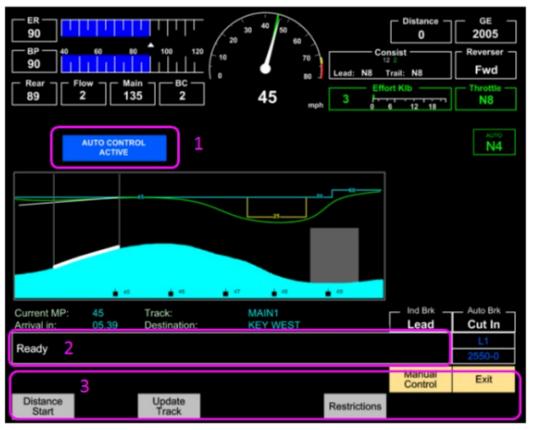
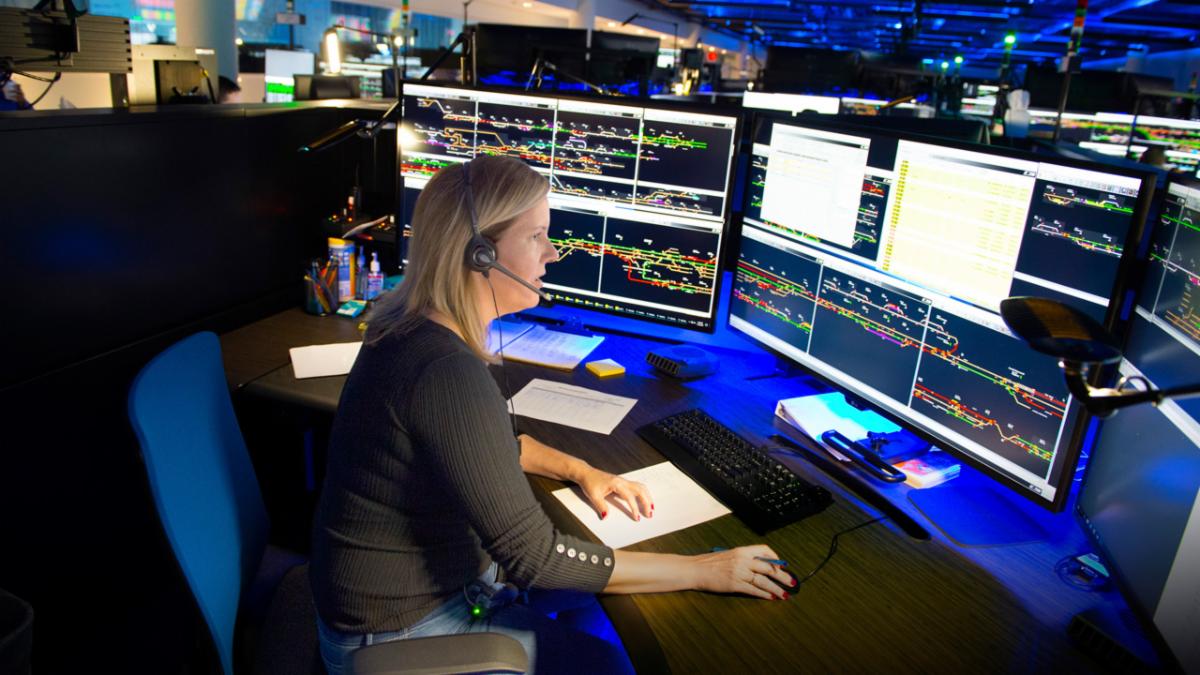
WASHINGTON — A Federal Railroad Administration-sponsored study on the use of locomotive cab automation systems found human errors occurred in three of 10 sessions in a locomotive simulator, and recommends further training on the systems for engineers, conductors and dispatchers.
The study covered the use of Trip Optimizer, the cruise-control-like system for locomotives, and positive train control. The 10 sessions at the FRA’s Cab Technology Integration Laboratory included one in which operators overlooked a Trip Optimizer request for track information and failed to notice when the system switched to manual mode; a failure to stop before a grade crossing; and speed restriction violations, one of which could be classified as major.
Along with additional training, the research team recommends strategies including additional methods to check that data has been properly entered in the systems, adding technology that can detect on-track maintenance personnel or equipment; allowing conductors to make programming changes; encouraging engineers and conductors to review information prior to starting a trip; and duplicating PTC and Trip Optimizer displays at the conductor’s workstation.
Among items the report recommends for further study are the lack of a noticeable overspeed indication when Trip Optimizer is in manual mode, and PTC switching off without the engineer or conductor being aware.
|
|
(Editor's Note: Alan Fisher does a good job explaining how the rail industry is being destroyed by Wall Street, PSR and all the rest. More reasons for the Class Ones to be taken into public ownership, control and operation with worker oversight.) |
|
The Four Companies that Make Freight Shipping Worse in the US |
|
(Editor's Note: Check out the numbers below. All told, unions representing 20,300 have ratified to date. With the BMWED vote Monday and the Machinists (IAM) last month, unions representing well over 30,000 have voted against the TA. This proposed contract is obviously NOT popular.)
|
|
ATDA Members Ratify Freight Rail Agreement |
|
The National Carriers’ Conference Committee (NCCC), which represents most U.S. Class I railroads (and many smaller ones) in national collective bargaining, reported on Oct. 4 that the American Train Dispatchers Association (ATDA) membership has ratified the tentative labor agreement.
ATDA is the fourth union to ratify the agreement resolving the current national bargaining round. Tentative agreements with eight other labor organizations remain subject to ratification. The ratification process will continue into at least mid-November, with all 12 unions agreeing to maintain the status quo until all union ratification votes are completed, no matter if any fail to ratify.
The tentative agreement implemented Presidential Emergency Board (PEB) 250 recommendations, which include a 24% general compounded wage increase during the five-year period from 2020 to 2024 and an annual $1,000 service recognition bonus.
|
|
(Editor's Note: Criticism of the U.S. railroad operations is growing by leaps and bounds. Here is a recent piece in the New York Times that is being widely circulated.) |
|
Mismanagement and 'Monster Trains' Have Wrecked American Rail |
|
The United States averted a national freight rail strike a few weeks ago, when the Biden administration stepped in to broker a deal between rail companies and their union employees. Rail workers have not yet ratified that agreement, and a strike is still on the table. According to a railway trade group, a shutdown could cost the economy more than $2 billion a day. Among the disasters that could ensue, power plants would lack the coal needed to produce electricity and water treatment plants would lack the chemicals needed to provide clean water. If the companies don’t come to an agreement with rail workers, eventually, grocery shelves would go empty.
Rail workers’ demands are not outrageous — union members have little to no predictability in their schedules and are subjected to draconian attendance policies. But the current standoff is about more, and is the result of a deliberate, half-century-long conversion of the nation’s rail system from a network that could deliver many kinds of goods to market (while also hosting hundreds of passenger train lines), to a fleet of land barges that are good for coal and containers — not much else.
After World War II, railroad companies ceded freight including mail and perishables to semi trucks and instead favored goods like newsprint, chemicals and steel coils, which could sit in rail yards for days. Many freight companies made this change enthusiastically; trucking’s rise gave them a strong reason to stop servicing goods that were financial and logistical pains to ship. So long to the rail cars full of livestock.
Despite shifting to nonperishable goods, railroads did not stay profitable. By 1976, several railroad companies had gone bankrupt, threatening to collapse rail shipping along with them. Sensing disaster, Congress stepped in to create Conrail, a mostly government-owned company to keep service functional in the Northeast and Midwest. Its executives saw austerity as the way to profitability. Conrail cut costs everywhere it could, abandoning redundant tracks. It took a while, but it worked. The
company was making strong profits by the ’80s and was re-privatized in 1987. Conrail may have begun by trimming excesses, but soon railroads across the industry would take those lessons in cost-cutting to an extreme. In pursuit of efficiency, railroad companies across the entire industry adopted the theory of precision scheduled railroading (P.S.R.), developed by the railroad executive E. Hunter Harrison in the 1990s.
Before P.S.R., freight shipping meant rail cars full of goods typically crossed the country on multiple trains, getting dropped off and picked up in yards and terminals in a time-consuming process. Harrison, seeing idle train cars and sitting inventory as waste, envisioned a system of shipping freight directly to its destination with consistent schedules for crew and customers. Goods, in theory, could arrive just in time for our lean supply chains.
If only it worked out. Alas, the actual implementation of P.S.R. led neither to precision nor scheduling nor railroading. When companies implemented P.S.R., they also adopted new technology that allowed for locomotive engines to be placed along the length of a train. Now, instead of engines pulling the train from the front, additional engines in the middle and the back help move even more train cars. Average train length grew around 25 percent from 2008 to 2017, and companies now regularly run trains that are three miles long.
|
|
(Editor's Note: There appears to be no end in sight. The bleeding continues. The Class One railroads cannot do the job. What? They are making record profits this quarter?) |
|
U.S. Rail Volumes Fell 3% in September |
|
U.S. railroads hauled 1,939,894 carloads, containers and trailers in September, a 3.1% decrease compared with volumes in September 2021, according to the Association of American Railroads.
The railroads logged 928,590 carloads and 1,011,304 intermodal units last month, down 1.1% and 4.8% respectively, compared to a year ago.
Six of the 20 carload commodity categories tracked by the AAR each month posted carload gains compared with September 2021. They included crushed stone, sand and gravel, up 11.2%; motor vehicles and parts, up 18%; and coal, up 1.8%.
Commodity categories that logged decreases included primary metal products, down 16.6%; all other carloads, down 21%; and grain, down 5%.
In September, intermodal slowed as consumers continued to change consumption trends toward services and away from goods, said AAR Senior Vice President John Gray in a press release.
|
|
WEBINAR: Investing in America's Rail Future
|
|
Investing in America's Future featuring Jennifer Mitchell, Deputy Administrator of the Federal Railroad Administration. Presented by Virginians for High Speed Rail and proudly supported by WSP, Siemens, and JBG Smith |
|
7 Takeaways from STB’s Hearing on Proposed CP-KCS Merger |
|
Last week’s public hearing before the Surface Transportation Board on the proposed merger of Canadian Pacific and Kansas City Southern consisted of three days of testimony spanning over 25 hours on why or why not the merger should proceed.
And the hearing isn’t over yet. Shippers and other stakeholders provided oral testimonies to STB on Monday and Tuesday, while CP (NYSE: CP) is expected to respond to them during a hearing Thursday.
Shareholders of CP and KCS approved the $31 billion merger in December and the deal is now before STB for review. CP has said it hopes for the agency’s approval by early 2023. CP and KCS maintain the merger would create a single rail system known as Canadian Pacific Kansas City, or CPKC, whose network would extend from Canada into the U.S. and Mexico.
Here are seven takeaways from last week’s hearing, which focused mostly on the Class I railroads’ responses to the proposed merger:
1. Transcontinental railroad supports future manufacturing and export needs, CP says
CP and KCS justify the merger as a reflection of current and future North American manufacturing trends. For instance, vehicle parts can be made in the U.S. and Canada, automobile sections can be assembled in Mexico and finished vehicles can go to dealerships throughout North America or ports for export.
A railroad connecting Canada, the U.S. and Mexico would facilitate that manufacturing process as well as give companies increased access to new geographical markets and provide more port options for exporting goods, CPS and KCS have argued.
|
|
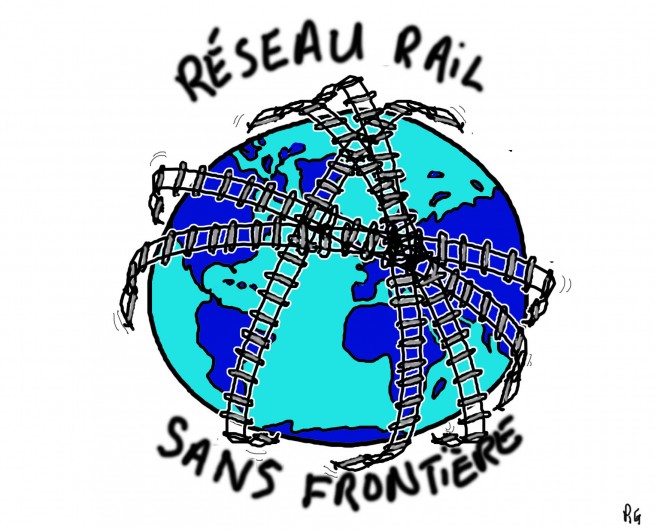
(Editor's Note: This brief synopsis is From the multinational group, our friends at "Rails without Borders.") |
|
Railway Workers are Struggling, All Over the World! |
|
Historic strike movement of railway workers in Great Britain since this summer, threat of strike still relevant in the United States, participation of railway workers in the national strike in France on September 29 after the strike of July 6, strike in the rail sector in Belgium on October 5, preparation of railway workers for the general strike of December 2 in Italy... Railway workers are struggling, all over the world!
The International Trade Union Network of Solidarity and Struggles, and the Rail Without Borders Network, reaffirm their support for railway workers who, on all continents, are fighting for the defence of their working conditions, the increase of wages, the defence and improvement of the public rail service.
We salute our fellow railway unionists from Ukraine engaged in the Popular Resistance to the invasion of Russian troops and the defense of their rights, as well as the railway workers of Russia and Belarus who, under very dangerous conditions, are taking part in the movements of disobedience to the war unleashed by the Putin regime.
The same goes for the Burmese comrades who are very present in the movement against the military coup and victims of fierce repression.
The International Trade Union Network of Solidarity and Struggles and the Rail Without Borders Network call for strengthening the protest movements decided by railway workers, in particular by circulating information on all these struggles, with a view to coordinated actions against the employers of the sector who exploit the employees and against the governments that destroy the public rail service.
|
|
NS Derailment Blocks Line in Ohio, Leads to Amtrak Detour
|
|
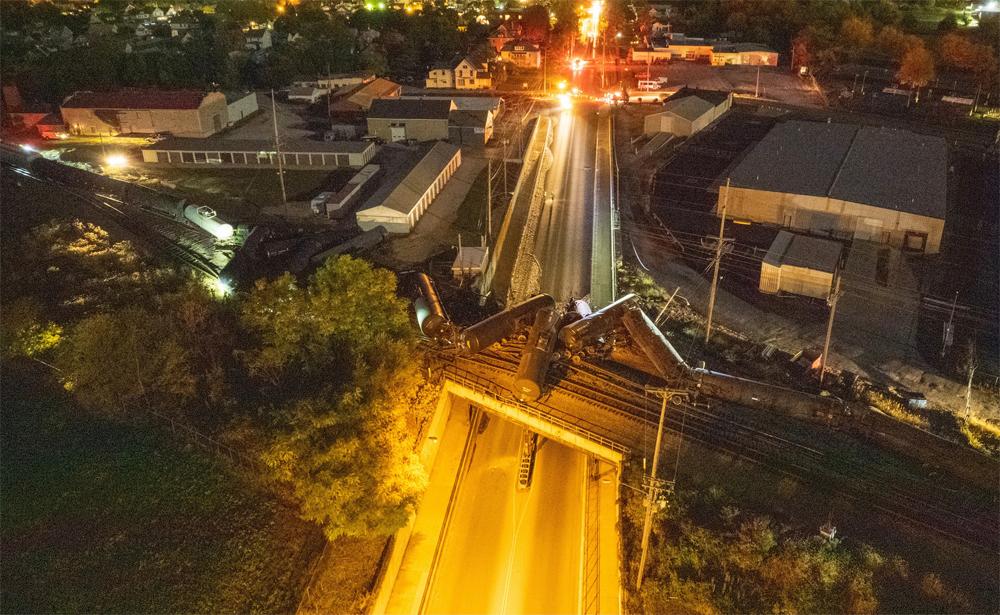
SANDUSKY, Ohio — Ten cars of a Norfolk Southern train derailed on a bridge over a street underpass in Sandusky on Saturday, sending tank cars and debris onto the street below and blocking a line used by Amtrak as well as NS trains.
WTOL-TV reports the derailment occurred about 4 p.m., closing Columbus Avenue. The station was told by an NS spokesman that the derailed cars were carrying paraffin wax, some of which spilled but posed no hazardous-material threat.
No injuries were reported. The derailment knocked down a power pole, interrupting electrical service to about 1,300 utility customers.
Amtrak announced on its Amtrak Alerts Twitter feed on Saturday evening that the Capitol Limited and Lake Shore Limited would be detoured between Elyria, Ohio, and Toledo on Sunday morning, bypassing their scheduled stops in Sandusky.
|
|
BNSF Derailment in Montana Leads to Gasoline Spill |
|
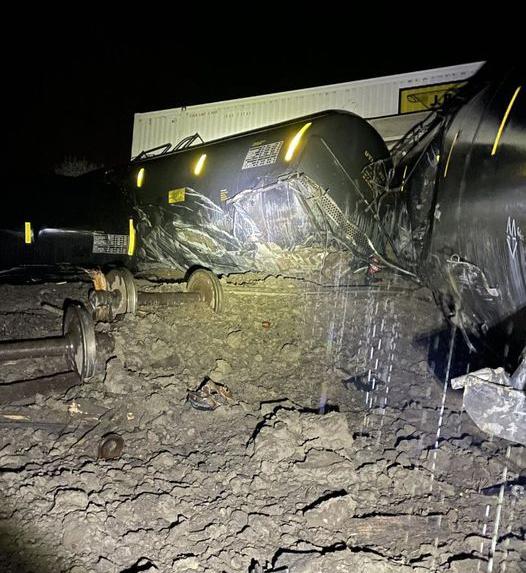
BRIDGER, Mont. — Residents near Bridger, Mont., were issued an evacuation warning late Friday night after a BNSF derailment that spilled about 31,000 gallons of gasoline, KTVQ-TV reports.
Fifteen cars were reported to have derailed in the accident at about 11:30 p.m. about a half-mile east of Bridger. No injuries were reported. In addition to gasoline, cars involved were reported to be carrying sorghum, animal fat, coal, and other products.
The Billings Gazette reports one 30,000-gallon tank car spilled all of its contents, while about 1,000 gallons leaked from a second tank. BNSF spokesman Ben Wilemon told the paper the rail line would likely reopen this afternoon (Sunday, Oct. 2)
|
|
|
|
|
|
|