|
|
|
POLICY & ADVOCACY UPDATE
Issue #28, 5 September 2024
| | | |
- STRA Bill introduced into Victorian Parliament
- New AA CEO meets with JSA Commissioner
- First international airline commits to WSI
- Hospitality employment growth strongest in restaurants
- Overseas arrivals year to June 2024
- Backlash to government's action to reduce student numbers
- Business WHS survey
| |
STRA Bill introduced into Victorian Parliament
The Bill to enact the 7.5% Short Term Rental Accommodation (STRA) levy in Victoria was introduced into Parliament last week. The Bill affirmed the government's decision to not extend the levy to commercial accommodation as a result of strong advocacy last year by the AHA/AA. All short stays in properties such as houses, apartments, cabins and granny flats, other than those defined as commercial residential premises, will be liable for the levy. Transitional arrangements cover all bookings made prior to 1 January 2025 which will not be liable for the levy, even if the stay ends on or after that date. Also exempted from the levy will be accommodation attached to aged care. schools and universities as well as premises occupied as the principal place of residence of the owner or renter of the premises, such as if a room made available for short stays or the owner makes the principal residence available while they are away.
The definition of "commercial residential premises" is critical to understanding if the levy applies, and in this regard, the Victorian Government has used the definition that the ATO uses for GST purposes (and the Vic Government uses for land tax), as there are specific rulings that aid in understanding the definition. See this State Revenue page for more information on how a hotel, motel, hostel and boarding house has been defined. Many serviced apartments will also be exempted if they are managed in a similar way to a hotel. However, according to a relevant tax ruling on the definition, some apartments which are owned by separate individuals, even if managed by an on-site agent, may not be exempted.
In most cases the levy will be payable by providers of booking platforms. A booking platform is defined as a person who carries on a business that facilitates and accepts bookings for short stays, regardless of whether the platform facilitates payment. This embraces real estate agents as well as web platforms such as AirBNB and Stayz. The platform provider is responsible for paying the levy to the extent of any stays booked through them. Owners and renters are responsible for paying the levy in respect of any direct bookings – that is, bookings they arrange themselves without the use of a booking platform.
The Victorian government also announced that councils will have greater powers to ban STRA in their jurisdiction, or to cap the number of days that the property can be offered for STRA. If councils take up this opportunity, international evidence and our own policy summary indicates it will have a much higher impact on the number of listings than the levy as it will change the business case for the property owner. This will be of significant benefit including improving the availability of rental accommodation for hospitality staff working in high tourist regions.
| | |
|
New AA CEO meets with JSA Commissioner
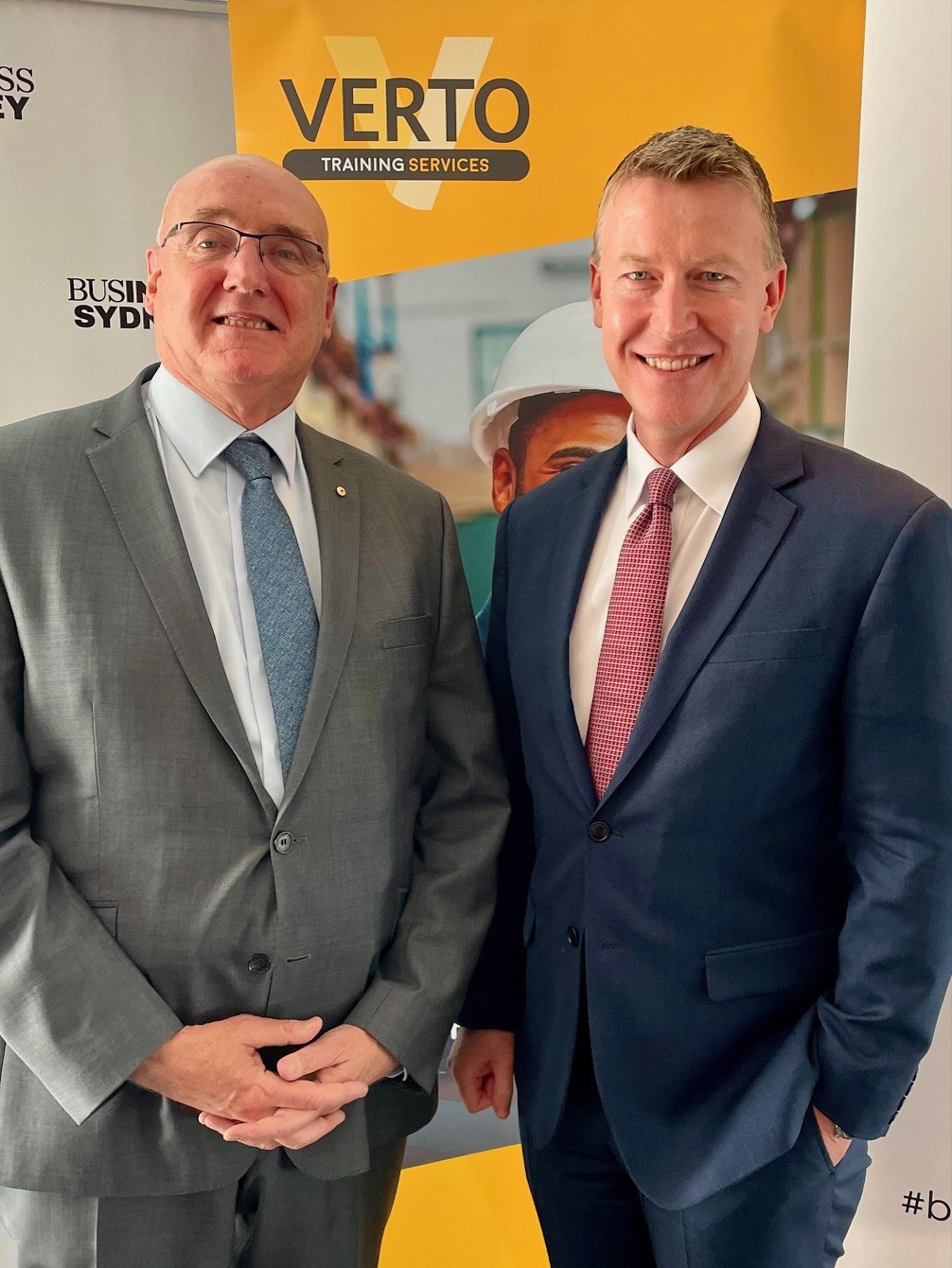
In this his first week as CEO of Accommodation Australia, James Goodwin met in Sydney with the Commissioner for Jobs & Skills Australia (JSA), Professor Barney Glover (pictured left with James), as well as with other association CEOs who are members of the Australian Chamber of Commerce and Industry. JSA provides labour market analysis and advice to government on workforce issues, including migration and training. The body is particularly relevant to the accommodation sector at present as it is providing advice on the Core Skills List which will control access to the sponsorship of temporary skilled migrants. Over the last 12 months, AA has met with JSA a number of times and made a submission regarding the Draft Core Skills List in May 2024. James took the opportunity at the meeting to raise our concerns about the list, about which JSA has submitted its advice in the last few weeks. The industry will continue to engage with Government on the migration settings and is scheduled to meet with the office of the new Home Affairs minister, Tony Bourke, next week in Canberra.
| |
|
|
First international airline commits to WSI
Last week saw an announcement from Singapore Airlines that they will operate from Western Sydney International Airport (WSI) when the new 24/7 airport opens in just over two years' time. The new commercial arrangement allows Singapore Airlines to begin developing its future operations at WSI. 80% of the airport's construction is now complete. Meanwhile at Sydney's Kingsford Smith Airport, the Minister for Infrastructure, Transport, Regional Development and Local Government, Catherine King, announced last week that the Government is protecting Rex's regional New South Wales slots at Sydney Airport to support it through the administration process. The Slot Manager at Sydney Airport has been directed to suspend the application of the 'use it or lose it' test on Rex's regional NSW slot holdings for the current and upcoming scheduling season. This test stipulates that airlines must use 80 per cent of their allocated slots or risk losing them. Its suspension will protect Rex's NSW regional slots at Sydney Airport until late March 2026.
| |
Hospitality employment growth strongest in restaurants and cafes
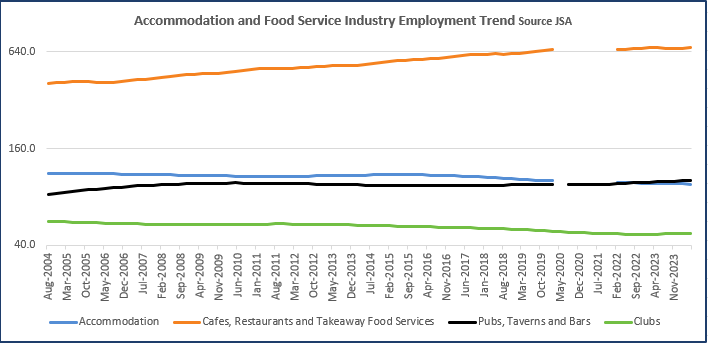
Last week Jobs & Skills Australia released new trend employment data for industries and occupations. This data reviews long term trends by taking out the seasonal and short-term influences, with the exception that the dramatic influence of COVID could not provide useful trend data for that period of time in accommodation as well as in cafes and restaurants. The below trend data for the Accommodation and Foodservice (AFS) industry for the last 20 years shows that the major growth in employment for AFS has been in the Cafes, Restaurants & Take away food service sector, where employment has increased by 66% from 407,700 in August 2004 to 677.800 in May 2024. Jobs in pubs and taverns have also strongly increased from 83,000 to 101,600, a rise of 22%. Jobs in the accommodation and club sectors have actually fallen, with 112,600 jobs in accommodation in August 2004, compared to 96,400 in May 2024, and club job numbers down from 56,500 to 47,600. As mentioned in many AA submissions, the decline in employment in our sector, even in the face of a substantial increase in hotel numbers and turnover, could be due to productivity improvement but most likely in large part is due to outsourcing of functions such as housekeeping. Those jobs would be counted in another industry sector that covers cleaning services.
| |
Overseas arrivals year to June 2024
In June 2024, according to the ABS, short-term visitor arrivals were 587,760, an increase of 8.4% on one year earlier, but still less than the 660,340 arrivals in June 2019. In the 12 months to June 2024, there were 7.97 million short term visitor arrivals, up by 36% on 2022/23 but still well down on the 9.3 million arrivals in the year to June 2019. The government's action to reduce international student numbers continues to have a detrimental impact. In June 2024 there were 39,230 international student arrivals to Australia, a decrease of 11,390 students compared with the corresponding month of the previous year. The number of student arrivals in June 2024 was also 14.8% lower than the pre-COVID levels in June 2019. As at 30 June 2024, Home Affairs reports that there were over 608,000 student visa holders in Australia and over 173,000 WHM visa holders (a 26.1% increase on WHM from the same period last year).
| |
|
Backlash to government's action to reduce student numbers
Given the importance of international students to our sector's workforce, AA has been raising concerns with migration and education minister that the combined effect of the actions to reduce international student numbers will not only harm our industry, but the economy generally. Last week, the Federal Education Minister announced that - subject to the bill passing - the overall number of international students starting a course next year will be set at 270,000. This includes higher education courses and vocational education and training courses. And what this means is, next year, that there will be about the same number of international students starting a course here as there were before the pandemic. There will be more in our universities and there will be fewer in our private vocational providers. The level that we're set for universities is about 15 per cent higher than it was before the pandemic. And the level for private vocational providers will be about 20 per cent less. For universities all up, it means they'll be able to enrol about as many international students next year as they did last year, 2023. Almost every regional university will be able to enrol more international students next year than they did last year.
In response, this week, the Victorian Minister for Economic Growth Tim Pallas called on the Commonwealth to reconsider its planned reforms which he said could deliver unintended consequences to the economy and jobs. Victoria holds 30 per cent of the national market share of international student enrolments and as the State's largest export, international students generated $14.8 billion in export revenue in 2023, supporting around 63,000 local jobs. Understandably, most of the larger capital city universities have been raising serious concerns, while the smaller regional universities are considering that actions such as caps on numbers will work in their favour. There is much still to play out on this issue, but given housing shortages and migration numbers are politically sensitive issues, and that the Coalition's policy is even more detrimental to student numbers, these actions will be difficult to reverse.
| |
|
Business WHS Survey
As a member of ACCI, Accommodation Australia is occasionally asked to encourage members to participate in national business surveys on important issues. Currently ACCI is conducting a survey on Work Health and Safety, and given WHS is a major issue for our industry, we encourage you to participate. The survey starts off asking questions of the owner/manager about your own health and then broadens. Information on and a link to the survey is below.
Business feedback is needed on how changes to Work Health and Safety may impact you and your business.
2024 has been another significant year of change for Work Health and Safety (WHS). There has been:
- New legislation on silica and a prohibition on engineered stone
- State-based psychosocial regulations and Codes of Practice
- New Incident Notification provisions around incapacity periods, falls, medical treatment, sexual harassment and violence
- Lowering exposure standards for silica, diesel, welding fumes and other chemicals
-
Discussions on regulating the gig economy and changes to work trends
Your views and responses are important in assisting ACCI and our efforts to collate data and information that shows what you think and want, which in turn helps us to better stand up for your interests when talking with policy makers, regulators and ministers.
We hope you will be able to assist by taking the survey here. It is anonymous and the survey takes approximately 13 minutes to complete.
The survey closes Wednesday 18th September 2024. We thank you in advance for your participation!
| |
|
Drop me an email at policy@accommodationaustralia.org or give me a call on 0418 277 919 if you have any national policy issue that you think AA should be following up. If you know an AA member who is not receiving this advocacy report but wants to, then encourage them to email me and we can add them to the distribution list.
Kind Regards
Jenny Lambert OAM
National Policy & Research Advisor
Accommodation Australia
| | | | |