January 2025

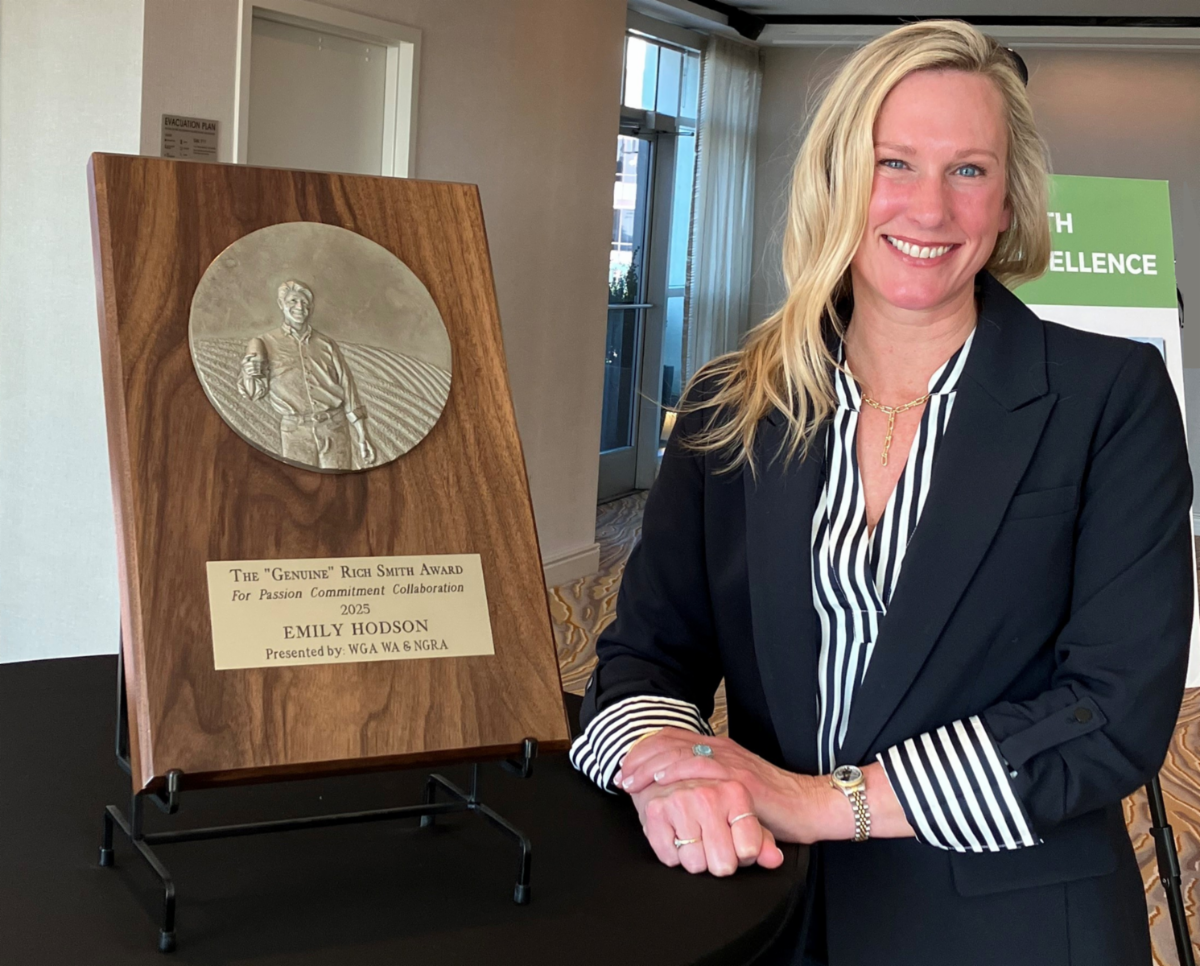
Virginia winemaker Emily Hodson with her well-deserved Rich Smith Award.*

EMILY HODSON WINS THE RICH SMITH AWARD

The ninth annual Rich Smith Award of Excellence for outstanding contributions to the American grape and wine industry was this week presented to Emily Hodson, head winemaker at Veritas Vineyards and Winery, a co-owner of Flying Fox Vineyards and Winery and an active industry leader, including representing the Virginia Wine Board on NGRA’s Board of Directors and serving as our newly elected Vice Chair.


The Rich Smith Award is the highest honor bestowed by NGRA, WineAmerica and Winegrape Growers of America—three organizations that Rich Smith helped to establish prior to his passing in December 2015. Together, we partner with the Smith Family (proprietors of NGRA member-organization Valley Farm Management) to annually confer the prestigious award on an industry member whose spirit and accomplishments reflect the passion, commitment and collaboration Rich was known for. And like Rich, this year’s honoree is writing her legacy in real time, right before our eyes.


Emily learned the art of winemaking from her father, patriarch of Veritas Vineyards, and the science from Virginia Tech, under the guidance of Bruce Zoecklein. Her top-rated wines have helped to put Virginia on the map as a serious wine region.


Emily also was part of the creation of the Virginia Winemakers Research Exchange, which gives local winemakers access to regional production-scale research facilities where they can conduct their own research under the guidance of a research enologist. It has undoubtedly led to accolades for Virginia wine like Wine Enthusiast Magazine’s Wine Region of the Year for Charlottesville, VA, and the Monticello AVA in 2023.


Emily led the charge, starting in 2021 (with her colleague Ben Jordan), to execute the Virginia Wine Board’s vision to develop winegrape varieties that are resistant to downy mildew. She continues to be a key industry advisor on the $1 million program, conducted in partnership with USDA’s Agricultural Research Service, to take Virginia into a more sustainable future.


We are so proud to work with Emily, a rare leader who actively leverages science as a means to advance the industry. We’re in awe of all that she’s accomplished and can’t wait to see what her ambitious future has in store—not only for her own businesses, state and region, but for all of us in the grape and wine industry.

Donnell Brown

President

*“Emily's love of science, her drive and passion for the Virginia wine industry are at the core of what Rich Smith did throughout his career,” said Rich’s son Jason, conferring the award on January 29 in Sacramento. Read the press release.


AROUND THE INDUSTRY

New NGRA Extension Directory is Live!

Check it out! The NGRA website, graperesearch.org, received a light redesign this winter. Our homepage now highlights ongoingly updated content, like this newsletter, and provides quick links to find an event, become an NGRA member and give to grape research.


But the big news is the addition of a new directory of viticulture and enology extension specialists to our website’s functionality. Looking for expert guidance on grape research? Use our new directory to search for an extension educator who can provide the support and insights you need. Huge thanks to Board members Stephanie Bolton (Lodi Winegrape Commission) and Keith Striegler (GALLO), and academic partners Michelle Moyer (Washington State University) and Hans Walter-Peterson (Cornell University), who collaborated to create this comprehensive, current compendium of extension personnel from all across the country.

New Alcohol-and-Health News

The debate rages on about the health impacts of alcohol consumption. This month, the Interagency Coordinating Committee on the Prevention of Underage Drinking (ICCPUD), part of the US Department of Health and Human Services (HHS), released its controversial report, titled “Scientific Findings of the Alcohol Intake & Health Study.” It was commissioned to help the HHS re-evaluate the Dietary Guidelines for Americans, but it conflicts with the review by the National Academies of Sciences, Engineering and Medicine, commissioned for the same purpose.


“The risk of dying from alcohol use begins at low levels of average use... Higher levels of alcohol consumption are linked with progressively higher mortality risk,” the ICCPUD report says. Seven servings of alcohol a week raises the risk of dying to 1 in 1,000, for both men and women. “This risk increases to 1 in 100 if they consume more than nine drinks per week.”


On the heels of the ICCPUD’s findings, the US Surgeon General Dr. Vivek Murthy released an advisory outlining the “direct link between alcohol consumption and increased cancer risk.” He says, “Alcohol is a well-established, preventable cause of cancer responsible for about 100,000 cases of cancer and 20,000 cancer deaths annually in the United States…yet the majority of Americans are unaware of this risk.” His advisory lays out steps to “increase awareness of alcohol’s cancer risk and minimize harm, including requiring a health warning label on alcohol-containing beverages to include cancer risk.

NIFA Funding Opportunities Under Review

In a notice posted on January 23, 2025, on the website of the USDA’s National Institute of Food and Agriculture, the agency announced that “all NIFA Requests for Applications are currently under review.” All grant programs that NIFA administers, including the critically important Specialty Crop Research Initiative (SCRI) and NIFA’s flagship Agriculture and Food Research Initiative (AFRI), are on hold. The notice advises interested parties to “check back for updates or subscribe to NIFA Funding Opportunities for email updates as they happen.”

New Research Priorities Chart the Path for Grapevine Health

A groundbreaking report from the National Academies of Sciences, Engineering and Medicine, “Advancing Vineyard Health: Insights and Innovations for Combatting Grapevine Red Blotch and Leafroll Diseases,” outlines key research priorities to curb the spread of grapevine red blotch and grapevine leaf roll diseases and mitigate their economic impact. Funded by the California Department of Food and Agriculture Pierce’s Disease/Glassy-Winged Sharpshooter Board, the independent report provides a roadmap for future research and action, offering 88 key conclusions and 64 actionable recommendations, focusing on high-priority research to close knowledge gaps and pursue the most promising management solutions. The PD/GWSS Board will use the recommendations in funding decisions for new research and outreach proposals.

Rest in Peace, Anita Oberholster

Anita Oberholster, Professor of Cooperative Extension in Enology in the UC Davis Department of Viticulture and Enology, passed away on January 11, 2025, after a long and courageous battle with cancer. Although she was only 50, Anita leaves a legacy of service to the wine industry and a model of teaching and Extension excellence. In lieu of flowers, donations in her memory may be made to the UC Davis Comprehensive Cancer Center Research Fund or the university’s Anita Oberholster Memorial Fund. Read tributes to Anita from the Department of Viticulture and Enology and Robert Mondavi Institute. The department will host a celebration of life on May 12, 2025.

Allison Jordan Is One of Wine’s Most Inspiring People

Allison Jordan, executive director of the California Sustainable Winegrowing Alliance and Wine Institute’s vice president of environmental affairs, was included this month in the Wine Industry Network roundup of Wine’s Most Inspiring People 2025. The honor recognizes her as a “Collaborative Leader Driving Wine Sustainability” in California’s wine industry. CSWA summarized the announcement, “From turning her master’s thesis into (our) certification program to leading international conversations on climate resilience, her collaborative approach is shaping the future of sustainable winegrowing.” We feel very lucky that Allison serves as chair of NGRA Natural Resources and Environment Research Theme Committee and is a member of our Board of Directors.

Randy and Jenny Heinzen Named ‘Persons of the Year’

The Paso Robles Wine Country Alliance (PRWCA) this month named Randy and Jenny Heinzen as 2024 Paso Robles Wine Industry Persons of the Year. The couple own Vineyard Professional Services, an NGRA member-organization, and Vineyard Professional Real Estate. “Vineyard Professional Services has transformed vineyard management practices across the Paso Robles AVA,” the award announcement says. “Randy has championed sustainable farming and technological innovation while serving on multiple state and national viticultural research boards.” Indeed, we’re proud to note that Randy is a member of NGRA’s Board of Directors.

Hans Walter-Peterson Is ASEV’s Technical Program Director

The American Society for Enology and Viticulture (ASEV) has appointed Hans Walter-Peterson as its Technical Program Director. Hans is senior extension associate for Cornell Cooperative Extension, responsible for viticulture extension in New York’s Finger Lakes region. In this new volunteer role, he’ll provide leadership for ASEV’s Technical Program Committee, which develops and oversees the organization’s symposia, workshops, seminars, and sessions for the National Conference or other conferences.


Hans says, “In addition to providing our members with access to the latest research, I want ASEV to be an organization that provides professional development opportunities for its members, particularly in extension and outreach. In recent years, I have worked with the National Viticulture and Enology Extension Community (NVEELC) [which NGRA has long supported], on ways to strengthen viticulture and enology extension specialists’ careers and skill sets. This would not only benefit ASEV extension members but the industry as a whole.”

USDA-ARS Hires a New Smoke Researcher

The USDA’s Agricultural Research Service Crops Pathology and Genetics Research Unit in Davis, CA, has hired a new Food Technologist, Torey Arvik, who will be focusing his research program on mitigating impacts of smoke exposure on grape and wine composition. Torey will be working with Research Chemist Arran Rumbaugh, who also focuses on smoke impacts, and together they’ll collaborate with several university researchers and ARS scientists to enhance impactful research for the grape and wine industry.

UC Davis Welcomes a New Wine Chemist

Liang Chen is the new Assistant Professor of Wine Chemistry in the Department of Viticulture and Enology at UC Davis. Hired in November 2024, his CV includes a PhD in wine chemistry from the University of Adelaide in Australia, postdoctoral studies at Institut des Sciences de la Vigne et du Vin (ISVV) at the University of Bordeaux in France. He also has been a research scientist at GALLO and contributed to the chemical analysis of wines that spent more than one year on board the International Space Station.

New Talent at Texas A&M

The Department of Horticultural Sciences at Texas A&M University this month announced the addition of four new members to its Viticulture & Enology Team:


  • Grape breeding and genetics: Andrej Svyantek, the new Horticultural Crop Breeder, leads the university’s new grape breeding program, created to deliver disease-resistant, climate-resilient cultivars to the Texas grape and wine industry.
  • Grape and wine secondary metabolism: Ahmed Darwish is Assistant Professor of Horticultural Secondary Metabolism, focusing on understanding natural biochemical diversity and regulatory roles in grape secondary metabolism, including aroma and flavors, phenolic and flavonoid compounds.
  • Grapevine physiology: Lorenzo Rossi is Assistant Professor of Horticultural Crop Physiology. His work will focus on advancing grape production across Texas, with an emphasis on root and soil health, vine physiology, and sustainable practices tailored to the unique challenges of Texas horticulture.
  • Viticulture extension: Cristin Kasprzak is the new Viticulture Program Specialist for the High Plains and West Texas, which is home to the majority of the state’s commercial winegrape production.

UC Davis Seeks an Assistant Professor of Applied Viticulture 

The Department of Viticulture & Enology in the College of Agricultural and Environmental Sciences at UC Davis is recruiting an Assistant Professor with an emphasis in applied viticulture. This tenure-track Assistant Professor position has a majority appointment in the UC Agricultural Experiment Station at the Oakville Experimental Station in Napa Valley. The appointee will develop an externally funded viticulture research program to address the critical challenges facing the California winegrape industry. Learn more and apply by March 15, 2025.


RESEARCH FOCUS

What a Century-Old Grapevine Reveals about Pierce’s Disease

By Kara Manke, UC Berkeley

A century-old grapevine cutting is providing new clues into the history of Pierce’s disease. Turns out, it’s been around a lot longer and has more genetic variation than was previously believed.


First reported in Anaheim, CA, in the 1880s, Pierce’s disease has since been found in grapevine in much of California and other parts of the US, and more recently, Europe. Triggered by the bacterium Xylella fastidiosa, the disease clogs the xylem that transport water and nutrients throughout the plant. Starved of nourishment, the vine’s grapes shrivel, its leaves turn brown and drop, and eventually the plant dies. Before it was studied, PD nearly decimated whole grape-growing regions in California and Texas, and continues to cost hundreds of millions of dollars to control. There remains no cure.


In a new study, researchers at UC Berkeley and the French agricultural research organization CIRAD identified a 120-year-old grapevine cutting from the UC Davis Center for Plant Diversity that contained traces of X. fastidiosa DNA from the early 1900s. By comparing the genome of this century-old X. fastidiosa strain with the genomes of more than 330 contemporary strains, the team was able to reconstruct the history of how the pathogen first arrived in California and later spread throughout the state.


Scientists had long assumed that X. fastidiosa was first introduced to California around 1880, when many species of grapes were brought from the east to establish vineyards. At the time, local newspapers started reporting a mysterious new disease that was affecting vineyards in Anaheim and the Santa Ana Valley. However, the genomic data suggests that the pathogen actually arrived in the US nearly 150 years earlier, around 1740, and came from Central America. The data further suggests that the disease arose in California from not one but at least three separate introductions of the pathogen.


“Even though this occurred over 250 years ago, it’s still relevant to understanding the global spread of plant pathogens today,” said Monica Donegan, a graduate student at UC Berkeley and co-first author of the study. “We found that the simplest assumptions about the routes and timing of pathogen introduction may be deceiving, which can impact things like international trade policies and quarantines for plant pathogens.”


The fact that there were likely three separate introductions of X. fastidiosa also suggests that multiple, genetically distinct pathogen populations of the pathogen may exist in California. Like different variants of SARS-CoV-2, these populations may all cause similar symptoms, but respond differently to stressors like climate change. ”These biological differences, even if they’re small, can be meaningful when it comes to disease management,” said study senior author Rodrigo Almeida, Professor and Hildebrand-Laumeister Chair in Plant Pathology at UC Berkeley.


The grapevine cutting that the team studied was collected by an individual named Alfred Tournier on August 2, 1906, in Modesto, CA, and labeled “Anaheim disease,” the original name for Pierce’s disease. It is among some 1,100 historic grapevine specimens in the UC Davis herbarium’s collection—a proverbial needle in a haystack. Using genome sequencing and bioinformatics, “the sample allowed us to calibrate the mutation rate of the pathogen as it evolved in California over the last hundred years (and) reconstruct the chronological history of the disease outbreak,” said co-first author Alexandra Kahn, a postdoctoral scholar at UC Berkeley.


In recent decades, X. fastidiosa has spread from the US and Latin America to other countries, including Portugal, Spain, Italy, Israel and Taiwan. Knowing the evolutionary rate of the pathogen can also help researchers estimate the timing of these introductions and prevent further spread.


“It was only recently that people realized they could use these historic herbarium specimens to study plant pathogens,” Dr. Almeida said. “I think this highlights the value of herbarium collections for research. There’s a lot of pressure on these collections because we can’t support them adequately, but they provide a huge value, and you never know how we may benefit from them in the future.”


This story is excerpted from the original post on Phys.org, “What a Century-Old Grapevine Reveals about a Disease That Plagues Wine Country,” December 16, 2024. More detailed findings appear in the team’s journal article, “Century-Old Herbarium Specimen Provides Insights into Pierce’s Disease of Grapevines Emergence in the Americas,” published in Current Biology this month.

Applying for a grant? Request a letter of support!

NGRA is pleased to provide letters of support for research projects that directly address our industry research priorities. Request a letter via our online request form at least two weeks prior to the grant deadline (or any internal deadline you may have). Requests are reviewed and approved by NGRA Research Committee leadership, so processing times may vary.


IN THE NEWS

Grapevine Capacity for Change

January 23, 2025 | HiRes Vineyard Nutrition Podcast

At the end of the growing season, it’s not just grapes that are harvested from vineyards—it’s their nutrients, too. For wine grapes, “we typically take out 20 to 60 pounds per acre of potassium just with the fruit that we’re harvesting,” WSU’s Markus Keller says in this podcast of the HiRes Vineyard Nutrition project he has led for the last four years, discussing the findings of the nutrition-focused field trials. For juice grapes, it can range up to 100 to 150 pounds per acre, he adds. Plus, “we can lose between 5 to 10 pounds of magnesium in the leaves at the end of the season, and that’s substantial.” Tune in as he discusses these and other surprising learnings from the project.


WSU Researchers Find While Adsorptive Sprays Can Help Mitigate Smoke Compounds, Rinsing Them Off After is Key

January 23, 2025 | Wine Business Monthly

In smoke exposure field trials, Washington State University researchers found that kaolin and bentonite barrier sprays can effectively absorb the smoke compounds emitted during wildfires. But they must be rinsed off once the smoke clears lest the smoke impact is made worse. Plus, they discovered that gene expression changes within the first two hours that vines are exposed to smoke.


Anti-Hail Shading Net and Kaolin Application: Protecting Grape Production to Ensure Grape Quality in Mediterranean Vineyards

January 21, 2025 | Horticulturae

A team of researchers from Fresno State and Italy’s Università Politecnica delle Marche explored the use of shade netting and kaolin applications to mitigate the climate change impacts on vineyards. They discovered that these tools enhanced grape quality with better acidity and reduced sugar concentration, and improved vine performance under heat stress.


How US Wineries Saved Canada’s Wine Industry After a Devastating Freeze

January 16, 2025 | Food & Wine

A catastrophic freeze in January 2024 decimated hundreds of acres of vineyards in British Columbia’s Okanagan Valley, which is home to 86% of the province’s wine production. As harvest neared, grape growers in Washington and Oregon came to the rescue with top-quality fruit at below-market prices. “To see another wine community facing a challenge from Mother Nature, we realized that could be us,” said Colleen Frei of Washington Winegrowers, an NGRA member-organization. It will be at least 2031 before the Canadian vineyards recover.


Will Mediterranean Vineyards Be Forced to Relocate?

January 14, 2025 | Vitisphere 

In his white paper, “The Urgent Need to Adapt,” French agrometeorologist Serge Zaka predicts that several million hectares of cropland along the Mediterranean rim will be lost to desertification by the end of the century. The region is heating up “20% faster than the rest of the world,” he says, with widespread summer heat stress events “way beyond the physiological resistance of the species grown there.” Some see his predictions as too dire.


Wine Minute: Data From Smoke Sensors

January 10, 2025 | Pacific Northwest Ag Network

Tune in to this podcast to hear WSU’s Tom Collins explain how research smoke sensors installed in vineyards around Washington State measure wildfire smoke and its impact on fruit and wine. Air sensors quantify the density of smoke by counting the number of milligrams of particles per cubic meter of air. Chemical sensors analyze the amount (in micro- or milligrams) per liter of ozone, carbon monoxide or dioxide, etc. to understand smoke’s composition. Together, these data can help estimate whether or how smoke events may damage vineyards.


Unravelling the Influence of Cluster Thinning on Wine Quality: A Narrative Systematic Review

January 9, 2025 | OENO One

Cluster thinning can influence wine quality by affecting sensory attributes, volatile compounds and polyphenol content. However, the extent of its impact varies widely based on several factors, including grape variety, vineyard location, climatic conditions, and the timing and severity of thinning interventions. Three grape scientists from Texas A&M combed through 49 papers for insight.


Climate Scientists Warn of Growing Whiplash Effect on Weather Patterns

January 9, 2025 | KQED

A new study by group of climate scientists, led by Daniel Swain of UC Agriculture and Natural Resources and UCLA, finds that a phenomenon they call “hydroclimate whiplash,” swings between alarmingly wet and seriously dry weather, is expanding globally. It’s fueled by the fact that a warmer atmosphere can hold more water vapor for longer periods before it bursts out as rain or snow. Thus, we see longer dry spells and more intense precipitation. As a result, global warming deepens droughts, triggers violent storms and floods, and exacerbates wildfire risk, exactly as Southern California is seeing this week.


Fifth-Annual Eastern Viticulture and Enology Forum Webinar Series

January 7, 2025 | Penn State Extension

The Eastern Viticulture and Enology Forum is coming to a computer screen near you, twice a month, now through April 29. This fifth-annual webinar series is a collaborative effort between the Penn State Extension Grape and Wine Team and 14 other viticulture and/or enology Extension programs at eastern land grant universities. The webinars are free with registration. Click to see the schedule and sign up for the next event, an expert panel discussion on “Vineyard Floor and Weed Management,” on February 18, 2025.


Climate Models Can’t Explain What’s Happening to Earth

January 6, 2025 | The Atlantic

Fifty years into the science of climate modeling, researchers can point generally to the changes ahead. But they’re also “noticing unsettling mismatches between some of their predictions and real outcomes,” writes The Atlantic’s Zoë Schlanger. “The whole world needs very specific information to make crucial decisions, and they needed it, like, yesterday. That scientists don’t have those answers might look like a failure of modeling, but really, it’s a testament to how bad climate change has been permitted to get, and how quickly.”


University of Haifa Study Reveals Insights for Winemakers Grappling with Climate Change

January 3, 2025 | Wine Business Monthly

A study by researchers from University of Haifa combines bioarchaeology, paleogenetics, ethnographic interviews and more to understand how ancient vinifera varieties have thrived in the desert in Israel’s Negev region for centuries—and could hold clues for wine production in a warming world. “Our findings suggest that reviving and incorporating historical cultivars, along with the agronomic practices that supported their growth, can significantly enhance the resilience of vineyards in the face of climate change,” says Joshua Schmidt, a co-PI of the study.


Good Point: Clean Plant 101

January 2, 2025 | Good Fruit Grower

Did you know that, unlike insects and many fungal diseases, the viruses, viroids, phytoplasmas and bacteria addressed by certification programs cannot be controlled by chemical sprays after plants are infected? That’s why “certified” (vs. just “clean”) plants are key to a thriving grape and wine industry. Click to learn more about the lingo of certified plants…and how they earn that distinction.


A Framework to Manage Fungicide Resistance in Grape Powdery Mildew

January 1, 2025 | Practical Winery & Vineyard Journal/Wine Business Monthly

In 2017, it was determined that resistance to FRAC 11 fungicides was causing widespread failures in grapevine powdery mildew control on the West Coast. (Fungicide resistance had been identified as early as 2002 on the East Coast.) In response, a team of scientists from across the US established the FRAME Networks project to tackle the problem, coast-to-coast. The SCRI-funded effort delivered rapid detection of fungicide resistance, simple and effective scouting using the Glove-Swab method, models for improved spore trapping and prediction, and a decision tree that walks growers through how to adjust their spray programs in the presence of fungicide resistance. 


Rotundone!

January 2025 | YouTube – Max Savage

Wait, what? Someone wrote a song about rotundone?! Australian singer/songwriter Max Savage set seven decades of grape research from the Australian Wine Research Institute to music in a compilation called “Songs from the Grapevine,” available on YouTube. Click to groove to “Rotundone” then move on to selections like “Band-Aid! A Song about Brettanomyces” and “Autonomous Tractors.”


Ants Best Humans at Test of Collective Intelligence

December 30, 2024 | Science

Ants are known in the grape and wine world to aid in the movement of mealybugs, complicating growers’ efforts to stop the spread of the leafroll virus mealybugs vector. Entomologists now report that ants can outsmart humans in group problem-solving. In scaled experiments testing ants’ and humans’ ability to maneuver a T-shaped object through a simple maze, ants “excelled in cooperation,” solving the puzzle more quickly than people did. Click to see video of their triumph.


Unique Research Project Aims to Grow Better Muscadine Grapes

December 27, 2024 | Growing Produce

A newly funded NGRA-supported project led by researchers at University of Arkansas and focused on developing Vitis x Muscadinia hybrid grape varieties with disease resistance and marketable quality traits has a unique tie to Texas. Muscadine is one of 13 species of grapes that are native to the state, and the only native species that has been improved through breeding, including (after only 100 years) for seedlessness. Collaborators from Texas A&M AgriLife will plant two field trials of the new seedless selections in Texas this spring as part of the project.


Path Ahead Presents Challenges and Opportunities in Sustainability

December 24, 2024 | The Packer

For fresh produce like table grapes, sustainability goes beyond inputs and IPM, regenerative ag and greenhouse gas emissions. It includes the recyclability and replacement of plastic packaging. And it extends to the persistent problem of food waste—the number-one material in American landfills—and new approaches to food recovery, the interception of excess or unsold perishable food while it’s still edible and distribution to those in need. 


The High Cost of Carbon

December 17, 2024 | UC Davis College of Agricultural and Environmental Sciences

The social cost of carbon (SCC)—a key figure policymakers use to quantify the benefits of climate and energy policies—is too low, according to a study led by UC Davis. It shows that current SCC estimates under-represent some channels by which climate change could affect human welfare, such as economic growth or changes to natural systems. When included, the SCC increases to just over $280 per ton of CO2 emitted in 2020—more than double the average published in the literature and larger than the US Environmental Protection Agency’s central estimate of $190.


Scientists Need More Time to Think

July 25, 2024 | Nature

A 2023 study showed that “science is becoming less disruptive, even though there are now more papers being published and grants awarded than ever before.” Computer scientist Cal Newport says that’s because “thinking time is often undervalued” and rarely quantified in job descriptions or grant awards. Scientists need to reclaim “the time needed to concentrate without interruptions. It is essential to designing experiments, compiling data, assessing results, reviewing literature and, of course, writing.”


Find these stories and more, published every weekday, on our Facebook and X (Twitter) feeds. You can also find us on LinkedIn. Use #graperesearch to join and grow the conversation!


UPCOMING EVENTS

February 3-4, 2025

Oregon Wine Symposium

Portland, OR


February 10-12, 2025

WineVit

Kennewick, WA


February 11, 2025

Sonoma County Vineyard Technical Group

Sonoma County Grape Day

Santa Rosa, CA


February 11, 2025

Ohio Grape and Wine Conference

Dublin, OH


February 19, 2025

UC Davis: Exploring Different Aspects of Vine Health

Davis, CA


February 27-28, 2025

USDA’s Agricultural Outlook Forum

Arlington, VA


March 3-4, 2025

Texas Wine and Grape Growers Association

IntertWINEd Conference & Trade Show

San Marcos, TX


March 4-5, 2025

B.E.V. NY

Canandaigua, NY


March 11, 2025

OSU Southern Oregon Grape Day

Central Point, OR


March 25-27, 2025

Eastern Winery Exposition

Lancaster, PA

Find all upcoming events on the NGRA website.
 

National Grape Research Alliance


The monthly NGRA newsletter is provided as a service to the US grape and wine industry.

If you're not a member of NGRA, please consider joining us.

Contact Us
Facebook  Twitter