|
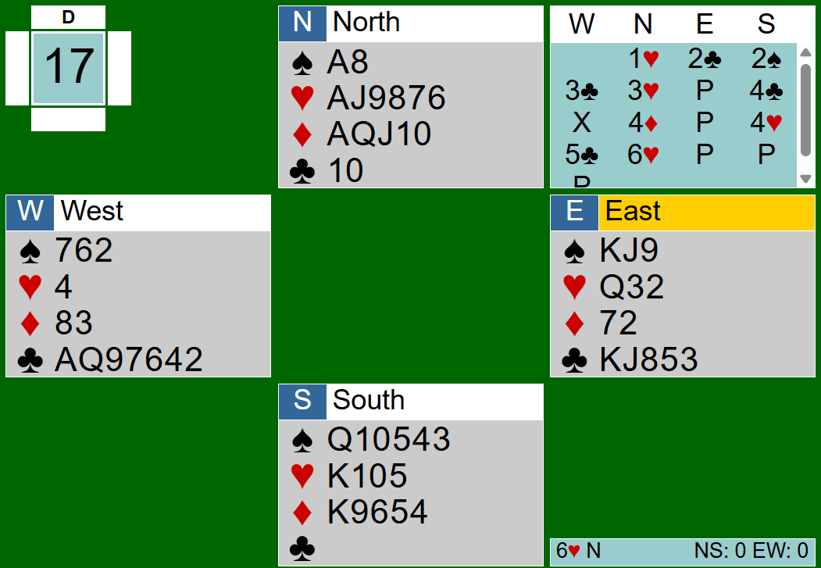
Let us turn to the opponents on this deal. While they did interfere, they did not do so effectively and so N/S found their way to 6♥. N/S were given the opportunity to bid on every level, thereby allowing them to share the information they needed to bid their slam. Let’s look at what the opponents could have done better.
The bidding started off
N-----E----S----W
1♥ – 2♣ ….
There is much to be said about E’s 2♣ bid, and it is all bad. First, E stepped into a live auction at the 2-level (S has yet to bid and so could have lots of points). E needs to have a good suit and a good 11-count at the minimum. But he actually has a very poor 11 HCP and an unimpressive 5-card club suit. For all he knew, S could have an opening hand and a club stack behind him. Moreover, the general principle is that bad bids mislead partner about Overcaller’s hand. E’s 2♣ bid has misled W badly. Finally, if the opponents win the contract, the poor overcall helps declarer place the outstanding cards (although even a sound overcall does that as well).
All in all, E should have passed. If he did, the auction would have continued this way.
N-----E----S----W
1♥ – P – 1♠ – 3♣
?
With the auction now changed, but with N facing 3♣ by W anyway, he probably makes the same 3♥ bid. (A 3♦ bid would have been better, for if N later gets to rebid hearts, it shows 6-4 and more than a minimum opening hand. That should spur S on in the face of stiff interference.) Here is the auction:
N-----E----S----W
1♥ – P – 1♠ – 3♣
3♥ – ?
Now E should jump into the auction with his fantastic club support and bid 5♣. There are several reasons to jump to the 5-level. For those who consider the Law of Total Tricks (LOTT) at least a valuable guideline, if not an unbreakable law, E knows his side has 11 clubs—W may have preempted with only 6 clubs— and it may even have 12 clubs. (An oversimplification of the LOTT is that your side is “generally” safe in bidding to the level of the number of cards in your trump suit that you hold together. (Larry Cohen wrote THE book on LOTT, To Bid or Not To Bid.) Indeed, if E/W have 12 clubs, then the clubs are divided 1-0 between the opponents, which means they only need at most 29 HCP in the other three suits to make a slam, as one of them has a club void.
But there is more. E knows that N/S definitely have a game in 4♥, even if partner only has a 6-card club suit (♣AQxxxx). That means the opponents have no more than 24 HCP (stripping out 10 HCP in clubs and 6 HCP in the majors for E) and a club void (or a singleton opposite a singleton), certainly game territory for hearts. 5♣ prevents them from ever bidding 4♥ as well as taking away whatever version of Blackwood they play.
Moreover, it puts N/S to what is called “the last guess.” It is impossible for them to know with certainty whether to merely double 5♣ or to go on to 5♥, or even 6♥. Mind you, they may guess correctly, but guessing is a less-than-ideal way to bid. All bidding systems are trying to do exactly the opposite: rather than making one’s partner guess what to do, one uses specific bids to accurately inform partner about their hands, and vice versa, so that the partnership can land in the best contract. Guessing is the opposite of that foundation of certainty. The jump to 5♣ gives N/S a chance to go wrong because they have to guess what to do. Without that high level interference, N/S have already shown they knew what to do.
As I mentioned last time, S, with a club void, would almost certainly bid on to 5♥. Interestingly enough, for N/S, after the contract of 6♥, doubling 5♣ is their second-best result, as E/W would be down 3 for +500; 5♥, making 6, is only worth +480 for N/S, a significant difference in matchpoints.
But even with minor variations or the original auction, E/W had a chance to stop the slam discovery. There are two ways it could have happened.
Firstly, after
N-----E----S----W
1♥ – 2♣ – 2♠ – ?
even with E’s bad overcall of 2♣, W should bid 5♣. He knows they have at least 12 clubs between them, if not 13, and W needs to take up as much bidding space as possible to make it difficult for N/S to learn about their club void as well as other features of their respective hands.
When W missed that opportunity to bid 5♣, he had yet another chance to prevent N/S’s easy stroll to 6♥ for after
N-----E----S----W
1♥ – 2♣ – 2♠ – 3♣
3♥ – P – 4♣ – ?
W should now bid 5♣. In doing so, he prevents N’s 4♦ bid, limiting N’s ability to show his hand.
Note that W eventually bid 5♣. Since he was willing to go that high, a major lesson when preempting is to make the highest bid one is willing to make at one’s first chance, do not do it in steps. It only allows the opponents to share favorable information in the bidding space that has been left them.
Another lesson from this article: do not make 2-level overcalls on poor 5-card suits and balanced distribution, which a 5-3-3-2 hand is, something I learned late in my bridge life. It seldom works and often helps the opponents.
|