|
Which 3 letter acronym represents Virginia’s guidance for writing outcomes and goals?
The correct answer is “c” – ACC (Acquisition, Context, Criterion)
Developing strong Individualized Family Service Plan (IFSP) outcomes and goals is essential for supporting infants and toddlers with developmental needs and their families. In Virginia, IFSP outcomes are designed to be functional, family-centered, and measurable, ensuring that they reflect what is most important to the child and family in their everyday routines. High-quality outcomes help teams focus on meaningful progress, promote collaboration, and provide clear direction for intervention strategies.
Virginia’s 3-Part Outcome Format
- Acquisition: What the child will do (e.g., “use 15 words”)
- Context: Where and when this behavior occurs (“during mealtimes at home”)
- Criterion: How often or by what measure it will be considered achieved (“5x/day over one week”)
Core Principles for Effective IFSP Outcomes
Individualized & Measurable
Tailor to the child and clearly define how progress is tracked.
Poor: “Jason will use words.”
Better: “Jason will use 15 words to request items (blanket, juice, ball) at least 5 times per day for one week.”
Routine-Based & Functional
Embed goals in daily contexts and meaningful activities. Avoid test-like, isolated skills—emphasize real-life participation.
Better: “Jason will walk 5 ft across the living room to join family playtime when the dog is present, every morning for seven days.”
Concrete, Positive Language
Use active verbs, jargon-free phrasing, and focus on strengths.
Family-Centered & Contextual
Reflect family routines, priorities, cultural values, and the natural environment
Writing Your Own Outcomes: Step-by-Step
Engage the Family: Use open-ended questions to learn:
- What routines are important for your child?
- What changes would you like to see in your child’s daily life?
Identify Priorities:
Choose a few meaningful routines or family-valued skills.
Create Family-Centered, Functional Outcomes:
- Acquisition (behavior)
- Context (routine/environment)
- Criterion (how measured)
Write Active, Measurable Statements:
- Include objective measures (frequency, duration, distance).
Example: “Ella will point to 8 familiar pictures (dog, cup, ball) during Storytime at home, 4 out of 5 days for two weeks.”
Options & Strategies:
- List what supports and strategies (e.g., modeling, prompts, AAC) will help the child and family meet the outcome.
Monitor Progress:
- Document ongoing assessment in contact notes.
These strategies ensure that IFSP outcomes are:
- Measurable, so progress is visible
- Grounded in daily life, aligning with routines
- Family-driven and culturally sensitive
- Action-oriented and written in plain language
Resources & Tools
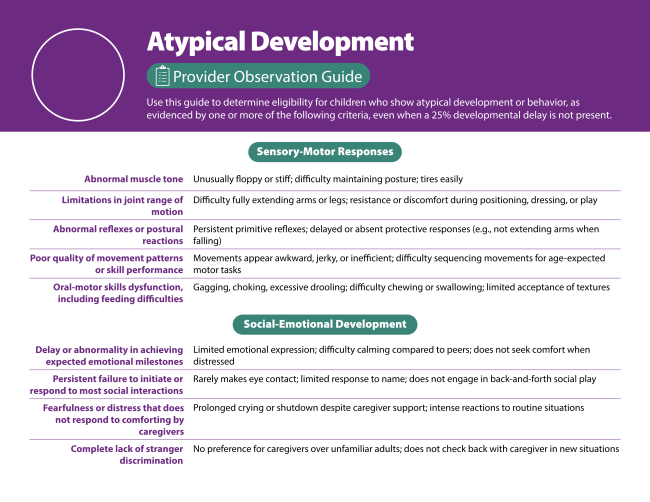
Our quick reference cards have a new look! Here are some that you may find useful for outcome and goal writing:
|