Ohio Water Resources Center Newsletter |
|
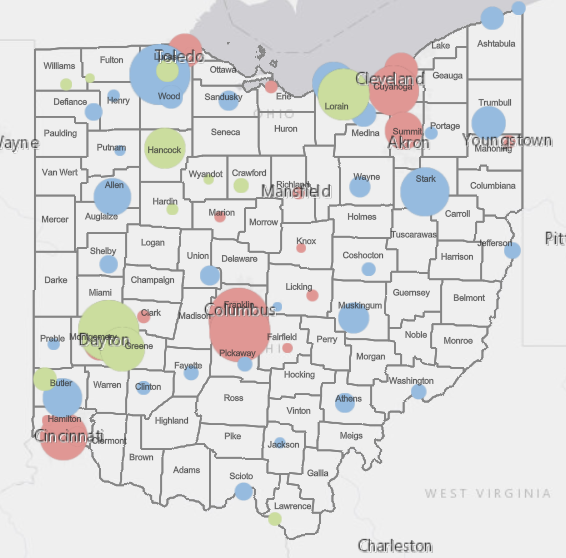
It has been nearly a year since Ohio WRC first started collaborating with Ohio Department of Health and Ohio EPA on the Ohio Coronavirus Wastewater Monitoring Network (OCWMN). This statewide project is helping alert state and local decision-makers to potential increases in COVID-19 cases in a specific area. Studying wastewater samples throughout the state can provide a leading indicator that assists in mitigating the spread of COVID-19 by looking in wastewater for gene copies/fragments of the virus that causes the disease. Ohio WRC has launched an interactive map that shows the development and expansion of the OCWMN. Along with the OCWMN project, there has been a similar collaboration with Ohio universities to monitor campus wastewater.
In the near-term, the future of wastewater monitoring will be in detecting and tracking SARS-CoV-2 variants of concern (VOC). With the emergence of VOC, the virus may become more highly transmissible and the effectiveness of antibody treatments and vaccines may be compromised. Because of this, it is critically important to create a system to monitor SARS-CoV-2 variants to protect therapeutic treatments, vaccines and diagnostic assays. Ohio is monitoring wastewater for VOC leveraging the existing OCWMN network and sequencing expertise and instruments at Case Western Reserve University, Ohio State University, Battelle and US EPA. This effort began with a pilot in January at 16 selected sites. A secondary pilot started in April using all of the OCWMN sites' wastewater samples that can be sequenced. After evaluation of data from both pilot projects, the team will decide on the usefulness of the data for the state and possible pathways forward. Multiple states in the US and countries around the world are developing wastewater sequencing methods and applications. For example, Oregon has been successfully monitoring VOC and includes variant data on its COVID-19 dashboard. Looking beyond COVID-19, wastewater monitoring has exciting potential as a public health tool for monitoring other pathogens, biomarkers, and the opioid epidemic. Ohio WRC will to continue the work with the many local wastewater treatment sites, universities, commercial partners, US EPA, ODH and Ohio EPA to provide important wastewater data to continue improving public health in Ohio.
|
|
OSU Extension: Water Quality Initiative |
|
Engaging Farmers in Water Quality Improvement Practices
Across 20 counties within the western Lake Erie basin, a new team of OSU water quality extension associates is partnering with farmers to help improve soil health and reduce nutrient runoff. The team leads applied on-farm research trials to help demonstrate the effects of conservation practices on water quality, soil health, and farm profitability. Results of these field trials are published annually in OSU’s eFields, so information can be quickly shared.
Through collaborations with university researchers, extension associates also help bring newer innovations, like manure side-dress toolbars and drone-assisted field surveys, to local farmers. The water quality extension associates help researchers find farmers interested in participating in applied research trials and assist researchers in sharing findings through fact sheets, webinars, and field-based training events.
|
|
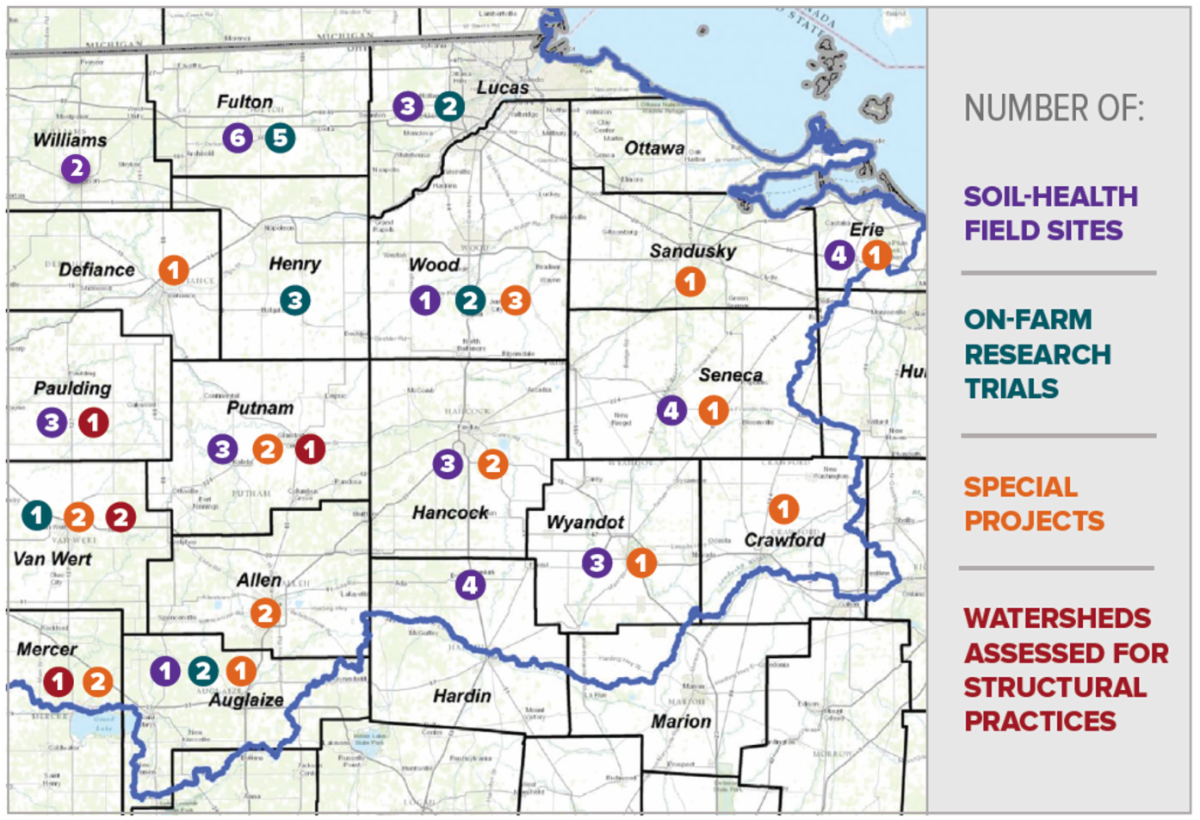
In their first year, these six new water quality extension associates completed 15 on-farm research trials, conducted soil health sampling on 41 fields in 11 counties, partnered with multiple researchers on special water projects – including establishing water quality monitoring stations with real time nitrate and phosphorus analyzers – and completed GIS-based agricultural conservation planning framework (ACPF) assessments on 79,000 acres (see map). That ACPF information is used to help identify potential sites for placement of structural water quality best management practices.
The team also started a “Water Quality Wednesdays” winter webinar series, produced water quality videos for the first virtual Farm Science Review, and conducted numerous outreach and engagement events. They hope to do even more once COVID-based restrictions on in-person events are lessened. Through education, outreach, and demonstrations highlighting the benefits of conservation practices, the extension associates hope to encourage widespread practice adoption and sustained practice implementation. Support for the water quality extension associates is provided through partnerships with USDA-NRCS and Cargill.
If you would like to partner with an extension associate on an applied water quality research project or would like their assistance in sharing your research findings with area farmers, please contact Heather Raymond, Water Quality Initiative Director for the College of Food, Agricultural, and Environmental Sciences: Raymond.54@osu.edu. Contact information for the water quality extension associates is also available here.
|
|
Large Decreases in Upper Colorado River Salinity Since 1929 |
|
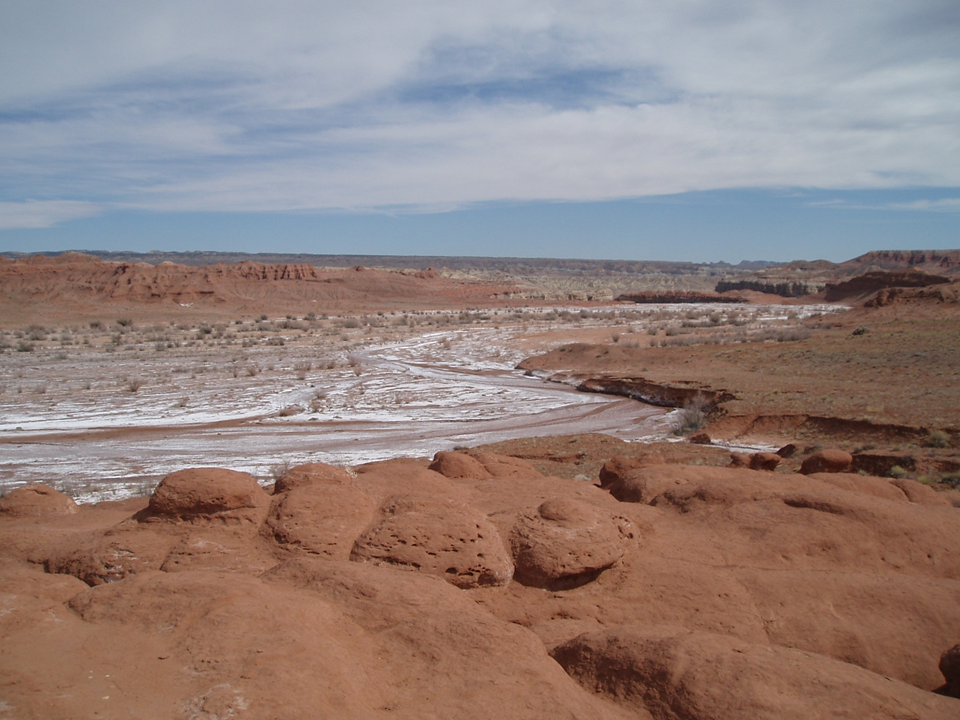
Salinity levels in the Upper Colorado River Basin, which covers portions of Wyoming, Colorado, Utah, Arizona and New Mexico, have steadily decreased since 1929, according to a new U.S. Geological Survey study analyzing decades of water-quality measurements. Salinity is the concentration of dissolved salt in water. High salinity levels in the Colorado River Basin cause an estimated $300-400 million per year in economic damages across U.S. agricultural, municipal and industrial sectors, as well as negatively impact municipal and agricultural users in Mexico. Reducing high salinity levels can benefit crop production, and decrease water treatment costs and damage to water supply infrastructure.
Findings indicate that large, widespread and sustained downward trends in salinity occurred over the last 50 to 90 years, with salinity levels decreasing by as much as 50% at some locations. The timing and amount of salinity reductions suggest that changes in land cover, land use and climate, in addition to salinity-control measures, substantially affect how dissolved salts find their way into streams that feed the basin. “Identifying the causes of dropping salinity levels will be important for water managers in the basin so they can anticipate future changes in salinity and optimize salinity-control practices going forward,” said Christine Rumsey, USGS scientist and lead author of the study.
Results show the steepest rates of decline in salinity occurred from 1980 to 2000, coincident with the initiation of salinity-control efforts in the 1980s. However, there has been a consistent slowing of downward trends after 2000 even though salinity-control efforts continued. Significant decreases in salinity occurred as early as the 1940s in some streams, indicating that, in addition to salinity-control projects, other watershed factors are important drivers of salinity change.
Funding for this study was provided by the Colorado River Basin Salinity Control Program, the Bureau of Reclamation and the Bureau of Land Management. The USGS is the primary scientific agency for collecting data on water quality and flow in the nation's rivers, with more than 13,500 real-time stream, lake and reservoir, precipitation and groundwater data stations across the country. The USGS also conducts analyses of these data to evaluate the status and trends of water-quality conditions. The new study was published in the journal Water Resources Research.
|
|
Via WaterWorld, March 24, 2021
Via Review Times, March 26, 2021
Via WDTN.com, March 29, 2021
Via cleveland.com, April 6, 2021
Via Putnam County Sentinel, April 8, 2021
Via Coshocton Tribune, April 9, 2021
Via The Highland County Press, April 14, 2021
Via Associated Press, April 15, 2021
Via WaterWolrd, April 15, 2021
Via Water Finance & Management, April 16, 2021
|
|
Have a news article you'd like us to feature in our Newsletter? Email us at OhioWRC@osu.edu! |
|
College students are invited to apply for a $1,000 WMAO Scholarship through the Columbus Foundation. Each year, WMAO offers one undergraduate and one graduate scholarship to recipients who are students with an academic focus on water resources pursuing a degree at an Ohio college or university. Check out this informational video for guidance. Deadline to submit an application online is May 31, 2021. If you have any questions, please contact Dennis Clement (dennis.clement@epa.ohio.gov), Chair of the Education Committee.
|
|
Ohio American Water Works Association is currently accepting nominations for the following awards: John Lechner Award of Excellence, John Sadzewicz Award, Keith Hunsberger Outstanding Customer Service Award, Richard Melick Award for Education, Operator Meritorius Water Distribution Service, and Operator Meritorius - Water Treatment Service. For more information, and to complete an online nomination form, please click here. The deadline for nominations in June 1, 2021.
|
|
Earth Science Applications: Water Resources |
|
NASA is currently seeking (in-person) reviewers for Earth Science Applications: Water Resources. Signing up does not commit you to serve, nor will NASA be obligated to invite you to serve on a review panel. If you are a funded team member on proposal to a given panel you will not be able to serve on that review panel, but you may be able to serve on another in the future. SMD recognizes and supports the benefits of having diverse and inclusive scientific, engineering, and technology communities and fully expects that will be reflected in the composition of peer review panels. Fill out the application form here, where you may identify whether you work or study at a minority-serving institution.
|
|
WMAO 50th Annual Meeting - Call for Abstracts |
|
Water Management Association of Ohio (WMAO) is celebrating their 50th anniversary with "Engaging Water Professionals Through the Decades" their 50th Annual Meeting and Symposium from November 3-4. For full abstract submittal information, click here. To directly access the online submittal form, click here. Deadline is June 15, 2021.
|
|
Maumee AOC Beneficial Use Impairment
Quality Assurance Project Plan, 2021
|
|
The Ohio Environmental Protection Agency's Division of Surface Water (DSW) will be conducting a partial evaluation of the Maumee Area of Concern (AOC) Beneficial Use Impairment #8 (eutrophication or undesirable algae) in 2021. DSW has compiled a proposed list of sampling sites for this survey. At this time, Ohio EPA is accepting comments on the proposed selection of sites. Please see the draft quality assurance project plan here. Comments are due by 5:00 p.m. on May 12, 2021, to EPATMDL@epa.ohio.gov. |
|
Water Resource Restoration Sponsor Program Year 2022 |
|
The Water Resource Restoration Sponsor Program (WRRSP) uses interest monies from the Water Pollution Control Loan Fund (WPCLF) loan to sponsor projects to fund preservation and restoration of aquatic habitat. A webinar will be held on Thursday, May 13, 2021 at 10:00 a.m. - 11:00 a.m. (EST) on what’s new, updates, and highlights for program year 2022, including: the program’s annual call for project nominations; pre-nominations; project management plans; readiness-to-proceed criteria; and funding sources. Continuing Education Units (CEU) will also be available for this webinar. Tom Harcarik will speak on Environmental Specialist, Division of Environmental & Financial Assistance. Register here. |
|
Big Walnut Creek Watershed TMDL Modification |
|
Ohio EPA is providing for public review and comment the modification of the Big Walnut Creek Watershed Total Maximum Daily Load (TMDL) document. The Big Walnut Creek TMDL document was approved by U.S. Environmental Protection Agency on September 26, 2005. The Total Phosphorus and Fecal Coliform TMDLs for the Alum Creek headwaters to above West Branch Alum Creek assessment unit are being modified to account for a new discharger. The draft modification documents are available here. Comments are due by 5:00 p.m. on June 4, 2021 to EPATMDL@epa.ohio.gov. To receive notifications on the development of TMDL projects, subscribe here.
|
|
WEF Conference - Residuals and Biosolids Conference 2021 |
|
May 11-14, 2021 • Greater Columbus Convention Center, Columbus, OH
Save the date for the 2021 Residuals and Biosolids Conference and plan to experience a robust program highlighting continued advances in the wastewater residuals and biosolids sector. Potential speakers are invited to submit an abstract for podium presentation, workshop, virtual presentation, or exhibitor mobile session.
|
|
Diversity in Water: Dr. Willie Harper |
|
May 13, 2021 • Online Event
Ohio American Water Works Association's Diversity in Water series is a virtual discussion highlighting the diverse voices and experiences of some very valuable, interesting, and leading professionals in the Ohio water industry. Please join Dr. Willie Harper for OAWWA's next speaker event. Register here. Find Dr. Harper's full bio here.
|
|
May 17-20, 2021 • Virtual Event
Join us for the second Virtual River Rally! Our engaging and fun virtual program will run for four empowering days. Featuring ‘live’ content including plenaries, workshops, discussions, and inspiring reflections from award recipients, along with access to a huge library of recorded workshops, opportunities to connect with peers, and an innovative new community platform that will connect the network for years to come. We hope you’ll join us!
|
|
2021 Ohio Stormwater Conference |
|
May 19-21, 2021 • Kalahari Resort and Conference Center, Sandusky, OH & Virtual
The 2021 Ohio Stormwater Conference is an annual conference dedicated to advancing the knowledge and understanding of comprehensive stormwater management for those dealing in all aspects of planning, design, implementation and regulatory compliance. The conference will provide updates on environmental issues, new technologies, regulatory information and pollution prevention. The 2021 Ohio Stormwater Conference is a great opportunity to strengthen your skills and knowledge in an intensive workshop setting with other colleagues. This is anticipated to be a hybrid event.
|
|
2021 Virtual UCOWR/NIWR Annual Water Resources Conference |
|
June 8-10, 2021 • Southern Illinois University, Carbondale, IL & Virtual
Universities Council on Water Resources (UCOWR) and The National Institutes for Water Resources (NIWR) are hosting their Annual Water Resources Conference. The conference will include live-streamed plenaries, panels, and workshops as well as recorded oral and poster presentations followed by live Q&A. Click here for more information and for registration.
|
|
TCWP Webinar Series - June |
|
June 9, 2021 • Virtual Webinar
Tinker’s Creek Watershed Partners is hosting webinars the second Wednesday of each month through August including speakers/topics related to stormwater practices, restoration, and engineering. There are two events in June. 9 AM - 11 AM: Dustin Doherty on Engineering Ethic and Kimberly Strong on Diversity and Inclusion Begins With You. 1 PM - 3 PM: Jason Mclean on Engineering ethics, laws, and rules. Register here.
|
|
2021 WEF Stormwater Summit
|
|
June 21-23, 2021 • Hyatt Regency Minneapolis, Minneapolis, MN
The Water Environment Federation is hosting the Stormwater Summit in cooperation with the Central States Water Environment Association. This Summit is crafted to deepen the technical knowledge of professionals involved in stormwater and provide forums where leading issues in the sector are discussed. The conference will include oral presentations, interactive discussions, pre-conference workshops, exhibits, mobile sessions, opportunities for networking in dynamic settings, as well as virtual components.
|
|
2021 One Water Technical Conference |
|
July 26-29, 2021 • Duke Energy Convention Center Cincinnati, OH
OAWWA and OWEA are excited to announce the 2021 One Water Technical Conference. The water and wastewater industries both face similar challenges with new and current regulatory requirements and development of emerging technologies as well as industry maintenance of our aging infrastructure being at a premium for our water and wastewater providers. We are looking to provide our members and conference attendees with a unique opportunity to gain professional development and educational opportunities for both industries at the same time.
|
|
76th SWCS International Annual Conference |
|
July 26-28, 2021 • Virtual Event
The Soil and Water Conservation Society (SWCS) invites submissions for the 76th SWCS International Annual Conference! The three-day event will provide the opportunity for attendees around the world to share their conservation stories and bring natural resource management solutions from far and wide into their homes and offices. This year’s conference theme, “One World, Connected through Conservation,” encompasses the shared resources on which all life depends while recognizing local-level issues and management.
|
|
Understanding Algal Blooms: State of the Science Conference |
|
September 8, 2021 • Stranahan Theater Great Hall, 4645 Heatherdowns Blvd, Toledo, OH
The 6th annual Understanding Algal Blooms: State of the Science conference will highlight current scientific knowledge related to algal blooms. Research and outreach leaders will present findings from recent studies and identify important areas of uncertainty.
|
|
October 16-20, 2021 • McCormick Place, Chicago, IL & Virtual
The 94th Annual Water Environment Federation Technical Exhibition & Conference is planned for 2021! The WEFTEC Program Committee is planning for an in-person event if conditions allow. WEF will continue to monitor the situation. What we do know about WEFTEC 21 is that it will not be exactly like previous events and will be incorporating a limited virtual component.
|
|
Have an event you'd like us to feature in our Newsletter? Email us at OhioWRC@osu.edu! |
|
Email: OhioWRC@osu.edu
Phone: 614-292-2807
Website: https://wrc.osu.edu/
Address: 311 Hitchcock Hall
2070 Neil Avenue
Columbus, OH 43210
|
|
|
|
|
|
|
|