|
|
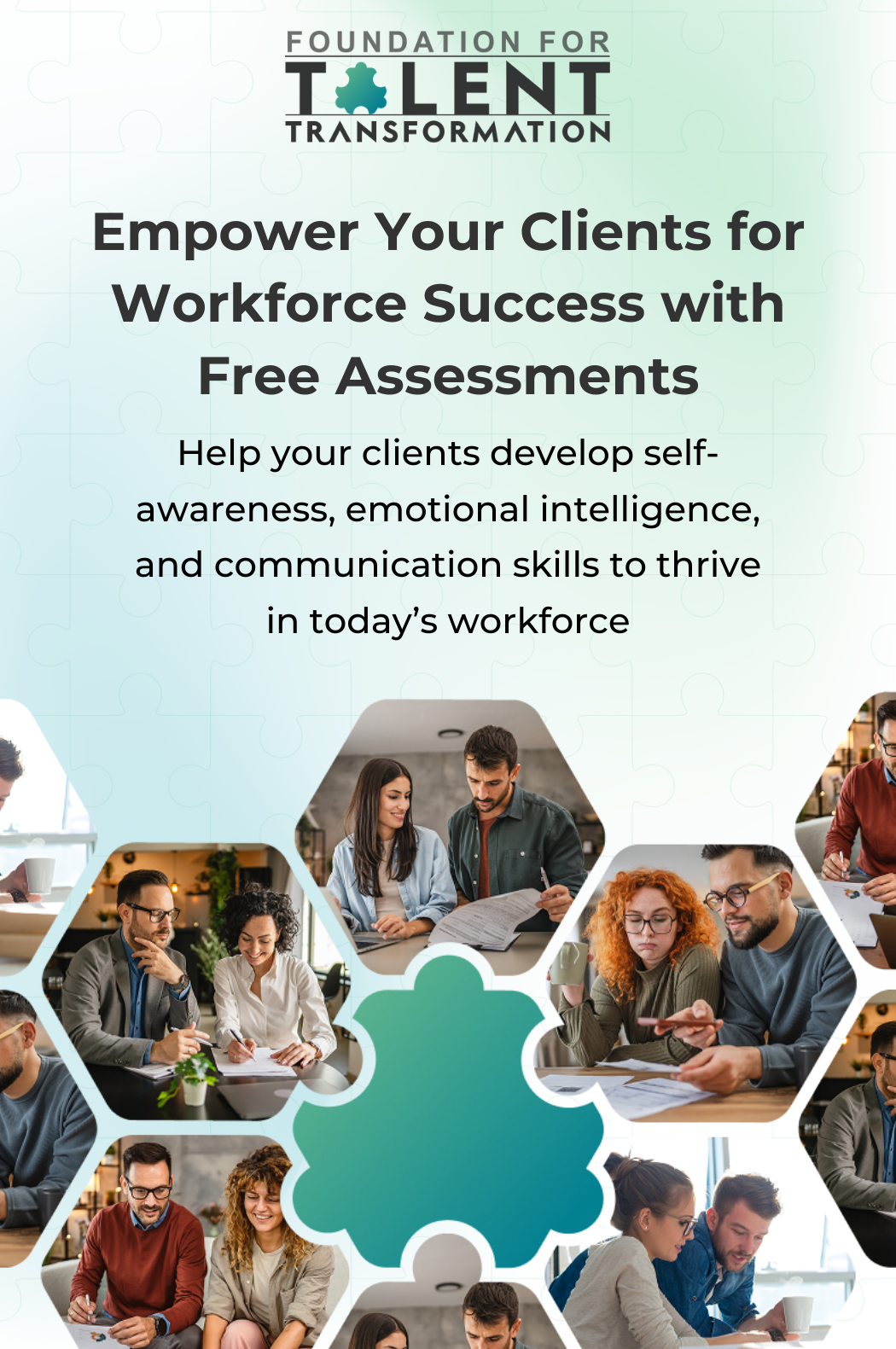
Partner with the Foundation for Talent Transformation to help people build the skills for lasting employability. Together, we will help you improve participation, completion, job readiness, placement, retention, and advancement, while gaining insights to strengthen program delivery and participant success!
| |
October 1, 2026
Welcome to the October 2026 Edition of the MUS Connector!
Technology is changing how people work, learn, communicate, and build careers. Across industries, digital skills are increasingly part of workforce readiness, from navigating workplace technology and digital communication to using productivity tools, accessing information, managing data, and adapting as new technologies emerge.
Artificial intelligence is accelerating that change. In August 2025, the U.S. Department of Labor issued Training and Employment Guidance Letter (TEGL) No. 03-25, encouraging state and local workforce development systems to use Workforce Innovation and Opportunity Act (WIOA) Title I Youth, Adult, and Dislocated Worker programs to help participants develop AI skills. The guidance also recognizes digital literacy as an important foundation for AI learning and encourages workforce systems to integrate AI education and training into existing programs and career pathways.
In February 2026, DOL advanced that work through Training and Employment Notice TEN 07-25, releasing the U.S. Department of Labor's Artificial Intelligence Literacy Framework. The framework provides workforce and education systems with foundational content areas and delivery principles for developing AI literacy while allowing programs to adapt learning to different industries, occupations, and workforce needs. It also recognizes digital literacy skills as prerequisites that may need to be addressed as individuals develop AI competency.
| | |
From the Desk of the Executive Director
A Milestone for Midwest Urban Strategies:
Achieving CEUAC Accreditation
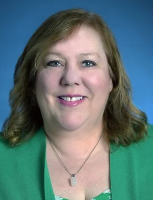
by Tracey Carey
Executive Director
I am proud to announce that Midwest Urban Strategies (MUS) has officially achieved accreditation through the Continuing Education Unit Accreditation Council (CEUAC), effective September 17, 2026. This achievement represents an important milestone for our organization and reflects our ongoing commitment to quality, accountability, innovation, and continuous improvement in the work we do to strengthen the workforce development ecosystem. Accreditation is more than a designation. It is an external validation that an organization has established systems, practices, and processes designed to support quality learning and organizational effectiveness.
Through the accreditation process, MUS examined our policies, learning practices, operations, documentation, and approaches to measuring impact. The process gave us an opportunity not only to demonstrate what we do well, but also to identify ways we can continue strengthening our organization for the future. For Midwest Urban Strategies, this achievement is especially meaningful because learning is central to our mission. Our network brings together workforce leaders, practitioners, partners, and communities to exchange ideas, test innovative approaches, build capacity, and develop solutions to some of the most complex workforce challenges facing urban communities.
Whether through Learning Labs, convenings, technical assistance, peer learning, or other professional development opportunities, we want every MUS learning experience to be intentional, relevant, high-quality, and capable of producing meaningful results. CEUAC accreditation provides an additional framework for holding ourselves accountable to that commitment. It also positions MUS to continue expanding the value we provide to our members and partners. As we move forward, accreditation will help guide how we design learning experiences, document outcomes, strengthen organizational systems, and demonstrate the impact of our work.
Most importantly, this achievement belongs to our entire MUS community. It reflects the dedication of our staff, Board, members, partners, and workforce professionals who continually challenge us to learn, innovate, and improve. We are proud of this milestone, but we also recognize that accreditation is not the finish line. It is a commitment to ongoing excellence!
As the workforce landscape continues to evolve, Midwest Urban Strategies will continue evolving with it. Creating opportunities for workforce professionals to learn from one another, strengthening the capacity of our network, advancing innovative workforce practices, and helping communities build stronger and more responsive talent development systems. We are excited about what this designation makes possible and look forward to sharing more about how CEUAC accreditation will strengthen our learning and professional development offerings in the months ahead.
Thank you to everyone who contributed to this achievement and who continues to make Midwest Urban Strategies a community of learning, collaboration, and innovation!
| | |
Midwest Urban Strategies Welcomes
Claudia Regalado to the Board of Directors
| | |
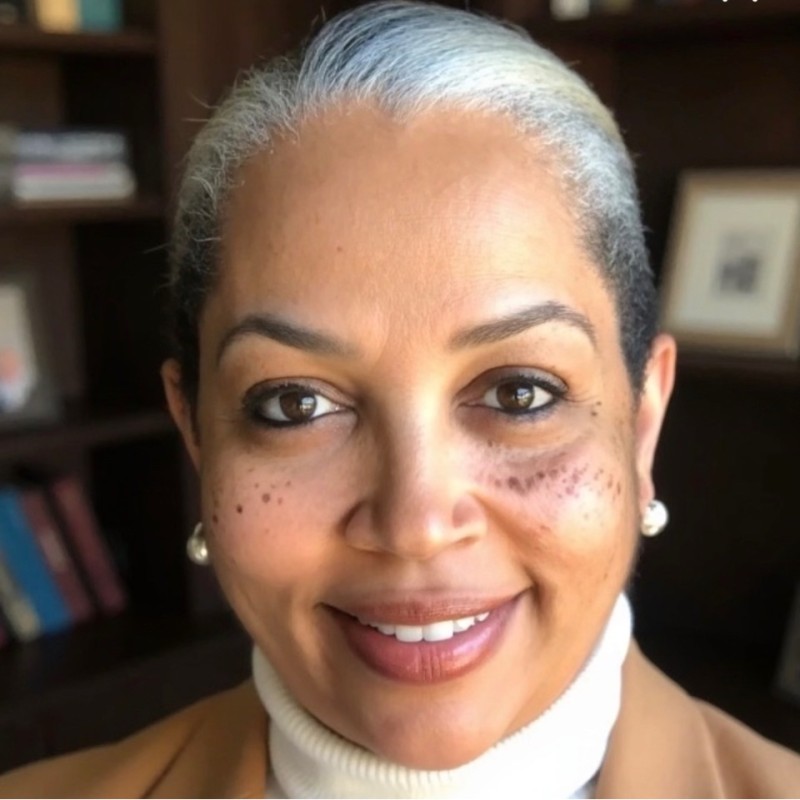
Midwest Urban Strategies is pleased to announce the appointment of Claudia Regalado to the Board of Directors! Claudia is the Director of Relationship Management Programs, Government, and Business for Chicago Cook Workforce Partnership where she helps lead relationships and strategies across one of the nation’s largest public workforce systems. Her work brings together workforce organizations, government, businesses, and community-based partners to strengthen service delivery and create a more coordinated workforce system for Chicago and Cook County.
Claudia has more than 20 years of experience spanning workforce development, organizational leadership, program administration, government and community partnerships, and employer engagement. She is passionate about strengthening the workforce development profession, developing emerging leaders, and building systems that remain responsive to the people, businesses, and communities they serve.
Claudia’s relationship with Midwest Urban Strategies began in 2021, when she was selected as a member of the inaugural cohort of the MUS Workforce Innovator Fellowship. Since then, she has remained engaged in regional collaboration and the exchange of innovative workforce strategies with leaders across the Midwest.
Claudia also serves as the Illinois State Director on the Board of Directors for the National Association of Workforce Development Professionals (NAWDP) and as Chair of its Governance Committee. She represents Local Workforce Innovation Area 7 (LWIA 7) through the Illinois Workforce Association (IWA), contributing to statewide collaboration among Illinois’ local workforce areas.
Welcome Claudia! We look forward to working with you!
| | |
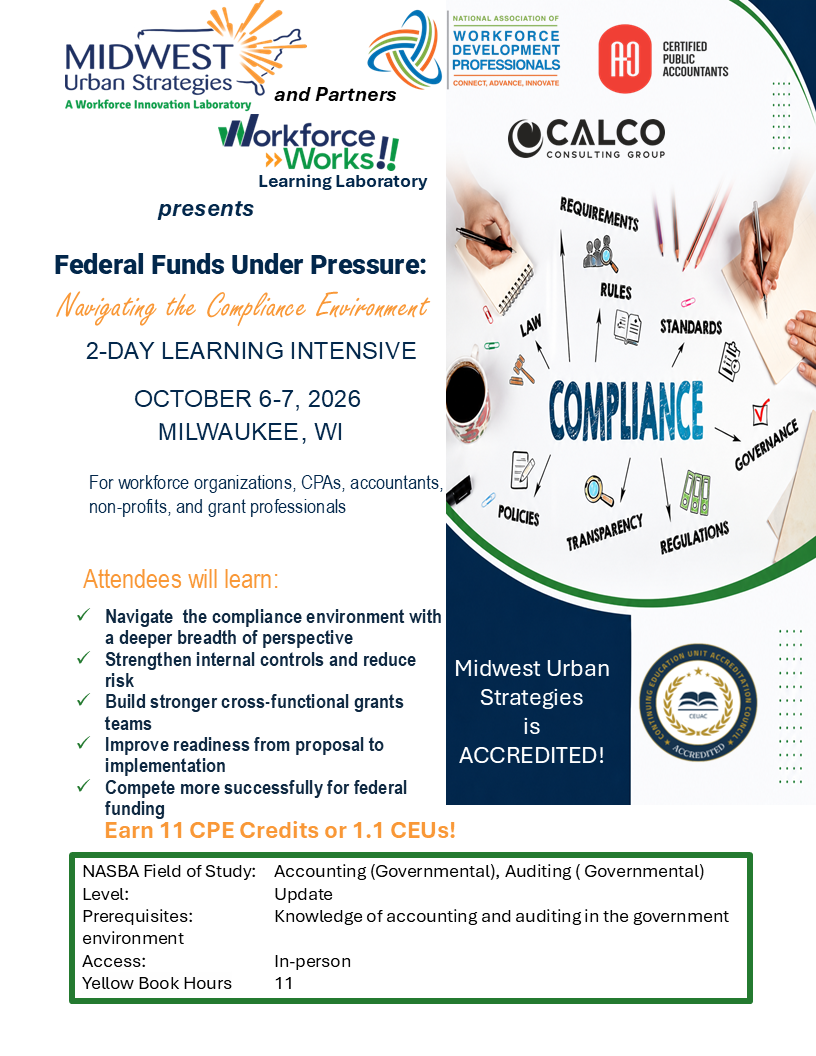
Federal Funds Under Pressure:
Navigating the Compliance Environment
2-Day Learning Intensive
| | |
Organizational readiness starts before the next funding opportunity arrives. Strong internal systems, cross-functional collaboration, leadership alignment, risk management, and organizational capacity all play a role in successfully managing federal investments. Join MUS and our partners in Milwaukee, Wisconsin for two days of practical learning designed to help organizations strengthen their systems!
Keynote Speaker: Laura Watson, former Deputy Assistant Secretary, U. S. Department of Labor, Employment and Training Administration. Session Speakers include, Melissa Robbins, CGFM, CWDP, NAWDP, Felicia Fountain and Paulette Francois, CALCO Consulting Group, Ryan Goerres, CPA, CFE and Elizabeth Tyson, MBA, CAAP of A&O Certified Public Accountants, and Tracey Carey, Midwest Urban Strategies!
| | | | |
MUS Policy Perspective
by Chris Andresen
Senior Vice President
Dutko Government Relations
Federal workforce development policy and funding are essentially on hold while we await the results of the midterm elections. Members of Congress will spend October in their states/districts ahead of the November 3rd elections. That presents an opportunity for local workforce development boards and stakeholders to invite federal elected officials to attend events, visits American Jobs Centers, or tour local employers active with local workforce development boards.
There is universal recognition that local elected officials must better understand the local workforce development system and its impact throughout the community. The best way to showcase that is with in-person visits and direct interactions/observations with elected officials, staff, businesses, and WIOA participants. With the congressional recess for the month of October, extending invitations to those Members of Congress could help to build a foundation for WIOA Reauthorization and workforce development funding for this year and beyond.
While this can feel daunting, we have several recent examples of congressional members, staff and Administration officials visiting local workforce development boards. Given the consistent advocacy in Washington, DC for workforce development policy and funding, Members are looking to learn more about these programs and how they are impacting their constituents – in many cases, they may not truly appreciate the barriers faced by individuals and the extensive work done to get people into job training and/or work.
| |
MUS Welcomes Four New Members!
by Kellie Landaker
Director of Membership, Learning, & Innovation
Midwest Urban Strategies continues to grow! We are pleased to welcome four new organizations to the MUS network: CALCO Consulting Group, D. Byers & Associates, Skilled US, and ARCHS. Each brings a distinct perspective and area of expertise that further strengthens the depth and diversity of the MUS membership landscape.
CALCO Consulting Group
CALCO Consulting Group is a professional business consulting and management firm serving nonprofit, private-sector, and government organizations. With expertise spanning workforce training, education, research and data analytics, program development, and technical assistance, CALCO brings valuable experience in developing practical solutions that strengthen programs and create viable career pathways.
D. Byers & Associates
D. Byers & Associates brings more than 60 years of combined experience helping organizations address challenges and strategically plan for growth. With expertise in grant management, talent and workforce development, training, assessments, strategic planning, and project leadership, the firm brings a valuable systems and organizational-development perspective to the MUS network.
Skilled US
Skilled US provides tuition-free career training designed to connect individuals with skills and credentials for high-demand, family-sustaining careers. Working across multiple states, Skilled US partners with industry to align training with workforce needs in fields including advanced manufacturing, construction, engineering, business, and IT.
ARCHS – Area Resources for Community and Human Services
St. Louis-based ARCHS works through an extensive network of community partners to strengthen human services and improve outcomes for children and families. Its work spans education, workforce development, grant and program management, and initiatives designed to disrupt generational poverty and expand opportunity.
Together, these four organizations add even more expertise, geographic reach, innovation, and perspective to an already robust MUS network. As MUS continues to grow nationally, we remain intentional about bringing together organizations that can learn from one another, collaborate across sectors, and strengthen the workforce ecosystem.
Please join us in welcoming CALCO Consulting Group, D. Byers & Associates, Skilled US, and ARCHS to Midwest Urban Strategies. We are excited to see what we can accomplish together!
Interested in Membership? Contact kellie@midwesturbanstrategies.com.
| |
October 2026 Member Spotlight
Organization Name:
National Association for Workforce Development Professionals (NAWDP)
Executive Leader:
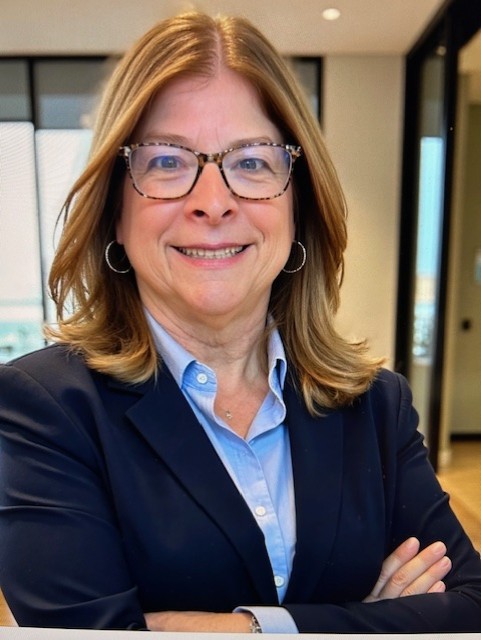
Melissa Robbins
Chief Executive Officer
Website:
www.nawdp.org
About NAWDP
Since its founding in 1984, The National Association of Workforce Development Professionals(NAWDP) has served as a trusted resource and advocate for professionals who help individuals prepare for, secure, and succeed in employment. Through advocacy, training, certification, and connection, NAWDP equips practitioners with the tools and support they need to drive economic opportunity, empower communities, and shape a more inclusive workforce system. No matter your role in the workforce development ecosystem—whether you provide direct services, support operations, engage with employers, or lead strategic efforts—NAWDP is your partner in progress.
The National Association of Workforce Development Professionals (NAWDP) is a professional association representing individual workforce development and human resources practitioners, who connect jobseekers, educators and employers to advance the American economy. NAWDP provides the professional development, resources, and certification credibility to individuals seeking to thrive in the workforce development industry as thought leaders and innovators. As the leading advocate for workforce development professionals, NAWDP builds relationships and connections with other industry-leading organizations to challenge and collaborate for the advancement of the industry.
Mission & Vision
At the National Association of Workforce Development Professionals (NAWDP), we champion those who champion others. Every day, workforce development professionals across the nation empower individuals, strengthen communities, and drive economic growth. Our mission, vision, and values guide our efforts to support and elevate this essential work.
CWDP Certification
Ready to get certified? NAWDP is the developer of the Certified Workforce Development Professional® (CWDP) certification. It was developed using research based on the job requirements of a wide range of workforce development roles. The results have been validated by professionals across the nation in a variety of settings as representative of the skills and competencies required for success in the industry.
NAWDP is governed and managed by a Board of Directors who are elected to represent the views and the needs of the membership of the geographic area they are elected to represent.
Learn more about NAWDP visit their website: HERE
| | |
The Workforce Behind the Workforce: Announcements and Upcoming Events
by Marjorie Cohen
Director, Programs
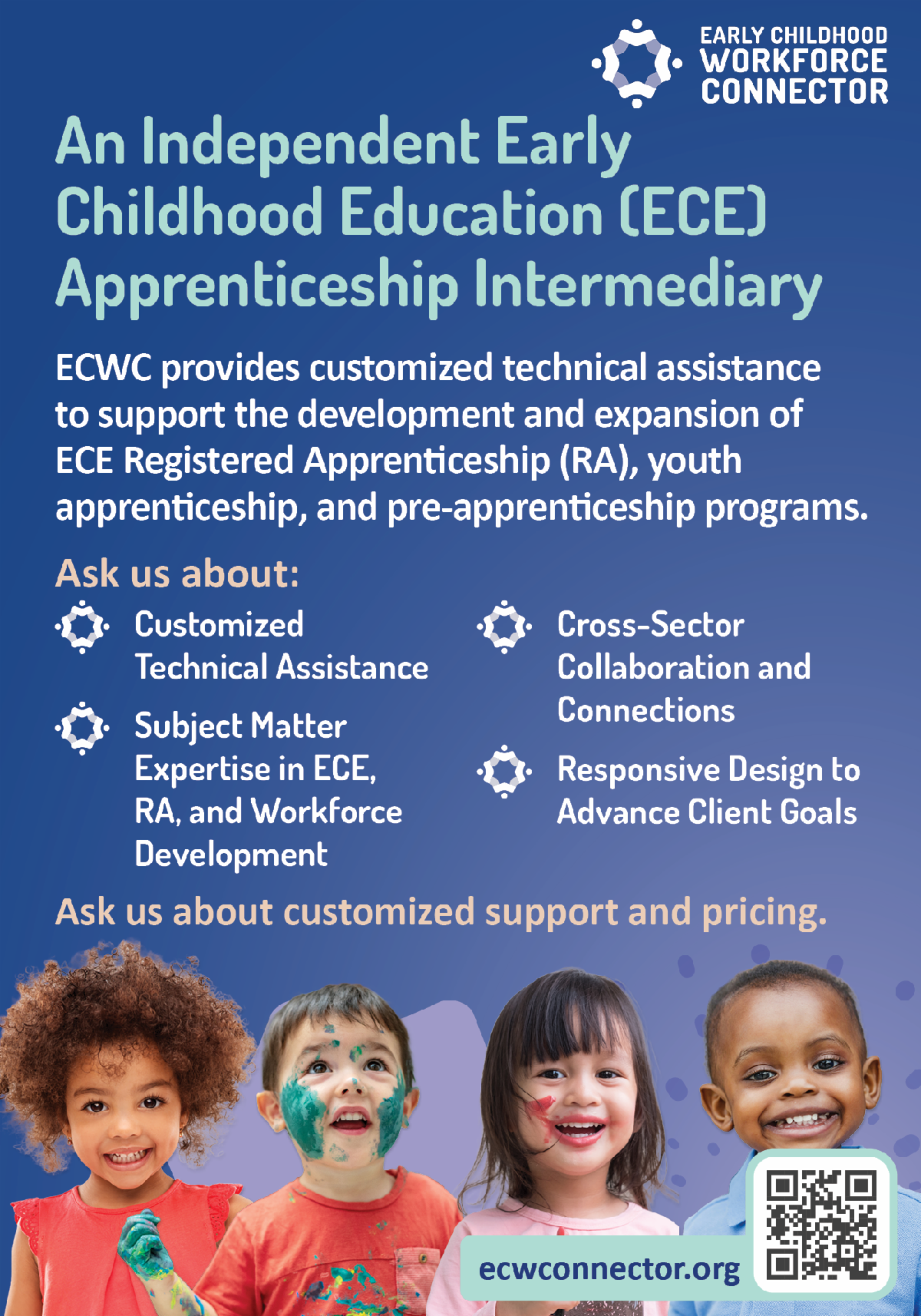
On July 16, 2026, Midwest Urban Strategies (MUS) participated in a virtual panel discussion on how Registered Apprenticeship programs can transform the early childhood education (ECE) workforce, hosted by the Hunt Institute. Along with colleagues from the MUS co-founded Early Childhood Workforce Connector, the Early Education Career Center, and North Carolina General Assembly Representative Gloristine Brown, D-Pitt, MUS discussed how WIOA can support ECE Registered Apprenticeship programs, among other topics.
As I’ve noted many times before in this column, many Early Childcare Education organizations simply do not have the infrastructure or capacity to support an apprenticeship program. However, the 20[1]4 Workforce Innovation and Opportunity Act (WIOA) can be used to support early childhood apprenticeships no matter what a community’s needs look like. WIOA governs what a workforce board is and does and outlines, actually, services that are offered by local workforce boards to employers, workers, adults, and youth, and these services can include education, skill building, career counseling, and supportive services. The workforce board can even serve as a registered apprenticeship program sponsor if the local organizations cannot.
The webinar was informative and engaging, and I encourage you to read the EdNC article linked above.
| | |
Workforce Works!!
Workforce Development Month in Review
by Casandra Blassingame
Brand, Communications &
Partnership Strategist
| |
September was Workforce Development Month and across the Midwest Urban Strategies(MUS) network, our members showed America what workforce development looks like in action.
MUS members opened their doors and took their work into their communities. They hosted events for employers, job seekers, and community partners. They engaged elected officials and elevated the voice of workforce development in important policy conversations, including discussions about artificial intelligence and the future of work. They celebrated learners completing training and entering the skilled trades, launched innovative pilots and programs, secured critical federal investments, strengthened employer partnerships, and created new pathways to economic opportunity. And just as importantly, our members told the story.
Through WorkforceWorks!!, we came together around a shared goal: helping more people understand America’s public workforce system and the extraordinary work happening in communities every day. The campaign was designed to reach beyond policymakers to employers, taxpayers, voters, community partners, professional networks, and the general public. Every hiring event, graduation, employer partnership, new initiative, success story, and community investment helped make that system more visible. As our WorkforceWorks!! Civic Guide reminds us, communication in workforce development is more than marketing. It is public education.
To every member organization and workforce professional who participated in Workforce Development Month: Congratulations, and Thank You! You demonstrated that workforce development is not simply a collection of programs. It is people, partnerships, innovation, opportunity, and communities working together to build stronger regional economies. September gave us an opportunity to celebrate that work. Now, we keep telling the story. Because Workforce Development Month may be over, but WorkforceWorks!! all year long!
| |
Technology is Changing More than How We Work:
It's Changing How People Need to
Prepare for Work
by Sandy Mead
Executive Vice President - Workforce Partnership
Skilltrade
For years, digital literacy often meant basic computer skills: using email, navigating the internet, completing an online application, or working with common software. Those skills remain important, but the definition of digital literacy is expanding quickly. Today’s workers are entering environments where technology is integrated into nearly every aspect of the job. They may need to learn new digital systems, interact with AI-supported tools, complete training online, communicate virtually, interpret information presented digitally, and adapt as technology continues to change. That means digital literacy is increasingly becoming part of workforce readiness.
One of the most promising developments is how technology can be used not simply to deliver information, but to create opportunities for learners to practice. AI-powered interactions can place learners in realistic situations where they must respond, make decisions, and solve problems. 3D simulations can allow students to visualize procedures, equipment, and workplace environments before entering a lab or worksite. Gamification can encourage learners to practice skills, receive immediate feedback, and remain engaged as they progress. These tools are particularly valuable when they complement—not replace—human instruction and hands-on learning. A learner might first encounter a concept through an online lesson, practice it through an interactive scenario or simulation, discuss it with an instructor, and then demonstrate the skill in a hands-on environment. Each step builds a different type of confidence.
This may be especially important for adult learners who have had limited exposure to newer technologies. Rather than treating digital literacy as a separate subject, workforce programs have an opportunity to incorporate it throughout the learning experience. Each time a learner navigates an online platform, participates in an interactive activity, communicates virtually, works through a simulation, or solves a technology-based problem, they are strengthening skills that can transfer to the workplace. The goal is not to turn every learner into a technology expert. The goal is to help learners become comfortable using technology as a tool for learning, communicating, problem-solving, and doing their jobs.
AI and emerging technologies will continue to change occupations, but perhaps the most important workforce skill we can help learners develop is adaptability. When education combines strong instruction, meaningful technology, real-world practice, and human support, we are doing more than preparing someone for a certification or their first day on the job. We are helping them develop the confidence to continue learning as the workplace changes around them. And that may be one of the most important definitions of workforce readiness today.
| |
|
When the Storm Hit, Digital Literacy Became a Lifeline
by Samantha Smith,
Director, Adult Literacy & Training
Center of Workforce Innovations
When the August storms swept through Northwest Indiana, they left behind more than damaged property, downed trees, and disrupted routines. They also revealed something we do not talk about enough in workforce development: Digital literacy is not just a workforce skill. Sometimes, it is a lifeline.
In the days following a catastrophic incident, people are suddenly expected to navigate complicated systems. Many of those systems live online. For many Northwest Indiana residents, they needed to find accurate information, understand rental agreements, insurance coverage, communicate with agencies, complete applications, upload documents, monitor updates, and determine which resources may be available to help them recover. For someone comfortable using technology, these tasks may feel frustrating but are manageable. For someone with limited digital skills or difficulty understanding complex information, the recovery process can become another crisis entirely. And that reality should matter deeply to those of us connected to the resources, working across workforce, education, and community systems. Because the truth is, the digital skills someone needs to recover after a storm are often many of the same skills they need to successfully navigate today's workforce.
We often talk about digital literacy as knowing how to use a computer, send an email, or navigate the internet. Those skills still matter. But the recent storms reminded me that digital literacy is much bigger than that. It is the ability to find information, determine whether it is trustworthy, understand what you are reading, complete digital tasks, protect yourself online, and confidently navigate systems that increasingly determine access to opportunities and resources. A colleague recently shared an experience that stayed with me. While helping someone navigate the challenges that followed the storm, the person first needed help understanding their rental agreement and what it meant for their situation. Before navigating websites, completing applications for resources, or uploading documents, they needed help understanding the information right in front of them. That moment reinforced something important for me: Digital literacy does not replace foundational literacy. It builds on it.
In workforce development, we regularly ask people to navigate digital systems. Apply for jobs online. Create accounts. Upload résumés. Complete assessments. Access training platforms. Communicate electronically. Complete employer onboarding. And now, increasingly, understand and adapt to workplaces where artificial intelligence (AI) and emerging technologies are becoming part of everyday work. But we cannot expect people to confidently navigate AI-enabled workplaces if they have never developed confidence navigating the digital world around them. Digital literacy is the foundation. Before someone can effectively understand how AI may impact their career, they may first need support learning how to evaluate information online, manage digital accounts, communicate electronically, navigate online platforms, and use technology to solve real-world problems. And perhaps just as importantly, they need the foundational literacy skills to understand the information those systems place in front of them.
One lesson workforce systems can take from moments like disaster recovery is that digital skills become most meaningful when connected to real life. People do not necessarily wake up saying, “I want to improve my digital literacy.” They say: “I need help applying for assistance.” “I don't understand this website.” “I don't know how to upload this document.” “I can't figure out where to start.” Those moments are opportunities. Workforce organizations, adult education providers, libraries, community organizations, and workforce development boards can help people build skills by connecting technology instruction to immediate needs. The skills used to navigate a recovery portal can strengthen someone's ability to navigate a job board. The confidence gained from uploading important documents can make it easier to upload a résumé. Learning to identify reliable recovery information can strengthen someone's ability to evaluate information encountered online. These are transferable skills. And transferable skills are workforce skills.
Technology will continue to change how we work, learn, communicate, and access opportunities. AI will accelerate that change. But as we prepare individuals for the technologies of tomorrow, we cannot overlook the foundational skills they need today. The recent storms in Northwest Indiana were a powerful reminder that digital literacy is about more than employment. It is about independence. It is about access. It is about confidence. And sometimes, it is about recovery. For workforce systems, that means digital literacy cannot be treated as an optional add-on or a box to check before moving on to the “real” work. It is part of the real work. Because whether someone is applying for a job, enrolling in training, navigating a government system, recovering from a disaster, or preparing for an AI-enabled workplace, the ability to understand and confidently navigate the digital world increasingly determines how fully they can participate in the opportunities around them.
When the storm hit, digital literacy became a lifeline. The question for those of us in workforce development is whether we will recognize it as one before the next crisis reminds us again.
| |
From Apprenticeship to Career Success:
Investing in People
by Eric Shepherd, Executive Director Foundation for Talent Development
Apprenticeships and other Earn and Learn pathways offer something powerful. They allow people to gain practical experience, develop valuable skills, earn an income, and move toward meaningful careers. Employers also gain access to talent prepared for their actual workforce needs. These models connect learning with opportunity. Employers define the competencies workers need. Education and workforce partners provide training and support. Participants apply what they learn in real workplaces. However, technical skills alone do not determine whether someone completes an apprenticeship, succeeds at work, or advances over time. Participants must also communicate effectively, manage responsibilities, respond to feedback, solve problems, and remain confident while learning. These human skills help turn access to an apprenticeship into lasting success.
Industry driven strategies begin with employers. They understand the work, the changing demands of their industries, and the capabilities employees need. Competency based apprenticeships translate those needs into clear expectations. Yet employers need more than workers who can complete technical tasks. They need people who arrive prepared, listen carefully, ask questions, accept guidance, adapt to change, and collaborate with others. A participant may understand how to perform a task but hesitate to ask for clarification. Another may have strong technical potential but struggle to receive feedback. Someone else may become discouraged after making a mistake and question whether they belong. An effective apprenticeship develops the whole worker. It strengthens technical competence and the human capabilities needed to apply it.
Earn and Learn pathways depend on coordination among employers, workforce boards, education providers, community organizations, and public programs. A workforce organization might help someone explore career interests. An education provider might deliver technical instruction. An employer might provide supervised workplace learning. A community partner might help address transportation, childcare, housing, or other barriers. Partners also need a shared plan for developing confidence, communication, adaptability, and self-awareness. When they share responsibility for these capabilities, participants experience a pathway designed around their success rather than a collection of disconnected services.
Completion, credential attainment, employment, retention, and wage progression are essential measures. They show whether a pathway produces results. But they do not always explain why one participant succeeds while another disengages. Assessments, reflection, coaching conversations, and supervisor feedback can reveal whether participants are becoming more confident, responsible, adaptable, and effective at communicating. They can also identify support needs before problems lead to withdrawal or job loss. This is not about labeling participants. It is about understanding what each person needs and recognizing growth that might otherwise remain unseen.
The promise of an apprenticeship should extend beyond preparing someone for one job. Strong pathways help people build skills, increase their earnings, and create greater stability. Technical competencies may qualify someone for an occupation. Human skills help that person continue learning, build productive relationships, assume greater responsibility, and pursue advancement. Worker mobility also depends on confidence. People must be able to see themselves progressing before they are likely to pursue the next opportunity.
Assessments can help participants understand their interests, strengths, communication preferences, and development needs. Online courses can strengthen workplace capabilities. Artificial intelligence coaches can provide opportunities for reflection, practice, and guidance between meetings with workforce professionals.
These tools should not replace human relationships. However, they can extend support and help workforce systems provide personalized guidance at scale. The Foundation for Talent Transformation provides psychometric assessments, online learning, and AI coaches that complement technical training. These resources help people strengthen communication, emotional intelligence, conflict management, career readiness, and confidence.
America needs apprenticeship and Earn and Learn models that respond to employer demand, connect systems, measure results, increase worker mobility, and embrace innovation. When we combine technical training with human development, apprenticeships become more than routes into employment. They become pathways to confidence, advancement, economic mobility, and lasting success.
| | |
NAWDP 101: Getting to Know NAWDP
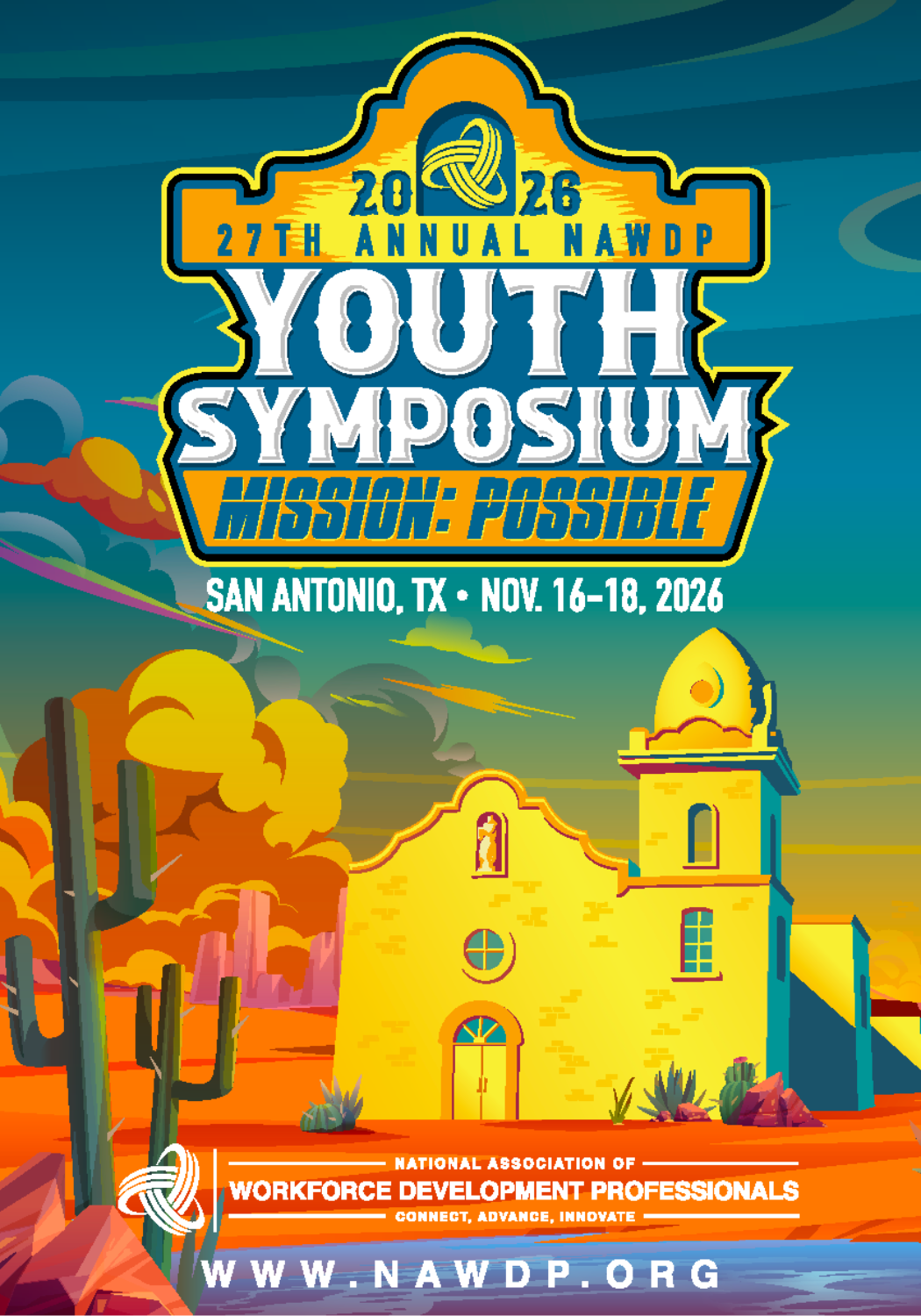
November 4, 2026, 1:00-2:00 pm CST | Are you new to NAWDP or thinking about becoming a member? Curious about the Certified Workforce Development Professional® (CWDP) credential and how it can support your professional growth? Join NAWDP’s Director of Membership, Alexis Franks, for an engaging introduction to NAWDP, including the benefits of membership, valuable resources and professional development opportunities, current NAWDP initiatives, and an overview of the CWDP and how you can earn it. Register Here
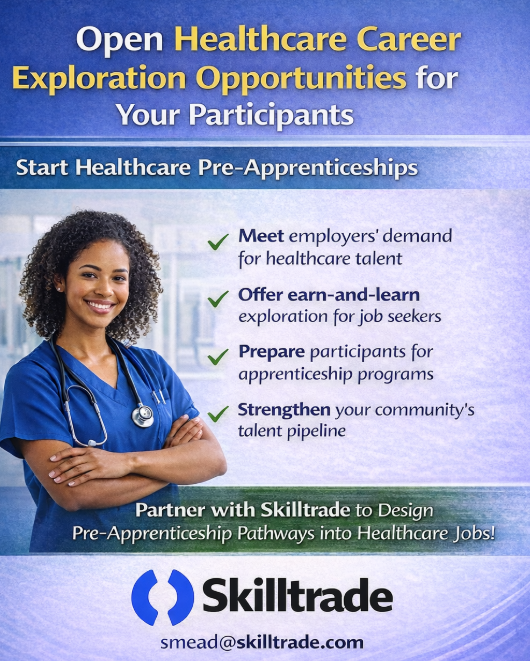
Skilltrade seeks partners to launch new Clinical Medical Assistant Career Training Pilot Programs across the country. Contact Sandy Mead to collaborate and learn more: Here
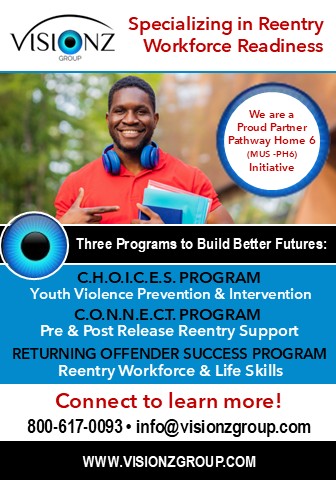
Visionz Group seeks partners to collaborate on expanding workforce readiness and reentry training programs in communities nationwide. Organizations interested in strengthening youth intervention, pre- and post-release support, and returning citizen workforce development are encouraged to connect and learn more: Here
The Foundation for Talent Transformation introduces its Well-being Framework in a comparative study of global models. More About Well-being Framework: Here
The Community Spotlight Advertisements are open to any organization, employer, or partner that wants to share programs, services, events, or solutions with a national audience of workforce leaders and practitioners. The MUS Connector provides a respected platform for those contributing to workforce innovation, talent development, and system strengthening to connect with peers across the country. To learn more about placement options or request a rate card, please contact Casandra at Casandra@midwesturbanstrategies.com.
Explore and Connect Today!
262-794-3019
| | Disclaimer: The views and opinions expressed in the author’s articles featured in this newsletter are those of the individual authors and do not necessarily reflect the official policy or position of Midwest Urban Strategies nor do they represent the views of any federal funding agency. Inclusion of these articles does not imply endorsement by Midwest Urban Strategies. | | | | |