|
Artificial Intelligence (AI) is no longer just a buzzword—it’s becoming an integral part of classrooms, planning periods, and professional learning communities. But the most powerful uses of AI aren’t about automation or replacement. They emerge when educators treat AI as a collaborator: a thinking partner that enhances creativity, supports personalized learning, and deepens critical thinking.
AI as a Teaching Partner
When a teacher begins planning a unit, AI can serve as a co-designer—helping to brainstorm essential questions, align activities with standards, and suggest cross-curricular connections. The U.S. Department of Education encourages this kind of instructional co-design, highlighting AI’s role in fostering innovation and responsiveness.
AI tools can offer a running start on creative planning, generating sample projects or thematic links that teachers can tailor to their students. As Nicholas Provenzano (aka The Nerdy Teacher) notes, AI can be a transformative partner in project-based learning (PBL)—a high-impact strategy that’s often time-intensive to plan. With AI handling some of the initial brainstorming and resource curation, teachers are freed to focus on student needs and authentic assessment.
For differentiation, educators are increasingly turning to AI to generate multiple lesson variations. With just a few prompts, they can design content for remediation, on-level instruction, and enrichment—while also supporting multilingual learners and students with IEPs. A Digital Learning Institute webinar highlights how AI-driven planning can save time and promote equity, creating more inclusive learning environments.
The collaborative power of AI also shines in feedback and assessment. Teachers can use AI platforms to provide instant, rubric-aligned feedback during revision, preserving time and improving learning outcomes. The University of Illinois reports that such formative feedback enhances student performance while easing the workload for teachers. Katie Durkin of MiddleWeb further emphasizes that AI can inspire student writers by offering meaningful revision suggestions, increasing both engagement and skill development.
AI for Deeper Student Thinking
AI is also becoming a tool for students, sparking deeper critical thinking and more engaging learning experiences. In literature or history classes, students might use AI to “interview” fictional characters or historical figures, gaining insight into motivation, context, and ethical dilemmas. UK schools have found that this strategy enriches discussion and deepens understanding, according to The Guardian.
Students preparing for debates or discussions can test their arguments against AI, receiving instant counterpoints and refining their logic in a low-stakes setting. A 2023 study by Kim and Tan found that AI-assisted dialogues improve students’ confidence and the sophistication of their reasoning. Recent Microsoft research also supports this, suggesting that increased self-confidence leads students to apply more rigorous critical thinking when working with AI.
Helping students analyze bias, tone, and credibility in texts (whether articles, sources, or their own writing) is a key part of teaching with AI. By guiding students to examine media and generative content critically, educators promote media literacy and ethical awareness. The National Science Teaching Association encourages this approach, emphasizing the importance of showing students how to analyze, not just what to believe.
Incorporating tools like Real or Fake Test into class activities can help students detect AI’s limitations and develop a healthy skepticism. Ethical exploration is also gaining momentum in AI-integrated classrooms. Through simulations and guided debates, students confront pressing issues like surveillance, bias, and digital citizenship. Digital Promise recommends this method to ensure students don’t just use technology but understand and challenge it.
Final Thought: From Tool to Teammate
The promise of AI in education lies not in shortcuts, but in smart partnerships. When educators and students collaborate with AI, they multiply what’s possible. Teaching becomes more creative. Learning becomes more rigorous. And technology becomes not just a tool but a teammate.
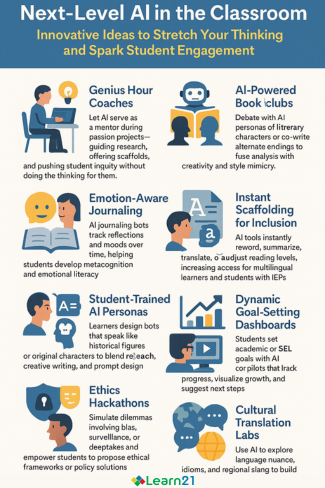
BONUS: Next-Level AI in the Classroom
Innovative Ideas to Stretch Your Thinking and Spark Student Engagement
1. Genius Hour Coaches
Let AI serve as a mentor during passion projects—guiding research, offering scaffolds, and pushing student inquiry without doing the thinking for them.
2. Real-Time Simulations
Use generative AI to create evolving roleplays in history, ethical debates in civics, or responsive science labs that react to student choices.
3. AI-Powered Book Clubs
Debate with AI personas of literary characters or co-write alternate endings to fuse analysis with creativity and style mimicry.
4. Emotion-Aware Journaling
AI journaling bots track reflections and moods over time, helping students develop metacognition and emotional literacy.
5. Instant Scaffolding for Inclusion
AI tools instantly reword, summarize, translate, or adjust reading levels, increasing access for multilingual learners and students with IEPs.
6. Student-Trained AI Personas
Learners design bots that speak like historical figures or original characters to blend research, creative writing, and prompt design.
7. Dynamic Goal-Setting Dashboards
Students set academic or SEL goals with AI co-pilots that track progress, visualize growth, and suggest next steps.
8. Teacher AI Studio Spaces
Educators remix ideas using multimodal AI (text, image, audio, video) to co-create engaging, cross-curricular content.
9. Ethics Hackathons
Simulate dilemmas involving bias, surveillance, or deepfakes and empower students to propose ethical frameworks or policy solutions.
10. Cultural Translation Labs
Use AI to explore language nuance, idioms, and regional slang to build empathy and global competence in world language or social studies classes.
For even more innovative uses of AI in education, check out the 100+ Creative ideas to use AI in education: A collection curated by #creativeHE.
|