|
On Monday afternoon, meeting attendees had the opportunity to visit two sites in Milwaukee that helped illustrate water conservation and aquaculture in the region.
Tour participants visited the Milwaukee Metropolitan Sewerage District (MMSD). The tour included a guided bus tour of the Jones Island Water Reclamation Facility to learn more about how wastewater is cleaned and returned to Lake Michigan. Attendees also toured the facility where MMSD makes Milorganite®, a slow-release nitrogen fertilizer trusted by experts since 1926.
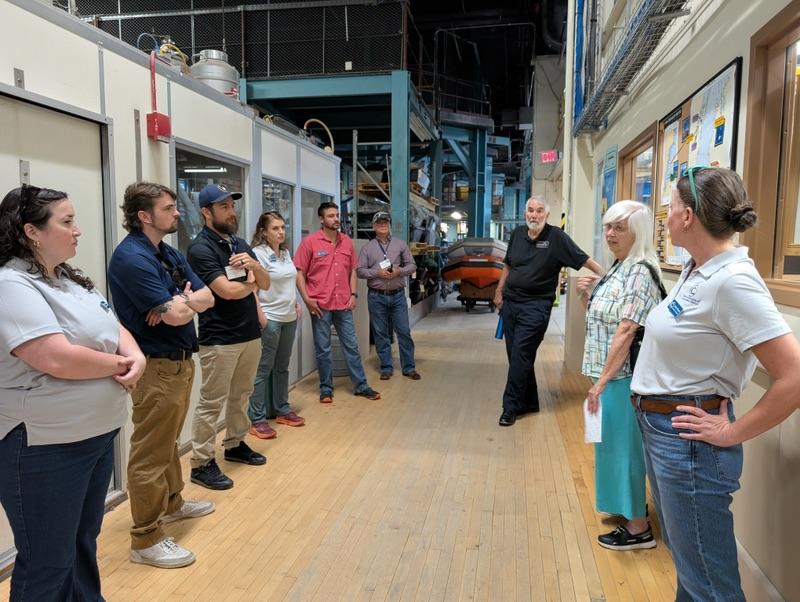
The tour also visited the University of Wisconsin–Milwaukee School of Freshwater Sciences, the nation’s first school focused entirely on freshwater research. They explored the university’s aquaculture facilities dedicated to sustainable fish farming and visited labs where scientists monitor and improve water quality in the Great Lakes and surrounding watersheds. This behind-the-scenes tour offered a unique look at innovations that protect and sustain freshwater resources.
On Tuesday, meeting attendees gathered early to head off on a full-day tour.
First, they visited Elkhorn, where the Walworth County Land Conservation Department (LCD) has been working since 2013 to install conservation best management practices on a 560-acre farm. The Walworth County LCD has partnered with NRCS, Ducks Unlimited, the U.S. Fish and Wildlife Service, the township, and the local lake protection group to implement conservation best management practices, including grassed waterways, wetland reconstruction, and sediment control basins, to protect soil health.
Next, the tour traveled to Case Eagle Park in Racine County, a collaborative research project between the Racine County Land + Water Division and the Watershed Protection Committee of Racine County, a local producer-led group. The park spans over 300 acres, including 50 acres of cropland. Researchers are studying soil health, water quality, and the carbon footprint of cropland plots, along with performance indicators like crop yields and economic performance.
For lunch, participants were treated to a meal at and tour of Starry Nights Farm in Kenosha County. Tour attendees learned how returning livestock to the land in a well-managed system can enhance soil health, water quality, wildlife habitat.
Later, folks spent a couple of hours visiting a unique regenerative stormwater conveyance system and learned about habitat restoration at Pritchard Park in Racine County, a collaboration between Racine County, Root-Pike Watershed Initiative Network (Root-Pike WIN), and the U.S. Fish and Wildlife Service.
The tour ended with a social gathering and a barbecue dinner at Discovery World in Milwaukee with beautiful views of Lake Michigan and time to explore the largest aquarium in Wisconsin.
|