|
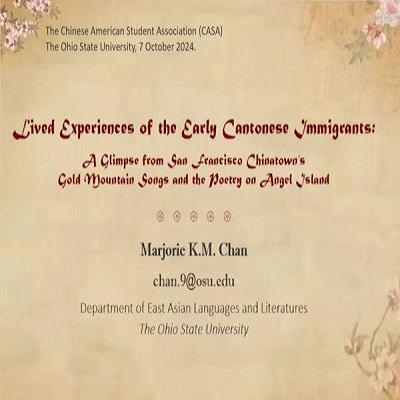
The Chinese American Student Association (CASA), with support from the Institute for Chinese Studies, will present a lecture featuring Marjorie K.M. Chan, Ohio State University, on Monday, October 7 from 6 - 8 p.m. in 2004 Evans Laboratory. Chan will present "Lived experiences of the early Cantonese immigrants: A glimpse from San Francisco Chinatown’s Gold Mountain songs and the poetry on Angel Island."
Abstract: The California Gold Rush (1848-1855) attracted hundreds of thousands of people from within the U.S. and beyond to California, including many from China who settled in San Francisco. They joined those who, back in 1838, had travelled north from Mexico to the city. In 1853, San Francisco’s Chinese neighborhood (“Little Canton”) was given the name “Chinatown” by the press. These residents, who came mostly from Cantonese-speaking counties in the Pearl River Delta in Guangdong Province in southern China, refer to their enclave as “Tangren Jie” 唐人街 (‘Tang people’s Street’).
This talk has two main objectives. The first objective is to provide some historical background on early Chinese immigration to the U.S., and on Angel Island Immigration Station (1910-1940) in San Francisco Bay. And the second objective is to present the lived experiences of these immigrants in the early 20th century of those seeking to enter the U.S. and those living in San Francisco Chinatown. This is accomplished through two main sets of poetry: (1) Angel Island poems that were carved by detainees into the walls of the barracks on Angel Island, many having been translated by Lai et al. (1980, 2014). And (2) Gold Mountain songs in two volumes (金山歌集, 金山歌二集 ) with many of them having been translated by Hom (1987). The poems offer a glimpse into not only the lived experiences of the immigrants, but also into family and loved ones left in China and those who were denied entry into the U.S. and were deported.
|