|
Call for Abstracts
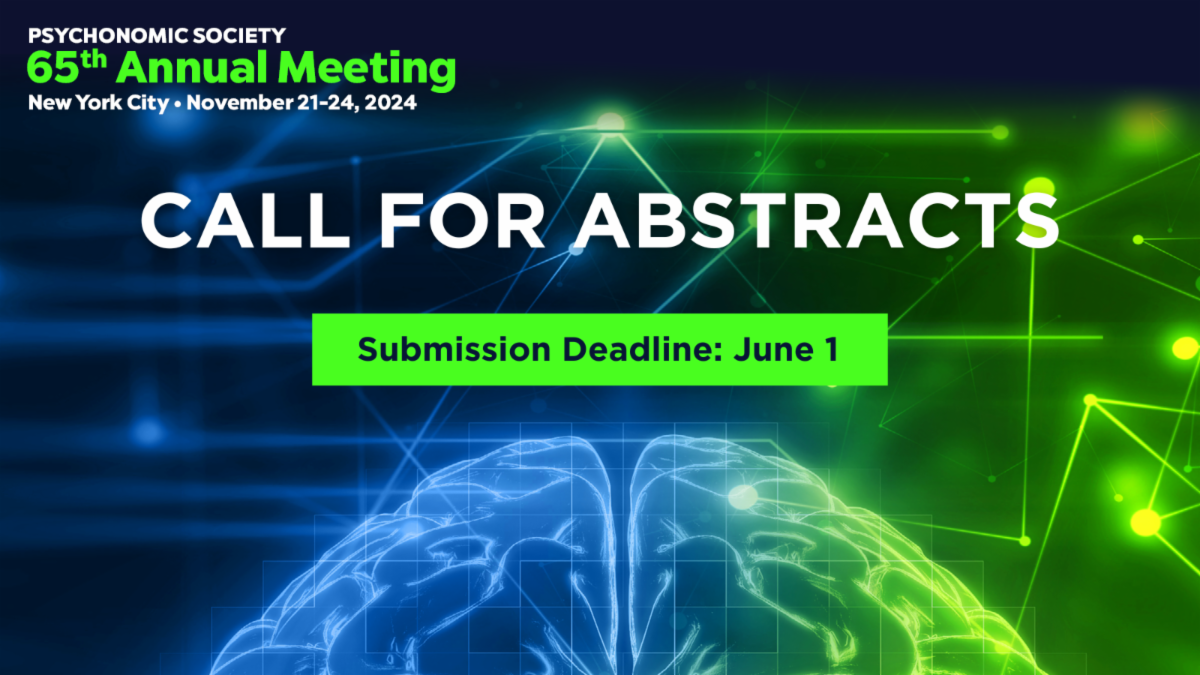
Abstracts may now be submitted for presentation at the 65th Annual Meeting in New York City, November 21-24, 2024. Please review the submission guidelines provided here. The deadline for abstracts (talks and posters) is June 1.
| |
| |
|
Call for Lunchtime Workshops
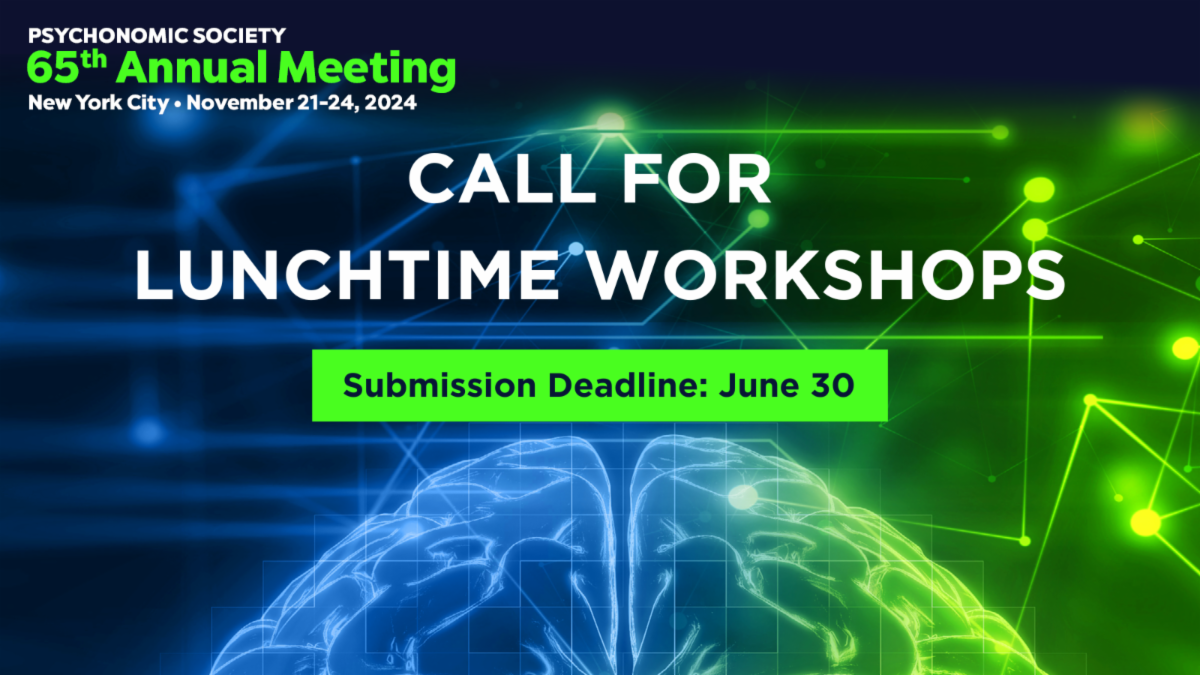
Lunchtime workshops are sessions intended to convey specific knowledge or skills. Workshops may involve one or several leaders/presenters.
A strong workshop proposal will make clear what knowledge, skills, tools, or insights participants might expect to gain from the session.
| |
| |
Please view the details and submission requirements here. The deadline for proposals (approximately one page) is June 30. | |
Symposia at the 2024 Annual Meeting | |
|
The Governing Board is pleased to announce symposia selections for our 2024 Annual Meeting. The dates and times of each symposium will be published in August. To view the symposia abstracts, please click here.
Understanding and Combating Misinformation Spread: The Role of Individual Differences, Sociocognitive Correlates, and Artificial Intelligence
Organizer: Taylor M. Curley, Air Force Research Laboratory, USA
New Frontiers in the Cognitive Sciences of Music and Health
Organizers: Daniel J. Levitin, Minerva University, USA, and Assal Habibi, University of Southern California, USA
How Does Meaning Come to Mind? Advances in Understanding Conceptual Knowledge
Organizers: Veronica Diveica, McGill University, Canada, Emiko Muraki, University of Calgary, Canada, and Penny Pexman, Western University, Canada
The Future of Future Thinking: Toward an Integrated Science of Prospective Cognition From the Psychonomic Society’s Leading Edge Workshop initiative
Organizers: Karl Szpunar, Toronto Metropolitan University, Canada, and Donna Rose Addis, Rotman Research Institute, Canada
Climate Change and Human Cognition Organizers: James Pomerantz, Rice University, USA, and Suparna Rajaram, Stony Brook University, USA
The Program Committee consists of Chair, Michael J. Kane, University of North Carolina at Greensboro, USA; Monica Castelhano, Queen's University, Canada; Myra Fernandes, University of Waterloo, Canada; Zenzi M. Griffin, University of Texas at Austin, USA; Heather Hill, St. Mary's University, USA; Christopher Madan, University of Nottingham, UK; Governing Board Chair, Stephan Lewandowsky, University of Bristol, UK; and Secretary, Marianne Lloyd, Seton Hall University, USA.
| |
PS One World Seminar Series Presents
Leah Fostick on May 22
| |
|
Different perceptual strategies in auditory processing
Speaker: Leah Fostick
Ariel University, Israel
May 22, 2024
11:15 AM - 1 PM U.S. Eastern Time | Register Now
Abstract
Does everyone perceive stimuli in the same manner? Similar perceptual processes are assumed for people with similar sensory, perceptual, and cognitive abilities. However, an increasing number of studies show differences in the ways participants perform different tasks, despite similar abilities. More.
All talks in the One World Seminar Series are underwritten by the Psychonomic Society and made available free of charge. The Society is committed to programmatic accessibility and has secured ASL interpretation and closed captioning for all One World events in the 2023-2024 academic year.
| |
Call for Nominations
2025 Governing Board
| |
|
Submit your nominations for the 2025 Governing Board Election by June 30. This year's elected candidates will fill the two full terms available on the Governing Board (2025-2030) and the third top vote getter will serve the remaining four years (2025-2028) of a Governing Board member's term due to a resignation.
Fellows and Emeritus Fellows of the Society may nominate up to four persons and Fellows as well as run for election. The election will open on August 1. To learn more about the election and submit your nominations, click here.
Members of the Governing Board help shape the activities and long-term strategy of the organization through participation in Board meetings and service on various PS committees. A full list of the 2024 Governing Board and committees may be viewed here.
| |
Congratulations to the
2024 Spring Class of Fellows!
| |
The Psychonomic Society Governing Board welcomes the following members as the newest Fellows of the Society. Join us in congratulating the 2024 Spring Class of Fellows! | |
|
Claude Alain, University of Toronto
William Choi, University of Hong Kong
Gidon Frischkorn, University of Zurich
Kevin Holmes, Reed College
Jared Hotaling, University of Illinois, Urbana-Champaign
Liv Hoversten, University of California, Santa Cruz
Chuchu Li, University of California San Diego
Jason Lodge, University of Queensland
Alice Mason, University of Bath
| |  |
|
Alodie Rey-Mermet, UniDistance Suisse
Jennifer Rodd, University College London
Agnes Rosner, Leibniz University Hannover
Jesse Sargent, Francis Marion University
Briony Swire-Thompson, Northeastern University
Susan Teubner-Rhodes, Auburn University
Igor Utochkin, University of Chicago
Katie Wissman, North Dakota State University
| |
|
Our new fellows were selected by the Fellows Committee: Jeanette Altarriba, University at Albany, SUNY, USA (Chair); Andrew Butler, Washington University in St. Louis, USA; Myra Fernandes, University of Waterloo, Canada; Kristi Multhaup, Davidson College, USA; and Thomas Redick, Purdue University, USA.
The Call for Fellows applications for the 2024 Fall Class is now open. The deadline is September 1, 2024. Learn more.
| |
Grants Available Up to $40,000 from
William K. and Katherine W. Estes Fund
| |
|
The William K. and Katherine W. Estes Fund invites proposals to fund advanced training opportunities in mathematical and computational modeling for psychological science in summer schools or focused workshops. The deadline for initial proposals is September 1.
Jointly overseen by the Psychonomic Society and the Association for Psychological Science, the Estes Fund supports a variety of activities aimed at strengthening methodology in mathematical, quantitative and experimental psychology and related areas. Learn more about the funded projects and how you can submit a 2025 initial proposal here.
|
|
Psychonomic Society Journals
| |
Double-blind Peer Review for
Psychonomic Bulletin & Review to Begin Shortly
In line with efforts to make publishing more accessible globally and at all career stages, we will pilot double-blind peer review for Psychonomic Bulletin & Review. Double-blind review masks author identities from reviewers, and vice versa, to minimize potential biases. The Governing Board has approved a one-year double-blind pilot, after which we will evaluate its impacts by comparing against the prior single-blind process. Analyses will cover submission numbers, review quality, biases, anonymization issues, and author/reviewer surveys. Guidelines will assist authors in writing anonymously, publishing preprints, and self-citation practices.
The editorial board will establish clear, fair, and open criteria defining the pilot's success upfront. If double-blind review does not continue after the pilot, reasons will be transparent per these criteria. Through this initiative, we aim to improve the publishing process in line with global best practices for accessibility and ethical evaluation.
| | |
The psychological reality of the learned "p < .05" boundary
| By V. N. Vimal Rao, Jeffrey K. Bye & Sashank Carma | |
Rao and colleagues found that graduate students, unlike undergraduates, were sensitive to the .05 boundary for statistical significance. They suggested that this sensitivity is learned through training and exposure to the literature. This effect was not linked to endorsements of questionable research practices. Read this paper.
|
By Simone Sulpizio, Fritz Günther, et al. | |
Taboo language and its variations across languages and populations are poorly understood. In a multi-lab collaboration, the authors compiled a comprehensive database of taboo words from 13 languages across 17 countries. Taboo words were characterized by low valence and high arousal and were rarely used in written language. Read this paper.
|
By Melanie Labusch, Jon Andoni Duñabeitia & Manuel Perea | |
Labusch et al. investigated brand names embedded in logotypes to test theoretical accounts of word recognition. Two experiments showed longer response times for altered brand names, favoring accounts that posit lexical memory traces may encompass surface perceptual details. Read this paper.
|
|
|
Attention, Perception, & Psychophysics
Volume 86, Issue 3
Psychonomic Bulletin & Review
Volume 31, Issue 2
Cognitive, Affective, & Behavioral Neuroscience
Volume 24, Issue 2
Attention, Perception, & Psychophysics
Volume 86, Issue 4
Cognitive, Affective, & Behavioral Neuroscience
Volume 24, Issue 3
| |
If you have recently published in one of our seven journals, you are eligible to request special coverage of your article on the PS Featured Content blog or All Things Cognition podcast.
This is a great way to disseminate your research findings to an even broader audience.
To request special coverage, ensure you are a member in good standing, follow these Guidelines for Authors or contact Dr. Laura Mickes, Digital Content Editor.
| |
SharedIt
Authors in our journals can share their content easily and legally through Springer’s SharedIt program, a content-sharing initiative.
| | | |
|
Membership gives you reduced registration fees for the Annual Meeting, complimentary access to all seven PS journals, the chance to submit proposals for exclusive PS funding opportunities, and more. | | | | | |