|
The TCCPI Newsletter
Issue #87: March-April 2025
| | |
TCCPI is a multisector collaboration seeking to leverage the climate action commitments made by Cornell University, Ithaca College, Tompkins Cortland Community College, Tompkins County, the City of Ithaca, and the Town of Ithaca to mobilize a countywide energy efficiency effort and accelerate the transition to a clean energy economy. Launched in June 2008 and generously supported by the Park Foundation, TCCPI is a project of the Sustainable Markets Foundation.
We are committed to helping Tompkins County achieve a dynamic economy, healthy environment, and resilient community through a focus on energy efficiency and renewable energy.
| |
Climate Groups Sue Hochul Administration Over
Climate Law Backtracking
by Colin Kinniburgh, Focus, 3/31/25
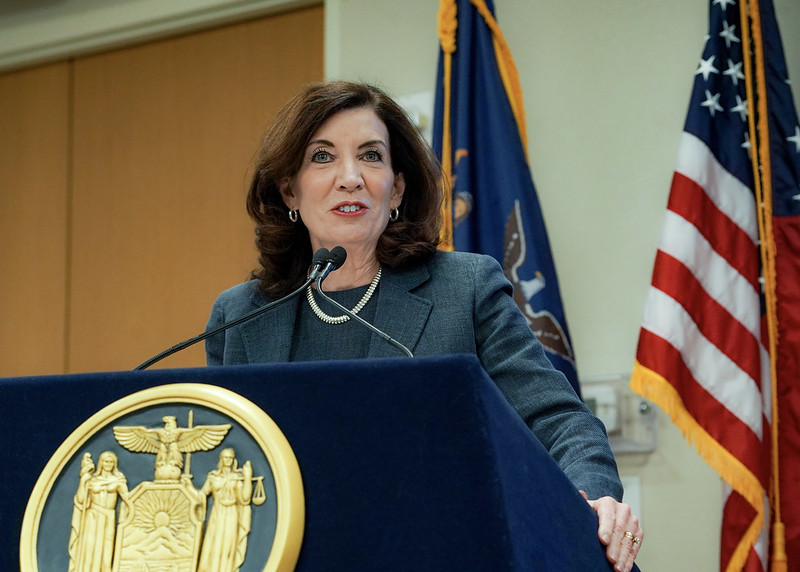
| | Gov. Hochul's delay in implementing the state climate law is at the center of a new lawsuit against the state. Photo Marc A. Hermann/MTA licensed under CC BY 2.0 DEED. | | |
It’s official: New York is being sued over delays in implementing its climate law.
Four environmental and climate justice groups filed a lawsuit on March 31 in a state court, claiming that New York is “stonewalling necessary climate action in outright violation” of its legal obligations.
By not releasing economy-wide emissions rules, the suit alleges, the state Department of Environmental Conservation (DEC), is “defying the Legislature’s clear directive” and “prolonging New Yorkers’ exposure to air pollution … especially in disadvantaged communities.”
| | |
Lawsuit Centers on Cap & Invest Rules
It’s the first lawsuit to charge the state with failing to enforce the core mandate of its 2019 Climate Leadership and Community Protection Act (CLCPA): eliminating nearly all of New York’s greenhouse gas emissions by 2050. The law tasks DEC with crafting rules to get there and to reach an interim target of 40 percent emissions cuts by 2030.
The lawsuit centers on rules for cap and invest, an economy-wide carbon pricing program that Hochul has been promising since 2023. DEC and the state’s energy research and development arm, NYSERDA, spent much of the last two years developing the program. In December, agency staff told environmental groups that the draft rules were all but ready to go and would be released in January, allowing the state to start charging polluters before the end of 2025.
At her State of the State speech in mid-January, Gov. Hochul made no mention of cap and invest. Her briefing book said DEC and NYSERDA needed more time to work out the details, promising only that DEC would publish rules requiring polluters to report their emissions. Her administration maintains that it is still moving ahead with cap and invest, but has declined to commit to any timeline for doing so.
Hochul’s backtracking is at the heart of the lawsuit filed Monday by Earthjustice and two other environmental law groups on behalf of Citizen Action of New York, PUSH Buffalo, Sierra Club, and WE ACT for Environmental Justice, all members of the NY Renews coalition that led the charge to pass the CLCPA.
“We’ve just seen a continual slow walk of climate action at the state level… that puts us in a position where we need to have a judge put us back on track,” said Eric Walker, the energy justice senior policy manager at WE ACT.
The plaintiffs charge that by walking back from its climate plan, New York is also infringing on its residents’ constitutional rights — specifically the rights to “clean air and water, and a healthful environment” enshrined through the Green Amendment that voters approved in 2021. Air pollution is especially harming the health of residents in disadvantaged communities, they allege, where several of the groups’ members live near fossil fuel plants or in high truck traffic areas.
| | |
Next TCCPI Meeting
Friday, May 30, 2025
9 to 11 am
TCCPI meetings have moved online. Contact Peter Bardaglio, the TCCPI coordinator, for further details at pbardaglio@gmail.com.
| | |
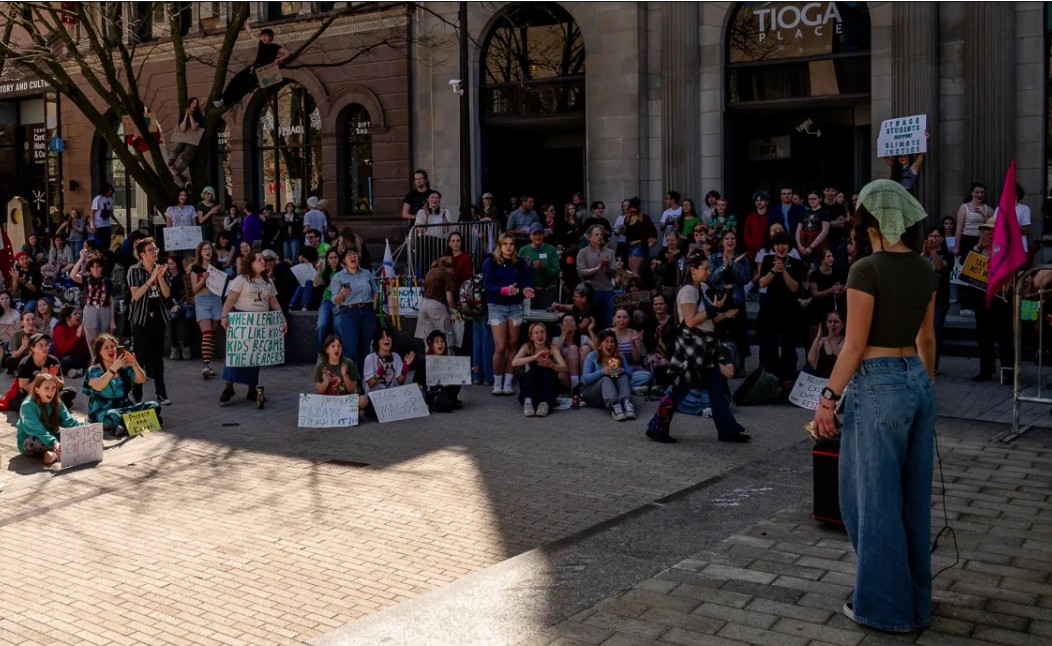
Ithaca City students walked out of their classes on April 22 in a rally on The Commons to observe People’s Earth Day 2025.
The event, which drew a crowd of over 200 people, was equal parts celebration of the Earth, condemnation of the federal government’s neglect of climate change, and Cornell University’s resistance to doing more to combat its causes.
Noa Greene-Houvras and other speakers on stage at the Bernie Milton Pavilion on The Commons addressed Cornell University’s attempts to amend the Ithaca Energy Code Supplement (IECS).
| | Attendees at the youth-led rally on The Commons on April 22. Credit: Casey Martin/The Ithaca Voice. | | |
Should Cornell be Exempt?
The IECS is the city’s fossil-fuel phase-out plan, and Cornell argues it should be exempt because adhering to the phase-out would actually lead to increased fossil fuel emissions.
This argument continues to be disputed by Cornell On Fire, Sunrise Ithaca, and other local environmental figures including Ian Shapiro, who helped develop the IECS.
In an interview with the Ithaca Voice, students Ada Goldweber and Frida Jefferis said they were in town two summers ago when wildfire smoke from Canada blanketed the sky. They fear days like those are going to become more common as the planet warms.
New Roots Charter School students participated in a handful of Earth Day activities before the rally. Claire Springston, a junior at New Roots, went on a birding hike around First and Second Dam during which she learned about existential threats to bird populations. This was her first protest.
“I think the most pertinent thing that could happen is more people being angry enough to all do something,” she said. “Even this event, it’s very cool. It’s probably not necessarily going to make a huge change.”
Macky Caraballo, another New Roots junior, was present at the rally to support the movement.
“There’s a lot of capitalism that crushes and kills the planet, and I’m very much against that,” Caraballo said. “Any support I can give to the destruction of capitalism, I’m all for it.”
Prompted by Caraballo, Crysania Little, a New Roots student, drew a sign for the protest depicting Trump eating the Earth. She said Trump’s actions make her worry for her future and future generations.
New Roots teachers like Diego Arenas-Purvinis and Connor Reynolds said at the rally that they’ve seen their students affected by the anxiety of climate change fears.
“It hits all the students differently from what I’ve seen,” Arenas-Purvinis said. “[From] a range of, ‘We need to do something about this’ [to] ‘What can we do about like, are we screwed?’”
What’s important to remember, Arenas-Purvinis said, is that change takes time. The more visible the movement is, the more people it draws in, they said. Even if change feels far away, this is where change happens, they said.
“It’s happening,” they said.
| |
City of Ithaca Earns LEED Gold Certification With Help
From Cornell Students
Staff Report, Fingerlakes1.com, 4/21/25
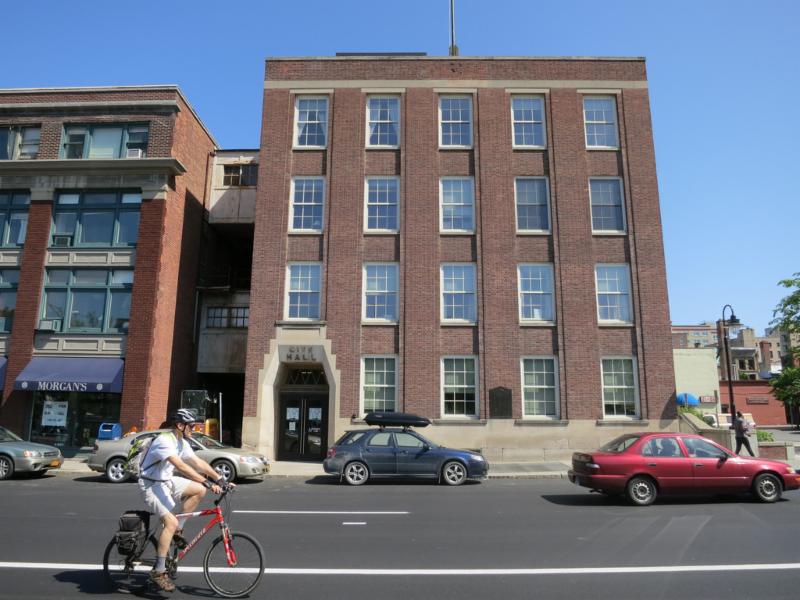
| | The City of Ithaca received LEED Gold certification with the assistance of Cornell students. Photo by Paul Sableman licensed under CC BY 2.0. | | |
The City of Ithaca has achieved LEED Gold certification through the U.S. Green Building Council’s LEED for Cities program, thanks in part to a multi-year collaboration with students from Cornell University.
Since 2022, a team from Cornell University Sustainable Design (CUSD) worked alongside Ithaca officials to compile the extensive documentation needed for the certification—recognized globally as a benchmark for municipal sustainability.
The student-led group collaborated with departments across the city to analyze metrics related to energy, water, waste, transportation, and land use.
| | |
A New Model for City-Campus Collaboration
More than 60 students contributed to the effort, representing disciplines such as civil engineering, environmental analysis, and urban planning. Their work earned Ithaca a Gold rating—the second-highest level under LEED for Cities, behind only Platinum.
The LEED evaluation considered a broad range of data including greenhouse gas emissions, green spaces, transit systems, and quality of life indicators. Ithaca scored high in multiple categories, especially in integrative planning and resource efficiency.
“This project gave our students a chance to work in real-world conditions while supporting the city’s sustainability goals,” said Sirietta Simoncini, a Cornell lecturer and faculty advisor for the project. “It required a resilient, interdisciplinary team to tackle the challenge.
Unlike most municipal LEED applications, Ithaca’s submission was largely student-driven. With guidance from city sustainability planner Savannah Vega and engineering firm Tetra Tech, students gathered data, conducted workshops with local officials, and revised their application based on initial feedback from the U.S. Green Building Council.
The city ultimately scored 60 out of a possible 110 points, enough to secure the Gold certification in late 2024.
“This is a new model,” Vega said. “We wouldn’t have had the capacity to do this alone. The students made it possible.”
The team is now developing a public-facing report to highlight Ithaca’s strengths and identify areas for improvement. The findings will be used to inform future projects, including the development of Ithaca’s Cherry Street district.
For the students involved, the experience offered more than just a résumé boost.
“It was really valuable to see how the city functions beyond the university,” said Jiayi Guo, a design and environmental analysis major who co-led the team. “We didn’t just earn a certificate—we built something that others can learn from.”
| | Take a step to save money and energy! | | One Last Thing: Let's Keep the Inflation Reduction Act Powering Upstate New York | | |
The following was originally published in the Ithaca Times on April 20, 2025.
Upstate New York has always been a place where hard work and innovation go hand in hand, going back to the building of the Erie Canal. Now, thanks to the Inflation Reduction Act (IRA), our region is seeing a surge in clean energy investments that are creating jobs, lowering energy costs, and strengthening local economies.
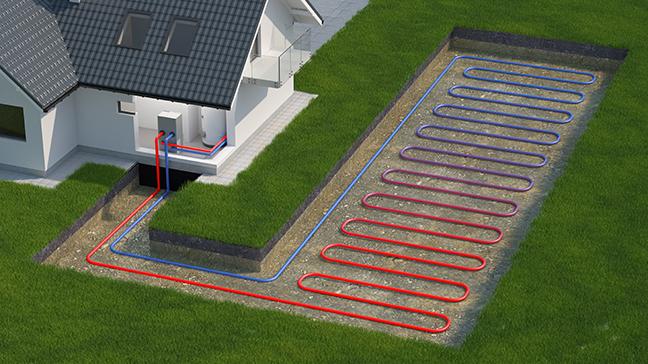
| | Federal tax credits through the Inflation Reduction Act (IRA) can cover to 30% of the installation cost of geothermal heat pumps, including labor and equipment | | |
The IRA Drives Economic Benefits
We can see firsthand how federal policies like the Inflation Reduction Act (IRA) are driving tangible benefits for our communities. Ithaca's groundbreaking plan to decarbonize the city’s buildings, for example, is tapping into federal incentives to make the transition affordable and sustainable.
Meanwhile, the IRA’s Rural Energy for America program is helping farms and small businesses across the Southern Tier invest in energy efficiency upgrades and clean energy projects for affordable energy they can generate on their own land.
| | |
Key to Private Investment Growth
Throughout our region and the nation, clean energy projects are delivering economic growth and hundreds of new jobs. Since the passage of the IRA, the U.S. has added more than 400,000 new clean energy jobs and seen over $422 billion in private investment. And in New York alone, federal clean energy tax credits have driven $115.47 billion in investments and created nearly 29,000 jobs since they were passed. Here in our region, the impact is clear: new, good-paying jobs in manufacturing, more reliable, locally-produced clean energy, and strengthened economic opportunities in both urban and rural communities.
Despite this momentum, some in Washington want to roll back these critical investments. Repealing clean energy tax credits would mean turning away billions in future investment, increasing energy costs for businesses and families, and slowing the progress we have worked so hard to achieve.
That’s why we need Rep. Josh Riley, Rep. Nick Langworthy, and Rep. Claudia Tenney to stand up for Upstate New York and protect the Inflation Reduction Act. Our region is already seeing the benefits, and by maintaining this momentum, we can build a future that is both economically and environmentally resilient. Now is the time to double down on our progress, like the early canal builders, not turn back.
Peter Bardaglio
TCCPI Coordinator
| |
Be sure to visit the website for TCCPI's latest project, the Ithaca 2030 District, an interdisciplinary public-private collaboration working to create a groundbreaking high-performance building district in Downtown Ithaca.
| |
309 N. Aurora St.,
Ithaca, NY 14850
607-229-6183
| | | | | |