We Untangle Complex Capial Structures

The commercial real estate debt market is not frozen, but it is far from liquid.

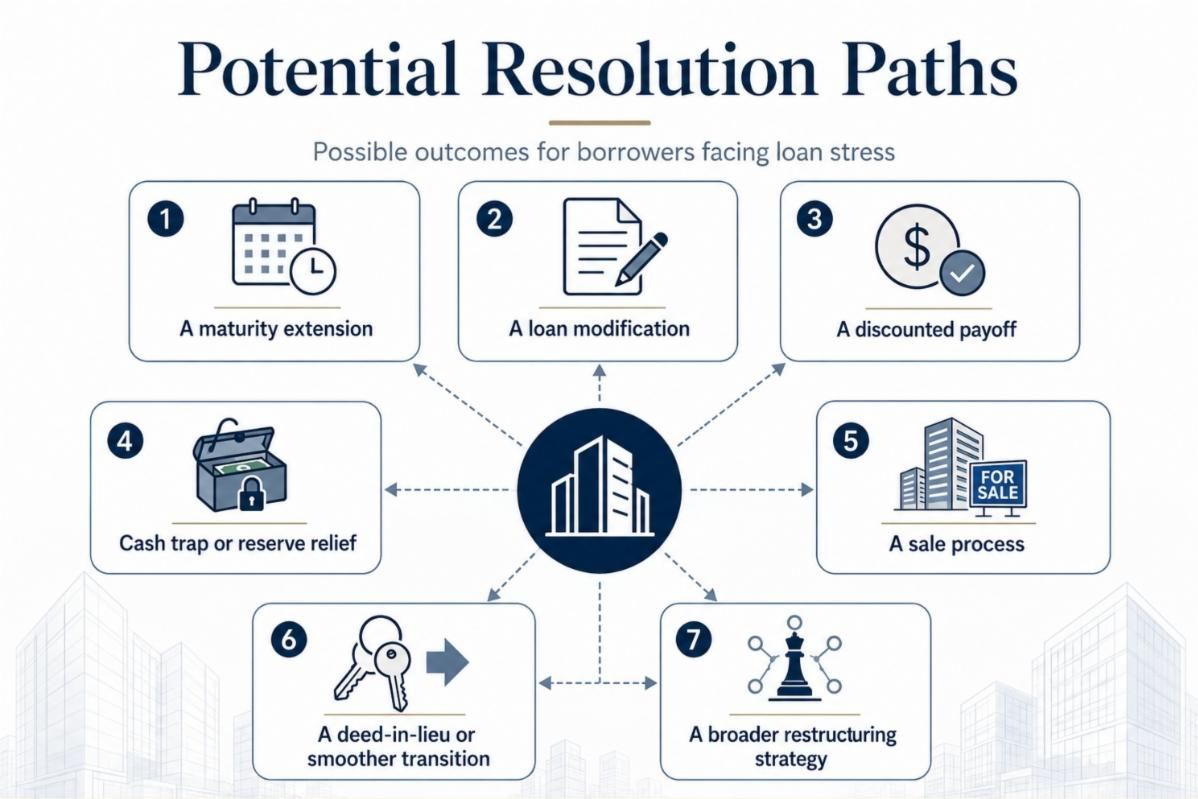
Lenders and special servicers are increasingly focused on resolution. Borrowers, meanwhile, are facing a more difficult refinancing environment, higher debt-yield requirements, and uncertainty around takeout financing. That tension is creating a clear friction point in the market.


Extensions are still happening. But they are more challenging to complete than they have been in the past.


They require the right proposal, the right borrower motivation, the right lender incentives, and a credible path forward.


WHY MATURITY RISK IS BECOMING THE BIGGER ISSUE

For many borrowers, the problem is not that the property has failed overnight. The problem is that the loan may no longer be refinanceable at the current debt amount.


Even when a borrower is still operating the property, today’s takeout financing may not provide enough proceeds to pay off the existing loan.


A loan on a watch list, a low DSCR, a cash trap, vacancy pressure, or an upcoming maturity can all be signs that a borrower should start evaluating options. But right now, maturity risk is often the biggest trigger because many borrowers simply cannot refinance into the current market and a sale process often produces disapointing results.

EXTENSIONS ARE STILL POSSIBLE BUT TERMS MATTER

There is a misconception that lenders are no longer granting extensions. That is not exactly what we are seeing.


Extensions can still happen, but they need to be supported by a serious and realistic plan. The borrower has to show what they are asking for, why it is necessary, and how the lender is better off by working toward a negotiated outcome rather than forcing a less productive resolution.

THE BASIS RESET IS STILL PLAYING OUT

In many office markets, the market has not fully found its bottom.


Some buildings are still operating an older and higher cost basis, while other properties have already gone through foreclosure or sale and now have a much lower basis. Those lower-basis owners can lease space at more competitive rents, which puts pressure on nearby owners who are still carrying older, higher debt loads.


Until more assets are right-sized, many markets will continue to feel uneven.

This is one reason that every loan situation needs to be underwritten carefully. A borrower’s strategy cannot be based only on hope that the market will recover. It needs to be based on what the asset can support today and what the lender is likely to accept.

TALK THROUGH A BORROWER SITUATION

The Henley Group is 100% Focused on Loan Workouts & Loan Advisory since 2009. We focus on Securitized Loans (CMBS, CRE CLO Freddie/Fannie) Balance Sheet Loans (Debt Funds, Traditional Banks, Life Co., Construction Loans).

We DO NOT Provide Financing | We DO NOT Sell Properties

We Pay Referral Fees to Our Partners