The Miles Franklin Newsletter
|
|
From The Desk Of David Schectman
|
|
David's Commentary:
So I’ve been thinking – for most of us, everything seems pretty “normal.” Very few people are actually
worried
. Who out there is afraid of where this is headed? I am, but I’m not your everyday normal person. I’ve been worried for the last two decades. I’ve been “The Boy Who Cried Wolf.” Actually, now is the third time that I can’t see any way out of a very big problem. I’m worried that this time it will be different! I’ll get back to this later in this narrative.
My friend Backwoods Jack chides me for keeping my money in gold and silver and for missing the current run up in the stock market. In a sense, he’s right. Indeed, I did miss the run up. Not because I’m uninformed, or stupid. I missed it on purpose. I am “worried.” Just because the Fed put out the fire in 2008 (at a cost of trillions of new dollars) I don’t believe that they corrected anything – in fact all they did was make things worse in order to keep the party going on a bit longer. A bit longer in this case could be a decade. But when we finally do pay the piper it will take longer than a decade to undo the damage that they have created. My history can be summed up in a sentence. He is almost always right, but always early.
I grew up in the 50s in a family where my father never earned any real money even in his best years. We were middle class when middle class meant having enough money to live comfortably but that was it. And it was a different kind of “comfortable.” One old car, a small black and white TV, one window air conditioner, a vacation maybe once every few years. We had very little and didn’t know it. Maybe that’s better? Janis Joplin nailed it – she sang, “Having nothing means having nothing to lose.” Money was never important to me, as long as I had enough to buy gas, a few beers, an occasional Gant button down shirt, a fashionable sweater or two and a nice pair of oxblood loafers. Ivy League was the big deal then. If you’re in your 70s you know exactly what I’m talking about. Hey, my first job after college, in 1964, paid me the grand total of $4,800 a year. I was happy with that. For a while. By the time I was 28 I was making $35,000 a year. I know that doesn’t sound like much today, but in 1968 we build a beautiful four-bedroom colonial home in the suburbs for less than $35,000. That house today would cost hundreds of thousands. And that’s what I made in a year, for several years in a row. But I didn’t care about investing. I made a science out of spending everything I made on a grand upper-middle class life style.
My wife Susan always worked and some years made more than I did, and we had enough money between us to enjoy the good life – two new cars, yearly vacations, new stereo equipment, etc. For our first 30 years of marriage, I was not interested in investing, other than some gold and silver I bought in the late 80s.
It was not until the mid-90s, when I had some extra money from the early success that Miles Franklin blessed me with, that, for the first time, I took a plunge in the stock market. I did what all my friends were doing; I took a few “tips” from people who didn’t know any more than I did, and jumped into the Dot Com market (bubble). I made a quick $100,000 and just as quickly I lost it. Even early on, when I was making money every day, something just didn’t feel right about it. That was when many successful people quit their jobs to become day traders in search of the good life. Nope, It didn’t seem right to me that one could make so much money so fast and so easily and without any particular skill set. And it turns out, it wasn’t.
I had missed the big gold and silver run up in the late 70s. I never had a chance to make “easy money.” My venture into the stock market in the late 90s provided a good lesson. And by 1999 I was totally out of stocks and tried to warn my friends that they should do the same. The looks I got! They all thought I was crazy. They might be right, but not about my views on the stock market.
By the time the stock market crashed in 2000, Susan was making from $150,000 to $250,000 a year as the Vice President of Sales at a boutique advertising firm. She was in charge of bringing in business from all the big food companies (Kraft, Ocean Spray, Carnival Cruise Lines, etc.) and she was very good at her craft. I was making enough to pay our living expenses. We had, the luxury of being able to invest her salary – and live on mine. I was convinced that a new bull market was in play in gold and silver. I loaded up and made a few very smart (lucky, actually) investments in mining shares. And my earnings were increasing rapidly, as the bull market in gold and silver continued throughout the 2000s. The more I made, the more I was able to invest in gold and silver.
I bought precious metals all the way up for over 10-years. The huge profits I made in mining shares (some went up 30-fold) built our fabulous contemporary house. And I used a lot of the profits to buy more
physical
gold and silver, which I understood was not to be sold. At least not then, and not even now. Actually, if things work out right, I will never have to sell them and can pass them on to my kids and their kids. That’s my plan. We shall see how it works out. But as that wise old banker I met in Zurich, at a seminar I was speaking at told me - I think his name was Frank Bauman from FOCO Bank – “You will never see a man broke, sitting on a park bench, with a gold coin in his pocket.” His advice was to put one ounce a week away when you are young and take one ounce a week out when you are old – you will never be poor. Savvy advice and a good plan! Yes, gold does go up - and it goes down, but it is always worth a lot of paper currency. That is not the history of paper assets.
O.K., you’ve followed my ramblings this far and you could sum it up this way. For most of his life he didn’t care about making a lot of money. He wasn’t interested in investing. The only stocks he owned that he made anything on were mining shares and he sold them when they were worth multiples of what he paid for them and used the proceeds to build a house and buy a lot of physical metals with the profits. And – he did not participate in the current run up in the stock market. I don’t feel bad. Heck, I made a LOT of money in the 11-year gold and silver bull market. And you know what, I’ll make a lot more in the coming bull market as well. We are rapidly moving toward a sea of change where things will flip-flop. The stock market will disappoint and take back most of it’s recent gains. Gold and silver will rise to levels no one will even believe. Real wealth will be made this time, because one of the casualties, besides the stock market, will be the US dollar. When people panic out of the dollar they will pay any amount, even an unreasonable amount for gold and silver. That’s what I’m holding out for.
I’ve lived through the ups and downs of the economy and the stock market. I was in my industry in 1987 and in 1999 and 2008 and honestly, could see what was coming each time. My friends and family ignored my warnings and none of them took any action, in advance. I did. I got it right. But I never jumped back in after the crashes. I guess I’m wired to be more focused on protecting what I have rather than increasing it – and it should be obvious by now to those of you who have been following the markets for a decade or two that you make money in gold and silver
fast
, and big time. Precious metals don’t go up the way the stock market does, which is usually gradual, over a long period of time. Most of the gains in precious metals come quickly. They spike, and then, at least so far, give much of it back. But if I’m right, this time gold should go up and stay there. Perhaps it will become the backing for a new currency? Jim Sinclair and Bill Holter think it will. They talk about the coming “reset.” If they’re right, and I wouldn’t bet against them, then you cannot have too much physical gold and silver and you better get it now, while you still can and while it is still cheap.
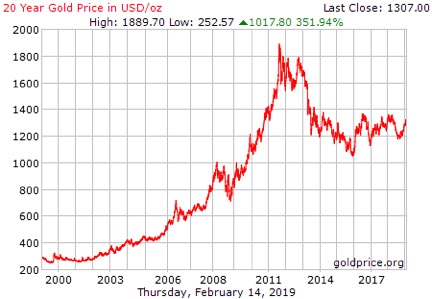
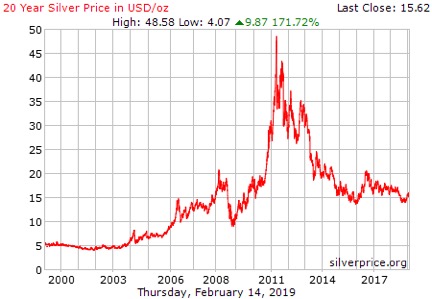
Note the spike in gold and silver in the most recent run-up. It was an 11-year bull market, but the big spike was a two or three year event. $250 to $1900 gold is impressive, much more than the recent triple in stocks. And silver, wow! $4 to $50! And you wonder why we are so excited about silver now, under $16 with a silver/gold ratio of 84+ to 1. That, dear readers, is a license to steal.
|
|
I am not concerned about my precious metals portfolio. I am not unhappy because I avoided the stock market for the last eight years. I am concerned because of the current interest in taxing the rich. There is a growing swell of envy and jealousy. You’ve been reading what Bernie Sanders, Elizabeth Warren, Kamala Harris and Ocasio-Cortez, to name but a few, are proposing. If you aren’t concerned about this, you should be. Because most of you will be considered “wealthy” by the masses when the stock market crashes and the next deep recession is at the doorstep. I am concerned that it will go way beyond raising taxes on all of us; I believe we will be targets.
This is the modern day equivalent of feudalism and serfdom except now, those on the lower end of the economy are much better off than the lowest classes were 300 years ago. They are targeting the billionaires now, but we will be in their sights too. We have more than they do, and that makes us a target too. As my friend Lou Reiter says, “David, what good do you think your gold and silver will do you when the shit hits the fan?” He has a point. Still, I would rather have it than not have it. I hope I never have to find out.
|
|
Greg Hunter’s USAWatchdog.com
Fed is Enemy of MAGA – David Stockman
Reagan White House Budget Director and best-selling author David Stockman says Fed policies over the last couple of decades hit the middle-class hard. Stockman contends, “The Fed drove up costs, prices and wages at 2% come hell or high water. You do that for two or three decades and, all of a sudden, you are totally uncompetitive. You have the highest cost structure in the world economy, and the jobs and production migrate to where companies can find lower costs and better profits. So, the Fed hit the economy and the middle-class, what I call fly-over America, with a double whammy. The Fed’s 2% inflation drove jobs offshore and undermined wages and the middle-class economy. At the same time, it vastly inflated and subsidized a massive gambling spree and financial asset inflation on Wall Street. . . . Not only was this (Fed) policy the enemy of MAGA . . . it also created a dangerous distortion in the distribution of national wealth.”
Stockman points out that debt is the highest ever in almost every sector of the economy, and much of it is never getting paid back. Is there a big global default coming? Stockman says, “Yes, it is very likely, and this is why it is so dangerous to be in the stock market today because the whole thing is propped up by debt. As soon as the defaults begin to cascade through the system, there is going to be a tremendous correction. At the same time this debt was exploding from $40 trillion to $250 trillion (globally), the balance sheet of the central banks went from $2 trillion to $25 trillion. . . . The central banks of the world have taken their balance sheets from $2 trillion to $25 trillion in roughly two decades, and all of that is one giant fraud because to buy all those assets . . . they just made it up. It was fiat credit. They issued credit . . . made out of thin air. So, what we have in the world economy underpinning this $250 trillion of debt is a massively bloated and fraudulent central banking system and balance sheet that made all this possible.”
Another sign of things starting to unravel, another reason to be worried – especially if you live in or near a large city.
Bill Holter’s Commentary
While I cannot vouch for the numbers, they seem correct. What happened you ask? They bought your votes, they were believed and no one complained until it was too late, which is now!
Apocalyptic Debt Crisis In America: 63 Of America’s Largest 75 Cities Are Completely Broke
January 31, 2019
The debt crisis in the United States of America has reached apocalyptic proportions. A new and horrifying report out details the reason why 63 of America’s largest cities are completely broke: debt and overspending.
According to a recent analysis of the 75 most populous cities in the United States, 63 of them can’t pay their bills and the total amount of unfunded debt among them is nearly $330 billion. Most of the debt is due to unfunded retiree benefits such as pension and health care costs. That means those depending on that money, likely won’t see a dime of it.
“This year, pension debt accounts for $189.1 billion, and other post-employment benefits (OPEB) – mainly retiree health care liabilities – totaled $139.2 billion,” the third annual “Financial State of the Cities” report produced by the Chicago-based research organization, Truth in Accounting (TIA), states. TIA is a nonprofit, politically unaffiliated organization composed of business, community, and academic leaders interested in improving government financial reporting.
“Many state and local governments are not in good shape, despite the economic and financial market recovery since 2009,” Bill Bergman, director of research at TIA, told Watchdog.org.
And here is another thing to be worried about – imagine the anger and frustration this will cause and the rich will be to blame. Unless the Fed prints more money and bails them all out and then, what will our dollars be worth? You will be able to gauge it by how many of them it will take to buy an ounce of gold and silver.
SRSrocco
NEW ERA OF THE MODERN PRECIOUS METALS INVESTOR: The Coming Pension Fund Disaster
February 3, 2019
Get ready for a new era of precious metals investor. That’s correct. Up until now, the primary buyer of gold and silver has been the older generation, 40-65+, but that will all change when the next financial crisis hits. The Millennials, or those in the 23-38 age group, have participated less in the stock market than previous generations. And, rightly so.
According to one study, Millennials preferred cash (30%) as their largest investment over stocks (23%)
. This should be no surprise as the older Millennials have experienced two market crashes, the dotcom NASDAQ crash and the 2008 market meltdown within a decade. Furthermore, the Millennials are likely very concerned and worried about the massive underlying debt and leverage in the system. Of course, it is probably true that most Millennials don’t understand the details of the financial markets, but have an excellent innate ability to recognize that SOMETHING IS SERIOUSLY WRONG.
In my newest video update,
New-Age Precious Metals Investor: Pension Fund Disaster
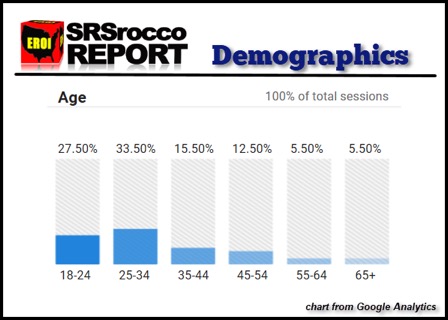
, I discuss how surprised I was to learn that the largest age group that followed the SRSrocco Report website were the Millenials, not the older generation. Now if that wasn’t surprising enough, the next largest group of readers came from an even younger group, aged 18-24:
|
|
The chart comes from my Google Analytics dashboard so that you can thank Google for that statistic. How on earth does Google know the demographics of my website, that is a subject matter for another day?
Regardless, while the mainstream media suggests that the younger generation are less interested in finances and politics, I actually believe they are hungry for GOOD INFORMATION
. Unfortunately, they will not find quality information in the mainstream press. Which is precisely why many of the Millennials are quite concerned about the future and continue to question everything.
Because I now understand that the largest segment of my readership is coming from the younger age-groups, I plan on putting out a series of articles on why it is essential to own and invest in precious metals. My newest video update starts with the upcoming U.S. State Pension Fund Disaster:
enable JavaScript if it is disabled in your browser.
In the video, I discuss what the typical American investment portfolio looks like and how it compares to the U.S. State Pension Fund allocation. Normally, when Americans get ready to retire, their investment portfolio is very conservative.
However, I was quite alarmed to find out just how risky the U.S. State Pension Fund assets have become.
According to NASRA, the National Association Of State Retirement Administrators, here is a breakdown of the U.S. State Pension Fund assets:
If you want to learn just how risky these assets are, especially the largest growth area in the U.S. State Pension Funds, “Alternatives,” I highly suggest that you watch the video above.
And it should be no surprise that the financial planners or pension fund managers never recommend gold or silver as part of an investment portfolio. This will turn out to be a huge mistake.
Now, the main reason that I am a gold and silver investor has less to do with the dangerously high debt-leveraged financial system and more to do with the Falling EROI (Energy Returned On Investment). However, I wanted to start with the U.S. State Pension Fund system because it may be one of the first to go when the markets begin the collapse.
In future articles and videos, I will focus on how the Falling EROI will impact the value of the other major asset classes, STOCKS, BONDS, and REAL ESTATE.
We must understand that without debt, the majority of these assets would lose most of their value. Furthermore, debt has only been able to grow as long as the U.S. and global oil supply rises. When global oil production finally peaks, we enter into a new ERA of the precious metals investor.
Stay tuned.
|
|
David's Commentary:
I would like to share the following YouTube trailer with you. Sasha, is Andy’s youngest daughter and she already knows that she wants to be in films. Unlike most of us, she has it figured it out by the age of eleven. I didn’t have a clue until I was in my 40s. Sasha is the young girl on the left in the trailer. She’s a natural.
Andy’s wife, Zhanna Schectman and her business partner Elizabeth Aseltine wrote and produced a short film. Sasha is starring in it. It was submitted to Zfest short film festival in Minneapolis and it was accepted. This is one of the largest local festivals after the Twin Cities Film Festival.
Minneapolis/St.Paul has a very talented community of independent film makers. Sasha was lucky enough to be in two films this year. This festival is hosted/judged by Louis Anderson.
Please watch this trailer on YouTube and if you like the YouTube video- give it a thumbs up. The more views and thumbs up we get, the greater chance they have to win the trailer category and it increases their chance of getting noticed in their film-making debut.
|
|
Private Safe Deposit Boxes
|
|
Unencumbered / Segregated Storage
|
|
About Miles Franklin
Miles Franklin was founded in January, 1990 by David MILES Schectman. David's son, Andy Schectman, our CEO, joined Miles Franklin in 1991. Miles Franklin's primary focus from 1990 through 1998 was the Swiss Annuity and we were one of the two top firms in the industry. In November, 2000, we decided to de-emphasize our focus on off-shore investing and moved primarily into gold and silver, which we felt were about to enter into a long-term bull market cycle. Our timing and our new direction proved to be the right thing to do.
We are rated A+ by the BBB with zero complaints on our record. We are recommended by many prominent newsletter writers including Doug Casey, Jim Sinclair, David Morgan, Future Money Trends and the SGT Report.
For your protection, we are licensed, regulated, bonded and background checked per Minnesota State law.
|
|
Miles Franklin
801 Twelve Oaks Center Drive
Suite 834
Wayzata, MN 55391
1-800-822-8080
|
|
Copyright © 2019. All Rights Reserved.
|
|
|
|
|
|
|