|
|
Visual Art Source is a nonprofit platform, our mission to further the discourse of both visual art, the the Visual Art eNewsletter, and social, political and cultural issues as seen through an art critical lens, The Democracy Chain eJournal.
You are invited to support the writers who make it all possible. Please click the any of the cups. Please forward the eNewsletter and while you are at it follow us on social media.
|
|
|
This Week's Contents
(scroll to see the full content of each article; please click the cup and compensate the writer)
|
|
Njideka Akunyili Crosby,
“Coming Back to See Through, Again”
|
Brenda Mallory,
“The North Star Changes”
|
Cara Barer and Alex Couwenberg,
“Atmospheric”
|
|
Please consider our sponsoring venues |
|
Njideka Akunyili Crosby, “Coming Back to See Through, Again”
by Jody Zellen
|
|
Continuing through July 29, 2023
Over the last decade since I first encountered her work in a London gallery, where I was much impressed with the skill and beauty of her work, I have had numerous opportunities to see Njideka Akunyili Crosby's works. Since then they have only grown more nuanced and sophisticated, as her current exhibition attests.
|
|
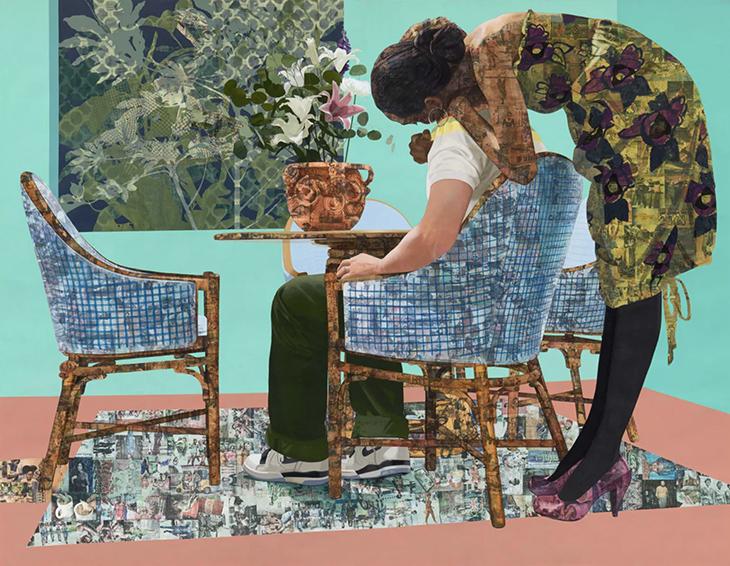
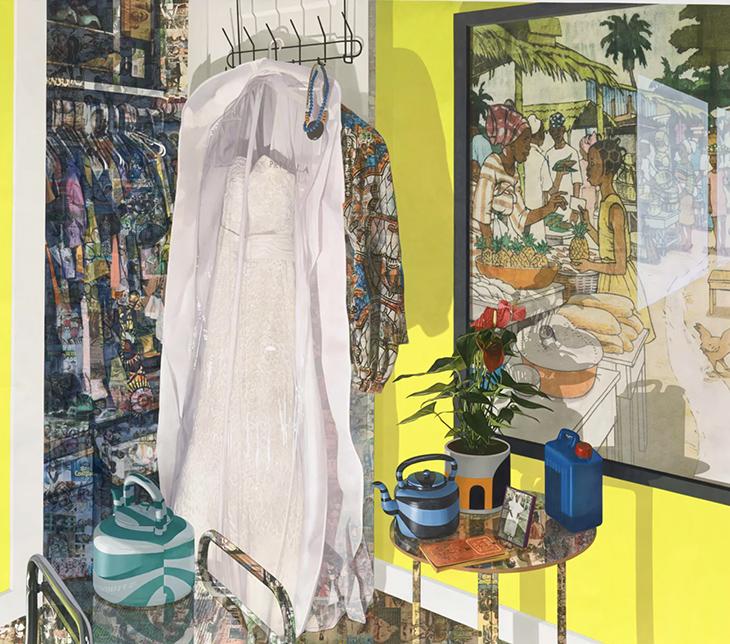
Njideka Akunyili Crosby, “Blend in — Stand out,” 2019, acrylic, colored pencil, charcoal,
and transfers on paper, 95 3/4 x 123 3/4”. All images courtesy of David Zwirner
|
|
In “Coming Back to See Through, Again” Akunyili Crosby presents a selection of multi-layered works on paper that juxtapose photographic transfers and painted depictions of interiors and exteriors some with, but many without people. Collectively and individually, these large-scale works on paper suggest a range of periods of time, as well as the possibilities of different worlds, all glimpsed through windows and doorways. |
|
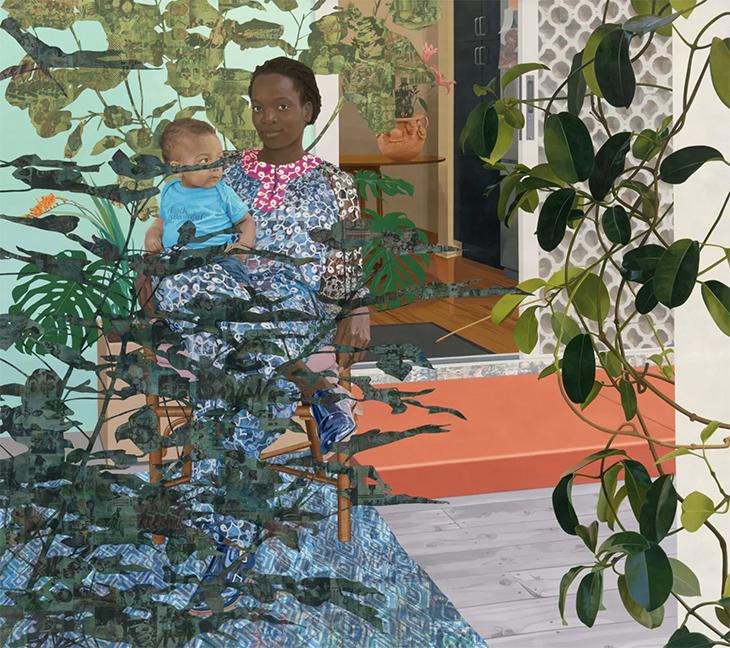
Njideka Akunyili Crosby, “Still You Bloom in This Land of No Gardens,” 2021 |
|
“Blend in — Stand out” (2019) is a large-scale work spanning 95 by 123 inches. The image depicts an interior setting but, true to form, Akunyili Crosby simply suggests the room, with walls and floor presented as flat solid colors. Within this closely cropped space are two figures — a woman hugging a man — seen from the side, four chairs, a rug, and a table with a plant on it. An abstract painting of plants, similar to the flowers in a pot on the table (as well as to other paintings in the gallery), hangs on the wall. Akunyili Crosby's blend of painting and collage is evident in this work with the beautifully collaged elements creating a compelling contrast to the painted areas. While elements of the background — walls and flowers, the seated man's arm, white T-shirt, sneakers and green trousers, as well as the woman's hand and legs — are painted, almost everything else is carefully constructed or overlaid with collaged (transferred) elements that come from both personal and historical sources. Akunyili Crosby's use of collage infuses her works with a sense of history that implies a continuum from past to present and helps to define her characters. |
|
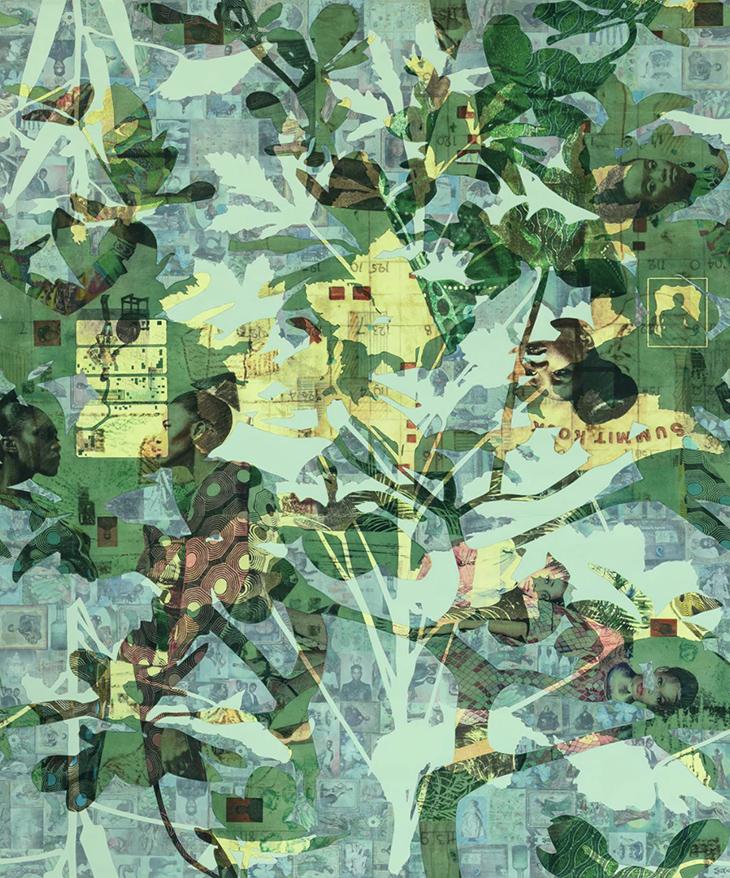
Njideka Akunyili Crosby, “Potential, Displaced, 2021, acrylic, colored pencil, and transfers on paper, 72 1/4 x 60” |
|
Like “Blend in — Stand out,” “Still You Bloom in This Land of No Gardens” (2021) is a self-portrait. Akunyili Crosby sits on a chair with her young child on her knee outside her home, which is surrounded by vegetation. The interior of the home is visible through an open door. The layered and balanced composition again juxtaposes flat painted areas against painted patterns and collages made from photographic transfers. Seen both in front of and behind mother and child, the mingling of plant life, patterns, and photographic montage both obscures and concretizes the figures. Akunyili Crosby draws from her childhood in Nigeria, the African diaspora, and notions of displacement and identity to weave together a narrative that is at once personal and universal. That the child wears a T-shirt that reads "Black is Beautiful" is visually subtle, yet politically pointed.
Interspersed among the figurative images are works that foreground nature. At first glance, “Dwellers: Cosmopolitan Ones” (2022), “Persistence of Vision: Screen Walls & Fruit Tree” (2022), and “Potential, Displaced” (2021) appear to be images of dense vegetation and architectural details in both solid tones and Akunyili Crosby's signature patterns of transfers. She is interested in the origins and migrations of plants (as well as people), in particular their cultural and historical associations. The green-hued leaves on a tree positioned at the bottom of “Persistence of Vision: Screen Walls & Fruit Tree,” in front of a light-tan screen/wall, are in fact green painted transfers culled from photographs and magazine pages. While seemingly an image of the type of residences built in Nigeria in the 1970s and 80s, Akunyili Crosby connects it to those who inhabited the area.
|
|
Akunyili Crosby's layered works can be understood on multiple levels. From afar, they are exteriors, portraits and landscapes that explore issues of family and nature. A closer examination casts them as encyclopedic adventures that integrate past and present, and the geographical locales of Los Angeles and Nigeria. The formal elements of paint and photographic transfer, abstraction and collage elevate the whole into evocative, seductive, engaging artworks that reveal more and more the longer they are observed. |
|
Njideka Akunyili Crosby, “Ejuna na-aga, ọ kpụlụ nkọlikọ ya; New Haven (Enugu) in New
Haven (CT),” 2022, acrylic, colored pencil, charcoal, and transfers on paper, 95 5/8 x 111”
|
|
|
|
Jody Zellen is a LA based writer and artist who creates interactive installations, mobile apps, net art, animations, drawings, paintings, photographs, public art, and artist’s books. Zellen received a BA from Wesleyan University (1983), a MFA from CalArts (1989) and a MPS from NYU's Interactive Telecommunications Program (2009). She has exhibited nationally and internationally since 1989. For more information please visit www.jodyzellen.com
|
|
“The North Star Changes: Works by Brenda Mallory”
by Lynn Trimble
|
|
Continuing through February 5, 2024
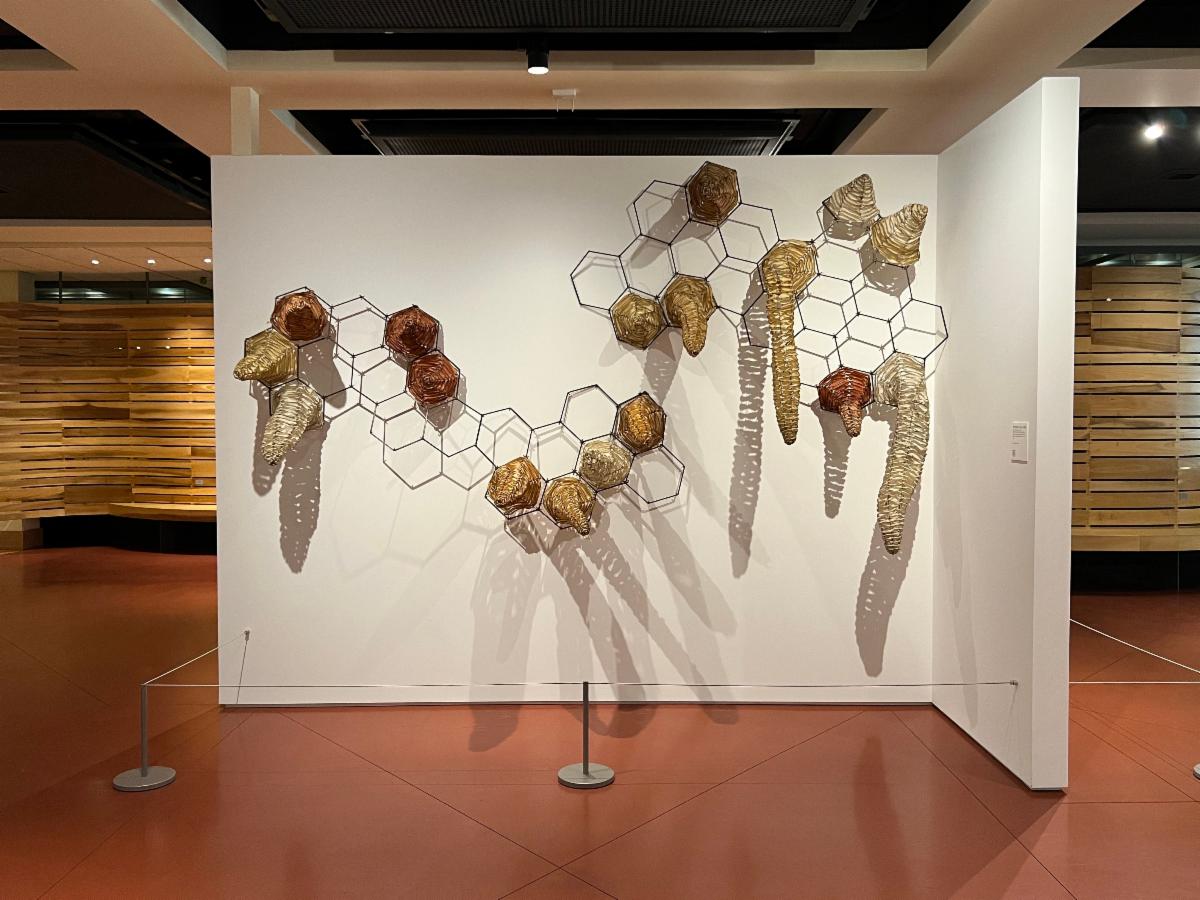
It isn’t readily apparent at first that Brenda Mallory, a member of the Cherokee Nation born in Oklahoma and based in Oregon, has created her myriad forms, patterns, textures, and connections primarily with unconventional materials. Mallory’s inventory includes bisected thread spools, hog ties, cardboard packing materials, fire hoses, nuts and bolts, and automotive drive belts. She has a wondrous facility for repurposing found and reclaimed items, which become both objects of art and tools for artmaking in her creative practice.
|
|
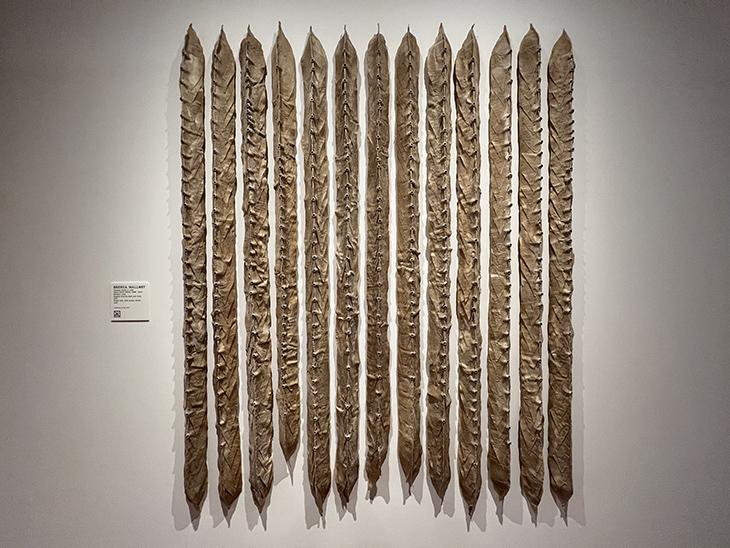
Brenda Mallory, “Demeter Does the Math (and Cries),” 2000, waxed cloth, shell casings, thread, wood. Photo: Lynn Trimble |
|
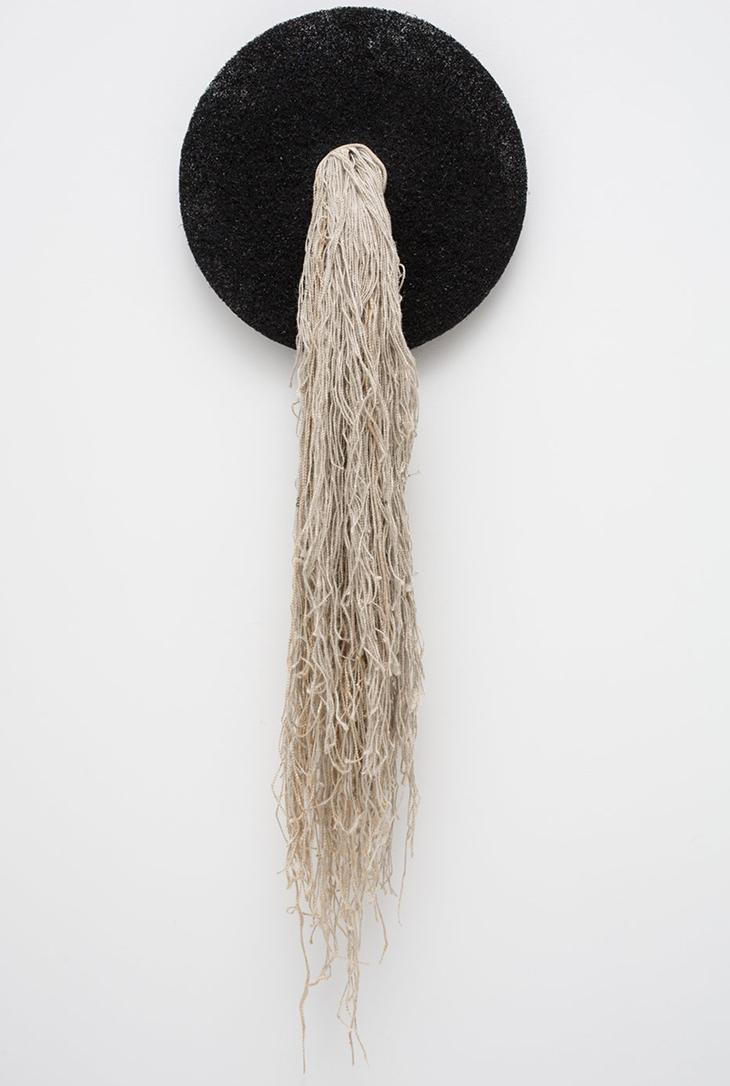
For “Demeter Does the Math (and Cries)” (2000), Mallory created thirteen parallel lines using waxed cloth, shell casings, thread, and wood. For “Zen Scrubber #2” (2015), she deconstructed linen fire hoses so strips of fabric emerge from a wall-mounted circular scrubber pad, much as a horse’s tail flows from its body. In every case, she works with a limited palette of black, white, red, and gold, often juxtaposing hard and soft materials that call to mind both organic forms and post-industrial waste. Often the artist assembles bits and pieces of fabric, such as the cast-offs of cotton menstrual pads, into bricolage assemblages that challenge binary perceptions of craft and fine art, a strategy long practiced in feminist art. |
|
Brenda Mallory, “Zen Scrubber #2 (detail),” 2015, scrubber
pad, paint, deconstructed linen firehose. Courtesy of the artist
|
|
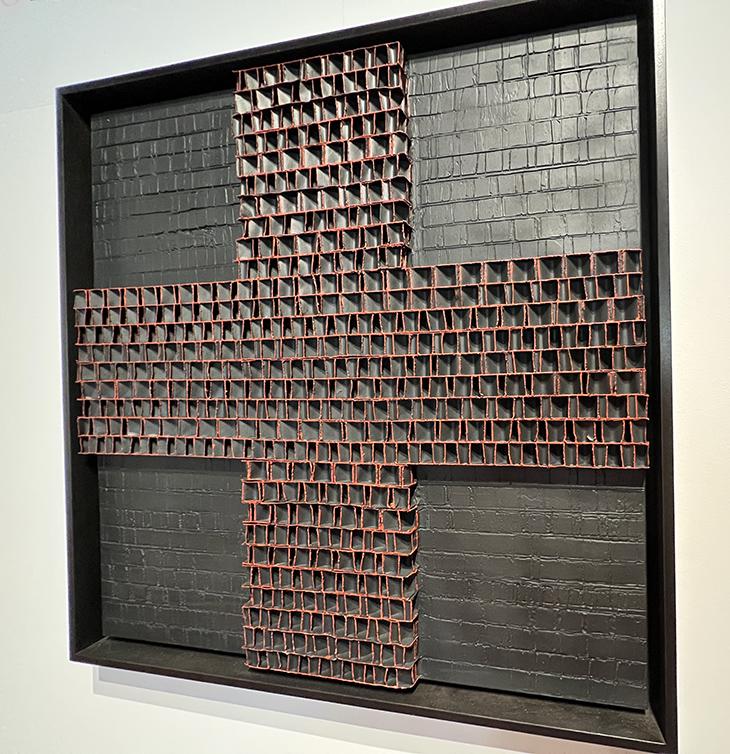
Brenda Mallory, “North Star (To Lead),” 2022, honeycomb
packing sheet, paint, encaustic. Photo: Lynn Trimble
|
|
Materiality rather than feminist rhetoric is Mallory’s muse, however, as revealed in the approximately two dozen works selected from a two-decade career in which she’s also worked in ceramics and glass. “North Star (To Lead)” (2022) is composed of a square cross within a square form made with honeycomb packing tape, paint, and encaustic. The exhibition’s title itself, “The North Star Changes,” hints at both the conceptual and physical threads that course like a pulsing, winding river through this body of work.
The exhibition title references the misconception that the North Star is a fixed entity while elevating the idea that the cosmos is ever-changing. If materiality feeds Mallory’s creative impulse, the work as presented amounts to a reflection on the fluidity of time, space, and existence. The approach is particularly poignant within the wider context of the museum’s “Substance of Stars,” a permanent exhibition opened in late 2022 that considers the sky knowledge and origin stories of four Indigenous peoples.
|
|
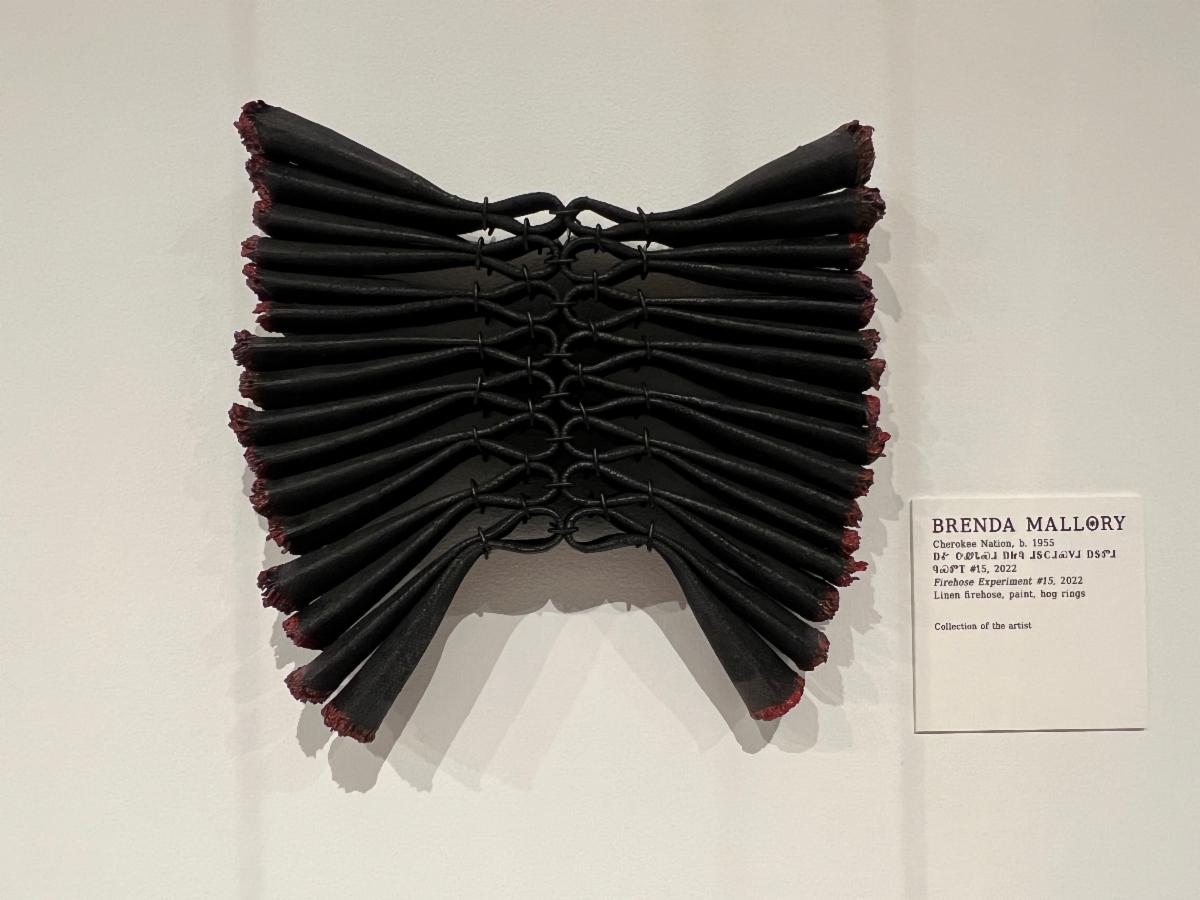
Brenda Mallory, “Firehose Experiment #15,” 2022, linen firehose, paint, hog rings. Photo: Lynn Trimble |
|
With Mallory’s works here we encounter both the grand scale of cosmology and the specificity of the artist’s — and our own — particular (albeit shifting) place within it. Her installations and sculptures, including abstractions made with materials sourced from a city dump, are imbued with multiple meanings informed by the original uses for the materials, the artist’s biography, and historical and contemporary social, cultural, and political landscapes.
The fire hoses used in “Firehose Experiment #16” (2022), for example, prompt association with their use to quell protests. The tall, dark totems paired with starburst forms in “Recurring Chapters in the Book of Inevitable Outcomes” (2015), allude to both the destruction caused by wildfires and our capacity to survive, adapt, and heal. Hog rings used in “Consensual Attachments: Across Time and Space” (2022) signal debates about animal cruelty in modern agribusiness practices. Honeycomb patterns, most prevalent in “biophilia: Emergent Properties” (2005), reference the artist’s memories of time spent with her beekeeping grandfather. In the white, circular ceramic piece “Precession” (2002), and the small wall sculpture “biophilia: Cradle” (2005),” we also see echoes of Indigenous basketry and weaving traditions.
|
|
Brenda Mallory, “biophilia: Emergent Properties,” 2005, waxed cloth, welded steel, nuts, wire, bolts. Photo: Lynn Trimble |
|
The feminist strategy of half a century ago was to assert the validity of female experience and perspective, including the symbolism of domestic materials. Mallory is a representative of a generation that has expanded our aesthetic vocabulary to include the materials associated with that history, now injected into art’s mainstream. “The North Star Changes” is an exquisite ode to connections and transformation — of ideas, cultures, nature, community, family, and self. |
|
|
|
Lynn Trimble is a Phoenix-based art writer whose work ranges from arts reporting to arts criticism. During a freelance writing career spanning more than two decades, over 1,000 of her articles exploring arts and culture have been published in magazine, newspaper and online formats. Follow her work on Twitter @ArtMuser or Instagram @artmusingsaz
|
|
Cara Barer and Alex Couwenberg, “Atmospheric”
by DeWitt Cheng
|
|
Continuing through July 21, 2023
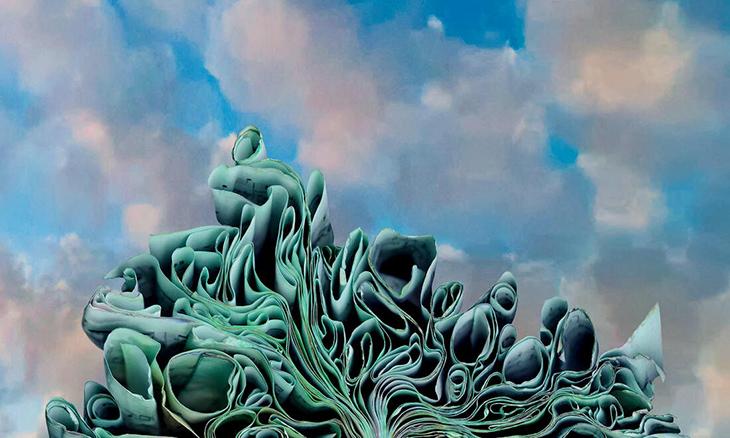
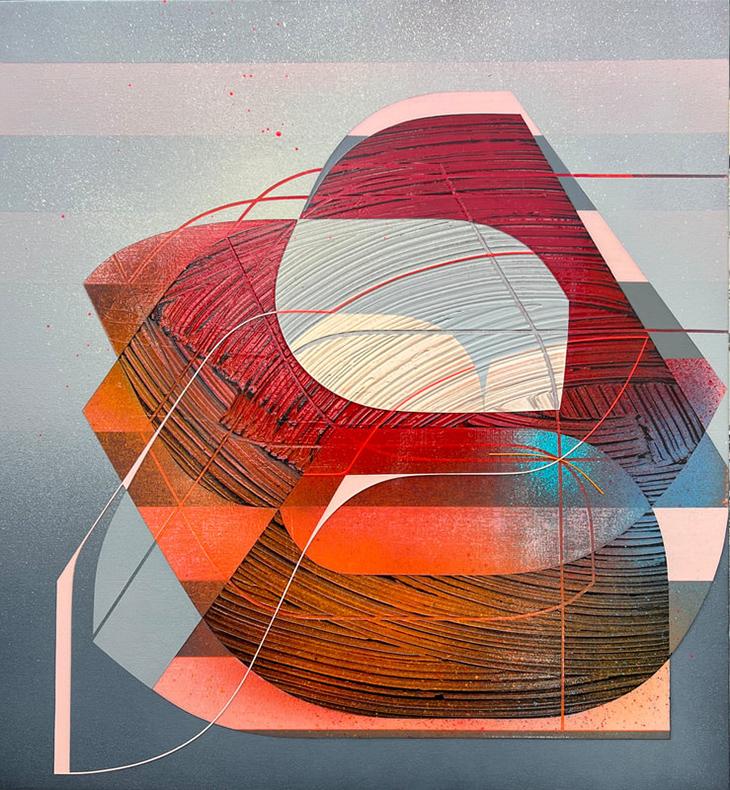
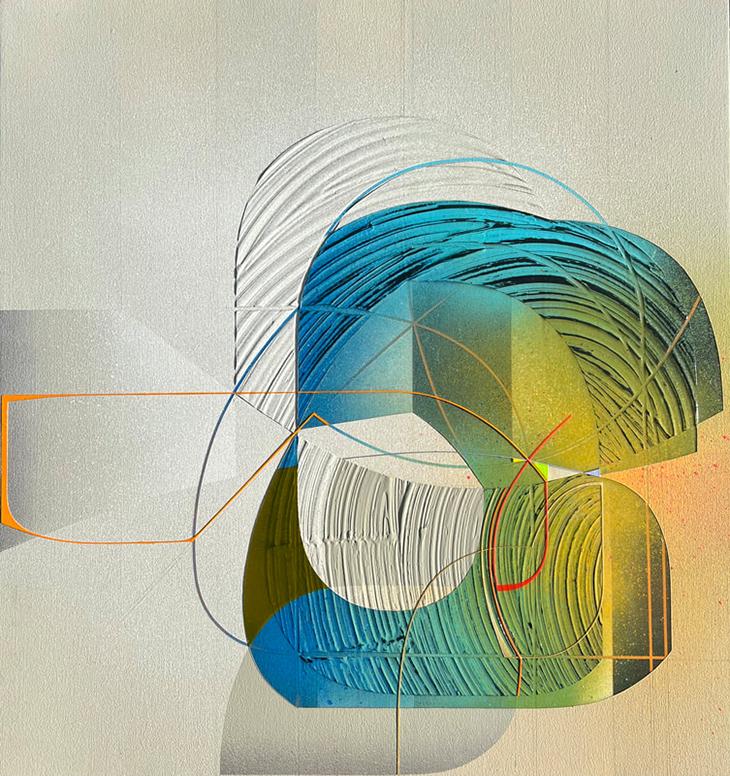
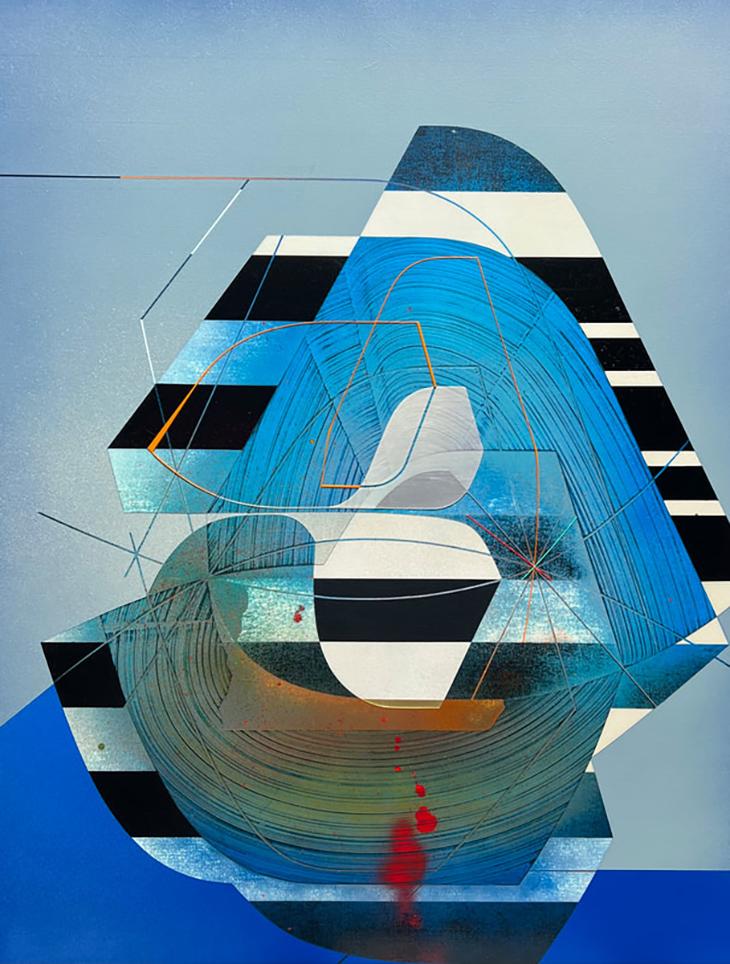
“Atmospheric” pairs the works of photographer Cara Barer and painter Alex Couwenberg. The title suggests both meteorology and, to the art-historically-minded, atmospheric perspective, that softening of contour and contrast toward the bluish horizon seen in landscape paintings. Barer’s ‘portraits’ of bound hardback books transform their soaked, dyed pages into suggestions of the floral realm. Couwenberg’s abstractions, melding painterly gesture with airtight composition, may not literally fit either of those definitions of “Atmospheric,” but the title does suggest visual aura, the aesthetic magic that draws, retains, and rewards our gaze. Couwenberg’s objects radiate force fields of pulsing meaning and mystery.
|
|
|
|
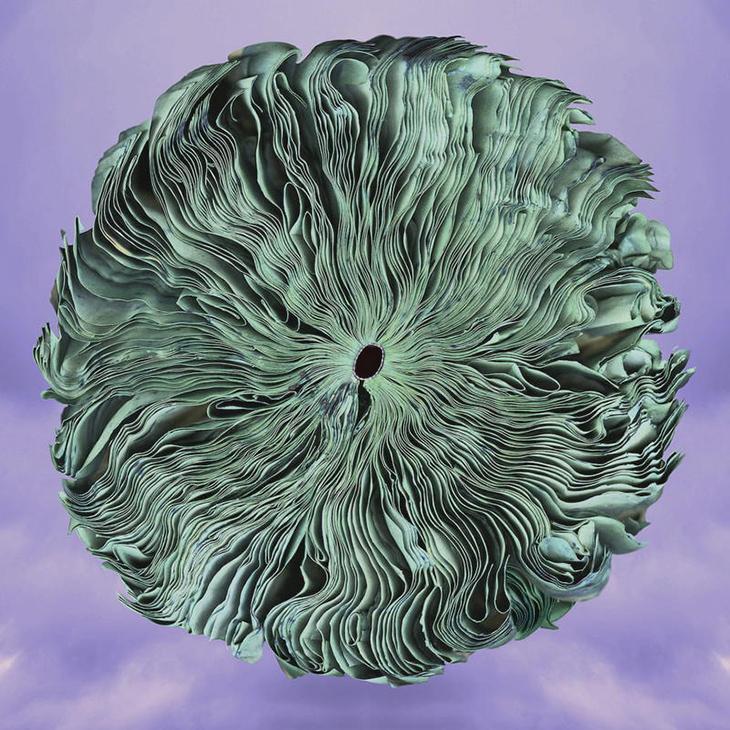
Cara Barer, "Green Earth New Sky" |
|
Barer dates her book-based conceptual photography to a humorous epiphany — “a random encounter with a Houston Yellow Pages” in the transitional period between analog and digital cultures, when reference books were being transformed into online information and the books themselves were being discarded. Clearly, the artist, with her fondness for the print medium (and for printed roadmaps over their GPS replacements), saw this transition as worthy of investigation. |
|
Cara Barer, “Cotton Candy Landscape,” |
|
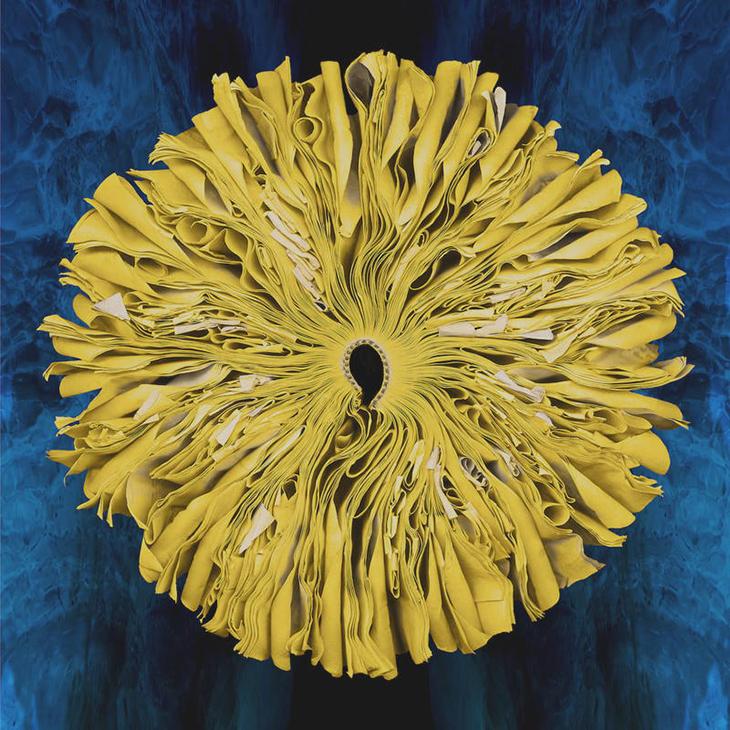
Barer describes her work, collecting old books and, deconstructing and reconstructing them, as a kind of recycling of obsolete data, repurposing the now useless objects as art — and as a commemoration of books as physical objects with their own life and life cycle. “I create a record of that book and its half-life,” she notes. Her orphaned hardcover books, unbound and rebound, dyed and dried into splayed, circular arrays of rippling, radiating pages, become botanical metaphors for sentience, spores or seed pods ready to transmit their coded/printed but unseen and undecipherable information. Barer’s floral books with their pages viewed edge-on are also mandalas, aids to meditation, or iconic symbols, like Dante’s mystic rose, or Jay DeFeo’s famously ethereal yet ponderous Beat-Era painting “The Rose.” |
|
Alex Couwenberg, “Adrift,” acrylic
and spray paint on canvas, 32 x 30”
|
|
Six of the seven photos here — “Air,” “Fire,” “Water,” “Aether, and “Green Earth, New Sky” — are circular blooms set against square backdrops suggestive of wind and water. The elemental themes and organic motifs are matched with the geometry of perfect forms. The seventh, “Cotton Candy Landscape,” depicts a verdant landscape bouquet of pages set against fluffy clouds, but the foliage also suggests flame; whether this presages intellectual enlightenment, or a 451-degree bonfire of vanities remains to be seen.
In his essay on the Great Wall and the burning of the books by the self-styled First Emperor of China, Jorge Luis Borges famously declared that the aesthetic phenomenon is the dreamlike state of sensing an imminent but elusive revelation. Couwenberg’s abstract acrylic paintings display beauty and visual authority, yet their spatial relationships remain ambiguous and shifting, i.e. infinite. While the flat colors and crisp edges of the artist’s geometric structures suggest digital origins (what I call Adobe Illustrator painting), the free brushwork, spattering, and acrylic impasto textures evince an impressive command of paint handling and the complex grammar of color, shape, and form.
Says Couwenberg, “My paintings are a product of my obsession over process … Each painting becomes an experience of constantly juxtaposing elements and forms within a composition attempting to arrive at a relationship between balance, tension, and harmony.”
|
|
This dialectic is based on the artist’s Southern California cultural influences, including the historical adaptation of car culture, informed by Finish Fetish and Light and Space art. Creating sharply delineated form teams with Couwenberg’s opposing tendency, breaking out of the Constructivist box with Expressionist brushwork and texture resulting in visual richness and spatial ambiguity. The impeccable finish of the lines, curves and planes create a perfect, even utopian miniature world that seems in places, to be emerging into the viewer’s space thanks to relief effects probably achieved with layers of acrylic gel applied within taped or stenciled areas. Couwenberg’s take on Abstract Illusionism — impasto blots or brushstrokes embellished with airbrushed shadows — goes beyond just fooling the eye. As Duchamp said of his own ‘lighthearted’ conceptualism, it fools the mind. |
|
Alex Couwenberg, “Dear You,”
acrylic and spray on canvas, 32 x 30”
|
|
Alex Couwenberg, “Hōkūle’a,” acrylic
and spray on canvas, 32 x 30”
|
|
Couwenberg’s playful titles, such as “Dear You…,” “Adrift, Stinger,” and “The Imperial,” hint at private jokes, and a witty but disciplined sensibility informing the discipline of the artist’s hand. Two pieces, “Kon-Tiki” and “Hōkūleʻa,” are named after Thor Heyerdahl’s balsa wood raft, which sailed from South America to Polynesia in 1947, and the contemporary analogue that has circumnavigated the globe using traditional (orally transmitted) wayfinding techniques. Perhaps these canvases, each a contraption of wood and cloth, are vessels for adventuring: “to strive, to seek, to find, and not to yield,” as Alfred, Lord Tennyson maintained in his poem, “Ulysses.” Unlike Tennyson’s version of Ulysses contemplating the boredom of old age in light of his earlier adventures, Couwenberg’s aesthetic adventure persists.
|
|
|
|
DeWitt Cheng is an art writer/critic based in the San Francisco Bay Area. He has written for twenty years for regional and national publications, in print and online, including: San Francisco Art Magazine, Daily Gusto.com, ArtBusiness.com, VisualArtSource.org, Artweek, Art Ltd., Artillery, East Bay Express, East Bay Monthly, Sculpture, Modo, Artomity, and his blog, ArtOpticon.us, with articles archived at Authors.com. He has written dozens of catalogue essays for artists, galleries and museums, and is the author of “Inside Out: The Paintings of William Harsh.” In addition, he served as the curator at Stanford Art Spaces from 2013 to 2016, and later Peninsula Museum of Art, from 2017 to 2020. Visit DeWitt Cheng online.
|
|
|
|
© 2023 TDC/VAS
Contact Information:
231 Cedar Heights Dr., Thousand Oaks, CA 91360
Ph: (213) 482-4724
|
|
|
|
|
|
|
|