|
Deal Analysis
By Bucky Sydnor
(sydnoriv@yahoo.com)
A Look At Slam Bidding Without Using Blackwood
You may not be used to bidding a slam without using your partnership’s version of Blackwood, but with highly distributional hands it has its merits, especially when part of the distribution involves a void.
Today’s deal comes from a game on BBO. My interest in the deal is just with the bidding. When focusing on the bidding, I think it is helpful if you do not know the full deal initially so you can experience what goes on in the head of one player during the auction.
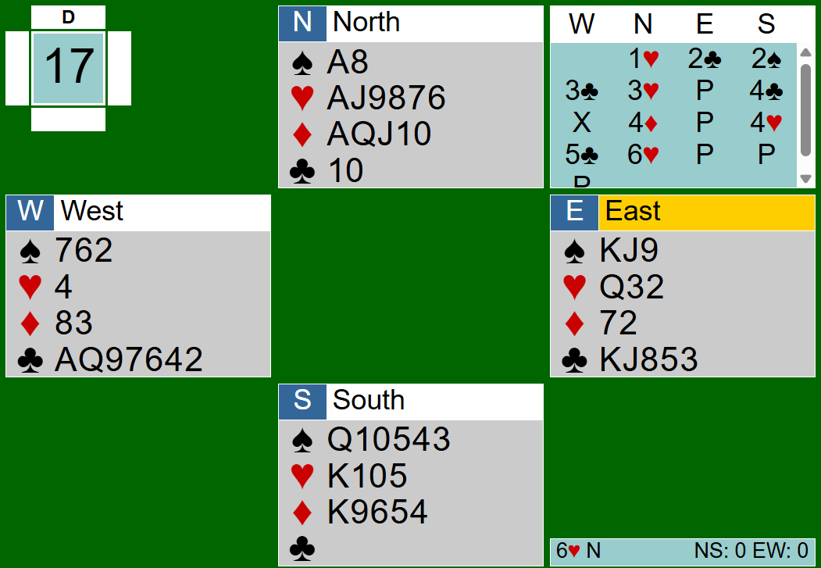
You are South and here is your hand, all 8 HCP of it.
♠Q10543 ♥K105 ♦K9654 ♣–
N dealt and opened the auction with 1♥. E jumped right in with 2♣.
Looking at only S’s hand and considering only N’s 1♥ opening, S had several options if the auction had been uncontested. S clearly had heart support; his issue would have been whether to support hearts immediately or bid 1♠ first. With the ♥K10x, 8 HCP and a void, his hand was worth a limit raise (but with only three trumps). Moreover, he had two kings and a queen for his 8 HCP with a 10 or 9 to go with each of them. That 8 HCP is far, far better than, say, a queen in every suit and low spot cards behind them.
But the interference changes how S should proceed. E’s overcall of 2♣ had increased the value of S’s hand, making his club void clearly valuable. One way to assess the new value of S’s is to consider that S may possibly be able to ruff the first two rounds of clubs, or has, in bridge jargon, first and possibly second round control. That makes his club void similar to holding the ♣AK. Now no oen but no one values a useful void as 7 points: in standard hand evaluation, a void is worth 3 points when you have 3-card trump support. So, one must be careful when mixing these two ways of viewing a void. But the former view is helpful in appreciating how powerful the void is. To repeat myself, the void gives N/S a first round control of clubs and possibly a second. Considering the interference, S decided to evaluate his hand as invitational and to show his spade suit en route to showing support later with 3♥.
W raised his partner’s overcall to 3♣ and N continued with 3♥. With E now passing—he was getting OUT of the auction, as you will see he should—the auction is back to S:
N------E----.S.....W
1♥ – 2♣ – 2♠ – 3♣
3♥ – P – ?
How should S proceed? With both opponents bidding clubs, S’s club void has increased so much in value that S decided he now wants to go to 4♥, and maybe higher. For example, if the opponents sacrifice with 5♣, he was considering 5♥, since the strength of his hand is not in high card points alone but in the club void alongside his two kings and a queen. The point is that S’s hand has great offensive potential but holds limited defensive potential.
Since S is now sure his side should be in 4♥, he decided that on his way there he should show his club control by cuebidding 4♣. This tells N that S had either the ♣A or a club void. In addition, it showed support for N’s hearts; indeed, it showed exactly three hearts because the way S has bid, he would have shown four heart support at his first response. So the cuebid could be useful information to partner as the bidding proceeded, and it turned out to be so.
W doubled the cuebid and N bid 4♦. That showed the ♦A and an interest in playing more than just 4♥. E passed. The auction was now:
N-----E----S-----W
1♥ – 2♣ – 2♠ – 3♣
3♥ – P – 4♣ – X
4♦ – P – ?
It was now time for S to slow down. He bid 4♥, telling partner that while, earlier, he could bid 2♠ over E’s 2♣ interference before he supported hearts, he had nothing more than the minimal points that he promised. Meanwhile W chimes in with 5♣, leaving the auction thus:
N-----E----.S----W
1♥ – 2♣ – 2♠ – 3♣
3♥ – P – 4♣ – X
4♦ – P – 4♥ – 5♣
?
While S was waiting for his partner’s call, he decided that if N passed or doubled 5♣, he would bid 5♦, showing both the ♦K and a desire to play 5♥ rather than to penalize 5♣.
But none of that was necessary: N closed out the auction with 6♥. Here is the full deal.
|