NEW YORK PARTNERSHIP FOR DENTAL THERAPY

Newsletter | July 2026

Dear Friend,


This month brings new tools for partners and organizations working toward dental therapy authorization in New York, along with an invitation to formally join the coalition.

New Webinar Recordings Available

An Introduction to Dental Therapy Education Programs


Educators from the University of Minnesota School of Dentistry and Skagit Valley College walk through how their dental therapy training programs are structured, who their students are, and what national education standards mean for the profession's future. Recorded July 20.


Slides available here.

Findings From a Scoping Review of Dental Therapy Research


Beth Mertz presents key findings from a scoping review assessing the evidence base for dental therapy in the United States, including implementation, safety, quality, economic impact, and contribution to access to care. Co-sponsored by the Schuyler Center for Analysis and Advocacy. Recorded June 30.


Slide available here.


Save the Date for our next webinar!

Mapping Oral Health Needs Across New York State

📅Tuesday, September 29 at 2:00 pm EST

(Description and registration coming soon)


New Blog Posts


Partner Corner

The Partnership for Dental Therapy is fortunate to work alongside organizations across New York State that share a commitment to oral health equity. This section is a space for partner voices. Each issue, we will feature an update, resource, or perspective from one of the organizations in our coalition.

The Step Two Policy Project is a policy think tank that focuses on issues involving health, behavioral health, and human services in New York. Our goal is to make complicated subjects more understandable to general readers, while providing detailed insights for people who work in the health policy field.

In a new blog, Adrienne Anderson, a Senior Policy Fellow, shares why dental therapy is a practical, evidence-backed answer to New York's dental access gap. Nationally, non-traumatic dental conditions drive over 2 million emergency department visits a year, and in New York, roughly 10.5 percent of all ED visits are for preventable dental conditions. A recent study of Minnesota counties found that the presence of dental therapists was associated with a meaningful drop in these visits, between 10.5 and 18.6 percent depending on the analysis. The piece also addresses common concerns directly: Minnesota data shows dentists' productivity rose, not fell, after dental therapists joined practices, and with only a third of the state's Medicaid-accepting dentists currently serving the third of New Yorkers who rely on Medicaid, dental therapists are positioned to expand access rather than compete for it. 


Read the full article on the our blog: Dental Therapy: a Workforce Strategy for Expanding Access to Care.

Federal Funding Signals Growing Momentum

Federal funding priorities offer another data point in dental therapy's growing momentum. HRSA's Grants to States to Support Oral Health Workforce Activities, the agency's largest funding source for state oral health workforce development, closed its 2026 application window this month. Beyond the twelve activities that Congress has designated as eligible for this funding, the Secretary of Health and Human Services holds authority to name additional priority activities, and the 2026 notice named three: substance use screening and referral, dental therapy program development, and prevention of early childhood tooth decay. 


Dental therapy has now been named a priority activity in back-to-back funding cycles, first in 2022 and again in 2026. The notice describes dental therapists as primary care oral health professionals who provide restorative and limited surgical services, and it notes that fourteen states have already authorized the role, with seventeen more considering it. 


That HHS has twice singled out dental therapy for priority federal investment, alongside activities like substance use screening, is a meaningful marker of the policy's footing. It reinforces that expanding this workforce model is increasingly seen as a practical, broadly supported response to access gaps, not a partisan proposal. 


New Resources

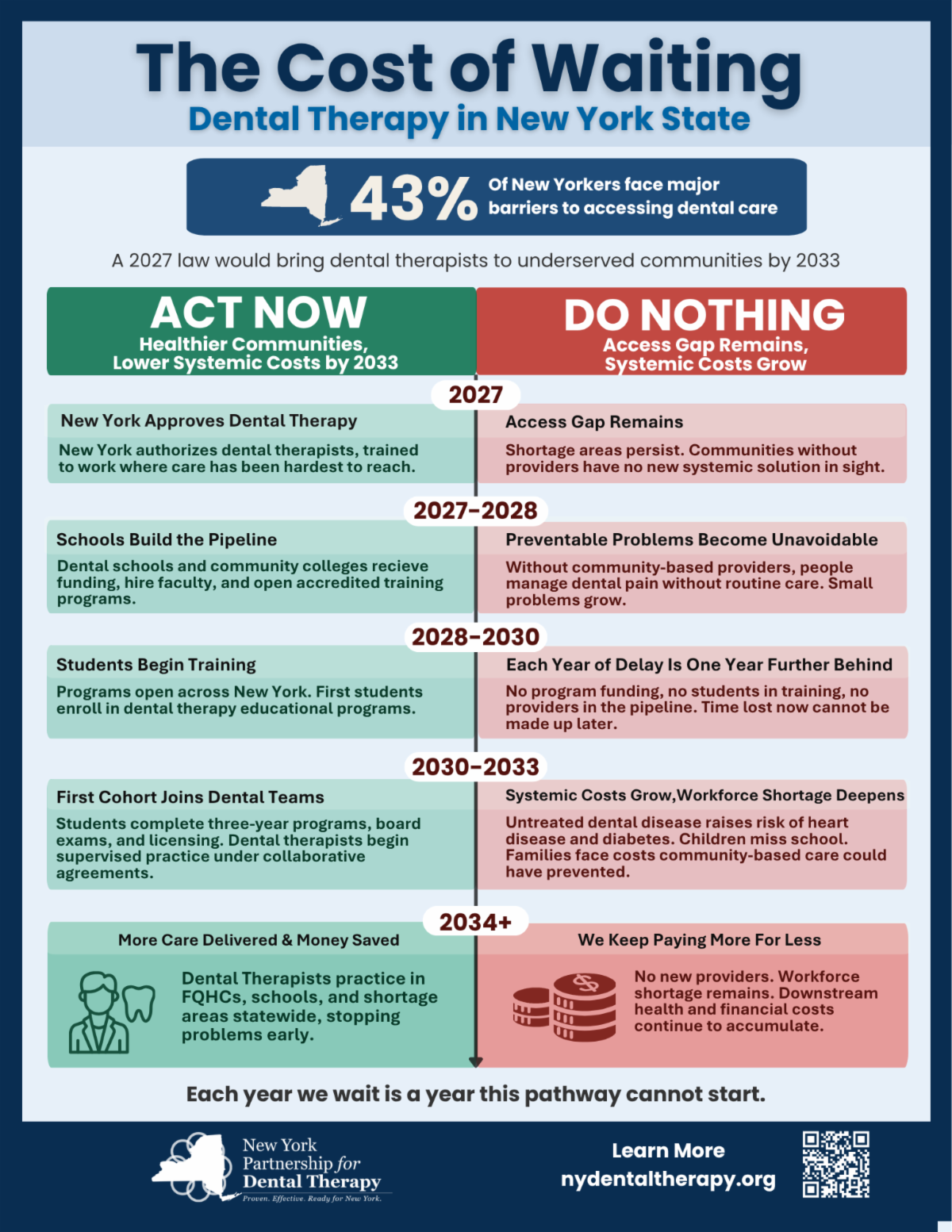
The Cost of Waiting: Dental Therapy in New York State

A 2027 policy change would bring dental therapists to underserved communities by 2033. Each year we wait is a year this pathway cannot start.


This new one-pager shows a side-by-side comparison of what we can expect to see over the next few years if New York approves dental therapy or doesn't in 2027.

Join the Partnership

We invite you to sign on as a member of the New York Partnership for Dental Therapy. Membership means a shared commitment to supporting the authorization of dental therapists to practice in New York State; it is not an endorsement of specific legislation.  

Together, we can take strides toward ensuring that all New Yorkers can access the oral health care they need, no matter their income or zip code. Click here to see our list of current members.

Questions? Contact us at nydentaltherapy@scaany.org.

Web

Was this email forwarded to you? Sign up to receive newsletters from New York Partnership for Dental Therapy directly to your inbox by clicking here.