Campaigning for Democracy And Socialism | | |
June 26, 2026: The Week in Review
The Madness in D.C. Keeps Spreading:
We Have To Find Ways To Stop It
| |
|
We have a nutjob in the White House.
Not that occupant of the Oval Office isn't the usual right-wing populist and fascist mafia don insisting on feudal fealty over the Constitution we've known for two decades. All that still stands.
But today the air feels stale and heavy, as if the country itself has grown tired of pretending. You walk down Constitution Avenue and the heat presses on your chest, and you think: This is what it feels like when our bourgeois republic, warped in normal times, begins to sag under the weight of its own absurdities.
The Sun glints off the marble, the tourists shuffle past the barricades, and the soldiers-young men and women who should be home or stationed abroad with some imperial purpose-stand idle in the shadow of monuments built for better men and women than our upper crust today.
We have a man in the White House who should never have been trusted with the keys to a golf cart, let alone the nuclear codes.
That is the simple truth. It is not new. It is not surprising. It is not even controversial to anyone who has been awake for the last decade. He is the same strongman wannabe, the same braggart who demands feudal loyalty from a nation founded on the idea that we make oaths to a constitution and no man is king. All that still stands. All that is familiar.
But something has changed. The madness has grown louder, stranger, more baroque. It has taken physical form. It has reshaped D.C. itself, as if the city were a stage set for the fever dreams of a man who cannot tell the difference between power and spectacle.
Washington looks worse now than it did when the British burned it in 1814. At least then the flames were honest.
Walk toward the Reflecting Pool, and you will see the water thick with green algae, a stagnant soup shimmering under the Sun. The troops stationed around it--rifles slung, eyes glazed with boredom--stand guard not against imagined vandals, but against the truth. The truth is that the President's own vanity project, the one that changed the color of the pool's lining, which likely heated the water enough to help the bloom spread. But he blamed "radical leftists" and "environmental terrorists," and so the soldiers stand there, guarding algae from imaginary enemies.
It would be funny if it weren't so pathetic. It would be pathetic if it weren't so dangerous.
The East Wing of the White House is gone now, torn down to make room for a Marie Antoinette ballroom--his phrase, not ours. Construction has stalled because he decided halfway through that he wants a bunker beneath it, deeper and more fortified than the one already there. The workers have stopped showing up. The contractors are suing. The scaffolding stands like the ribs of a dead animal, jutting out against the sky.
Where the Rose Garden once offered a quiet place for reflection, there is now a martial arts cage--steel bars, bright lights, a platform for the spectacle he calls "American strength." He held a fight there on his birthday, a grotesque display that felt less like a sporting event and more like a ritual humiliation of the office he occupies. The roses are gone. The soil is packed down. The cage remains.
And then there is the Arc of Trump, a ridiculous golden archway he plans to erect so it blocks the once-solemn view toward Arlington Cemetery. The dead who rest there fought for a country where they believed in humility, sacrifice, and the quiet dignity of service. Now their resting place is to be framed by a monument to one man's ego.
Inside the capital, a Hall of Heroes is being built-another vanity project. The blueprints leaked. They show statues of Washington, Lincoln, Tubman, King, and, inevitably, Trump himself. Larger than the others. Taller by several feet. The sculptor reportedly objected. He was fired.
Across the river, the Kennedy Center sits under a massive tarp, a shroud meant to hide the fact that a court ordered the removal of Trump's name from its edifice. The tarp is white, billowing in the wind like a sail on a ship that has lost its way. It is a monument to pettiness, to the smallness of a man who cannot bear the idea of being told "no."
Everywhere you look, there is gold trim--thick, garish, nouveau riche gold slapped onto buildings, fences, podiums, even lampposts. It is the color of insecurity, the color of a man who has never understood that real power does not need to announce itself.
And through it all, U.S. troops stand idle. They guard empty streets, empty lawns, empty fears. They guard the Reflecting Pool from the algae that grows because of him. They guard the martial arts cage from the ghosts of the roses that once grew there.
This is not governance. This is not leadership. This is not even politics. It is a theater of the absurd. It is the theater of a man who believes that if he can reshape the capital in his own image, he can reshape the country as well.
But the real danger is not the gold trim or the algae or the cage fights. The real danger is that while he obsesses over these absurdities, he ignores the crises that actually matter.
The war with Iran--his war of choice--grinds on, draining lives and treasure with no clear objective and no end in sight. Inflation, driven in part by that war, eats away at the paychecks of working people. Prices rise. Wages stagnate. People of color and women are purged. Families struggle. And when asked about it, he shrugs. "I don't care," he says. Or, "It doesn't matter."
He says these things because he believes them.
He does not care about the working class. He does not care about the Constitution. He does not care about the truth. He only cares about the show, if it's about him. He cares about the applause. He cares about the next rally, the next camera, the next chance to stand in front of a crowd and bloviate for ninety minutes about enemies real and imagined.
He goes to a Mack Truck factory and rants about conspiracies. He lies about the economy, about the war, about the algae in the Reflecting Pool. He lies because the lies are easier than the truth, and because the truth would require him to do the one thing he cannot do: govern.
Meanwhile, he demands that the Smithsonian remove exhibits about slavery, about genocide, about the darker chapters of our history. He wants a museum without memory, a country without accountability. He wants a past that flatters him and a future that obeys him.
There is more, of course. There is always more. There are rumors of new construction projects, new monuments, new purges of civil servants who refuse to bend the knee. There are whispers of plans to rename federal buildings, to rewrite curricula, to reshape the judiciary in ways that will outlast him.
But the question that hangs over all of this--the question that keeps people awake at night--is simple: Can we keep this man in charge of the nuclear codes for two and a half more years?
It is a question that feels like it belongs in a different era, a different country, a different kind of story. It is the kind of question that Hemingway might have asked in the ruins of a failed republic, or that Camus might have posed in a world where absurdity has become indistinguishable from fate.
But it is our question now. And the answer is not obvious.
A nation can survive bad policies. It can survive corruption. It can survive incompetence. But it cannot survive the erosion of reality itself. It cannot survive a leader who treats truth as an inconvenience, who treats institutions as toys, who treats the capital as a canvas for his own delusions.
The algae will clear. The gold trim will tarnish. The tarp will come down. The martial arts cage will rust. These things are temporary.
But the damage to our democracy, such as it is--the slow, grinding erosion of trust, of norms, of shared meaning--will not disappear so easily.
We are living in a time when the absurd has become normal, when the grotesque has become routine, when the capital itself has become a monument to one man's insecurity. And we must decide, as citizens, whether we will accept this as the new American condition.
The soldiers stand on street corners or by the Reflecting Pool. The algae swirls in the heat. The wreckage surrounds the White House. And the question remains, heavy as the summer air: How much longer can this go on?
[All LeftLinks editorials, unless otherwise designated, express the views of our stalwart editor, Carl Davidson, and not necessarily any organizations he is connected with. Everyone, of course, is welcome to steal them and shamelessly pass them around, far and wide, with or without permission. A thank you note would be welcome, though!]
| | | | |
WE ARE INVITING FEEDBACK!
Please send us your letters, comments, queries, complaints, new ideas. Just keep them short and civil. Longer commentaries and be submitted as articles.
Click Here to send a letter
DIFFICULTY READING US?
View as Webpage
Food for thought: Our weekly format is missing too much of vital ideas in the news. What do you think of 'Daily Extras!' once or twice a week?
We're also considering 'Friday Night at the Movies' for 1940s Noir classics, as well as vital new films yet to gain top Hollywood status. Would you project us from a laptop onto your big screen TV and invite friends for popcorn and a 90-to-120 minute show?
Let us know.
| |
We're going to try something new, and you are all invited.
Saturday Morning Coffee!
Started in August 2022, then going forward every week.
It will be more of a hangout than a formal setting. We can review the news in the previous days' LeftLinks or add a new topic. We can invite guests or carry on with those who show up. We'll try to have a progressive stack keeper should we need one.
Most of all, we will try to be interesting and a good sounding board. If you have a point you would like to make or a guest to invite, send an email to Carl Davidson, carld717@gmail.com
*****************
Continuing weekly, 10:30 to Noon, EDT. Here's the ongoing link:
*******************
NEW FEATURE: A summary and transcript of the previous week:
Full Text and Zoom Summary AVAILABLE HERE
******************
Meeting ID: 868 9706 5843
Let's see what happens!
| |
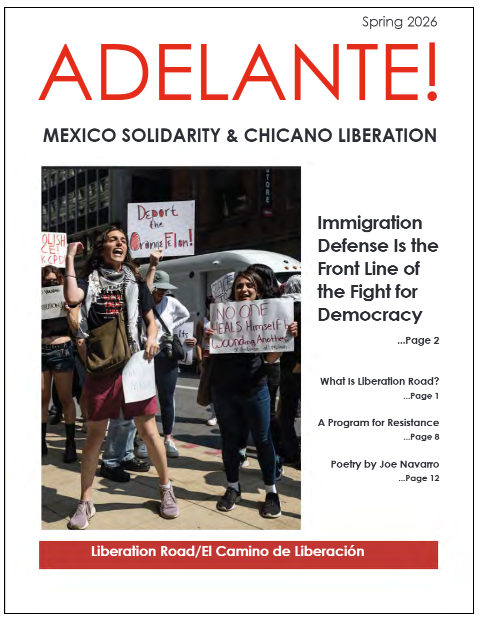
Table of Contents
Editors Commentary.
Building Campaigns and Movements against Fascism and War... Page 5.
Analysis and Global Reach.
US Imperialism And Iran: A History of the Killing Today. By Harry Targ. ... Page 11.
Israel and the Impact of the War on Iran. By Rod Such. ...Page 30.
Our Future: Ecosocialism or Ecofascism. By Jerry Harris. ... Page 36.
Remarks by Mexican President Claudia Sheinbaum in the Barcelona, Spain, Summit in Defense of Democracy, April 18, 2026. ... Page 56.
Two Tudeh Party Statements: “Resolution of the (Expanded) Meeting of the Central Committee of the Tudeh Party of Iran”. March 17, 2026, and “The Announcement of a ‘Temporary Ceasefire’ — A Step Forward Toward Achieving Lasting Peace,” April 9, 2026. ... Page 60.
When Labor Rises, Everyone Can Rise.
Three Crises of Labor: ‘Organize or Die’ Gets Uncomfortably Relevant.
By Hamilton Nolan. ... Page 67.
The Consequences of Bad Labor Law: Savage inequality and long TSA lines. By Hamilton Nolan. ... Page 72.
Civil Society and Campaigns on Social Terrain.
The War of Southern Aggression: The MAGA reconstruction of the North is well underway. By Michael Podhorzer ... Page 79.
Why Was Minnesota’s Resistance to ICE the Strongest Yet? Five
organizers to take us inside the Twin Cities’ Response. ... Page 88.
How to View Protests Like an Organizer. By Tim Hjersted. ... Page 102.
Stop the Crimes of Trumpism: Build the Resistance. By Paul Krehbiel. ... Page 109.
Theory for Our Time.
After Habermas: Reflections on What I Learned from Him. By Nancy Fraser. ... Page 123.
Accelerating Systemic Reform of Mainstream Media: An In-depth Analysis. By Guo Quanzhong ... Page 127.
Toward 21st Century Municipal Socialism. By Jay Jurie. ... Page 134.
Book and Film Reviews.
‘Original Sins’ by Eve L. Ewing. Reviewed By Janet Tucker and Meta Van Sickle. ... Page 167.
‘Social And Solidarity Economy In Cuba: Foundations And Practices For Socialist Development,’ edited by Rafael J. Betancourt and Jusmary Gomez Arencibia. ... Reviewed by Harry Targ... Page 174.
14.95 plus postage.
Go Here To Purchase
For discounted bulk orders: carld717@gmail.com
| |
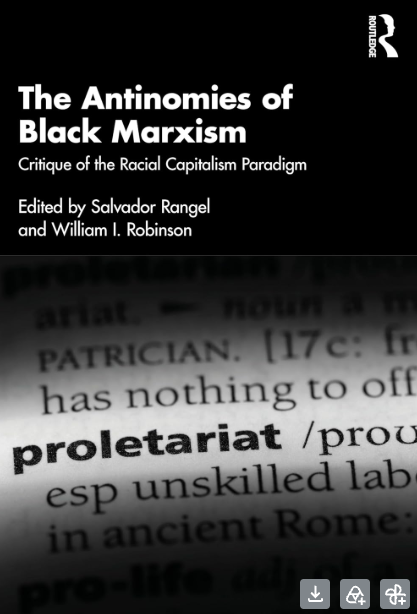
William I. Robnson: I am pleased to announce that the book I have coedited, with Salvador Rangel, has just been released: "The Antinomies of Black Marxism: Critique of the Racial Capitalism Paradigm":
Foreword: Walter Benn Michaels
Introduction: Salvador Rangel and William I. Robinson, The Crisis of Global Capitalism and the Race Fetish
Chapter One: August H. Nimtz, Jr., Marxism and the Black Struggle: The ‘Class v. Race’ Debate Revisited
Chapter Two: Gregory Meyerson, Rethinking Black Marxism: Reflections on Cedric Robinson
Chapter Three: Asad Haider, The Shadow of the Plantation
Chapter Four: Joseph G. Ramsey, Sifting the ‘Stony Soil’ of Black Marxism: Cedric Robinson, Richard Wright, and Ellipses of the Black Radical Tradition
Chapter Five: William I. Robinson, Salvador Rangel, and Hilbourne A. Watson, The Cult of Cedric Robinson’s Black Marxism: A Proletarian Critique
Chapter Six: William I. Robinson, Salvador Rangel, and Hilbourne A. Watson, A Proletarian Critique of Cedric Robinson’s Black Marxism, Take 2
Chapter Seven: Cedric Johnson, The Wrong Durée: The Politics of Cedric J. Robinson’s Racial Capitalism
Chapter Eight, Conclusions: Salvador Rangel and William I. Robinson, Proletarian Power is Our Only Salvation
More info here
| |  | |
Lester Dore, Presente!
This is an obit that Lester wrote for himself while he was still with us.
Lester Harrison Dore returned to Mother Earth on June 20, 2026. He was born to Harrison Dore and Ailene Palmer Dore in Port Arthur TX on June 12th 1944. He grew up in southwest Louisiana, Florida, and Oklahoma, and retained a life-long fondness for the music and food of the South.
A near-sighted kid who didn’t have eyeglasses prescribed until he was in the third grade, he spent a lot of time observing nature up close--lizards and insects and the little ecosystems formed around the giant live oaks he loved to climb in. ... He graduated from Tulsa (Oklahoma) Central High School in 1961 and attended the University of Tulsa for 4 semesters, settling on a major in art. Moved by the writing and music of the Beat Generation, he left home and college to travel to Mexico and then to Chicago, which was his home, on and off, for more than a decade. He spent a Wanderjahr in Paris, Morocco, and Amsterdam, returning in 1965 as an enthusiastic participant in the Cultural Revolution of the 1960s.
He helped found the found the “underground” newspaper the Chicago Seed in 1967, spent the year 1968 in the Haight-Ashbury neighborhood of San Francisco...
In Chicago, he used his self-taught skills as an illustrator and production artist, along with his year of training as a sign painter at the Institute of Lettering and Design, to launch a career as a graphic artist. He worked as a freelancer, as a partner with his friend from the Seed days Paul Zmiewski, and later as a staff member of In These Times, the Ocooch Mountain News, the Heartland Journal, and the Progressive. His illustrations also appeared in other progressive and counterculture publications such as High Country News. The Heartland Journal, begun in 1979 by community organizer and friend Michael James, became a platform on which to practice his skills as a designer and illustrator, and sometime writer and editor. ...He was also, for a time, a member of the radical Salsedo Press collective. As he spent more and more time in Wisconsin, he worked for another friend and fellow Chicagoan Emily Osborne, on her magazine, the Ocooch Mountain News. ...Read More
| |
Pro-Democracy Coalition Plans Mass Mobilization on July 4
to Counter Trump-Centered
250th Birthday
The Next250 coalition is focused on building a future in the US in which Americans declare their “interdependence” and work together to secure economic justice and an inclusive democracy. ...Read More
| |
Indivisible
We Fight On, Together
Our democracy is under threat.
But we will not yield to fascism.
We will stand together and we'll fight back in defense of our rights, our communities, and our values.
Join Our Weekly Chat
Every Thursday, Indivisible co-founders Ezra Levin and Leah Greenberg help wade through the week’s news, answer your questions, and provide timely calls to action.
Upcoming Actions:
Register for Event
| |
Join us in Chicago for a four day conference of socialist politics, education, and community.
Sept 4-7, 2026
The Socialism Conference is a center of political education rooted in strategic discussions and debates about the world we live in and the world we’re fighting for.
If your organization is interested in endorsing the conference and further collaboration, please also feel free to write to us at info@socialismconference.org.
| |
From Convergence:
In the conversations that follow, Jennifer Disla explores the ways that a grounded, political understanding of our individual identities and experiences can connect us to movement. When we realize that the same forces that shape our lives also affect others, she suggests, identity can help build the political unity we need so badly in our fight for multiracial democracy. Disla, Deputy Director of One Fair Wage, uses her own story as a lens and invites four trusted movement leaders and activists to reflect on specific areas: Roshnee Vázquez on healthcare, Michelle Higgins on spiritual practice, Darlene Nipper on Black leadership, and Maria Elena Perez on reproductive justice.
Healthcare
Jennifer Disla: I begin with healthcare because as a Healthcare for America Now organizer campaigning for the Affordable Care Act, I saw democracy work at its best. I was impacted by the broken healthcare system: I was one of the many who faced bankruptcy after a medical emergency.
Since the Affordable Care Act, I have reaped the benefits of having access to preventive services like therapy and medical management to treat Bipolar Disorder. Without such measures, I would not be able to live an ordinary, everyday life. Additionally, my medical team continues to lean in with the lens of cultural competence to understand my lived experience as an Afro-Latina in professional and personal settings.
I called in Roshnee Vázquez, a sister in Chi Upsilon Sigma National Latin Sorority Inc. Corazones Unidos Siempre, and a psychotherapist committed to culturally competent practice to provide more insights.
The Affordable Care Act and Mental Health
Roshnee Vázquez: The Affordable Care Act (ACA) has been vital to the improvement of overall healthcare for millions of individuals. Specifically, it has helped safeguard access to behavioral health treatment. The ACA designated mental and behavioral health services as essential care and protected those with pre-existing conditions, increasing coverage for individuals with mental health needs.
Studies have shown that the ACA has specifically increased access to outpatient psychiatric services. This has been impactful in addressing disparities in behavioral health care. The ACA has also supported adherence to recommended treatment plans, helping prevent premature termination of services that can lead to inadequate care and symptom relapse, and reduced overall health and quality of life.
By current estimates, more than one in six individuals enrolled in the health insurance marketplaces created by the Affordable Care Act has at least one mental health diagnosis. These mental health diagnoses include, but are not limited to, anxiety disorders (approximately three million people), depression disorders (two million people), trauma and stressor related disorders (approximately one million), and bipolar disorders (approximately 500,000 individuals). Keeping these statistics in mind, it is important to remember that mental health conditions often co-occur. This underscores the need for integrated and sustained care. ...Read More
| | | |
News of the Week, Plus More
Our News Editor Team for the week:
Eric Blanc, Jesse Crawford, Bill Fletcher, Jr.,
William I. Robinson, Harry Targ, Janet Tucker, Susan Weiss
| | |
Photo: Victory in NYC, Brad Lander, Zohran Mamdani at a GOTV rally
Socialists Win Big in NYC! But What Does It All Mean?
Thoughts On The Limitations Of DSA, The WFP,
And Our Unions After Tuesday's Historic Election
Let's be honest: none of our organizations are anywhere close to being as deeply rooted in the working class as we need to (or aspire to) be
By Eric Blanc
Labor Politics
Jun 24, 2026 - [An earlier version of this article painted a one-sidedly negative picture of the Working Families Party and a one-sidedly positive picture of NYC-DSA’s advance in working-class communities. Thanks to comrades who reached out with criticisms; the much-updated version below strikes me as more well-rounded and more strategically useful. ]
Tuesday’s election made clear the limitations — strategically and organizationally — of New York City’s labor leaders.
In the city’s two marquee congressional primaries, candidates backed by labor’s biggest names — 32BJ, 1199SEIU, DC37, the Hotel and Gaming Trades Council, the United Federation of Teachers, and others — went down to defeat. In the first, Congressional Hispanic Caucus chair Adriano Espaillat, a corporate Democrat who racked up some fourteen union endorsements, lost his Upper Manhattan and Bronx seat to Darializa Avila Chevalier, a thirty-two-year-old democratic socialist insurgent backed by Zohran Mamdani, the New York City Democratic Socialists of America (NYC-DSA), and Justice Democrats.
Delivering Avila Chevalier the biggest Congressional upset since Alexandria Ocasio-Cortez’s win in 2018, a majority of District 13 primary voters showed that they no longer trust a Democratic establishment unable or unwilling to seriously challenge Trump and an oligarchic status quo. Yet most union leaders haven’t yet followed their lead. And it’s a sign of serious internal decay that these organizations, so powerful on paper, can now deliver so little in the way of actual votes. Far too often, union members have become disconnected from our organizations.
A repeat of the Cuomo error
We saw this same movie play out in early 2025, when most of the city’s union leadership lined up behind Andrew Cuomo — a serial harasser they’d demanded resign four years earlier — and watched Mamdani beat him anyway. (And in another, no less troubling form, we’ve seen how many unions across the country have struggled to convince their members to vote against Trump.)
Faced with an era of crisis and anger at the status quo, voters of all backgrounds are increasingly tired of old-guard politics, particularly in its corporate Democratic variety. It’s hard to take seriously the shallow identity-based appeals of establishment leaders like Espaillat when they are all too eager to cash donor checks from the real estate interests responsible for pushing working-class communities of color out of the city.
Union leaders need to come to terms with the fact that backing old-guard politicians like Espaillat or Cuomo is no longer a risk-averse, pragmatic wager. Even on purely self-interested grounds, savvy union operators should start reading the room. With a possible Alexandria Ocasio-Cortez presidential run looming, the stakes are high.
The race in Brooklyn’s District 7 was also significant, though for different reasons. It was a battle for the senior partner of New York City left politics, with the race pitting Brooklyn borough president Antonio Reynoso — a genuine progressive backed by a nearly identical union roster, the Working Families Party (WFP), and the city’s main progressive non-profits — against union activist and DSA cadre Claire Valdez. Unlike with Espaillat, this was a race between two anti-establishment candidates, whose immediate programs are not too far apart. And very much to its credit, the WFP played a central role in Tuesday’s exciting ousting of centrist incumbent Dan Goldman by Zohran-backed progressive Brad Lander; no less noteworthy, the WFP last year built a broad an anti-Cuomo alliance and eventually endorsed Zohran #1 in the ranked–choice primary.
But District 7 was an important test case for the relative strength of DSA’s organized base versus that of non-profits, the WFP, and allied unions. Once the results were tallied, DSA came out on top in a surprisingly decisive victory: Valdez swamped Reynoso 56 percent to 36 percent.
That’s a very good thing, because having a democratic socialist cadre like Valdez in Congress opens up important new opportunities for going on the offensive against the Democratic establishment and for recruiting large numbers of people nationwide into a radical, democratic membership organization like DSA. While progressives and socialists should always search for ways to collaborate, the weakness of the latter has for decades been a particularly crucial obstacle to transforming the Democratic Party and organized labor.
Only a tiny handful of unions had the political courage and conviction to stand up for Valdez’s bold vision of transformational change. United Auto Workers (UAW) Region 9A, led by director Brandon Mancilla, should be commended for fighting so hard for both Valdez and Avila Chevalier. As UAW president Shawn Fain put it at Valdez’s January 9 campaign launch event:
“This is exactly how the labor movement can fight back against corporate greed and inequality: by electing more of our own.” (Claire was also endorsed by IFPTE and AFGE as well as by the left-led, South-Asian non-profit DRUM Beats.)
And while Tuesday’s election results are exciting for democratic socialists, it’s important to be sober about the still-serious challenges and limitations facing us. While Tuesday shows that large numbers of working people are now willing to vote for our candidates, DSA’s electoral base — and especially our activist base — remains disproportionately college educated and young. In New York, as in the country as a whole, education and generational polarization remain the most important divides within the left-of-center coalition.
It’s important to push back when union and non-profit leaders claim to be the only legitimate political spokespeople for the multiracial working class; if that were true, Tuesday’s elections would not have gone the way they did. But we should all be honest: none of our organizations, from the unions to the non-profits to DSA, are anywhere close to being as deeply rooted in the class as we need to (or aspire to) be. After five decades of neoliberal atomization, union busting, and the fraying of working people’s social fabric, this should be no great surprise. Structural obstacles like these are not easily or quickly overcome.
We need deeper roots
It’s true that Zohran and democratic socialist ideas are very popular. And it’s true that DSA meetings (especially over the past 18 months) are much more racially diverse than smears against us would suggest. But democratic socialism’s organized roots in workplaces and working-class neighborhoods do remain alarmingly thin. Getting votes and building sustainable on-the-ground power are not the same thing.
The big upshot from Tuesday’s election is that all progressives and leftists need to be far more ambitious about going out and organizing working people of all backgrounds. For NYC-DSA in the Zohran era, the openings for recruiting and developing large numbers of young black and Latino New Yorkers are immense, but we’ll have to make a serious turn towards building an organizing culture better capable of absorbing and developing new leaders beyond the self-selecting activist types who normally join. (Learning from the organizational methods of mega-churches would be one useful place to start.)
The relative narrowness of all our organized bases also means that DSA, non-profits, unions, and the WFP can’t afford to get stuck in narrow faction fights or turf wars. Since it’ll take all of us to overcome our corporate enemies and their political enablers, we can’t let our strategic differences prevent us from uniting tactically on campaigns we can agree on, whether in electoral politics or on policy fights. As I wrote in an article written exactly one year ago about Zohran’s victory in the mayoral primary:
It took a liberal-Left alliance to defeat Cuomo. A huge amount of credit is due to Brad Lander for being a man of principle who refused to punch Left. At the same time, Zohran smartly rejected a widespread leftist tendency to treat liberals and liberalism only as ideological competitors to be fought. Look at how he adopted the best parts of the “abundance agenda,” how he cross-endorsed Lander, and how he framed his criticisms of Israel in the language of liberal equal rights. Leftists can’t defeat the old establishment — let alone overcome the Right — on their own. And mutuality cuts both ways: we can’t ally with liberals only when we’re in the lead.
That being said, there are strong moral and political reasons why unions, progressive non-profits, and the WFP should try to be bolder electorally and more collaborative when it comes to DSA. Only transformative working-class politics can deliver the type of change working people desperately need and, in so doing, provide a viable alternative to Trumpism. Working people are angry and the old establishment is discredited. Now is a moment for raised expectations and bold initiatives, not business as usual or narrow maneuvers to protect one’s organizational turf.
Tuesday’s election shows that voters are hungry for change. It’s time we get organized together to deliver it.
As mentioned above, this is a significantly revised version of an earlier, way-too-polemical and way-too-quickly-written assessment of Tuesday’s election. When it comes to debate within the movement, it’s always better to err on the side of political generosity; politics is hard, and none of us have all the answers to what it’ll take to win. I already knew this, but making this week’s mistake was a useful reminder. Mea culpa. ...Read More
| | |
Photo: Workers remove algae from the reflecting pool this week. Ken Cedeno/Reuters
The 350-Foot Lie: How a $16 Million Paint Job
Became a Knife-Wielding Conspiracy
On the algae, the arrests, and the incredible
shrinking-then-growing slit nobody can find
By Dean Blundell
deanblundel.substack.com
June 23, 2026 - There is a particular flavor of presidential statement that arrives pre-debunked, where the rebuttal is baked into the claim itself, and you barely have to do any work. This week, we got a vintage bottle of it.
Asked by a reporter whether he had any proof that vandals took a knife to the Lincoln Memorial Reflecting Pool, President Trump offered this:
“When you have a 350-foot slit, from one end to the other, you think that’s proof?”
No, Mr. President. The existence of the thing you are trying to prove is not proof of the thing. That’s not evidence. That’s a sentence walking in a circle until it gets dizzy and falls into the pool — which, given the state of that pool, I would not recommend.
Let’s walk through what actually happened, because the real story is dumber and more revealing than the conspiracy.
The setup: a no-bid blue paint job that turned green.
In April, Trump announced he was personally fixing the Reflecting Pool, the long basin between the Lincoln Memorial and the Washington Monument that’s been there since the 1920s. He wanted it painted in “American Flag Blue” ahead of the country’s 250th birthday. The contract — reportedly no-bid — went to a Virginia company that had previously worked on a pool at one of his own golf clubs. The final bill came in around $16 million, several million over the estimate.
Then they filled it with water.
Within days, the water turned a fluorescent, Kermit-the-Frog green. The “American Flag Blue” coating began peeling off the bottom and floating to the surface in ribbons. Workers were photographed dumping bottles of hydrogen peroxide into the basin. A dead duckling was found floating in the muck. Crews showed up with vacuums. The Interior Department, to its credit, gave the honest answer: the algae was “residual,” from reactivated supply lines. In other words, a pool that sat, got refilled, and bloomed. The most boring possible explanation, and almost certainly the correct one.
Algae-Antifa: Trump Invented a 250-Foot Knife Gash, Arrested a 67-Year-Old Olympian, and Blamed Vandals for His Iran Green Reflecting Pool Disaster
June 21: This is the part where a normal administration says, “Renovations are tricky, we’re cleaning it up, give us a week.” Instead, we got a knife.
Enter the vandals (who do not appear to exist)
Trump’s first move was to invent a culprit. On Truth Social, he announced that vandals had attacked the pool — slashing the lining, pouring in chemicals, the works — and that arrests had been made. “Who would do such a thing?” he wrote. “These are very serious crimes having to do with the destruction of National Monuments. Years in jail!”
Here is the problem, and it is a fundamental one: even if someone peeled a strip of paint off the side, that does not produce a pool full of algae. Peeling paint and a green algae bloom are two completely different phenomena. One is a coating failure. The other is biology. A vandal with a box cutter cannot make your water turn green any more than slashing your tires can give your car a cold. The vandalism story doesn’t even explain the thing it was invented to explain.
The incredible morphing slit
Now watch the central “fact” of this story change shape in real time, because this is the tell.
Saturday (Truth Social): a 250-foot “gash.”
Monday, early in a press conference: a “290, maybe 300-foot” slit.
Monday, minutes later: a 350-foot slit, cut “very violently” with “a box cutter or a knife of some kind.”
The wound grew by a hundred feet over a weekend and another fifty feet over the course of a single press availability. A real, measured piece of physical evidence does not fluctuate like a guy estimating how big the fish was. You measure a slit once. You don’t ballpark it upward every time you mention it.
And then the kicker — the line that should follow this man around:
Just 48 days earlier, on May 4 at a White House small business event, Trump bragged about how indestructible this exact lining was. “You’ll never have a leak, it’s very strong,” he said, specifically raising and dismissing the idea that it could be cut. Forty-eight days later, the same indestructible, uncuttable lining had supposedly been opened up like an envelope by a guy with a box cutter. It cannot be both your triumph of unslashable engineering and the easy victim of a 350-foot knife attack. Pick one.
“Go see the Parks Department”
The single most damning moment came when a reporter asked the obvious question: where’s the proof? Photos? Video?
Trump’s answer was to point at someone else’s office. “You’d have to do is see the Parks Department. They’ll show it to you, or see the secretary,” he said. He’s claimed officials have pictures — pictures the administration has, as of this writing, declined to release. The evidence, apparently, will be revealed in court. OOOOOHHHH. In court you say? The “secretary” you say? Like Doug Bergum, Interior Secretary or his actual secretary?
This is the oldest move in the book. When you have proof, you show the proof. You don’t tell the reporter to go file paperwork with a separate federal agency. The Interior Department and the White House have not produced any evidence the lining was cut. The contractor hasn’t said a slit caused the peeling. The Park Service hasn’t said it either. The only person describing a 350-foot knife wound is the man who ordered the paint job that failed after Trump drove on it to big dick (little dick) the world into thinking he’s “The Boss.”
The “vandals,” in the flesh
So who are these hardened monument-saboteurs hauled in by the Park Police? Let’s meet the most famous one.
David Hearn. Sixty-seven years old. From Bethesda, Maryland. A three-time U.S. Olympic canoeist. He stopped at the pool in the middle of a 52-mile bike ride because — being a guy with a materials-science background — he was curious about the peeling coating he’d read about. He reached in and touched a loose flap that was already detached, felt it (”very rubbery,” he reported), and let go when a Park Service worker told him to. Minutes later he was surrounded by National Guard troops and Park Police, handcuffed, held for five hours, denied phone calls, and charged with misdemeanor destruction of government property.
“I did not remove, I did not damage, I did not rip, tear, break, destroy or harm any part of the Reflecting Pool,” Hearn said. “It’s a completely unfounded accusation.”
This is your knife-wielding vandal. An Olympian feeling a piece of paint that had already peeled off the failing coating, and 5 other innocent people who simply touched the lifted shitty paint swatches or put their hands in the reflecting pool water.
The Park Police told reporters that five people were arrested and another five issued federal citations; the White House press secretary later put the number at six arrests on Fox News, calling them “deranged individuals” and — this is real — claiming they were “longtime donors” to Democrats. (Fox helpfully ran down Hearn’s ActBlue history, as though donating to Obama is the missing forensic link to a phantom box cutter.) One of the other people swept up was reportedly a 17-year-old cited for picking up a piece of floating paint. Another was a young woman who reached in to fish out a chunk of the loose sealant.
So the federal vandalism dragnet, in practice, consists of: an Olympic athlete, a teenager, and a woman picking trash-coating out of the water. The dangerous saboteurs are the curious citizens who came to look at the disaster the paint job created. They’re not the cause of the peeling. They’re tourists at the scene of it.
What this actually is
Strip away the box cutter and the morphing measurements and the deranged-donor theory, and you’re left with a very small, very human story: a vanity project went wrong, in public, in an embarrassing way, right before a national celebration. The water went green. They doused it with hydrogen peroxide (paint remover). The paint floated up. 4 ducks have died and six people have been arrested, just because.
And rather than say “renovations are hard, we’ll fix it” — the thing that would have cost him nothing — the response was to manufacture an enemy, inflate a wound that no journalist walking past the pool can actually see (a Daily Beast reporter looked; there was no massive gash), and arrest the bystanders who showed up to gawk. The proof is always somewhere else. With the Parks Department. With the secretary. In court. Coming next week. In the photos we won’t show you.
It’s the same structure every time. The failure is never the failure. There’s always a knife. There’s always a slit that grew fifty feet while you were talking. There’s always a Democrat with an ActBlue receipt. And there’s always a reporter being told that the assertion is its own evidence — you think that’s proof?
No. We don’t. That’s rather the whole point. ...Read More
| | |
Save Social Security: Take the Cap Off FICA
By Bernie Moreno and Elizabeth Warren
The New York Times
Mr. Moreno, a Republican, is the senior U.S. senator from Ohio. Ms. Warren, a Democrat, is the senior U.S. senator from Massachusetts.
One of us is a Republican from Ohio who built a business that generated hundreds of jobs. The other is a Democrat from Massachusetts who built a career protecting consumers from financial tricks and traps.
We don’t agree on everything, but here’s one thing we do agree on: Congress must act now to save Social Security for generations of Americans to come.
Social Security is a core component of our nation’s promise — a covenant between the federal government and Americans who pay into it throughout their working years so they can retire with dignity.
That promise is at risk of unraveling. For years, seniors in Ohio and Massachusetts have told us how concerned they are about the future of Social Security. A new report from the trustees who oversee the Social Security Trust Funds shows they are right to worry: Unless Congress acts, the fund from which most Social Security beneficiaries are paid will be significantly depleted by late 2032. After that, Social Security benefits could be cut by more than 20 percent.
That’s just six years away. Instead of cutting benefits for the retirees who count on Social Security, we need to take bipartisan action to protect those benefits, reward work and restore fairness.
That starts with a common-sense solution: lifting the Social Security payroll tax cap.
For 2026, the payroll tax cap, or taxable maximum, is $184,500. Workers and their employers each pay 6.2 percent on wages up to that amount. (Self-employed individuals pay 12.4 percent.) Today, the maximum Social Security withholding for one worker is $22,878, or 12.4 percent of $184,500. Not a penny more, even if an individual’s salary far exceeds $184,500. Since the vast majority of Americans make less than that, most people are paying Social Security taxes on 100 percent of their earnings while the highest earners are paying on only part of theirs.
Why should a middle-class nurse pay a larger share of her paycheck than a wealthy corporate lawyer? This is doubly unfair in an economy in which top earners’ wages, over time, have pulled far ahead of those of the average worker.
According to one estimate, eliminating the payroll tax cap would inject around $3 trillion into the program over the next 10 years. Lifting the cap so that all income is treated the same would generate substantial revenue that would extend the solvency of Social Security for another generation.
Our plan would also help to safeguard Social Security’s earned-benefit structure, in which workers make contributions to the program from their paychecks. This structure has delivered a basic level of retirement certainty for generations. One 2025 poll found that 65 percent of Democrats and 62 percent of Republicans support lifting the cap, “including a significant majority of respondents with annual household income over $200,000.”
This is a no-brainer: The wealthiest Americans, who have benefited the most from America’s opportunities, should contribute the same percentage of their income as a factory worker in Chillicothe, Ohio, or a teacher in Worcester, Mass.
Most Americans work into their 60s or 70s. Throughout their working lives, they pay into Social Security with the understanding that it will help them support themselves in retirement. With rising prices and artificial intelligence causing economic uncertainty for the future, Social Security must remain a stable foundation to help retirees afford life’s basic necessities.
Social Security was created by overwhelming bipartisan congressional majorities. Today, members of Congress from both parties must come together again to save it. That’s why the two of us are working together on legislation to remove the cap on Social Security taxes and extend the solvency of our retirement system. Americans deserve nothing less. Preserving the American dream for our children and grandchildren depends on it. ...Read More
| | |
The Petrodollar Is Cracking: Varoufakis & Wolff
on Empire, Iran, and Capitalism's Crisis
What happens when war, energy, finance, and empire collide? In this wide-ranging discussion hosted by Democracy At Work, economists Yanis Varoufakis and Richard Wolff examine the origins of the petrodollar system, the changing role of US power, the economic consequences of conflict in Iran, and the deeper crises shaping global capitalism today. Together, they explore questions of empire, class struggle, financialization, deindustrialization, China’s rise, and the future of the international order. 1hr, 47 min.
| | |
Photo: Image by Diane Krauthamer/Wikimedia Commons, licensed via CC BY 4.0
Trump, the Iran Memorandum,
and the 'World’s Greatest Authority'
By Bill Fletcher Jr
Z Magazine
June 22, 2026 - The announcement of the US/Iran Memorandum of Understanding allegedly ending the war between Iran and the USA/Israeli axis has brought forth more confusion than I can remember in the aftermath of any crisis.
And, how can we even use the word “aftermath” when, shortly after the “signing” of the Memorandum, Israel continued its relentless war against Lebanon, and Iran-–as a result-–announced another blockade of the Straits of Hormuz! And then, on June 21st, Trump, once again, threatened Iran and specifically threatened to kill the Iranian negotiating team! We will get back to this in a moment.
First some background.
Though the mainstream media and liberal commentators have consistently referred to the USA/Israeli assault as Trump’s supposed “war of choice,” such a designation entirely misses the mark. Would one call Hitler’s invasion of Poland in 1939 a war of choice? Perhaps in a very technical sense, since it was not a defensive war, but the reality was that it was a war of naked aggression. History has identified it as such, and there has been no ambiguity, except among a certain ring of fascists.
Additionally, consider that Trump twice engaged in what were supposed to be good-faith negotiations with the Iranian government, only to launch military actions against them during the negotiations. The Japanese did exactly the same thing in the lead-up to Pearl Harbor, and, in fact, Japanese negotiators were in Washington, DC, at the time of the Pearl Harbor attack. History has been very unkind to the Japanese for such duplicity. Why should it be anything different with Trump?
Let us be clear that this has been a war of aggression on the part of the USA and Israel, countries that had similar and different reasons to attack Iran. They carried out the attack with a high level of hubris, poor intelligence, an irrational view of air power replacing soldiers on the ground, and an overall lack of preparation. In fact, they could not even define the objectives of the war.
During the course of the war there have been liberal commentators who have criticized Trump for failing to enter the war with a set of clear objectives, including but not limited to the failure to overthrow the Iranian theocracy or definitively crippling their military. This point of view is astounding since it suggests that had Trump been clearer about destroying the Iranian military and overthrowing the Iranian regime the war might have been justified! As any student of international law can attest, an unprovoked military assault against a country that offers no evidence of an imminent attack is in violation of international law and such actions have, since World War II, been condemned, with the exception of the “pass” regularly provided to Israel.
Does international law matter?
The contempt for international law demonstrated by Trump, et al, went hand in hand with a dismissal of human rights. On the first day of the war of aggression, US aircraft killed 175 Iranian civilians, mainly children, in a missile attack on a school. The attack at first appeared inexplicable except when it was later revealed that the US intelligence assessment of that area was completely out of date. Trump’s response? According to the New York Times, Trump replied most recently, “Mistakes are made. War is nasty.”
Trump’s contempt for the victims of US atrocities matches his contempt for people from Asia, Africa, Latin America, and the Caribbean unless, of course, they are Afrikaners from South Africa. It is in Trump’s contemptuous view of the global majority that we see the parallels between the Trump administration on foreign and domestic policy. The ethnic cleansing and atrocious treatment of immigrants in the USA – documented and undocumented – who have been warehoused and denied humane treatment displays the same attitude the Administration has taken towards the Iranians, including attacking civilian targets and attacking non-military Iranian targets on the high seas.
The basic principle that applies is that no principle applies! This is what so many people failed to understand when they classified Trump as a supposed isolationist. He and his administration are not isolationists! Instead they are a regime that believes that no law, foreign or domestic, should constrain a US administration from undertaking policies driven by perceived self-interest, however avaricious.
The Memorandum signed by Trump is as odd as a four legged duck. Despite the denunciations of the Obama administration’s Joint Comprehensive Plan of Action – the Iran nuclear deal of 2015 – by Trump and MAGA and their insistence that it be obliterated, Trump has won nothing of substance for the US ruling elite. As has been acknowledged in both Left and Right circles, the Strait of Hormuz was open before the war; the price of oil was down; the global economy was not teetering on the brink of recession; billions of dollars per day were not being thrown into war; and Iranian civilians, neighboring Arabian/Persian Gulf nation-states, along with US personnel in western Asia, were not facing war and terror. Trump has won nothing for the US elite or his MAGgot millions. And, as should be obvious, the people of the United States have won nothing through the pirate assault on Iran.
How should we understand this situation? First, these are the steps of a 15 year old encased in the body of an 80 year old who displays serious cognitive issues. Second, these are the actions of a segment of the US political elite that wishes to reshape the world in the interest of transnational capital, particularly the fossil fuel and tech sectors. Third, these are the actions of an Administration that exists in both unity and tension with Israel wherein it, for ideological and strategic reasons, wishes to reinforce Israel, while at the same time Trump does not particularly value chaos in western Asia (the latter appearing to be a major objective of the Israeli government).
This war and settlement are an abomination. The entire process of engaging in this war of aggression must be denounced, if not ridiculed. The stand of people of good will must be that there was never any justification for this war and, indeed, the USA and Israel need to supply Iran with reconstruction assistance. They cannot afford to walk away and shrug.
There is one more critical lesson.
Our fight against rightwing authoritarianism and neofascism at home is not now and has never been separate from our duty to oppose wars of aggression and acts of tyranny on the global stage (the latter including standing with the Iranian people not only against the USA/Israeli aggression but, separately, against the repressive Iranian theocracy). Trump and MAGA have a global vision which includes domination of the Western Hemisphere; transactional relationships with other countries insofar as it benefits transnational capital and US political elites; and strong relationships with other tyrannical powers under a 21st century version of spheres of influence. The global majority has no interest in such a vision. And such a vision will not succeed to the extent to which we succeed in taking down rightwing authoritarianism and neofascism in our respective countries.
We moved far too slowly in responding to the Iran war. We sit awaiting a possible US strike against Cuba, not to mention other possible Trump targets. Those of us standing against rightwing authoritarianism and neofascism simply cannot sit out the global struggle.
Bill Fletcher, Jr. is coordinator and cofounder of standing4democracy.org. He is a longtime trade unionist, international solidarity activist, and writer of fiction and nonfiction. ...Read More
| | |
OUR WEEKLY ICE ROUNDUP... Edited by Susan Wise (right).
VIDEO ABOVE: Georgia State Police removed ICE protestors who flaunted a jarring prop representing an ICE officer and a child in chains ahead of the third World Cup match in Atlanta on Sunday. There is no shortage of protests and demonstrations around the stadium, with most carrying on without disruption.
PHOTO BELOW: Texas anti-ICE protesters convicted of terrorism charges sentenced to at least 50 years in prison. Activists accused of being part of antifa get long prison terms in case seen as test of Trump’s crackdown on dissent ...Read More
| | |
Photo: Part of Smithsonian's slavery exhibit
Falsifying History: First the Kennedy Center, Now the Smithsonian
How long can the museum system’s leader, Lonnie Bunch, survive?
By Clint Smith
The Atlantic
June 22, 2026 - When President Trump summoned Lonnie Bunch, the secretary of the Smithsonian Institution, for lunch at the White House on August 28 of last year, Bunch’s advisers assumed that the end was near. Trump had spent months threatening the Smithsonian’s independence; just nine days earlier, he’d written on Truth Social that “the Smithsonian is OUT OF CONTROL, where everything discussed is how horrible our Country is, how bad Slavery was, and how unaccomplished the downtrodden have been.”
It stood to be a tough visit, and not only because Bunch, the first Black leader of the Smithsonian, takes the widely held position that slavery was, in fact, “bad.” Bunch is the founding director of the Smithsonian’s National Museum of African American History and Culture and, as such, is one of the country’s leading and most visible advocates for the commemoration and celebration of Black history. From the start of the second Trump administration, the entire Smithsonian had been a target of those on the MAGA right who are preoccupied with expunging what they understand to be “wokeness” from prominent institutions.
In March 2025, Trump issued an executive order demanding the restoration of “truth and sanity” to American history and directing Vice President Vance, who sits on the Smithsonian’s Board of Regents, to reverse the spread of “divisive ideology” in the museum system. Then, in May 2025, Trump attempted to fire the director of the Smithsonian’s National Portrait Gallery, igniting a two-week standoff. It did not seem to matter to him that the Smithsonian, though partially funded by the federal government, is meant to be independent.
Bunch’s staff assumed that he would come under sustained attack from the president. He was already contending with regents who wanted to fire him for the Smithsonian’s putative leftism. At one meeting, Representative Carlos Giménez, a Republican from Miami who holds one of the three seats on the board reserved for members of the House, accused Bunch of sympathizing with Fidel Castro and demanded his resignation, a call that resulted in a rare rebuke from the chancellor of the board, Chief Justice John Roberts.
It is Bunch’s long-standing position that the Smithsonian, which was founded in 1846, should not leave a visitor with negative feelings about the United States. The collection of museums largely represents a celebration of American ingenuity, art, and innovation. Bunch believes that the Smithsonian’s presentation of history should be comprehensive and complicated, as well as optimistic. His position would not have been considered particularly controversial before the rise of Trump; nor would Bunch have been considered anything but a mainstream historian. Like many historians, he argues that learning about negative aspects of American history does not undermine people’s ability to understand the good the country has done.
“Every day, I have somebody talk to me about how important it is to have complexity and nuance,” he said at a meeting of the Organization of American Historians in April. “How they really understood something after they’ve gone through a Smithsonian exhibition that they had no idea of.” Bringing that complexity to life, he believes, is the mission of the institution, and he was ready to argue that point with Trump over a chicken-and-gravy lunch.
But the anticipated showdown never came. Over the course of two and a half hours, Bunch was subjected to a charm offensive. The president treated Bunch warmly; much of their conversation had to do with White House decor. At one point, Trump showed Bunch four chandelier samples for the Oval Office; one was clear, the others white, silver, and gold. Trump asked which one he preferred. Bunch, who wasn’t born yesterday, chose gold. Trump turned to an aide and said, “See? He agrees with me!” Trump then asked Bunch to name the most important building in Washington. Trump’s own answer was the Eisenhower Executive Office Building, the White House’s next-door office complex. Bunch mentioned that the building is famously ugly, at which point Trump called in aides to show Bunch renderings of the structure, repainted white. (The account of this lunch is based on conversations with White House and Smithsonian officials as well as people in close contact with Smithsonian leadership.)
Bunch knew beforehand that one specific issue would be raised, either by Trump or his aides: the location of the space shuttle Discovery, which Texas’s Republican senators want to move from the Smithsonian’s National Air and Space Museum annex near Dulles International Airport to Houston. Senator John Cornyn had been lobbying for years to have the shuttle moved to Houston and, according to people familiar with his efforts, had more recently begun making the case to the White House that, among other things, the Smithsonian is too “woke” to display the retired space vehicle.
But Bunch came prepared with a nonpolitical rebuttal: Millions of tourists have visited the Discovery at the Smithsonian facility, and only a fraction of that number would see it in Houston. At which point Trump became seized by the subject of Dulles’s appearance. Trump has criticized the modernist airport for being ugly and outdated. He told Bunch that Dulles should be “knocked down,” built again, and named after him. After a 10-minute digression about the airport’s shortcomings, Trump took Bunch on a tour of the Cabinet Room. He didn’t mention the space shuttle again. Nor did he mention the Smithsonian’s understanding of American history.
When the meeting was over, Bunch was relieved but flummoxed. The episode, he explained to an audience at UCLA in November, was “the most stressful lunch I’ve ever had in my life.”
“I kept waiting for the sword of Damocles to come take my head off,” Bunch recounted. “There was no logic to the conversation.”
Since that lunch, the 73-year-old Bunch has continued to defend the Smithsonian, but he appears to be inching closer to leaving. His family, fearful of what continued public antagonism means for his well-being, wants him to retire. He has begun to talk more openly about the strain that Trump’s interest has put on the Smithsonian. “For the Smithsonian, this is probably the most difficult time since the Civil War,” he said at the gathering of historians.
The conflict has largely disappeared from the news in recent months—a partial reflection, perhaps, of Bunch’s diplomatic finesse, as well as the general global and domestic chaos that is a feature of the Trump era. But as America approaches its 250th birthday, the Smithsonian is readying itself for the tensions over how it tells the story of the nation to resume, and potentially reach a climax.
A conviction in the necessity of curatorial independence has motivated Bunch throughout what has surely been among the most contentious periods a Smithsonian secretary has ever faced. “I tell people all the time, ‘I’m a nice guy, but poke me in the eye and I’ll fight you forever,’” he said at a public event in March. “So the key here is not to fight just to fight. The key is to make sure you’re just trying to protect an institution, to do the work we need to do.”
He’s gotten the Smithsonian this far. What is uncertain is whether the institution is built to withstand an assault from a chief executive with designs on shaping history—or whether it needs a charismatic executive of its own to survive.
Bunch grew up in the 1950s and ’60s in Belleville, New Jersey, where he and his family were the only Black people. The biographies he was assigned in middle school looked like the town. So Bunch found histories of Black life in his grandfather’s old trunk, which ultimately led him to Booker T. Washington, Frederick Douglass, Harriet Tubman, Sojourner Truth, and W. E. B. Du Bois.
After studying for his Ph.D. in history and stints as a curator and professor, Bunch became a curator at the Smithsonian’s American-history museum in 1989. While assembling an exhibition on 19th-century America with a focus on the legacy of slavery, he traveled to plantations throughout the South, attempting to find one site that he might highlight as representative of the larger institution. He traversed Louisiana and Alabama and North Carolina, walking across land where exploited Black hands had harvested the sugarcane, cotton, and tobacco that would help build America’s wealth. Ultimately, he found himself at a rice plantation established in the 1730s at the edge of the Sampit River, in the Lowcountry of South Carolina.
Not what they want to remember, but what they need to remember
There, Bunch encountered Princy Jenkins, a 90-something Black man who had been the plantation’s caretaker and had once lived in one of its slave cabins with his formerly enslaved grandmother. Jenkins told Bunch bluntly: “If you are a historian, then your job better be to help people remember not just what they want to remember, but what they need to remember.” The directive stayed with him. Bunch committed himself to ensuring that in his historical and curatorial work, he would not compromise on the truth, no matter how difficult it was to face.
In 2001, Bunch left Washington to become the president of the Chicago Historical Society (today the Chicago History Museum), a move that he understood made a return to the Smithsonian unlikely. Two years after Bunch moved, however, Congress finally passed legislation that advocates had been pushing for over nearly 100 years: It would create a national African American museum. The relentless efforts of Representative John Lewis had finally made the idea a reality. In December 2003, President George W. Bush signed into law the National Museum of African American History and Culture Act. Now someone needed to create it.
Bunch by then had become one of the most well-regarded historians and museum curators in the country. He was an obvious choice. When asked if he would be interested, he was flattered, but uncertain. There was “no staff, no site, no architect, no building, no collections, and no money,” he wrote in his memoir. It would take at least 10 years to open the museum’s doors. “It carried the weight and the burden of history,” he wrote.
But it was also an unprecedented chance to tell the story of his people, and in doing so, to tell the story of America. He didn’t want to see someone else potentially squander the opportunity. It might take years off his life, he thought. But if he did it right, it would be worthwhile.
As Bunch turned his attention to the new endeavor, he had to navigate tensions within the Black community about how to tell the story of Black American life. Some scholars and activists told him that the museum needed to “out-Holocaust” the United States Holocaust Memorial Museum by focusing largely on “what they did to us.” But Bunch also heard from people who said that the new museum should focus on a more hopeful and inspiring message. He often recounts the story of meeting an elderly Black woman who thanked him for his work, hugged him, and whispered into his ear, “Whatever you do, don’t discuss slavery.”
Bunch took both viewpoints seriously, but he came to believe that slavery or no slavery was a false choice. He understood that slavery was painful for many Black Americans to confront. These were people’s ancestors: their great-grandparents, their grandparents, even their parents. (Ruth Bonner, the woman who would ring the bell to signal the opening of the museum, was the daughter of a man who had been born into slavery.) And yet he knew that the museum had a responsibility to present and contextualize the full history. “As a country, we cannot fully understand ourselves without embracing the nation’s interdependency with slavery,” Bunch wrote. ...Read More
| | |
Graphic: This Day in History: President Franklin D. Roosevelt signed the Servicemen’s Readjustment Act
On June 22, 1944, President Franklin D. Roosevelt signed the Servicemen’s Readjustment Act, commonly known as the G.I. Bill.
By Richard Bluttal
Making History Come Alive
Jun 23, 2026 - This landmark legislation was designed to provide a wide range of benefits to returning World War II veterans, known as GIs, to ease their transition back into civilian life and to acknowledge their service to the country.
Key Provisions of the G.I. Bill
1. Education Benefits:
- The G.I. Bill provided funding for veterans to attend college, university, vocational, or technical schools. This included payments for tuition and fees, which covered the costs for many institutions, making higher education accessible to millions who might not have been able to afford it otherwise.
- Additionally, veterans received a living stipend to help them cover living expenses while they pursued their education.
2. Home Loan Benefits:
- One of the most significant aspects of the G.I. Bill was its provision for low-interest home loans. Veterans could access guaranteed loans without a down payment, making it easier for them to purchase homes and integrate into communities. This contributed to a substantial increase in home ownership rates in post-war America.
3. Unemployment Compensation:
- The legislation offered unemployment benefits for veterans who were struggling to find work after returning from military service. This cushion helped diminish the immediate economic burden on veterans and their families, allowing them some financial stability as they sought employment.
4. Business Loans:
- The G.I. Bill also included provisions for veterans who wanted to start their own businesses. It provided access to capital through government-backed loans, fostering entrepreneurship among returning servicemen and women.
Impact on American Society
The G.I. Bill had profound and lasting effects on American society. Some important aspects include:
- Higher Education: Approximately 8 million veterans took advantage of the education benefits, resulting in a significant increase in the number of college graduates and professionals in fields such as engineering, medicine, and education.
- Economic Growth: The influx of veterans into the workforce, coupled with enhanced education and vocational training, contributed to a post-war economic boom in the United States, known as the "Golden Age of Capitalism."
- Social Mobility: The benefits provided by the G.I. Bill contributed to upward social mobility for many American families, enabling a broader segment of the population to pursue higher education and gain employment in professional and skilled occupations. This, in turn, helped shape a more educated workforce and contribute to the expansion of the middle class in America.
- Legacies: The G.I. Bill set a precedent for future legislation aimed at veterans, influencing the treatment of service members returning from later conflicts, including those who served in Korea, Vietnam, and beyond.
In summary, the signing of the G.I. Bill by President Franklin D. Roosevelt in 1944 was a pivotal moment in American history, establishing a framework for veterans' benefits that had immense implications for individuals and society as a whole. Its legacy is still felt today, as education and homeownership remain essential components of the American Dream. ...Read More
| | |
Book Review: ‘We Need Plot Twists’: Behind the Scenes of Trump’s Second Term
In 'Regime Change,' two New York Times journalists offer a riveting chronicle of the weird fusion of reality and show business in the White House.
By Fintan O’Toole
The New York Times
Fintan O’Toole is the author of “We Don’t Know Ourselves: A Personal History of Modern Ireland” and the advising editor of The New York Review of Books.
REGIME CHANGE:
Inside the Imperial Presidency of Donald Trump
By Maggie Haberman and Jonathan Swan
June 18, 2026 - In January 2026, The New York Times asked Donald Trump why, having told his family not to make new business deals in foreign countries during his first term as president, he was permitting them to do so now. He answered: “Because I found out that nobody cared. I’m allowed to.”
In “Regime Change,” the New York Times journalists Maggie Haberman and Jonathan Swan’s riveting and richly textured narrative of the first 14 months of Trump’s second term, the authors include this reply as part of a coldly devastating account of how the Trumps have added more than $1 billion to the family fortune.
By “nobody,” as Haberman and Swan make clear, Trump meant those who enable his impunity: the sycophantic courtiers with whom he has surrounded himself; the Republican majority in Congress that abandoned its duty to check executive power; the tech moguls who rushed to pay homage to him; the MAGA base that venerates him. So long as none of them publicly objects to his actions, he has permission to do whatever he wants.
All this presents a profound challenge to journalism. The profession is shaped by an assumption that has been around at least since the Greek tragedians: Revelation is followed by reversal. When Oedipus’ (or Richard Nixon’s) crimes are exposed, he must fall from power. But not so Trump. With a few notable exceptions, he relies on a collective shrug of indifference from those in his support system, and defies exposure. What can journalists do in a world where there is no shame and, apparently, no consequence?
Haberman and Swan have spent more than a decade covering Trump’s political career and the events they portray are in themselves well known: the excesses of Elon Musk’s Department of Government Efficiency, the chaos of Trump’s tariffs, the vampiric return of Jeffrey Epstein, the militarization of American cities, the unleashing of ICE on migrant communities, the abuse of the justice system to go after Trump’s perceived enemies, the assault on the independence of the Federal Reserve, the headlong stumble into war on Iran.
What the authors add is the vivid detail that makes these events feel actual. They wrest reality itself back from the distorted world of entertainment, illusion, fantasy and denial that Trump has generated around himself. It is this flood of provocation, atrocity, self-dealing and fabrication that makes Haberman and Swan’s counternarrative so vital.
In an hour-long interview with the president in March 2026, Trump reflects on his legal battles and presidential campaigns and tells the authors, “Essentially I won every fucking time,” but then complains, “And I’m tired of winning and winning and winning and just getting bad fucking press. It’s about time that you tell the truth. Okay?”... ...Read More
| | |
Photo: Thousands of citizens demonstrated in front of Albania’s Prime Minister’s Office in Tirana for the 20th consecutive day on June 20. (AFP via Getty Images/ Adnan Beci)
Inside Albania’s Youth-led ‘Flamingo Revolution’
Jared Kushner’s planned luxury resort on protected wetlands in Albania has sparked the largest pro-democracy movement since the fall of communism.
By Eleftheria Kousta
Waging Nonviolence
June 22, 2026 - Just before dusk, a crowd began marching down Dëshmorët e Kombit Boulevard in Tirana, Albania’s capital, toward Prime Minister Edi Rama’s office. As they approached, the sound of drums and their chants calling for “revolution” got louder. Once they arrived, the national anthem echoed throughout the avenue.
Since May 31, protesters have been setting off every single day at 6 p.m. from Skanderbeg Square to take part in what has been dubbed the “Flamingo Revolution.” The iconic bird was chosen because of its connection to the natural protected area of Vjosa-Narta in Zvernec, where plans for a $1.4 billion luxury resort linked to Jared Kushner, an American real estate mogul and Donald Trump’s son-in-law, have caused fierce opposition. The project’s scale would require ecocide, endangering thousands of species in Europe’s last wild river delta. The lack of transparency and corruption has also riled up the local population, who were fenced off from their own land without notice.
The initial protests in Zvernec started as a dispute between residents joined by environmental groups against the developers who fenced off the area and brought heavy machinery into an extremely sensitive ecosystem. However, the protests exploded when a resident was assaulted and dragged by a private security member in the presence of the police, who stood by without intervening.
Protesters tell me this is the first time they have felt hopeful that the system will change. With an estimated 100,000-200,000 people joining the protests on the weekend, this is the biggest nationwide movement the country has seen since the fall of Enver Hoxha’s communist regime. Protesters chant “Albania is not for sale” and “Rama quit” to the tune of “Seven Nation Army” by The White Stripes, reminiscent of U.K. football fans.
Previously, protests such as those that occurred in February 2026 amid a corruption probe into then-Deputy Prime Minister Belinda Balluku have been co-opted by opposition parties. Between 2018 and 2019, a student movement against sweeping privatization reforms of higher education prepared many young people to become more politically conscious. They were successful in forcing the government to drop tuition fees, but it ended there. This time, protesters are demanding much more.
More unity than ever
As a youth-led uprising, for many it has become a form of socializing. “We are joking that we have replaced meeting for coffee with going to the protest as a hangout,” said Sara, a 23-year-old protester.
Olsi Nika, who heads the environmental group EcoAlbania, says that the current political system has alienated Gen Z-ers. “The majority of the protesters are young people who were raised with a progressive European mentality,” he explained. “So, how on Earth can you set up a formula that … is driven by a political elite that is still operating on the mentality of the old regime?”
While the movement has no definitive leadership, everyone helps however they can. One elderly protester brings free fruit, and another elderly couple hands out bottles of water. Another group of friends picks up litter from the streets. One of them, named Thea, says that they got together and decided to do this so the municipality’s street cleaners don’t have to bear the brunt of the government’s actions that people are protesting.
“This is an injustice done to the Albanian people. Our land is being sold to foreign investors with no transparency, and we are being sealed off from it,” she explained.
Other volunteers have also set up a “kids’ corner” for those coming with their families. I often see three generations of the same family together in the square. One of them is 42-year-old Elvira. “This is all about young people having a future in this country. I am here because of them, for my daughter,” she said.
Protesters are taking pride in mobilizing with dignity and unity like never before. Sidorela Vatnikaj, an activist working across social issues, says that she joined forces with others from a multitude of groups to support the protests with logistics. She even spent money out of pocket to set up a sound system and invite members of the public to come and speak without having to be on a list. Everyone — young, old, established activists, ordinary people, city residents and rural dwellers — has stepped forward to voice grievances and motivate the crowds to not give up on their cause.
Every evening, new people address the crowd. The 14th day featured people from the diaspora who had traveled back home to share their stories. They talked about the hardships of emigration and that they won’t stand for a country that forces its young people to leave. Vatnikaj says that many came in on a one-way ticket because they saw for the first time hope that things might change.
Similarly, Maya, a veterinary doctor in Sweden, said she used her annual leave to come back so she could protest with her people in Tirana. Elsewhere, across all major cities with sizable Albanian populations, diasporas and their allies have been marching in solidarity.
Sara also tells me that solidarity from abroad has overjoyed people in Albania.
“Gen Z-ers are all fed up with their politicians and the system,” she said. “That’s a big thing we have in common. We see each other, how we have been rising, and we give each other hope.”... ...Read More
| | |
Nuclear 4.0: China's NEW Thorium Reactor Changes Everything!
The Futurist
China's latest #nuclearenergy project could completely change the future of #China and #chinaeconomy
And By Launching its first #thoriumreactor, China is marking a significant milestone for #nuclearenergy ( #moltensaltreactor )
You might have never heard of thorium, but its potential is a game-changer for our future to fight #climatechange and #globalwarming . While Traditional nuclear plants use a more than 50-year-old Technology based on #uranium, #thorium is safer, capable of burning nuclear waste, and is suitable for use in arid, landlocked areas, exactly like the #Gobidesert
But one stat makes this new #moltensaltreactor truly remarkable for China. China is home to one of the world's largest supplies of #thorium; with only one ton of Thorium, it's possible to generate the same amount of energy as with 3.500.000 tons of Coal. And by tapping into this resource and becoming the first country in the world to commercialize this energy, China will have enough energy to power its country for the next 20,000 years!
| | |
Photo: Recent violence in the streets of Belfast
Nobody Has The Right To Spread Fear, To Intimidate
or To Terrify Innocent Families – Mary Lou McDonald TD
By Greg O'Loughlin
Friends of Sein Fein
June 14, 2026 - Sinn Féin leader Mary Lou McDonald today called for political leadership in response to the attacks and acts of intimidation in Belfast, and said: “Nobody has the right to spread fear, to intimidate, to terrify innocent families.”
Speaking in the Dáil during Leaders’ Questions, she expressed her solidarity with the victim of the barbaric knife attack on a man in Belfast on Monday night, hailing the bravery of those who came to his aid, and said the suspect must pay a heavy price for this brutal crime.
Ms McDonald said: “Were it not for the selfless bravery of members of the community, including Maitiu Mág Tighearnán – putting himself at risk, jumping from his car and using his son’s hurl to stop the brutal assault – the victim would surely have lost his life.”
She condemned outright the groups of masked men who burned families out of their homes last night and urged Taoiseach Micheál Martin to join her in “offering support to the victim of Monday night’s vicious assault and to take this opportunity to condemn unequivocally the appalling violence carried out against innocent families last night.”
She said: “Many of those leading this violence are the same people who will burn tricolours on top of bonfires on the twelfth of July.
“What occurred last night echoes back to the pogroms on Bombay Street in 1969 when families and children were burnt out of their homes by Loyalist mobs.
“Why? Because they were Catholic. Why? Because they were Irish.
“Many were forced to leave, fleeing for their lives to cross the border into Dundalk and beyond – refugees in their own country.
“This was inflicted on the Irish nationalist community time and again. And when we said never again.
“When we said we would never allow anyone to be treated this way again – we meant it and we meant anyone.
“Not Irish. Not any community. Nobody has the right to spread fear, to intimidate, to terrify innocent families.”
Ms McDonald’s Dáil contribution in full:
Taoiseach, we must address events in Belfast over the last forty-eight hours.
A knife attack on Monday night that was barbaric, vicious and depraved.
The stuff of nightmares.
The victim suffered horrific slash injuries to his eyes, his face and neck.
Were it not for the selfless bravery of members of the community, including Maitiu Mág Tighearnán – putting himself at risk, jumping from his car and using his son’s hurl to stop the brutal assault – the victim would surely have lost his life.
I want to acknowledge and thank the first responders on the scene and to acknowledge the swift actions of the PSNI who apprehended the suspect of this heinous crime.
He is now in custody.
And he now faces the full weight of the law.
He must pay a heavy price for this brutal crime.
My thoughts are with the victim and his family as they live through this nightmare and as he continues to be treated in hospital.
It was right that political leaders in the north came together to unequivocally condemn this attack and call for the swift delivery of justice.
The assault provoked genuine shock, disgust and anger across communities.
Taoiseach, last night groups of masked men burned families out of their homes.
Targeted and attacked innocent people.
Terrified and endangered small children.
We witnessed racist, intimidation and violence orchestrated by Loyalist and far-right thugs.
People hellbent on whipping-up hatred for their own ends.
Many of those leading this violence are the same people who will burn tricolours on top of bonfires on the twelfth of July.
What occurred last night echoes back to the pogroms on Bombay Street in 1969.
When families and children were burnt out of their homes by Loyalist mobs.
Why? Because they were Catholic.
Why? Because they were Irish.
Many were forced to leave, fleeing for their lives to cross the border into Dundalk and beyond – refugees in their own country.
This was inflicted on the Irish nationalist community time and again.
And when we said never again.
When we said we would never allow anyone to be treated this way again – we meant it and we meant anyone.
Not Irish.
Not any community.
Nobody has the right to spread fear, to intimidate, to terrify innocent families.
And we have a duty to communities.
To show political leadership.
To stand up for what is right.
The good, decent people of Belfast have lived through division and hatred before.
They wear the scars and the pain of those times.
They will not allow it to happen again.
They will not allow their peace and their better future to be robbed from them.
In the aftermath of this violence, threats have been made to the life of Belfast’s Mayor Róis Máire Donnelly.
She will not bow to these threats of violence against her.
She will continue to stand with every community in Belfast and continue to call out racist thugs.
Taoiseach, will you join me offering support to the victim of Monday night’s vicious assault and to take this opportunity to condemn unequivocally the appalling violence carried out against innocent families last night? ...Read More
| | |
Photo: The artificial photosynthesis system produces formic acid from carbon dioxide and water – at right is its unique electrolyzer Osaka Metropolitan University
Artificial Photosynthesis System Produces
'Solar-Fuel' Even in Low Light
High-Design Feature of the Week
By Etiido Uko
New Atlas
June 21, 2026 - Unlike conventional solar systems, which are hampered by the sun’s fluctuations and require backup systems to even them out, leaves can harness solar energy even in low-light conditions. Taking a step toward that leaf-like performance, researchers at Osaka Metropolitan University have developed an artificial photosynthesis system that produces formic acid from carbon dioxide and water using solar power.
The interesting bit is not simply that it makes formic acid. It is that the device is designed to keep producing it more steadily throughout the day without relying on the battery-based control hardware normally used to tame unstable sunlight. The system uses a redesigned electrolyzer that can partially self-regulate. In testing, the setup produced a pure aqueous formic acid solution under real sunlight, even as the light intensity changed. To understand how, there are a couple of foundational technologies to quickly unwrap.
When we talk about harnessing solar energy, most people immediately think of solar panels converting sunlight into electricity, which is then stored in batteries. However, other paths exist. One example is a setup that directly stores solar energy as heat. The device in the Osaka Metropolitan University research is another example. It is an artificial photosynthesis electrochemical fuel-production system that uses sunlight to convert water and carbon dioxide into useful fuels, such as formic acid.
These solar-fuel systems feature standard photovoltaic panels that generate electricity. Instead of storing electricity as chemical energy in batteries, an electrolyzer uses that electricity to drive chemical reactions, in this case to produce fuel.
Works in poor sunlight
Now, sunlight is not exactly a reliable power source. It rises, falls, disappears behind clouds, and generally refuses to behave as the stable electricity supply engineers would prefer. This is a problem because the electrolyzer is not just passively receiving electricity; its chemical reactions actively depend on it. The current passing through it controls how quickly the reactions occur, while the voltage helps drive those reactions forward. If the solar input drops, the reaction slows. If it rises sharply, the electrolyzer may receive more current than the flow system is balanced for. Either way, the production rate changes, and in a liquid-fuel system, that means the final product concentration can drift.
There is also an efficiency problem. A solar panel does not simply produce one fixed amount of power. At any given moment, depending on sunlight and temperature, it has a particular combination of voltage and current at which it delivers the most usable power. This is called the maximum power point. If the device connected to the panel does not present the right electrical “load,” the panel is pulled away from that sweet spot. It may still be generating electricity, but not as much as it could under those conditions. In other words, some of the available sunlight is left on the table.
Conventional systems solve this with Maximum Power Point Tracking (MPPT). In simple terms, MPPT is an electronic middleman that constantly monitors the solar panel’s voltage and current, then adjusts the electrical load so the panel keeps operating near its most efficient point as sunlight changes. In many solar-fuel systems, this means adding a controller, a DC–DC converter, and often a battery to buffer and stabilize the power before it reaches the electrolyzer. It works, but it also adds cost, complexity, and a slightly awkward redundancy: you are trying to store solar energy as fuel, but you still need a battery-based system to make the fuel-making system behave properly.
The Osaka team’s solution is to remove that electronic middleman and make the electrolyzer do some of the matching work itself.
At the center of the device is a special solid-state electrolyte built into the electrolyzer. The key property here is that its ionic resistance drops as the temperature rises. In plain English, when the electrolyzer warms up, ions can move through it more easily, which allows more current to flow through the system.
That creates a useful self-adjusting loop. When sunlight becomes stronger, the solar panel supplies more power. The electrolyzer receives more electricity and naturally heats up. As it heats, its resistance decreases, allowing it to conduct more current from the solar panel. When sunlight weakens, the system cools down and draws less current. Instead of forcing the panel and electrolyzer to match each other through an external battery-based MPPT system, the electrolyzer’s own thermal and electrical behavior helps it follow the changing solar input.
This is why the researchers call it a chemical MPPT system. It is not MPPT in the usual electronics-heavy sense, nor is it a separate box sitting between the solar panel and the electrolyzer, constantly chopping and adjusting voltage. The matching function is partly baked into the electrolyzer itself.
There is also a second control layer, where the concentration problem comes in. The system uses low-power pumps and a pump controller that monitors the current passing through the electrolyzers. Based on that current, it adjusts the flow of water and other reactants through the device.
This matters because the current indicates how fast the fuel-producing reaction is occurring. If more current flows, more formic acid is produced, so the system can increase the flow rate to prevent the final liquid from becoming too concentrated. If less current is flowing, the system can reduce the flow so the product does not become too diluted. The same flow control also affects how much heat is carried away from the electrolyzer, which feeds back into its resistance and electrical behavior.
So the “trick” is the combination of the solid-state electrolyte’s temperature-dependent resistance, the electrolyzer’s self-heating, and the flow-control system. Together, they help the device use solar power efficiently while keeping the formic acid concentration more stable from sunrise to sunset.
Now, this is not the invention of artificial photosynthesis itself. It is also not the invention of solar-powered electrolysis, formic acid production from CO₂, or MPPT. All of those ideas already exist. The actual innovation is how the team folded the power-tracking behavior into the electrolyzer, reducing the need for a conventional battery-supported MPPT setup.
The device still needs more durability testing, and the researchers note that long-term performance will depend heavily on the electrolyzer itself. Low-light operation and high-current operation are also still present practical engineering limits.
Still, the potential is easy to see. A cheaper, simpler, and more autonomous solar-fuel system could be useful for distributed fuel production, CO₂ utilization, remote chemical generation, and future systems that store daytime solar energy as liquid fuel rather than electricity alone.
For now, it is a proof of concept, albeit a clever one. Instead of adding more electronics to force unstable sunlight into line, the researchers redesigned the fuel-making device so it can work with the day as it changes.
A paper on the study was published in the journal EES Solar. ...Read More
| | |
New Journals and Books for Radical Education...
Use Changemaker for Your Holiday Gifts,
Thus Lending Us a Hand, Too!
| | |
From Upton
Sinclair's 'Goose Step' to the Neoliberal University
Essays on the Ongoing Transformation of Higher Education
By Daniel Morris
and Harry Targ
Paperback USD 17.00
This is a unique collection of 15 essays by two Purdue University professors who use their institution as a case-in-point study of the changing nature of the American 'multiversity.' They take a book from an earlier time, Upton Sinclair's 'The Goose-Step A Study of American Education' from 1923, which exposed the capitalist corruption of the ivory tower back then and brought it up to date with more far-reaching changes today. time. They also include, as an appendix, a 1967 essay by SDS leader Carl Davidson, who broke some of the original ground on the subject.
Click HERE to Purchase
| |
The Man Who Changed Colors
By Bill Fletcher, Jr.
When a dockworker falls to his death under strange circumstances, investigative journalist David Gomes is on the case. His dogged pursuit of the truth puts his life in danger and upends the scrappy Cape Cod newspaper he works for.
Spend a season on the Cape with this gripping, provocative tale that delves into the
complicated relationships between Cape Verdean Americans and African Americans, Portuguese fascist gangs, and abusive shipyard working conditions. From the author of The Man Who Fell From The Sky.
“Bill Fletcher is a truth seeker and a truth teller – even when he’s writing fiction. Not unlike Bill, his character David Gomes is willing to put his life and career in peril to expose the truth. A thrilling read!” − Tavis Smiley, Broadcaster & NY TIMES Bestselling Author
| | |
See the ad at the top for the new NSL for May 2026. But the previous issue is still available here:
New Studies on the Left, November 2025
Paperback $14.95
...is a journal of socialist theory and practice. It is the successor to ‘Dialogue and Initiative, published as an annual journal of the Committees of Correspondence for Democracy and Socialism in book form from 2012 to 2022.
It will continue the CCDS policy of left unity, including articles with a variety of left perspectives, including debates.
This issue contains a dozen articles grouped under the headings of Analysis and Global Reach, Electoral campaigns, and Book Reviews. Some are reprinted from other sources, but many appear here for the first time.
Among the authors are Carl Davidson, Jay Jurie, Paul Krehbiel, Rod Such, Harry Targ, Janet Tucker and Meta Van Sickle.
Click HERE to purchase
| |
A China Reader
Edited by Duncan McFarland
A project of the CCDS Socialist Education Project & Online University of the Left
244 pages, $20 (discounts available for quantity orders from carld717@gmail.com), or order at :
The book is a selection of essays offering keen insight into the nature of China and its social system, its internal debates, and its history. It includes several articles on the US and China and the growing efforts of friendship between the Chinese and American peoples.
| | | |
Digging Deeper into the Meaning
of Palestine
By Rod Such
Author's note: My initial decision to begin reviewing books on Palestine and the Palestinian liberation struggle was to write for political activists, rather than academics or the general public. This book, which collects dozens of reviews over a decade, might also be regarded then as a kind of wide-ranging primer or introduction to Palestine that will lead hopefully to an ongoing learning experience.
316 pages, $19.00 (discounts available for quantity), order at:
Changemaker Publications
https://www.lulu.com/spotlight/changemaker
| | | |
Photo: Demonstrators take part in a protest at the Utah State Capitol to oppose the construction of the Stratos data center in Box Elder County on May 23, 2026, in Salt Lake City, Utah. Natalie Behring / Getty Images
The Fight Against AI Data Centers Is the
Newest Frontier of Global Class Warfare
AI is deepening worldwide webs of accumulation, ushering in new class and power relations.
By William I. Robinson
Truthout
June 23, 2026 - The relentless drive by Big Tech corporations to expand data center construction to every continent has sparked a growing movement of mass resistance. From the United States to Ireland, from Chile to Malaysia, grassroots communities are protesting water depletion, soaring utility bills, air and noise pollution, and environmental destruction.
Behind the data center boom is the artificial intelligence (AI) revolution. The amount of capital and energy needed to supply AI training and compute power is skyrocketing. The massive increase in compute power in turn requires monumental amounts of electricity along with water for cooling computers. This tsunamic shift in energy requirements has led to a global grab for land on which to locate data centers, energy sources to fuel these centers, and the rare earth and other critical minerals that AI technologies require.
The data center boom has spared no continent. New hyperscale data centers cost more than $100 billion; generate upward of one gigawatt, equivalent to an average nuclear power plant; and sprawl across thousands of acres. China and the United States are experiencing the fastest growth in data centers and investment is also flowing outward from both countries and from Europe to new regions. Southeast Asia is experiencing an unprecedented data center boom, with major hubs in Malaysia, Thailand, Vietnam, the Philippines, Indonesia, and Singapore. Latin America is experiencing its own expansion, mirroring that of Southeast Asia, with hubs in Mexico, Brazil, Chile, Colombia, and Peru, with submarine cables linking hubs to global circuits.
Africa is going through a similar construction boom, with major hubs in South Africa, Kenya, Nigeria, and Morocco. Data centers are proliferating in the Middle East, driven by the availability of cheap land, abundant fossil fuel, and billions of investable dollars in sovereign wealth funds. Saudi Arabia’s $40 billon fund made it the largest investor worldwide in AI in 2024. Both it and the United Arab Emirates announced that year that they would launch $100 billion investment plans for data centers, researchers, and other AI ventures. In the words of OpenAI CEO Sam Altman, “I do guess that a lot of the world gets covered in data centers over time.”
A data center under construction in the U.S. state of Utah gives an idea of the gargantuan dimensions of these mega-investments. Once completed, it will cover twice as much land as the island of Manhattan, require more power than the entire state of Utah uses, and suck in a vast amount of water in the drought-stricken area.
A recent United Nations Report projects that by 2030, global AI development will annually demand 945 terawatt-hours of electricity and 9.3 trillion liters of water — equivalent to the water needs of 1.3 billion people — threatening to aggravate shortages and drought. In the United States, about two-thirds of upcoming data centers are set to be built in places that have been among the driest in the country over the past year. Of 809 planned data centers, 517 are in locations that have been in drought conditions throughout the past year.
Pax Silica and the AI Capital Complex
AI is deepening worldwide webs of accumulation, bringing about new class and power relations, and promising to have a transformative effect around the globe. It is fast becoming a general-purpose technology — meaning that, like electricity or the internet, it spreads throughout all branches of the economy and society and becomes built into everything.
Nearly 100 percent of U.S. economic growth in 2025 came from investment in digital technologies. To give an idea of the meteoric rise of AI-driven technologies to the very core of the global economy, adjusted annual private fixed investment in these technologies in the United States alone jumped from $17 billion in 1970, to $65 billion in 1980, to $175 billion in 1990, $496 billion in 2000, topped $800 billion in 2020, and then reached $1.5 trillion by early 2026. Worldwide, AI spending was forecast to total $2.5 trillion in 2026, a 44 percent increase over 2025. To put this in perspective, the expansion of AI infrastructure in 2025 represented nearly three percent of the entire global GDP.
Use of AI is also skyrocketing around the world. In 2024, 78 percent of organizations surveyed by Stanford University’s Human-Centered Artificial Intelligence center reported using AI, compared to 55 percent just a year earlier (the percentage using generative AI jumped from 33 to 71 in this same period). China showed the highest rate of growth in the use of AI — 27 percent — from 2023 to 2024. This growing dependence on AI is not limited to the core countries of the world capitalist system. The 78 percent figure is global. The figure was 72 percent in Asia-Pacific, 80 percent in Europe, 82 percent in North America, 75 percent in China, and 77 percent in what the Stanford report refers to as “developing markets,” including India, the Middle East and North Africa, and Central and South America.
The new AI-driven technologies mediate the gamut of human interactions. Many corporations, states, political, military institutions, schools, and hospitals are now dependent on these technologies to function. This dependence of our global economy and society on these technologies gives big tech corporations and the billionaires, financiers, and warlords who control them enormous structural power over states and peoples.
A vast expansion of data centers to feed the computational needs of AI underpins this emerging AI capital power bloc. This new ruling class is cohering as a triangulated bloc of transnational capital that brings together the giant tech companies, transnational finance capital, and the military-industrial-repression complex — to put this another way, the bloc brings together Silicon Valley, Wall Street, and the Pentagon.
The AI revolution has greatly enhanced the class power of the transnational capitalist class over the global working class and its structural power over capitalist states. In his final farewell address to the nation on January 14, 2025, outgoing U.S. President Joe Biden warned of a “tech industrial complex” and of a new “oligarchy taking shape” through the “dangerous concentration of power in the hands of a very few ultra-wealthy people” — a warning that reenacted president Dwight Eisenhower’s famous 1961 final address on the dangers of the “unwarranted influence of the military-industrial complex.”
The U.S. State Department has referred to the new AI dispensation as Pax Silica. “If the twentieth century ran on oil and steel, the twenty-first century runs on compute and the minerals that feed it,” declared U.S. Under Secretary of State for Economic Affairs Jacob Helberg in December 2025. Pax Silica involves developing “global supply chains” that are to drive “historic opportunity and demand for energy, critical minerals, manufacturing, technological hardware, infrastructure, and new markets not yet invented.” In the first year of its second term, the Trump government undertook a sweeping deregulation of AI and promised to promote a vast expansion of data centers.
Led by the new hegemonic capital complex, the transnational capitalist class has unleashed a predatory round of digitally driven expansion around the world, pivoting toward more extreme forms of extractivist accumulation as it seizes land, energy, and mineral resources to fuel the demands of AI technology and data centers. This is the big picture behind the global maelstrom, from Venezuela to Iran, from the Congolese and Sudanese civil wars to Washington’s Greenland grab to ICE terrorism in U.S. cities.
Data centers in Ireland rely heavily on fossil fuels, are driving up energy prices, and are projected to add as much as $850 to household utility bills over the next decade.
AI in the hands of the transnational capitalist class is an instrument of class warfare against the global working and popular classes. AI accelerates the process whereby labor is deskilled, made precarious, and expelled through algorithmic restructuring of the labor process and outright automation. The flip side of the jobs apocalypse this will induce is the degradation and immiseration of those workers still required, including the data workers themselves who are reduced to itinerant laborers. One report tracked down the workers who powered OpenAI’s popular AI chatbot, ChatGPT. It found that the wages were so miserable that a number of them could not afford housing and were homeless.
Warfare, social control, and repression are also being digitalized and automated. Global AI supply chains span everything from mineral extraction to manufacturing to data center operation. Each step along the way involves the displacement of communities, the exploitation of labor, and the repression of resistance. Big tech has sought to embed itself in military and security agencies around the world. The AI state is a warfare state with enhanced capacity to surveil and control. The whole thrust of capital investment and accumulation worldwide is shifting to advanced AI-driven militarization.
Communities Fight Back Against the Data Center Takeover
Seen in this light, escalating resistance worldwide to the data center construction boom constitutes a working-class struggle from below. As the “Silicon Valley of Europe,” Ireland has grabbed global attention for its growing mass movement against the data center invasion. The country has one of the largest clusters of data centers in the world. Dozens of centers in Dublin alone suck in more electricity that all urban homes combined in the country, accounting now for over 20 percent of the country’s electricity supply. A report by Friends of the Earth found that data centers in Ireland rely heavily on fossil fuels, are driving up energy prices, and are projected to add up to nearly $740 to household utility bills over the next decade.
In the United States, 7 out of every 10 people oppose having data centers located in their communities.
In Mexico, residents near a Microsoft data center say that, since the plant opened in 2024, power cuts have become more frequent and water outages can last for weeks, affecting schools and hospitals. In Chile, activists shut down Google’s expansion plans in 2024. In the Netherlands, protests blocked access to a construction site for Microsoft’s planned facility this month. In Malaysia, citizens in the state of Johor launched the country’s first data center protest, demanding compensation for dust and noise pollution. Similar protests have taken place in the United Kingdom, Brazil, Spain, Australia, and throughout the United States as a global movement comes into being to push back against the billionaire tech oligarchs.
In the United States, 7 out of every 10 people oppose having data centers located in their communities. The backlash has led, as of June 2026, to over 100 proposed moratoriums on new data center construction at the local, county, state, and national level. At commencement ceremonies on U.S. university campuses graduates now boo their commencement speakers as soon as they mention AI. In May 2026, a group of leading activists, journalists, scholars, and researchers launched the AI Resist List, a publicly accessible global database that documents resistance against the AI capital takeover. The ruling class is taking notice. There is growing evidence that police departments and other state security and intelligence agencies are surveilling and even preparing to criminalize data center critics.
State Ownership and the Future of AI
In March, Sen. Bernie Sanders and Rep. Alexandria Ocasio-Cortez introduced the AI Data Center Moratorium Act, legislation that would enact a “reasonable pause” to the development of AI “to ensure the safety of humanity.” Sanders also called for the public to take a 50 percent ownership stake in AI companies. In early June, Sanders met with OpenAI CEO Sam Altman, at the latter’s request, to discuss the Senator’s proposal. Altman agreed that there should be some measure of public participation but he made clear he did not support Sander’s 50 percent threshold, which would deprive technology corporations of controlling shares.
However, these kinds of public ownership arrangements can operate as a mechanism to subsidize capital just as they can function to impose constraints on capital’s prerogatives, depending on the nature of the arrangement. Thus far, the state has intervened in the private sector less to regulate than to guide and shore up the development of digitally based accumulation and the war economy, suggesting that the emerging Pax Silica world order requires certain forms of state capitalism.
In early 2026, the U.S. government committed an initial $10 billion to acquiring equity stakes in private companies from the AI capital complex, including semiconductor company Intel, the military firm L3Harris Missile Solutions, and rare earth mining companies MP Materials and USA Rare Earth, among others. In addition, the White House issued an executive order to “revitalize the defense industrial base” that obliges private contractors with the federal government to prove they are prioritizing “warfighter capability and readiness.” Senate legislation later codified the order, requiring contractors to submit “qualified defense investment plans.” Whether public AI ownership in the United States would function to bolster capital’s power or force capital to be more responsive to the working class depends on how mounting class and popular struggles play out. ...Read More
William I. Robinson is Distinguished Professor of Sociology at the University of California at Santa Barbara. His most recent book is Epochal Crisis: The Exhaustion of Global Capitalism (2026).
| |
CHANGEMAKER PUBLICATIONS: Recent works on new paths to socialism and the solidarity economy
Remember Us for Gift Giving and Study Groups
Interested in Studying Gramsci? In a Serious way? We have a group that meets Sundays via Zoom, 11am-12:30pm, facilitated by Piruz Alemi. We go paragraph by paragraph, even line by line, reading aloud, then discussing, through The Prison Notebooks, using an online PDF. If you are interested contact Carl Davidson at carld717@gmail.com
HERE'S ONE OF THE LATEST FROM CHANGEMAKER:
| | Click William Ad Below to Go to Purchase Site | | |
HOLIDAY SALE ON EVERY TITLE BEGINS TODAY!
Hard Ball & Little Heroes Press is sharing the holiday spirit by offering a 25% discount on ALL TITLES from November 15-December 25. Enter SOLIDARITY in the discount box when you order a book, 25% will be automatically taken off your cost.
Happy holidays! Tim Sheard, editor
For the children...
Good Guy Jake...An inspiring Children’s Christmas story for Labor!
Imagine young children reading a book about a union that wins back the job of a sanitation worker unfairly fired for taking toys out of the trash. That’s what they will discover in Good Guy Jake.
For years Jake has repaired and painted broken toys he pulled from the trash on his rounds and given them to the children in the local shelter at Christmas. But when an angry motorist reports Jake to the sanitation company, Jake is fired for breaking city regulations.
His union takes the case to arbitration. There, the union brings in a crowd of children, who show the judge the toys Jake gave them and tell her that he taught them the true meaning of Christmas.
| | |
Honda in Mexico: Fifteen Years Fired and Still Fighting
José Luis Solario Alcalá worked at Honda from 2000 to 2010, when he was fired for leading a drive to form an independent union in opposition to the charro CTM union. After 15 years, his case was finally heard. At the end of May, 2026, the Federal Board of Mediation and Conciliation ordered his reinstatement.
When did Honda build its El Salto plant where you worked, and when was it unionized?
In 1988, Honda built its huge manufacturing plant in El Salto, an industrial area in Guadalajara, Jalisco. I started to work there in 2000. We built Honda CR-Vs and motorcycles.
Honda brought in a company union, and, like other CTM affiliates, it controlled our contracts and didn’t consult the workers. Our wages were the lowest of all auto assembly plants in Mexico, around $10 a day. In Mexico, the law says companies must share 10% of their profits with their workers. In 2008, payout was suspiciously low. We knew productivity had increased, so we figured profits must have been higher. A union representative is allowed to see the books, but since our union rep was CTM, we knew he wasn’t reporting the truth. We marched on Human Resources and forced them to admit we were right. We got $900 USD more per worker! This experience sparked our resolve to form a real union.
If workers mention a new union, they get fired, but after winning the extra pay, we got more confident. So, in 2010, some of us founded an independent union, the STUHM, the Union of United Honda Workers of Mexico (Sindicato de Trabajadores de Honda de México). Because we couldn’t talk about the union at work, we talked to workers at bus stops, at their homes and at our second jobs — our pay was so small, most of us worked at other places too. I worked two days a week as a waiter along with some other Honda workers.
Out of 3500 workers, we signed up 47, enough for the government to register us as a union. We had a lot of support, but we decided to stop signing up people — putting their names on a public record — because it would identify them to the company and risk getting them fired. But the 47 was a strong beginning core.
I was the General Secretary of STUHM, but only a few months after our campaign went public, Honda fired me. STUHM remained strong. Then in 2013, after another job action, 19 more STUHM members got fired.
What happened to you and the fired workers?
Japanese automakers still prefer staying in Mexico, 2020: MexicoNow News
Because I kept organizing, the company wanted something worse for me than just being fired. They had me arrested in 2012 on a fake charge, which was dismissed. In 2014, a new plant opened in Celaya, Guanajuato, and the Japanese Autoworkers Union (JAW) came to help us. They got the plant to agree that if STUHM won a union representation election there, it would recognize us. But as often happens, the company brought in people who were not workers to vote, and we lost. I kept on organizing — and I was arrested again in 2019. I had contested my firing, and they accused me of lying and alleged that I had actually resigned. They even had a resignation letter they said I signed! For that terrible “crime,” they sent me to a maximum-security prison. Later, after we proved the signature wasn’t mine, I was released.
You and the other fired organizers took your cases to the labor authorities. What happened?
When you’re fired, for 30 days you have the right to ask for reinstatement. I appealed my firing to the authorities. At that time, the tripartite Labor Relations Board consisted of the company, the union and the government; all three were connected to each other and to the PRI party. It was very hard to win. Many workers never bothered to file cases. The 2019 labor reform set up a new system, but the old Labor Relations Board still exists and will continue to work until all its cases are resolved. Some of the 19 workers also appealed, but half have abandoned the case; they had to move on with their lives.
It took 15 years for my case to rise to the top of the pile. A few weeks ago, the Federal Board of Conciliation and Arbitration ruled in my favor. They agreed that I was unjustly fired for organizing a union and should be reinstated.
Former Honda workers and community supporters gathered for a press conference on Solorio Alcalá's reinstatement. Photo: CEREAL
But after I won, Honda immediately appealed, so my case is not over. I wasn’t surprised. I lost cases in 2014, 2017 and 2018. I know the company too well to think they will give up. But I won’t give up either! They can’t get rid of me.
We have a new labor regime under Morena, but I don’t see a change. It’s still biased in favor of the multinational corporations — for union organizers to win cases of discrimination is still very difficult
How are you doing? Will you go back to Honda when you’re reinstated?
For us fired workers, we can’t find jobs comparable to Honda because we’re blacklisted. I worked as a waiter even when I worked at Honda and still do. I’ve been an Uber driver and a delivery worker. Some of the other fired workers got loans and started their own small businesses, such as selling hamburgers.
Would I go back to Honda? Absolutely! The El Salto plant is smaller and doesn’t make cars anymore, but it’s still open. I haven’t given up on my fight to get rid of the CTM union, which still “represents” workers. We won’t ever get what we have a right to get until we have an honest union willing to fight. ...Read More
| | |
ADELANTE#5 is hot-off-the-press.
This attractive English-Spanish 24-page pamphlet outlines Liberation Road's analysis of ICE and the nationwide resistance. It explains Trump's ethnic cleansing/mass deportation campaign, the roots of the so-called "immigration crisis", and elaborates a comprehensive program for winning immigrant rights and more.
It also contains a fabulous poem "No Borders" from our comrade Joe Navarro, reaffirming our commitment to the cultural-spiritual component of our struggle.
You can view and read it here, in both English and Spanish.
We can send you files to print copies as you need them on any 11 x 17 Color printer at a version of Kinko's near you, or also on an 8.5 x 11 home desktop color printer. You can bulk order hard copies with a union bug, but supplies are limited. Contact BilG4@gmail.com
Why is it important to use ADELANTE? First, the deep answer for LR and other socialist cadres. It's designed for what we can call 'red mass work.' It's not enough for us to be deeply engaged in this struggle. Thousands of progressives and liberals are working hard to 'build a movement.' But more is demanded of us. We have to build organizations within the movement, organizations at all levels, but especially our socialist organization.
This is what's special about Adelante.
It's designed as a collective organizer and a collective educator. First, it explains the deeper nature of the ICE battles and democracy. Second, it ties that explanation to the Chicano 'national question' and to solidarity with Mexico. And third, it introduces LR as a vital organization connecting everything to the need for revolutionary organization and socialism.
In brief, it draws the most advanced fighters to us.
So share it with your contacts, friends, and family members -- either the print or digital versions. Tell them it helps to make sense of issue of immigration and exposes the MAGA lies, and explains why immigrant defense is truly a frontline of the fight to prevent Trump from imposing a fascist regime on our country.
Use the ADELANTE series to organize discussion groups with your close ontacts. You can get support for this piece from the LR Immigrant Defense Leadership Team. You can also create your own podcasts of the ADELANTE! with support from Carl Davidson and Bill Gallegos, who are the main authors of its content. We also have comrades who can help you do this in Spanish. And of course you can disseminate ADELANTE! on Facebook, Instagram and other social media platforms that you use.
You can also distribute the ADELANTE! at mass events and actions, either the pamphlet itself (which you district can reproduce) or as a flyer with a QR code that folks can download to get the pamphlet. Most of all, have a plan for how you can use this powerful publication to advance our unique politics, sharing with folks from DSA or other left organizations in your area, Please let us know if you have any questions or help outlining what support you need on this and other revolutionary literature. Hasta La Victoria Siempre!
| | |
|
Our Amazing Resource for Radical Education
CURRENT FEATURE: In the 'Study Guides' Section
A 4-PART STUDY OF THE SHAPING OF THE
RUST BELT WORKING CLASS.
From the settlers to the present, and how its consciousness is conflicted. Prepared by Carl Davidson and Rebecca Tarlau,
with some help from the DSA Rust Belt group.
| |
There are hundreds of video courses here, along with study guides, downloadable books and links to hundreds of other resources for study groups or individuals.
Nearly 10,000 people have signed on to the OUL for daily updates, and more than 150,000 have visited us at least once.
Karl Marx's ideas are a common touchstone for many people working for change. His historical materialism, his many contributions to political economy and class analysis, all continue to serve his core values--the self-emancipation of the working class and a vision of a classless society. There are naturally many trends in Marxism that have developed over the years, and new ones are on the rise today. All of them and others who want to see this project succeed are welcome here.
May 2026 Updates to the Online University of the Left
May 31, 2026
New Video Course: Explore the life and legacy of notable Black scholar and civil rights pioneer W.E.B. Du Bois. From his birth, just five years after the Emancipation Proclamation, to his death, on the eve of the March on Washington in 1963. His legacy as an activist continues to resonate today, on our Home Page.
New Course Text: What Marxism Can—and Cannot—Do : Marxism remains the most powerful tool for understanding capitalism, but it is not a formula for building socialism. By A. J. Horn, Jan 20, 2026, now on our Home Page.
A new post on our Blog Page: The Fourth World Congress on Marxism, themed “Marxism and Human Civilization”, held in Beijing University.
Now in our Science and Discovery Dept: Particles are nature’s smallest constituents, but that doesn’t mean they’re fundamental. So what is the Universe made of? The answer to this question, Felix Flickerus, contests, is perhaps a surprising one: yes, the Universe is built from fundamental units – but fundamental need not mean smallest. This view is generally adopted by those physicists, such as myself, who work in the largest discipline within the subject: quantum matter. This is the study of quantum behaviors that manifest on everyday scales: the attraction of iron to a magnet, the flow of electricity along a wire, or the passage of sound through a crystal. In these settings, too, we find particles. But these particles are not elementary, like the electron: they are emergent.
Now in our Psychology Dept: Sociality: Why Mead Matters, By Bibhash Sharma…George Herbert Mead’s theory can be linked to Karl Marx’s concept of Alienation. Modern capitalist societies often produce fragmented identities, leading individuals to become disconnected from authentic social relations. Social media validation culture, hyper-competition, and consumerist aspirations create psychological pressures that affect the formation of self.
Now in our Political Economy Dept: Epochal Crisis: The Exhaustion of Global Capitalism, (Cambridge UP, 2025). This is a discussion of the most recent book from Professor William Robinson, Distinguished Professor of Sociology at the University of California, Santa Barbara.
Plus two downloadables in our Books Dept: Marxism and Freedom: From 1776 Until Today Handy for our 250th 4th of July, this is a 1958 book by Raya Dunayevskaya that argues Marxism is fundamentally about human liberation, tracing its development from the American and French Revolutions through Marx’s work, and critiquing of what she terms its perversion in Stalinist and Maoist states. The book introduces her philosophy of Marxist Humanism, emphasizing that theory emerges from the lived struggles of oppressed groups, and connects historical events like the American Civil War and the Paris Commune to Marx’s ideas on freedom.
The World and Africa: Color and Democracy Collected in one volume for the first time, The World and Africa and Color and Democracy are two of W E. B. Du Bois’s most powerful essays on race. He explores how to tell the story of those left out of recorded history, the evils of colonialism worldwide, and Africa’s and African’s contributions to, and neglect from, world history.
|
| |
|
Harry Targ's 'Diary of a Heartland Radical'
BUILDING A SOCIALIST FUTURE
Reposted from earlier versions but even more relevant in 2026
This essay was written at the outset of Trumpism and the brazen rise of white supremacist movements. ALSO, it was written at a time when social movements, including the Bernie Sanders campaign, had captured the imagination of many young people, people of Color, immigrant activists and others..
Click here for Harry's Blog
| | Tune of the Week: Platters - 'Smoke Gets In Your Eyes' 2:30 min | | |
TV Review: Prime Video’s ‘The Gray House’ Is a
Frustrating Depiction of Espionage During the Civil War
By Aramide Tinubu
Variety
Examining the Civil War gives us true insight into the United States’ past and present. Created by Leslie Greif, Darrell Fetty and John Sayles — and executive produced by Kevin Costner and Morgan Freeman — Prime Video’s latest historical drama, “The Gray House,” is a harrowing and high-octane depiction of several unlikely heroines who turned the tide of the war in favor of the Union.
Inspired by true events, the show chronicles the bloody and vicious war through the eyes of two Southern socialites, a formerly enslaved woman and a daring sex worker. Though sprawling and highly detailed, “The Gray House” becomes so clunky and overrun with extraneous characters and narratives that the women at its center nearly get lost in the chaos.
“The Gray House” opens in Richmond, Virginia, on the fourth of July in 1860, nine months before the Civil War officially begins. Still, there is a great deal of tension in the city as Southern states are beginning to secede. Yet, at the Van Lew’s sprawling estate, it’s business as usual. Regal and elegant, Eliza Van Lew (Mary-Louise Parker) is hosting a lavish Independence Day party and trying to stop some of the most esteemed politicians, especially Virginia Governor Henry Wise (Mark Perry), from talking shop at her soiree. Meanwhile, her drunken son John Van Lew (Ewan Miller) is in a continued fight with his flirtatious, attention-seeking wife, Laurette (Catherine Hannay). However, the real belle of this ball is Elizabeth Van Lew (Daisy Head), Eliza’s unmarried daughter. Elizabeth’s beauty has enchanted men across the South, including the debonair New Orleanian, Hamton Arsenault (Colin Morgan), who has come to the party bearing gifts.
The Van Lews would fit perfectly in a frame from “Gone With the Wind,” but appearances are deceiving. Working closely with their free Black staff, including the unassuming Uncle Isham (Ben Vereen) and Mary Jane (Amethyst Davis), who has just returned in secret from Liberia, the Van Lews’ plantation is a safe house on the Underground Railroad. Though the work they are doing is already deadly and dangerous, Mary Jane and the Van Lews decide to dial it up a notch when the war breaks out and newly appointed Confederate President Jefferson Davis (Sam Trammell) arrives in Richmond to establish his residence and the Confederate headquarters. The women, alongside baker Thomas McNiven (Christopher McDonald), decide to expand their network, forming a spy organization that gathers information directly from the Jefferson estate, The Gray House, delivering it to the Union Army.
Across the eight-episode limited series, there is a lot that “The Gray House” gets right. Parker, Head and Davis are particularly effective at illustrating the dangers of their abolition work. And yet, especially after Elizabeth recruits sex worker Clara Parish (Hannah James) into the fold, the consequences for everyone involved differ depending on their status in society. While the Van Lews are able to hide behind whiteness and wealth. Mary Jane and Clara, who readily put their bodies and lives at risk, have no recourse if they are exposed. To infiltrate the Davis’ home, the Van Lews give Mary Jane to Mrs. Davis (Laura Morgan) as a lady’s maid. Though she has been freed since Mr. Van Lew’s death, Mary Jane willingly places herself back in captivity for the sake of the greater good. Clara isn’t quite as vulnerable as Mary Jane, but she is also a woman in the world with only her wits and her body to barter with.
Though these women’s contributions to safeguarding American democracy and the abolition of slavery are vividly depicted, “The Gray House” overwhelms itself with unnecessary characters and added storylines, as well as melodramatic acting. Espionage requires discretion. However, the exaggerated looks, loud whispers and waving of freedom papers and passes in the faces of staunch Confederates and degenerate racists are preposterous even for a fictional adaptation. Moreover, the depictions of the heinous lawman Stokely Reeves (Paul Anderson) and slave catcher Bully Lumpkin (Robert Knepper) play out more like caricatures from the past instead of real-life men whose ideals and sentiments about race and America still echo in the minds of many of our present-day leaders and everyday people.
Accurate depictions of the antebellum South remain essential, specifically in a society that seeks to deny history. “The Gray House” accurately portrays the vicious cruelty, violence and brutality of the era and the people who risked everything to change it. Yet the show gets lost within itself. The point of the series is to highlight these heroes, particularly the women who risked everything so that America may have a different, more equal future. Unfortunately, in trying to accommodate everyone’s perspective, including soldiers on the battlefield and even the assassin John Wilkes Booth (Charles Craddock), the narrative becomes uneven and exasperating.
All eight episodes of “The Gray House” premiere Feb. 26 on Prime Video. ...Read More
| | |
Initiated by CCDS
522 Valencia St.
San Francisco, CA 94110
415 863-6637
| | | | | |