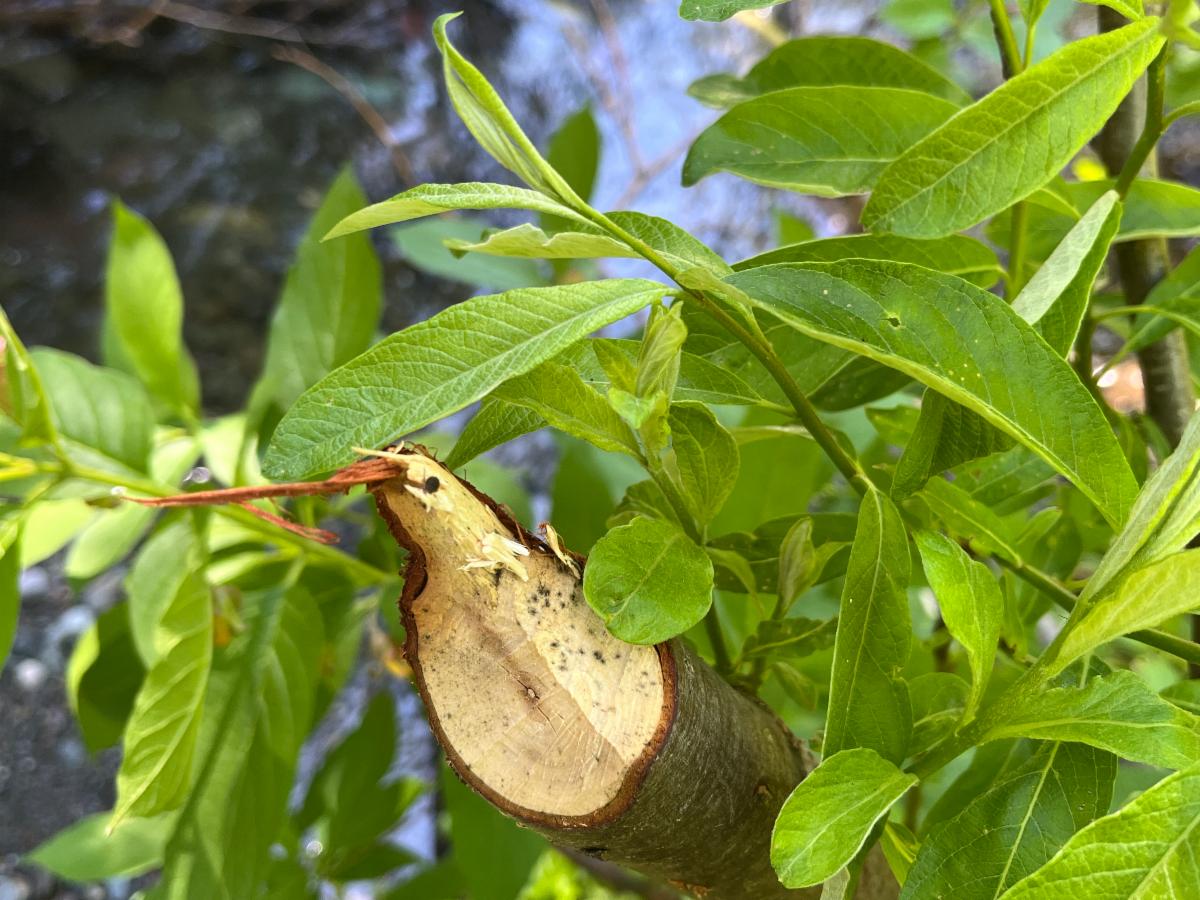
|
Beavers Go Big at The Wildlife Society 2026 Montana Chapter Conference
In late February, the Montana Chapter of The Wildlife Society held its 64th Annual Conference. With the conference theme of "Coordination and Collaboration in Conservation," it's not surprising that beavers played starring roles at the sold-out event in Missoula. Beavers featured in talks and posters describing research from around the state, many of which showcased beaver benefits to resilient, biodiverse watersheds. You can check out the abstracts below, and the full program here. Many thanks and congrats to all the contributors for this impressive body of work!
(POSTER) VARIATION IN HABITAT USE OF FAUNA IN RELATION TO BEAVER DAMS AND WATER AVAILABILITY IN SMALL PRAIRIE STREAMS IN MONTANA
Ethaniel Marshall*, University of Montana; Ross Coldsmith, University of Montana; Colleen Piper, University of Montana; Lisa Eby, University of Montana; Blake Hossack, U.S.G.S Coop Unit
Human activities and climate change continue to impact wildlife and ecosystem integrity in eastern Montana. In the state’s semi-arid prairie ecosystems, the North American beaver (Castor canadensis) may play an important role in buffering against drought. By impounding water, beaver dams can increase the resilience of water-limited ecosystems and promote species richness for both aquatic and terrestrial species. However, there is still limited understanding regarding the influence of beaver dams on species richness and composition in these semi-arid, prairie ecosystems. Through a camera-trap study, we sought to examine how wildlife species richness and composition in eastern Montana is associated with changes in water availability during the summer. We used 48 cameras that recorded nightly wildlife activity across beaver-dammed and unimpounded sites on four small, prairie streams (7 PM to 7 AM, June through September 2025). Presence or absence of water was determined from photos, which showed drying events occurred at both beaver-dammed and unimpounded sites. To date we have identified 14 mammal species and 5 groups of bird species, including waterfowl and songbirds. For our next steps, we will examine how beaver influences species richness and composition associated with prairie streams. This project will provide useful insights into how wildlife use beaver-dammed and undammed sections of small streams as well as how that use changes throughout the summer in response to changing water conditions in eastern Montana prairies
BUILT TO LAST? USING REMOTELY SENSED DATA TO ESTIMATE OCCUPANCY AND PERSISTENCE OF BEAVER DAMS IN PRAIRIE STREAMS
Colleen Piper*, University of Montana; Matthew Webster, University of Montana; Lisa Eby, University of Montana; Blake Hossack, USGS
Drought and extreme precipitation events are projected to increase in frequency and severity across arid and semi-arid ecosystems globally. In response, beavers (Castor canadensis) and beaver-based restoration practices have gained attention for their potential to enhance ecological resilience by retaining water and moderating hydrologic variability. However, most studies informing these approaches have focused on systems with perennial flow, low confinement, and abundant woody vegetation, leaving uncertainty around applicability to prairie streams. We used a 100 x 100-m grid-based sampling approach with remotely sensed data to detect beaver dams and estimate relationships between dam occupancy and persistence with channel characteristics, peak flow events, and availability of woody vegetation across streams in northeastern Montana. Based on a multi-season occupancy model that accounted for false-negative and false-positive detections from images in 2017, 2019, 2021, 2023, beaver dams were estimated to occur in 3.6% (95% CI = 3.3–3.8%) of our sampling grid, and two-year persistence probabilities ranged from 17.1% to 40.7%. Our estimated occupancy translates to ~0.4 dams/stream km across the study area, which is within the range of densities measured in other prairie systems (0.08‒1.40 dams/km) and lower than densities from montane systems (3.4‒11.4 dams/km). Higher dam occupancy and persistence were most strongly associated with lower channel confinement and lower peak flows. Upstream catchment area was negatively associated with dam occupancy and persistence, whereas woody vegetation was not associated with persistence. Our results illustrate the important role that hydrologic and geomorphic drivers play in structuring beaver dam dynamics in prairie streams.
EVALUATING THE IMPACTS OF RIPARIAN RESTORATION ON CLIMATE RESILIENCE, BIODIVERSITY VALUE, AND PRODUCTIVITY IN GRASSLANDS
Ellen Welti, Kansas State University; KS Justin Nowakowski, Smithsonian Environmental Research Center; Jonathan Drescher-Lehman, Smithsonian Environmental Research Center; Maya Rayle*, Smithsonian's National Zoo and Conservation Biology Institute; Andrew Boyce-Pero, Smithsonian's National Zoo and Conservation Biology Institute; Kelsey Molloy, The Nature Conservancy; Shelby Weigand, National Wildlife Federation
Temperate grassland ecosystems are the most threatened ecosystem type in the world, and 62% of North American temperate grasslands have been lost. Within grasslands, mesic and riparian areas serve as critical habitat for many local and migratory species, however, many of these systems are highly degraded. Low-tech process-based restoration (LTPBR), which includes construction of beaver dam analogs (BDAs), is an attempt to restore degraded stream ecosystems by slowing water down and retaining moisture further into the summer season. While LTPBR has been effective in wet climates and montane ecosystems, it is unknown how this restoration strategy changes biodiversity value, productivity, and climate resilience of the riparian areas of a dry grassland ecosystem such as the Northern Great Plains. To evaluate whether LTPBR increases thermal refugia and soil moisture and assess how these changes influence the biodiversity value in riparian areas, we leverage a suite of low-cost automated tools, including microclimate and soil moisture sensors to assess climate resilience and productivity, and autonomous recording units (sound) to assess biodiversity at paired restoration and control sites. We collaborate with a diverse set of partners and private landowners to construct LTPBR structures and implement this 5-year monitoring evaluation. We will present the results from our first season, which includes bioacoustics data from 10 sites and microclimate data from 14 sites. The results of these monitoring efforts will help inform future restoration strategies and help conservation practitioners to allocate resources towards riparian restoration.
EFFECTS OF STREAM GEOMORPHOLOGY ON BEAVER COLONY SUCCESS IN SOUTHWESTERN MONTANA
Denali Stetson*, Montana State University, Bozeman Daniel Atwater, Montana State University, Bozeman Daniel Tyers, USDA Forest Service and Montana State University, Bozeman Tim Covino, Montana State University, Bozeman
Beaver (Castor canadensis) are ecologically vital for maintaining riparian ecosystems. They were broadly dispersed throughout North America prior to the 1900s but their numbers greatly declined with Euro-American settlement due to habitat loss and trapping. Reintroduction efforts have been used to restore beaver populations and improve degraded riparian areas. This occurred in the southern Absaroka Beartooth Wilderness, a designated Wilderness on the northern tier of the Greater Yellowstone Ecosystem where beavers were extirpated by about the 1970s. Between 1986 and 1999 forty-six beavers were reintroduced into this area. To assess the results of this program, researchers recorded active lodges, caches, and dams throughout 4 drainages and thirteen meadows since 1986. These surveys have documented widespread beaver activity and a stable population. My project involves pairing almost forty years of beaver colony inventory data with Rosgen stream classification surveys I completed in the ABW and northern Yellowstone National Park to assess the relationship between beaver activity and stream morphology. Our objective is to predict the probability of beaver occupancy based on relevant environmental and geomorphic parameters. Model outputs will be applied to stream systems in adjacent geographic areas where Rosgen surveys have also been conducted to predict potential beaver occupancy across a broader landscape. Our findings will be used to inform future beaver reintroduction efforts across the Greater Yellowstone Ecosystem
SHOCK, SEED & DAM - A LARGE-SCALE GRASSLAND RESTORATION IN WORKING LANDS
Neil Vruno*, Coordinating Wildlife Biologist for Pheasants Forever, Inc.
Maintaining and restoring native grassland habitat in a multi-use landscape is critical for the future of our sagebrush prairie ecosystems and the critters that depend on them. By partnering with a rancher located in the Northern Shortgrass Prairie of eastern Montana, we are using cost-shared management practices to protect and restore native prairie habitat across both private and public land. In spring of 2024, virtual fencing technology was implemented on the ranch to improve grazing management on nearly 16,000 acres. In spring of 2026, we will 78 reseed nearly 1,000 acres of agriculture fields back to native grasses and install Beaver Dam Analogs (BDAs) to improve water retention along a 10-mile stretch of an intermittent stream. Virtual fencing will increase the effectiveness of the native grass seeding and BDAs with its fine scale grazing management, allowing for necessary rest and recovery of restored upland and riparian areas. These practices can improve habitat for a wide variety of upland birds (pheasants, sharp-tailed grouse, turkeys), big game species (pronghorn, deer), grassland songbird species and multiple species of concern (greater sage-grouse, Baird’s sparrow, chestnut-collard longspur and thick-billed longspur). These practices will also improve the rancher’s ability to manage grazing for sustainable livestock production, keeping grass right-side up in a multi-use, working landscape for years to come.
USING REMOTELY SENSED DATA TO UNDERSTAND THE INFLUENCE OF BEAVER DAMS ON SURFACE WATER IN PRAIRIE STREAMS OF EASTERN MONTANA
Matthew Webster*, University of Montana; Colleen Piper, University of Montana; Lisa Eby, University of Montana; Blake Hossack, U.S. Geological Survey; Patrick Donnelly, University of Montana & Numerical Terradynamic Simulation Group; Thomas Riecke, University of Montana
Water fuels mesic productivity in semi-arid and arid regions. Beaver-based restoration is increasingly being implemented to conserve and restore streams and riparian areas and promote ecosystem resilience to drought. However, the influence of beaver dams on surface water has not been examined in small prairie streams. Watersheds in eastern Montana are characterized by erosive soils and sparse woody vegetation, often resulting in deeply incised channels with confined stream flow. This region is also known for variable and unpredictable summertime flows across intermittent and permanent streams. Although data from satellite imagery has dramatically increased our ability to monitor beaver dams and surface water change across landscapes, assessing the effects of beaver in prairie watersheds has been hindered by factors such as small stream size, intermittence, and deeply incised stream banks. To quantify the effects of beaver in prairie streams in eastern Montana, we created a land cover classifier that uses fine scale, freely available satellite imagery to identify surface water across the landscape. We then coupled this surface water data with topographic, geographic, and hydrologic data to quantify the relative influence of beaver dams on surface water in prairie streams. Results from this research show that 1) our surface water classifier performs well, 2) the relationship between dams and surface water is strongly constrained by channel confinement and stream discharge.
|