| |
Treasures of NAASR's Mardigian Library:
NAASR and the Establishment of the Mashtots Chair at Harvard, 1954-1969
| | In conjunction with the celebratory event NAASR held on May 6, 2023, marking the appointment of Christina Maranci as the third holder of the Mashtots Chair in Armenian Studies at Harvard University, we are devoting this Library Treasures installment to materials from NAASR’s own organizational archives pertaining to this organization’s pioneering effort to establish the first chair in Armenian Studies in the U.S.—or, indeed, anywhere in the Armenian diaspora in North America—focusing on the years from 1954 to the appointment of the first chairholder in 1969. | |
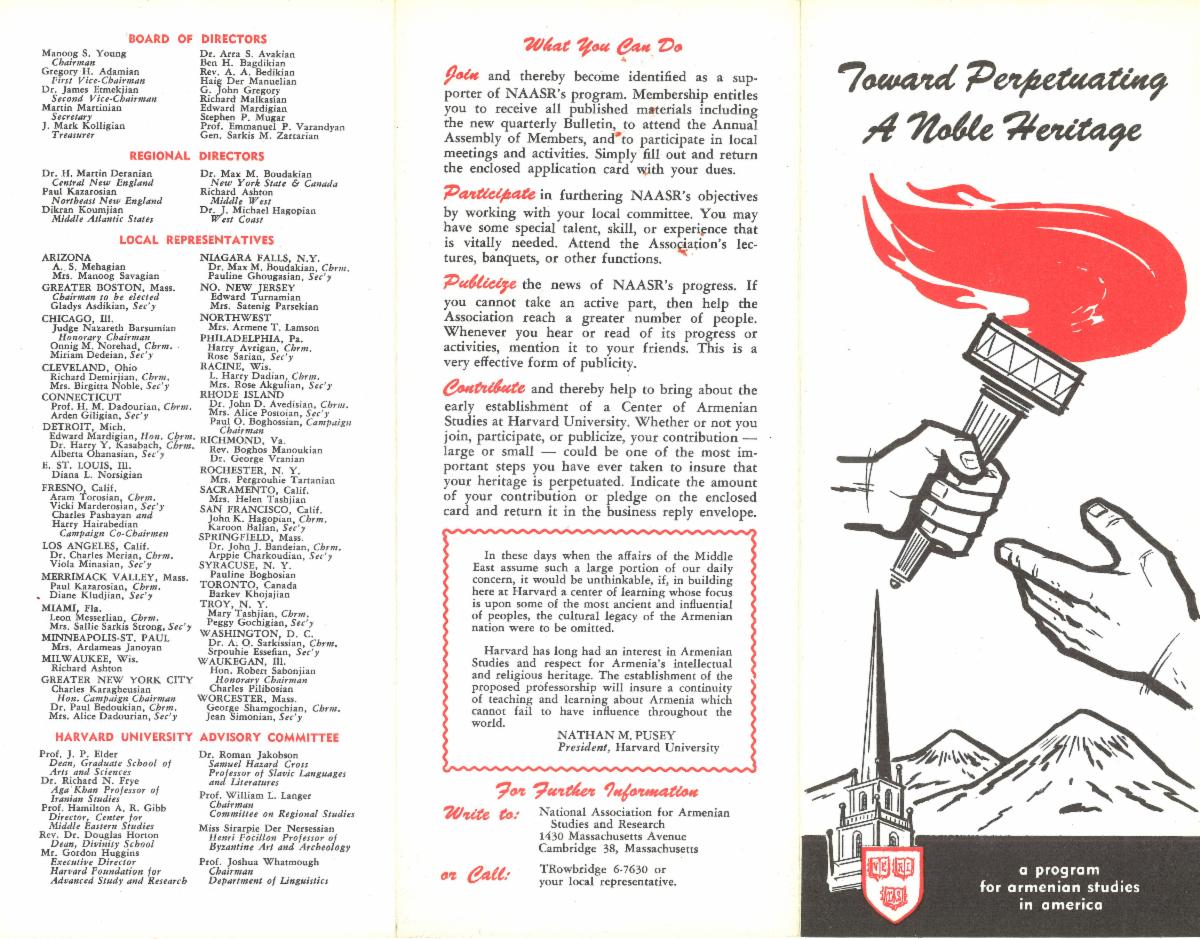
Above: NAASR brochure from 1958, "Toward Perpetuating a Noble Heritage." Click to view in its entirety.
| |
The text below was presented by NAASR’s Director of Academic Affairs Marc A. Mamigonian on May 6 and draws from his article “From Idea to Reality: The Development of Armenian Studies in the U.S. from the 1890s to 1969,” published in the Journal of Armenian Studies, vol. 10. We dedicate this Library Treasures to the visionary men and women who indeed made the idea of Armenian Studies a reality.
| |
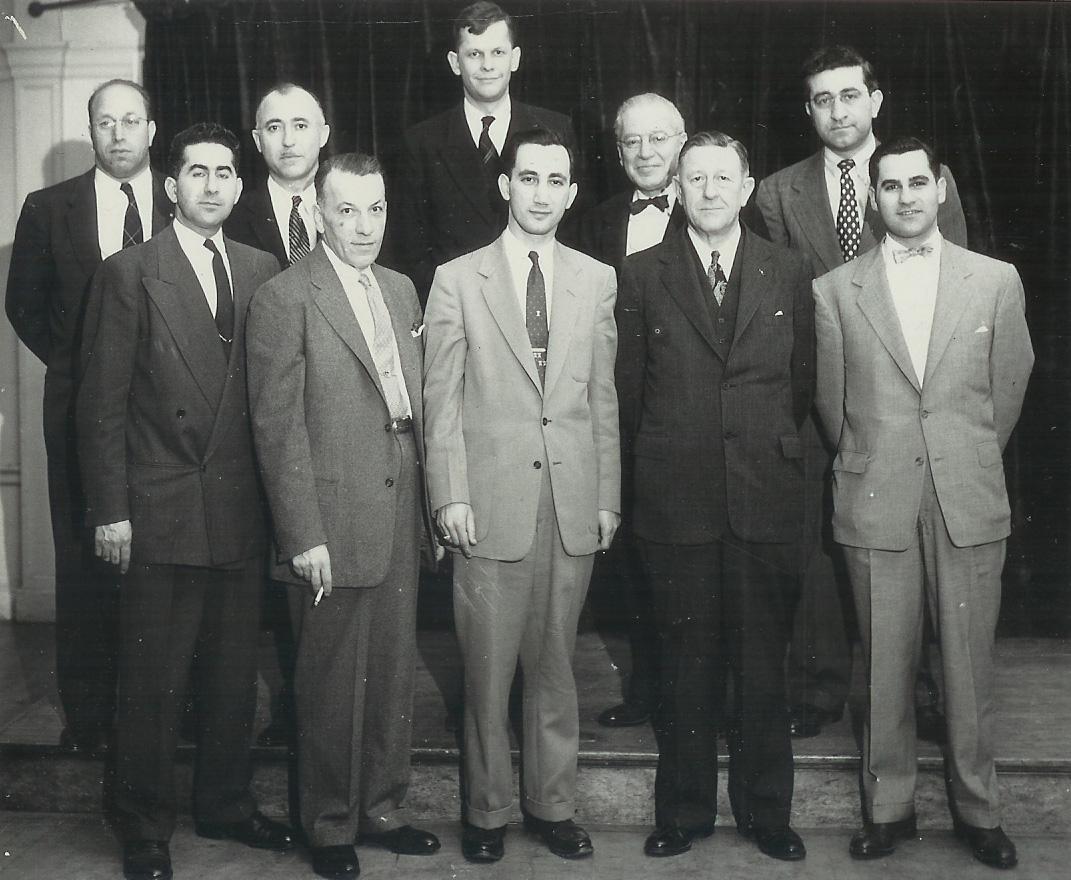
NAASR Founders (partial), March 1955: Back row, left to right: K. Merton Bozoian, Thomas T. Amirian, Richard N. Frye, G. John Gregory, Jack Guveyan; Front row: Arra S. Avakian, J. Mark Kolligian, Manoog S. Young, William L. Langer, Haig Der Manuelian.
| |
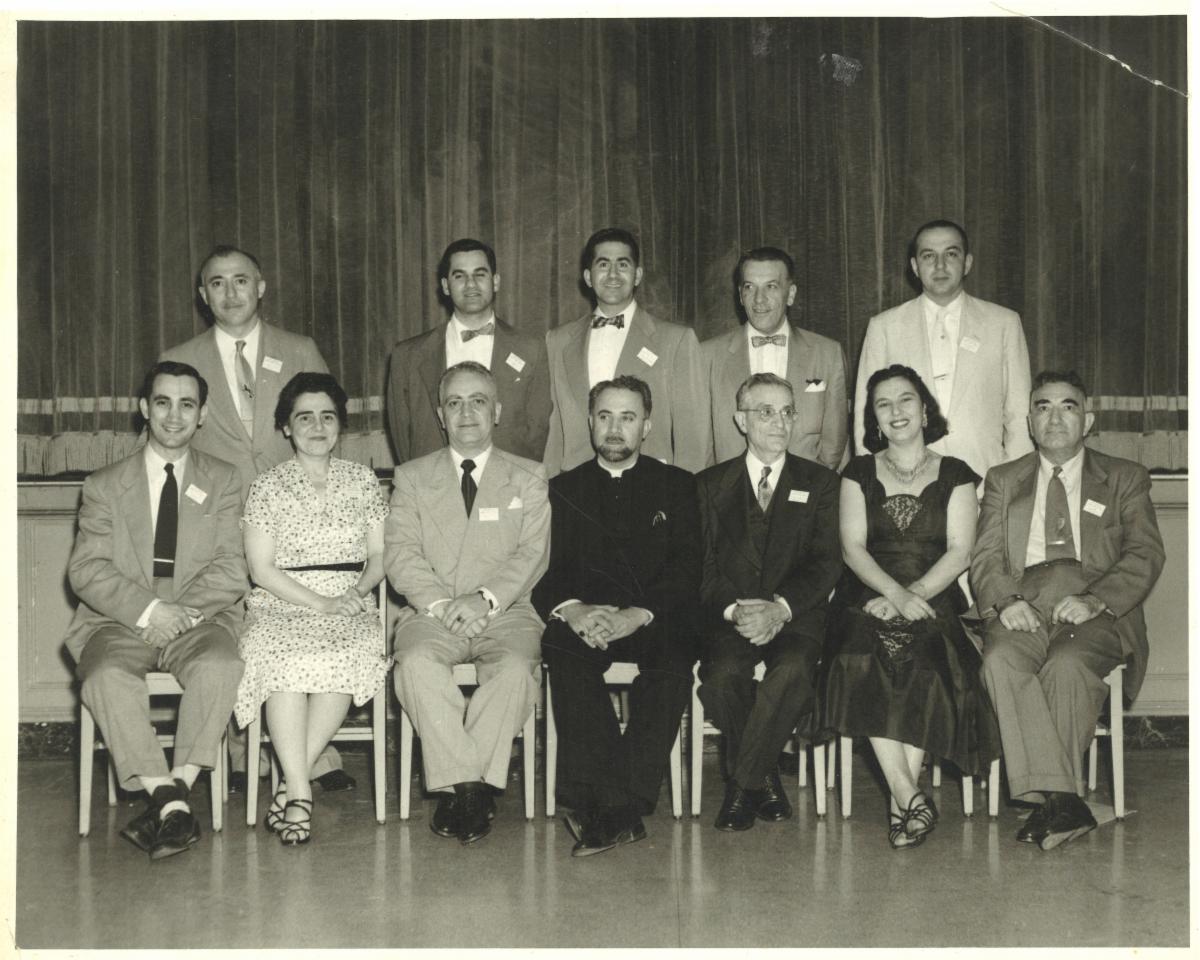
Above: Members of NAASR's first Board of Directors (partial), June 1955: Back row, left to right: Thomas T. Amirian, Haig Der Manuelian, Arra S. Avakian, J. Mark Kolligian, Richard Malkasian; Front row, left to right: Manoog S. Young, Zabelle D. Tahmizian, Sarkis Zartarian, Abp. Tiran Neroyan, Rev. A. A. Bedikian, Armine Dikijian, Manasseh G. Sevag.
| | There were various efforts, prior to the founding of NAASR, to establish Armenian chairs or programs at American universities, none of which got very far. When NAASR was launched in 1955, there could not have been many who anticipated that it would succeed where others had failed. | | In an early announcement, it was stated that the founding members had decided that there was a need for a national organization for the advancement of Armenian studies in America. They further decided that the first major task that needs to be undertaken, in order to place Armenian studies on a scholarly and continuing basis in America, was to work for the establishment of an endowed professorship or chair for Armenian studies at a leading university. | |
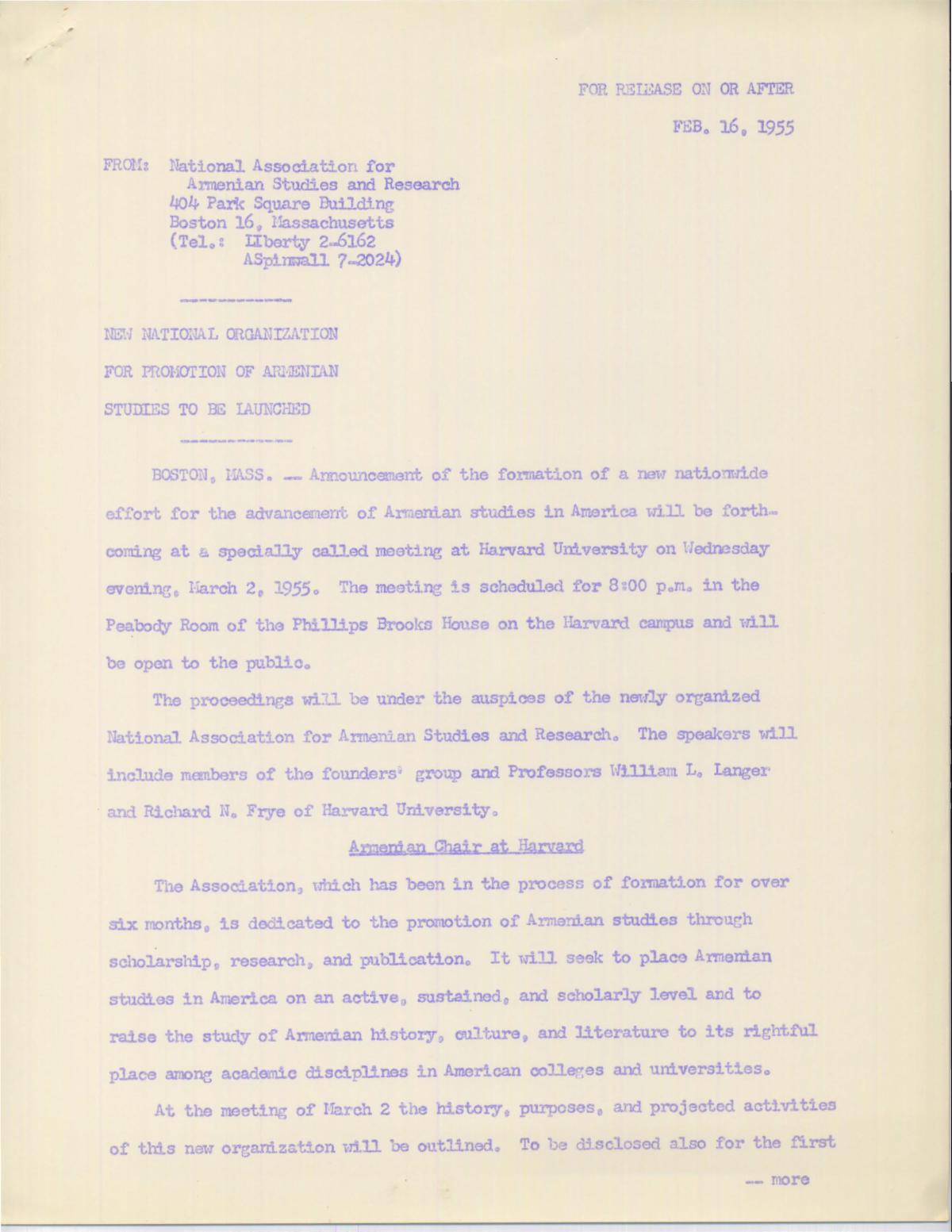
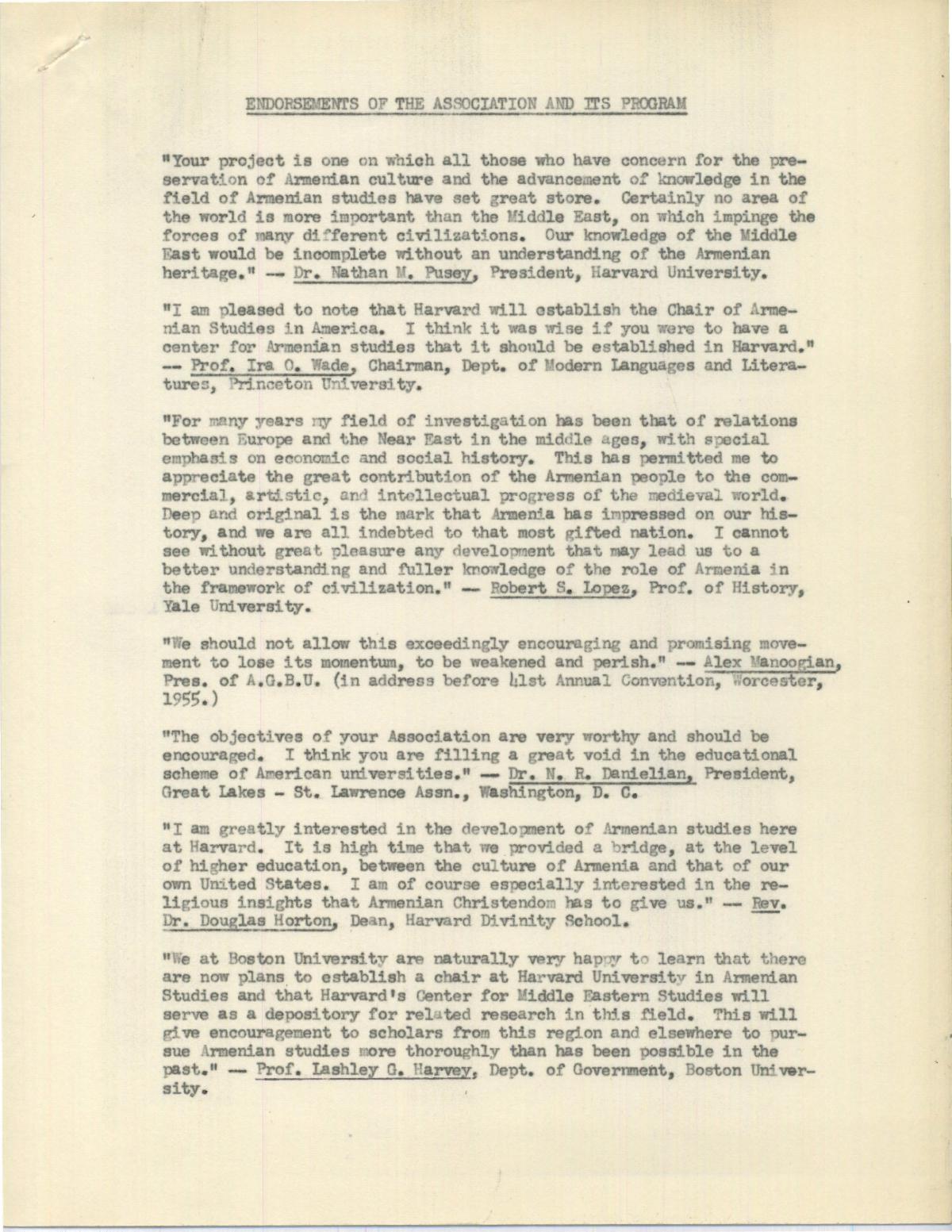
Above left: NAASR Press Release, Feb. 16, 1955, "New National Organization for Promotion of Armenian Studies Launched," also including partial list of Founding Members. Right: endorsements of the organization from scholars and leaders of the Armenian community, ca. 1955-56. Click on the images to view the documents in their entirety.
| | Harvard University was identified as the location of that first chair, and it was hoped that the necessary $300,000 could be raised within three years. That would be equivalent to about $3.5 million in 2023 dollars. | |
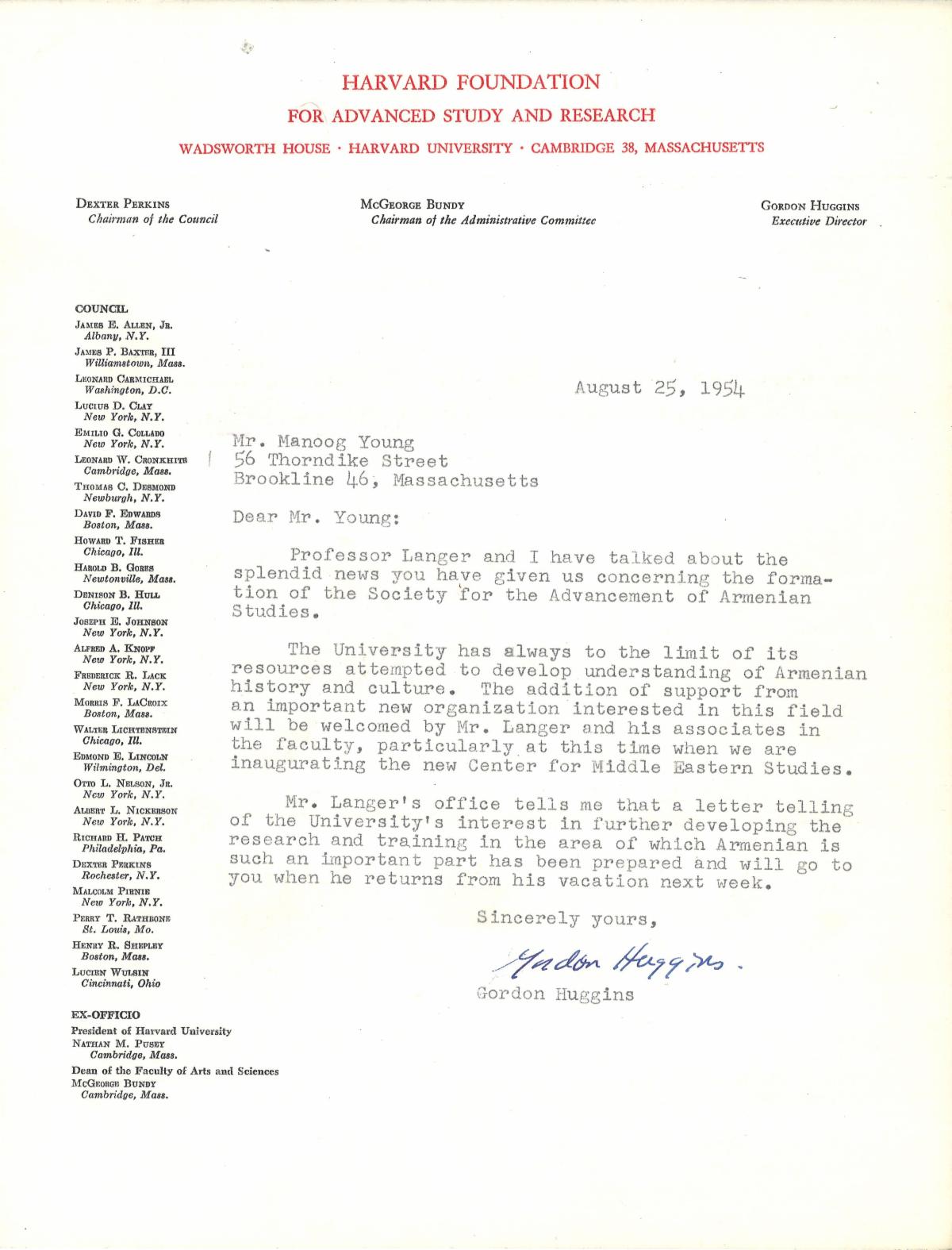
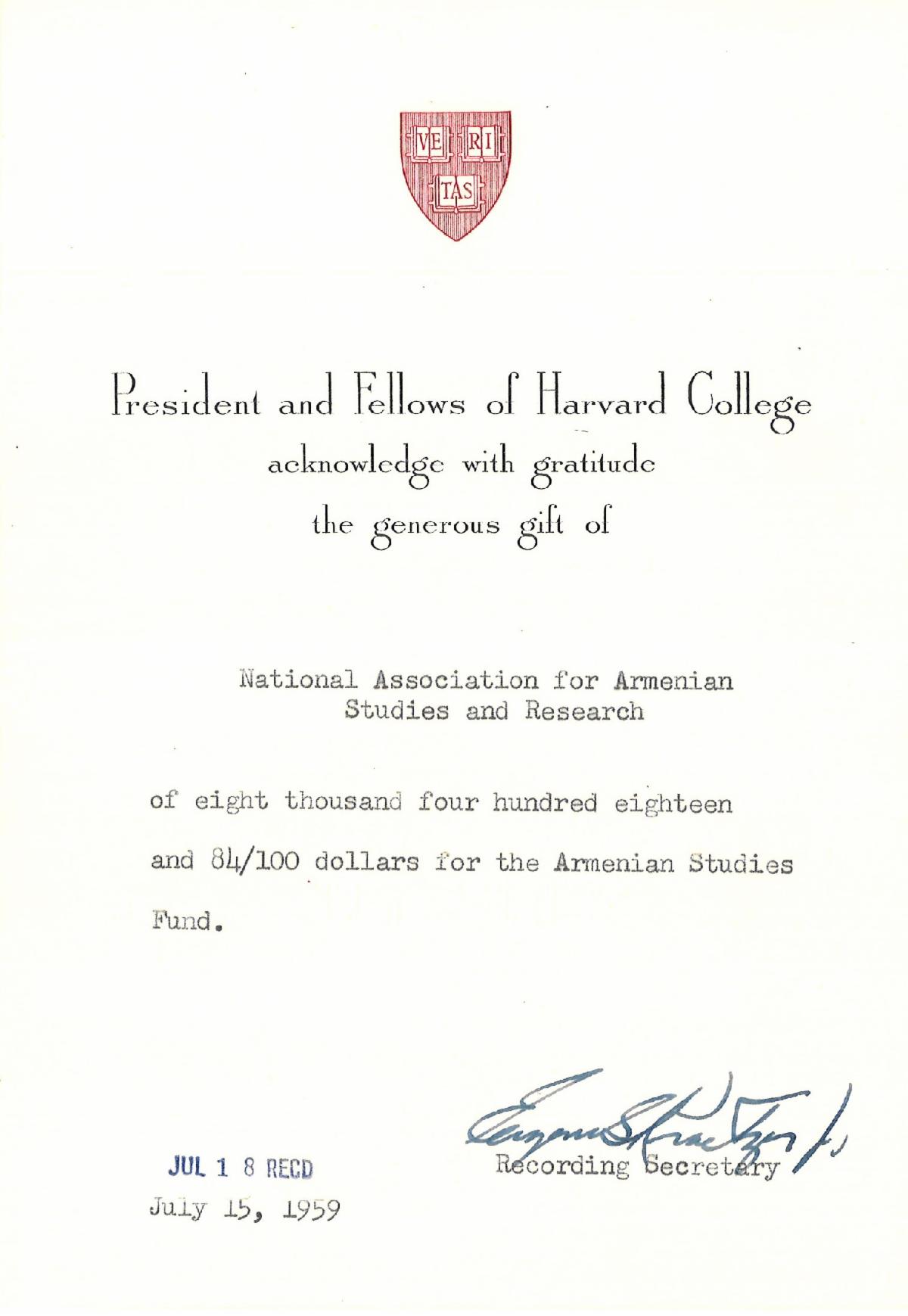
Above, left: Letter from Gordon Higgins, Executive Director of Harvard Foundation for Advanced Study and Research, to Manoog Young, dated 8/25/54, welcoming the news of the formation of NAASR (which was not yet named NAASR); Right, acknowledgement of a transfer of $8,418 from NAASR in 1959, shortly after the May 1959 "Victory Banquet."
| |
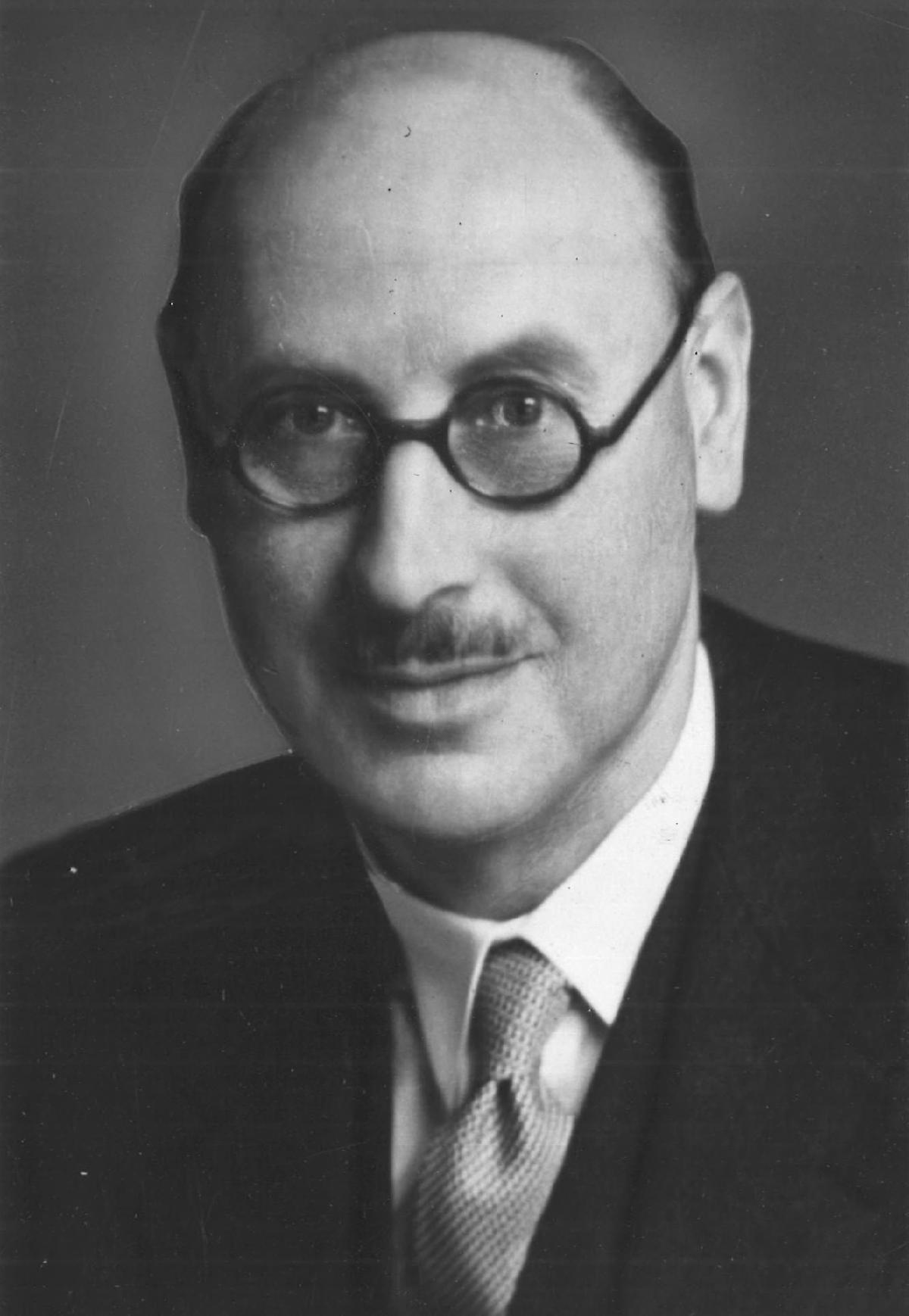
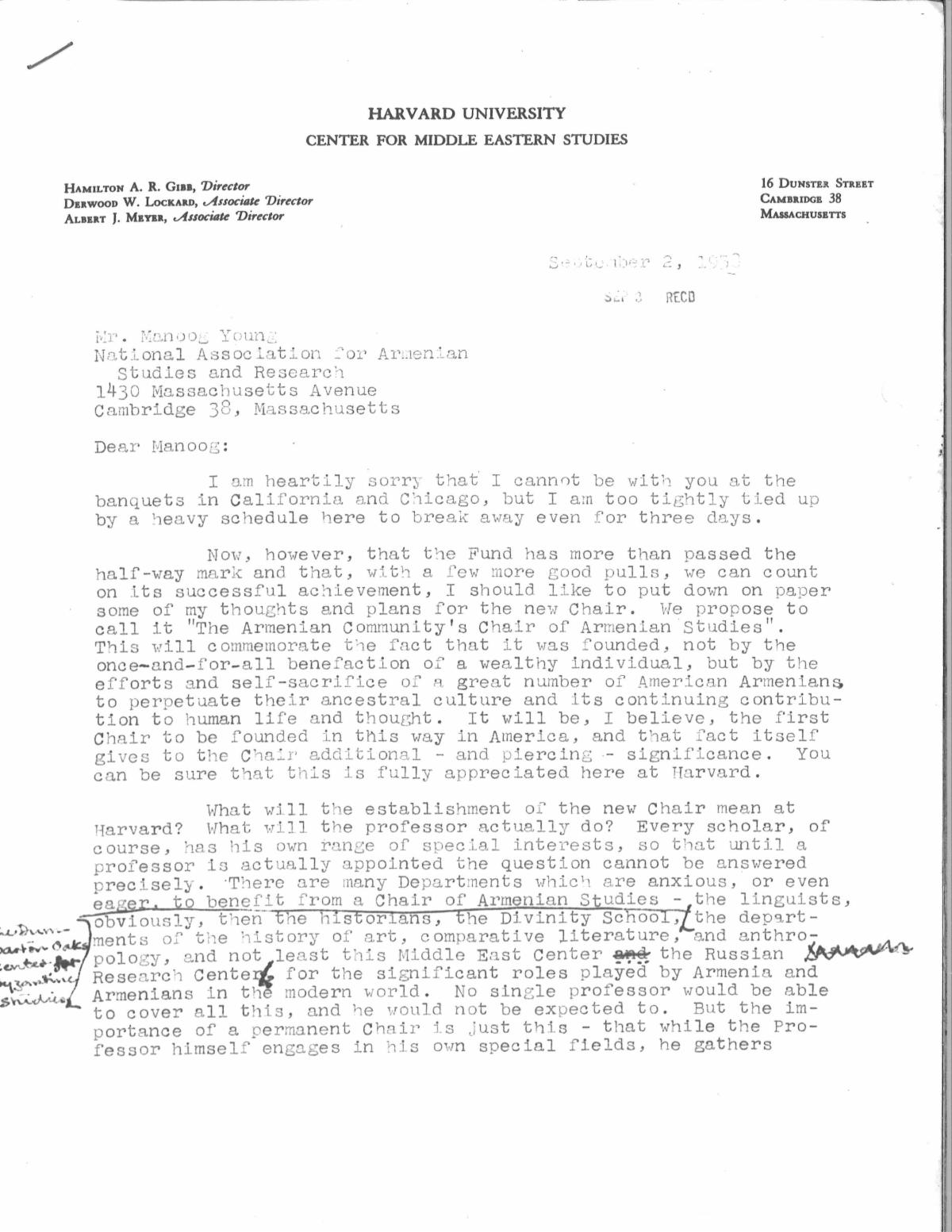
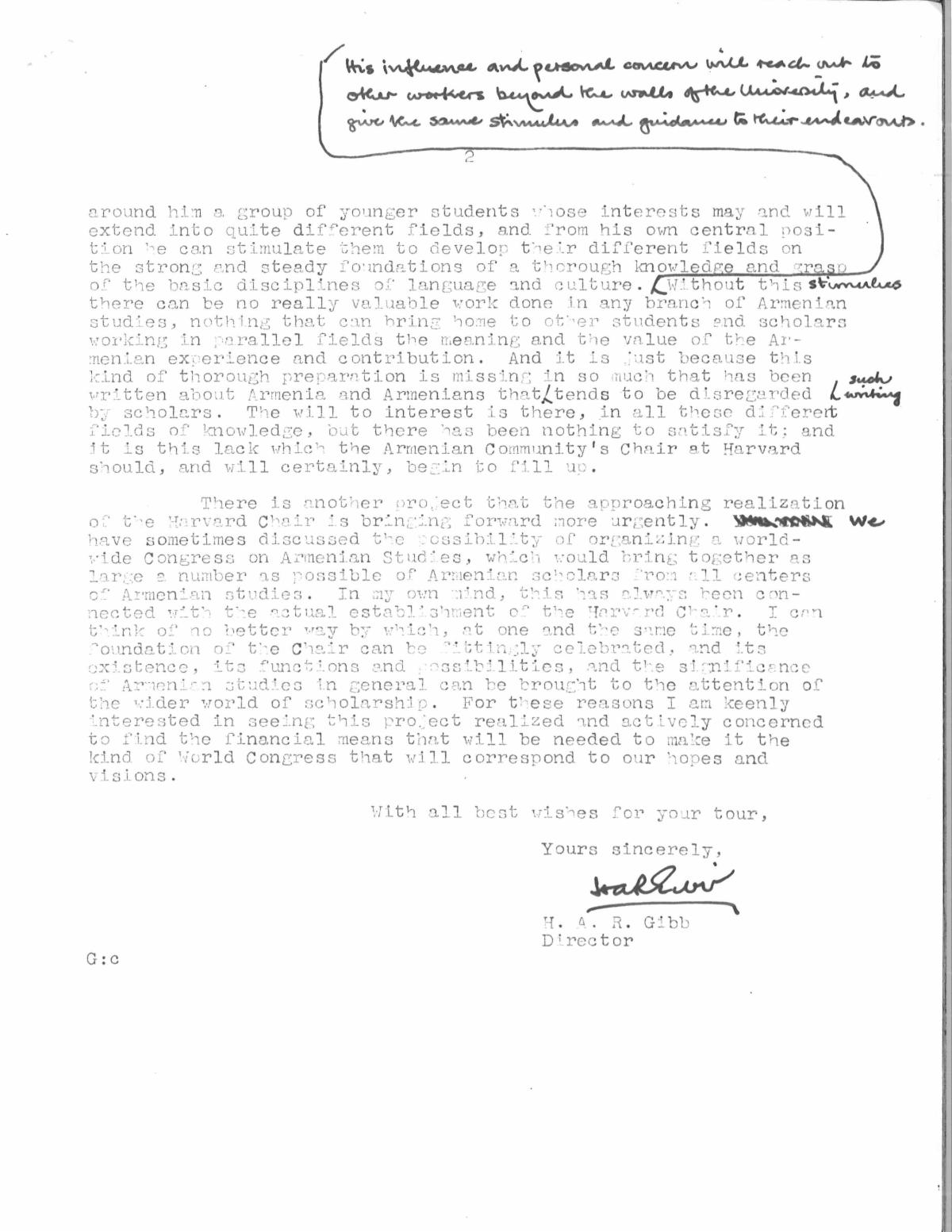
Ultimately, more than 3,000 people made contributions; there had never been a chair established at Harvard University, or anywhere else, through the kind of community-wide effort led by NAASR. In 1958, as the campaign neared its close, Hamilton Gibb (1895-1971; photo on right), then the Director of Harvard’s Center for Middle Eastern Studies, which had itself only been established in 1954, wrote to NAASR Chairman Manoog Young that “it will be, I believe, the first chair to be founded in this way in America, and that fact itself gives to the chair additional—and piercing—significance. You can be sure that this is fully appreciated here at Harvard.” Indeed, Gibb proposed that the chair be called “The Armenian Community’s Chair of Armenian Studies.”
| |
Above: Letter from Hamilton Gibb, Director of the Harvard Center for Middle Eastern Studies, to Manoog S. Young, dated September 2, 1958: the Harvard Armenian Chair "will be, I believe, the first Chair to be founded in this way in America, and that fact itself gives to the Chair additional--and piercing--significance."
| |
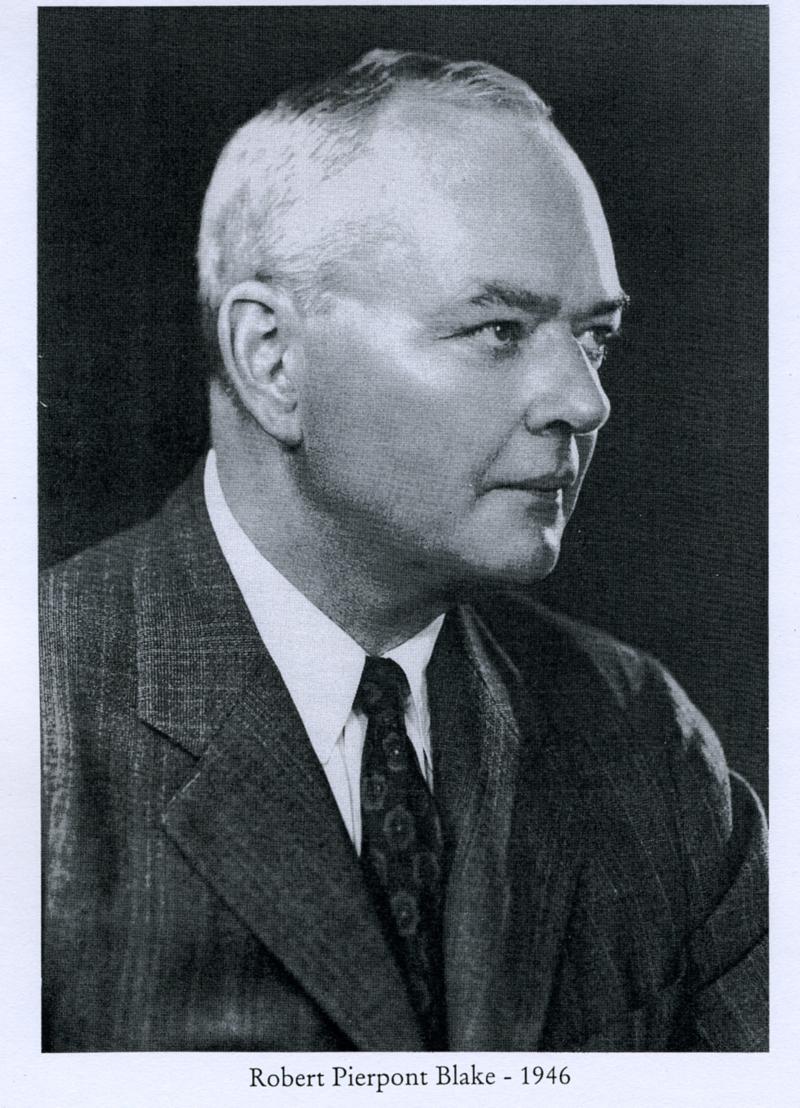
Even before NAASR, there was a foundation for Armenian Studies at Harvard—which was one of the reasons the NAASR founders chose Harvard to be the site of the first chair. One of the pioneers of Armenology in the U.S. was Robert P. Blake (1886-1950), whose interest in and involvement with Armenian subjects dated back to 1910. Blake was at Harvard from the 1920s until his death in 1950, and in the late 1920s he began offering a class on “Armenian Historical Documents.” He also taught Byzantine History and would later give courses in the History of the Ottoman Empire and classes in Armenian and Georgian languages in the department of Comparative Philology.
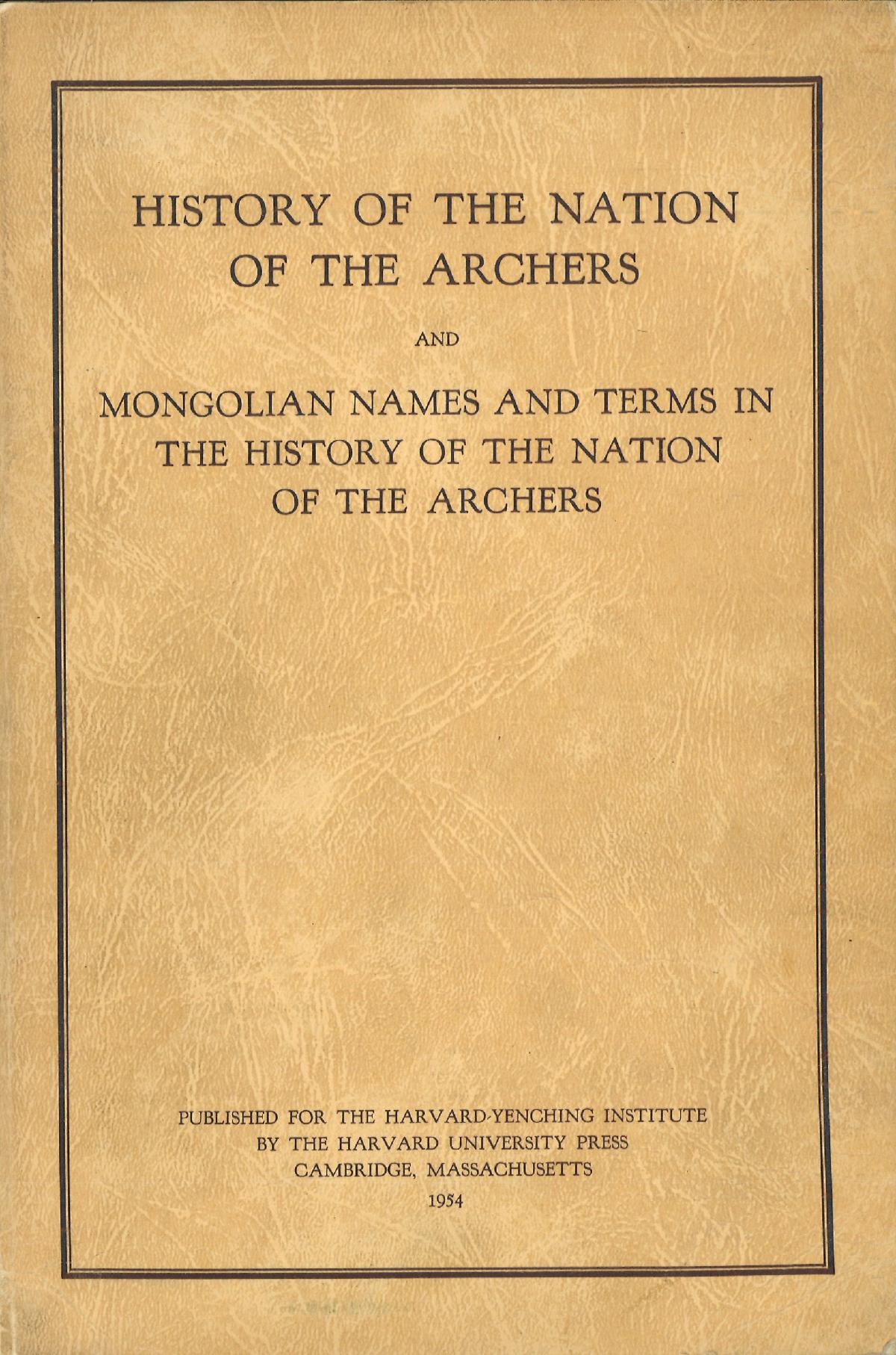
Blake remained active until his death and in many ways paved the way for the permanent program in Armenian Studies at Harvard, a cause taken up by one of his students, Richard N. Frye (1920-2014), with whom he had translated the medieval Armenian text History of the Nation of the Archers (The Mongols) [Patmut'iwn Azgin Netoghats'], originally published in the Harvard Journal of Asiatic Studies (vol. 12, nos. 3-4) in 1949 and as a stand-alone volume in 1954 by the Harvard-Yenching Institute.
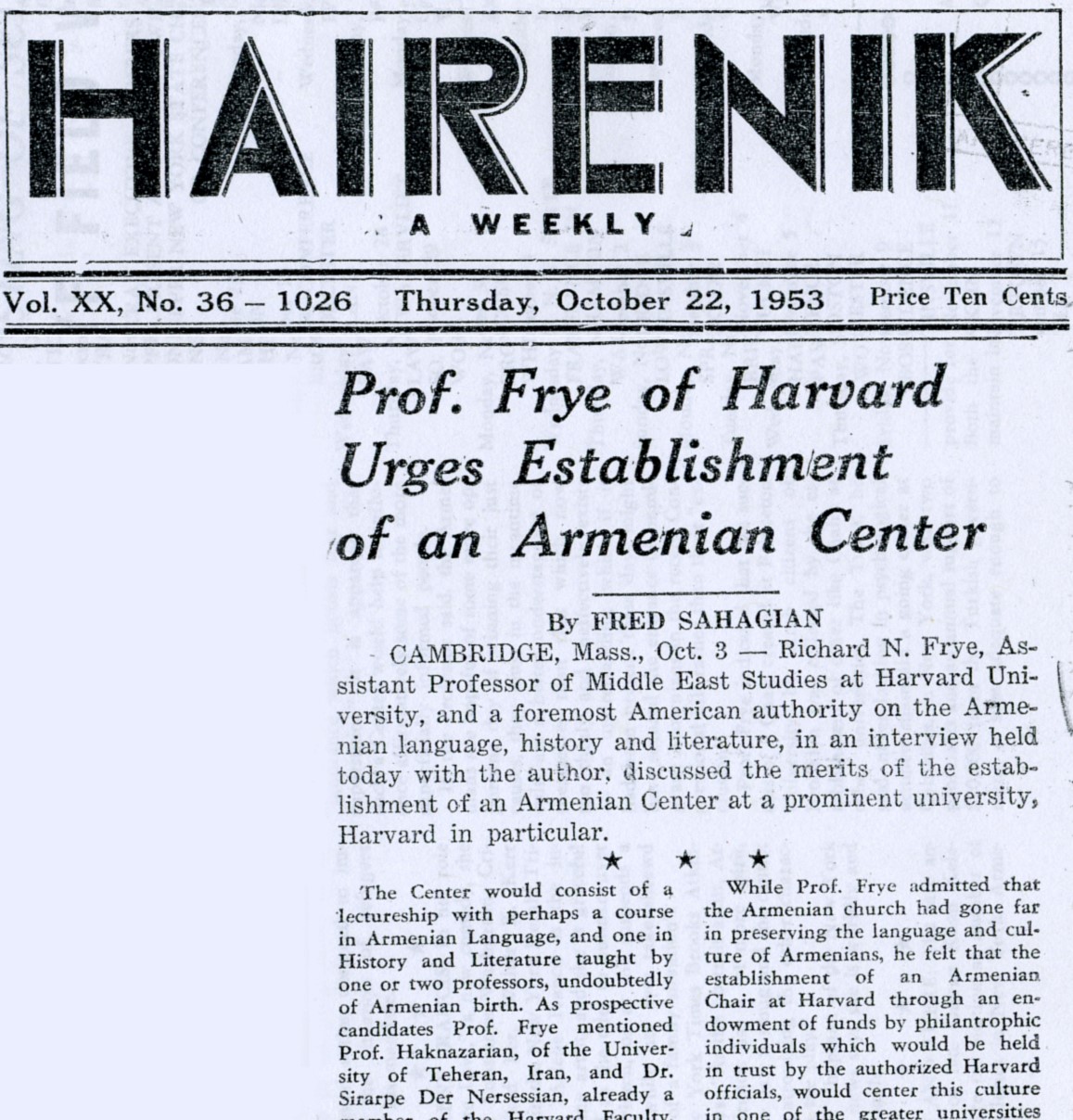
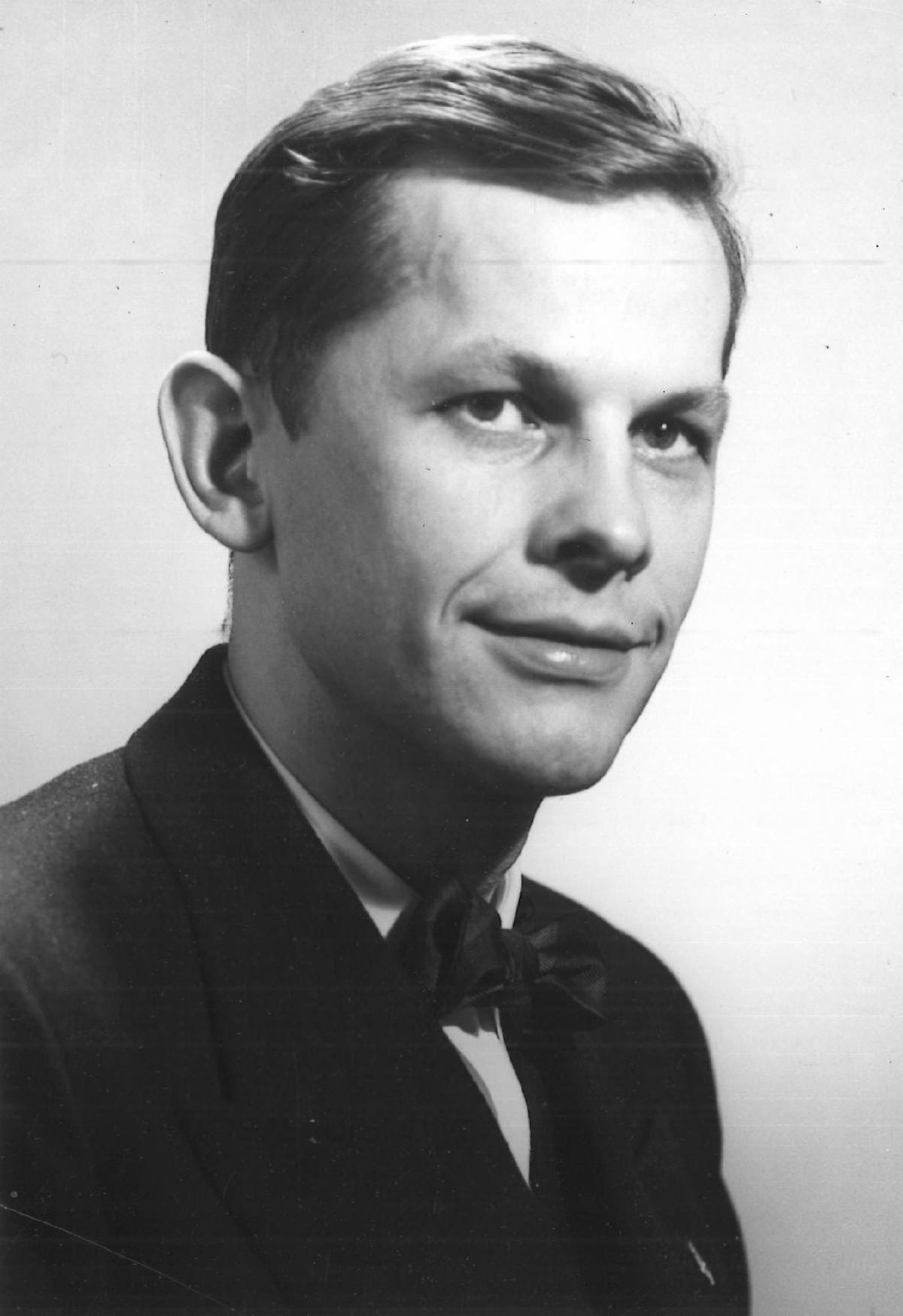
| | Frye took over the teaching of Armenian language at Harvard after Blake’s death, in addition to teaching Persian, Turkish, and other classes. As early as 1953, Frye was advocating for an Armenian center at Harvard. | |
Above: Richard N. Frye was in the forefront of efforts to advocate for--and then to establish--Armenian Studies on a permanent basis at Harvard.
| | Archibald Cary Coolidge (1866-1928), one of the founders of Russian Studies in the U.S., taught a class in the 1920s entitled “The History of the Eastern Question,” which, after his death, evolved into “The History of the Near East in Modern Times” under his former student, William L. Langer (1896-1977). | |
Above: William L. Langer speaking at a NAASR function in 1957.
| |
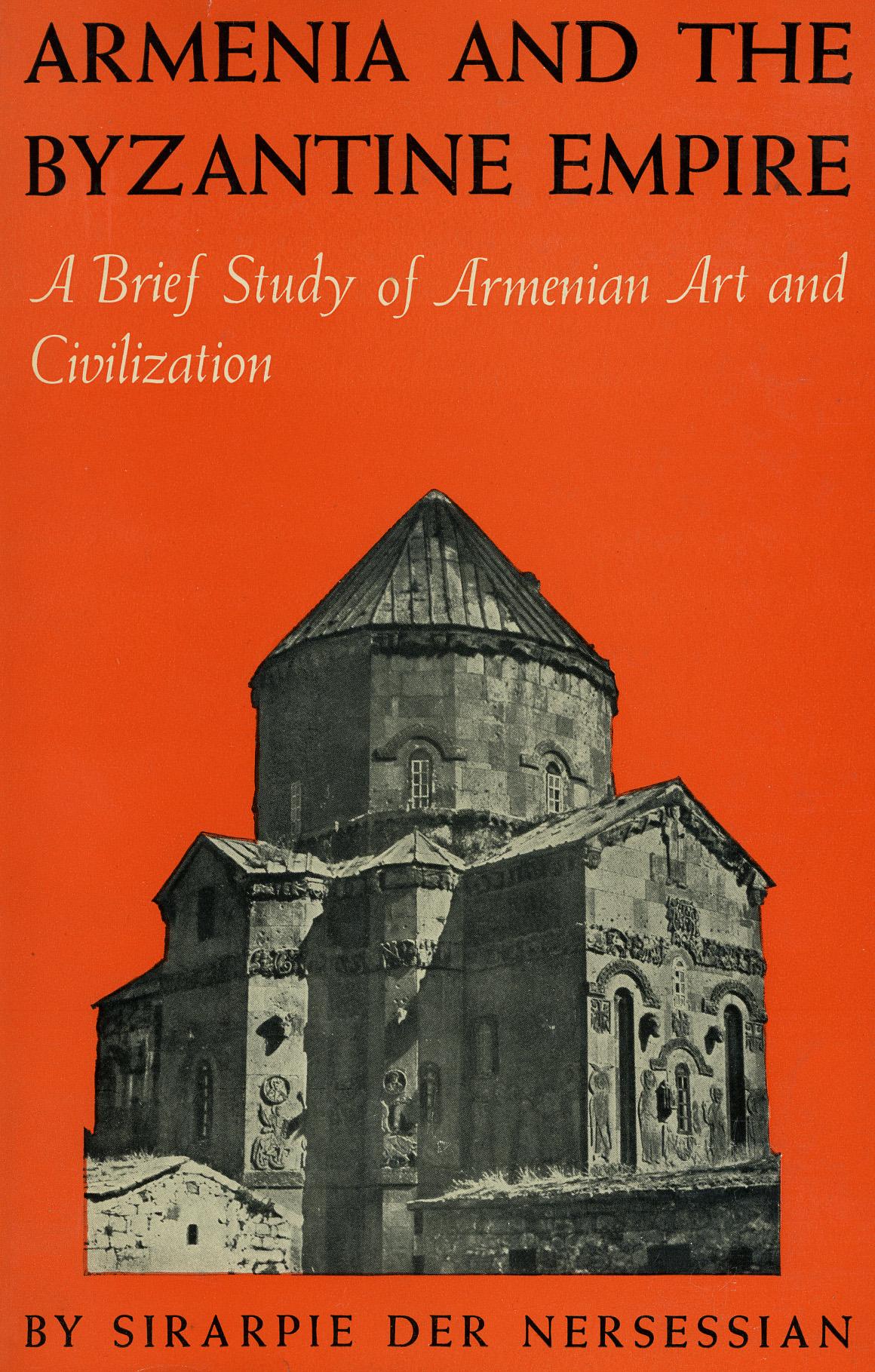
Sirarpie Der Nersessian (1896-1989) came to the U.S. in 1930 and began as a part-time lecturer at Wellesley and eventually became chair of the Department of Art History. From the 1940s until her death she was affiliated with Dumbarton Oaks, which became part of Harvard in 1939. Her Armenia and the Byzantine Empire: A Brief Study of Armenian Art and Civilization (1945) was the first volume published by Harvard University Press that focused entirely on Armenians.
| |
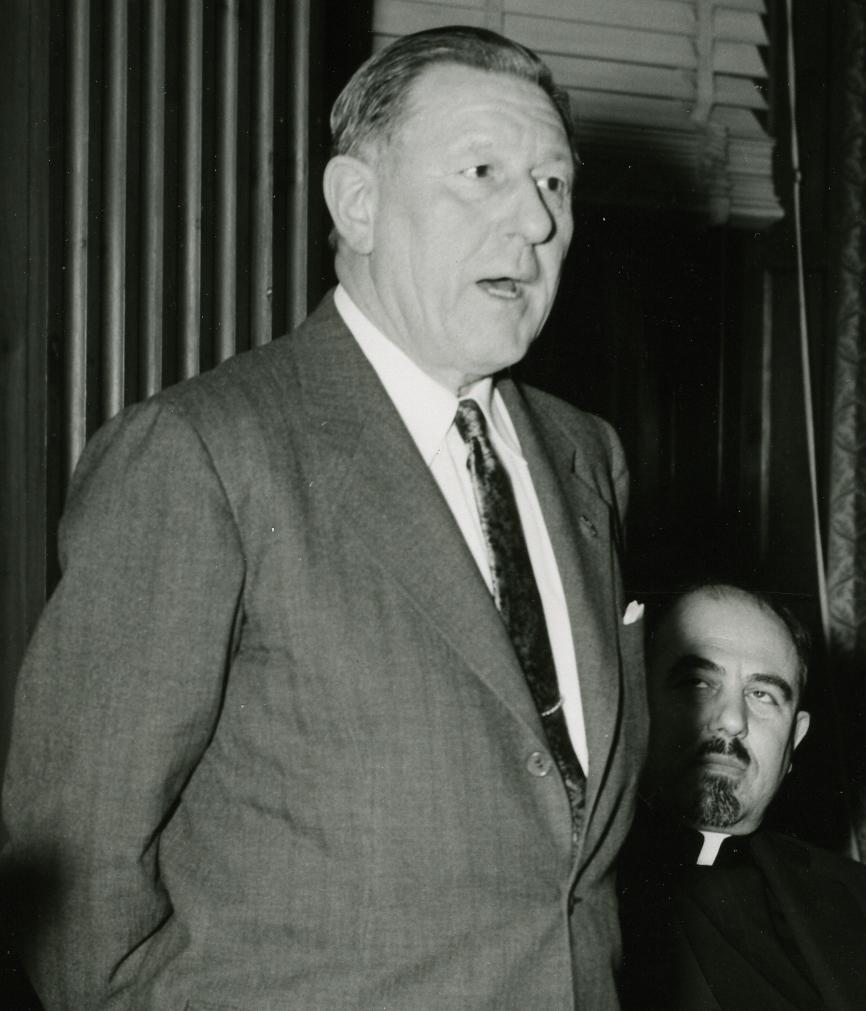
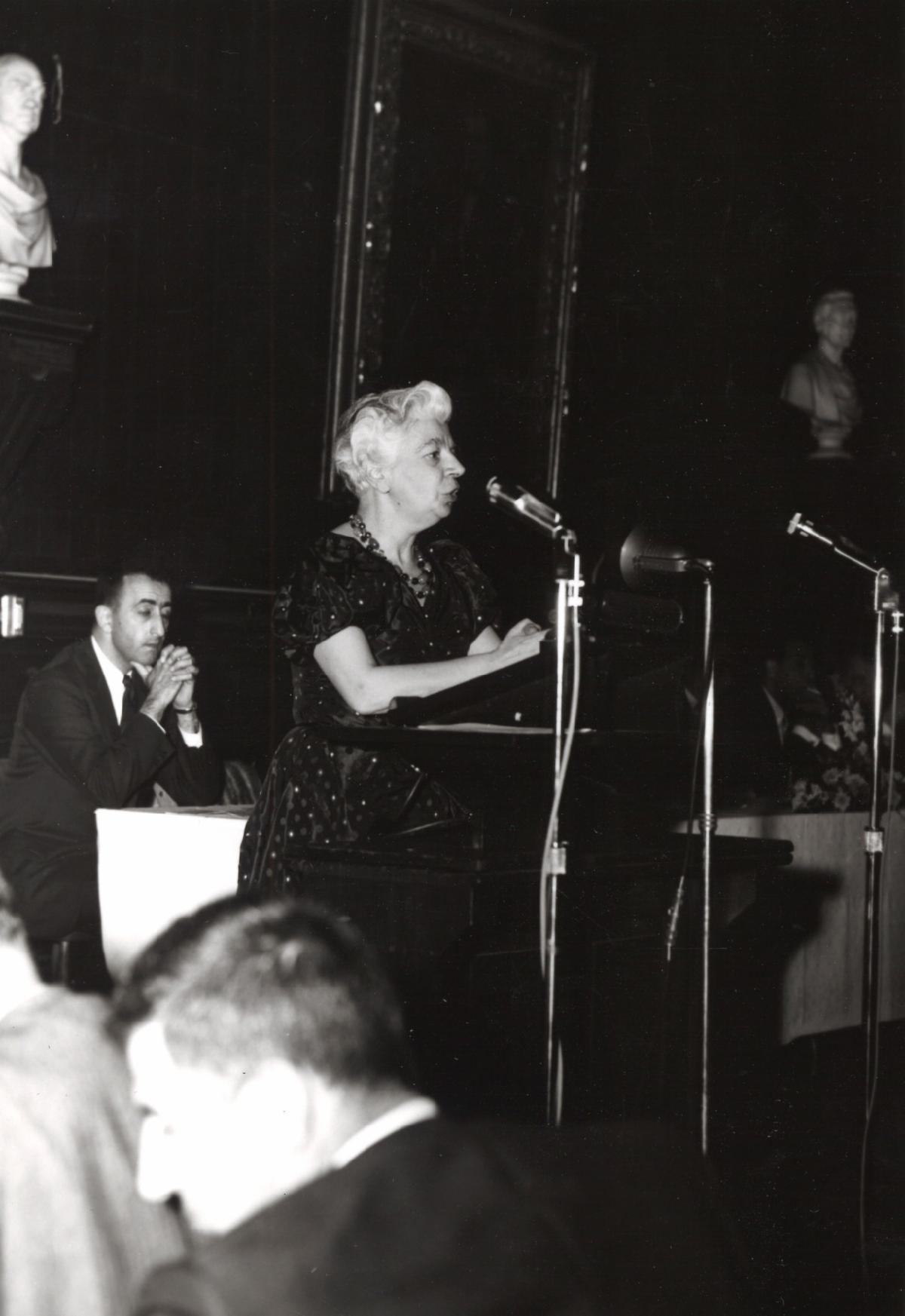
Above: Sirarpie Der Nersessian's pioneering 1945 book; Der Nersessian speaking at a NAASR function at Harvard, late 1950s.
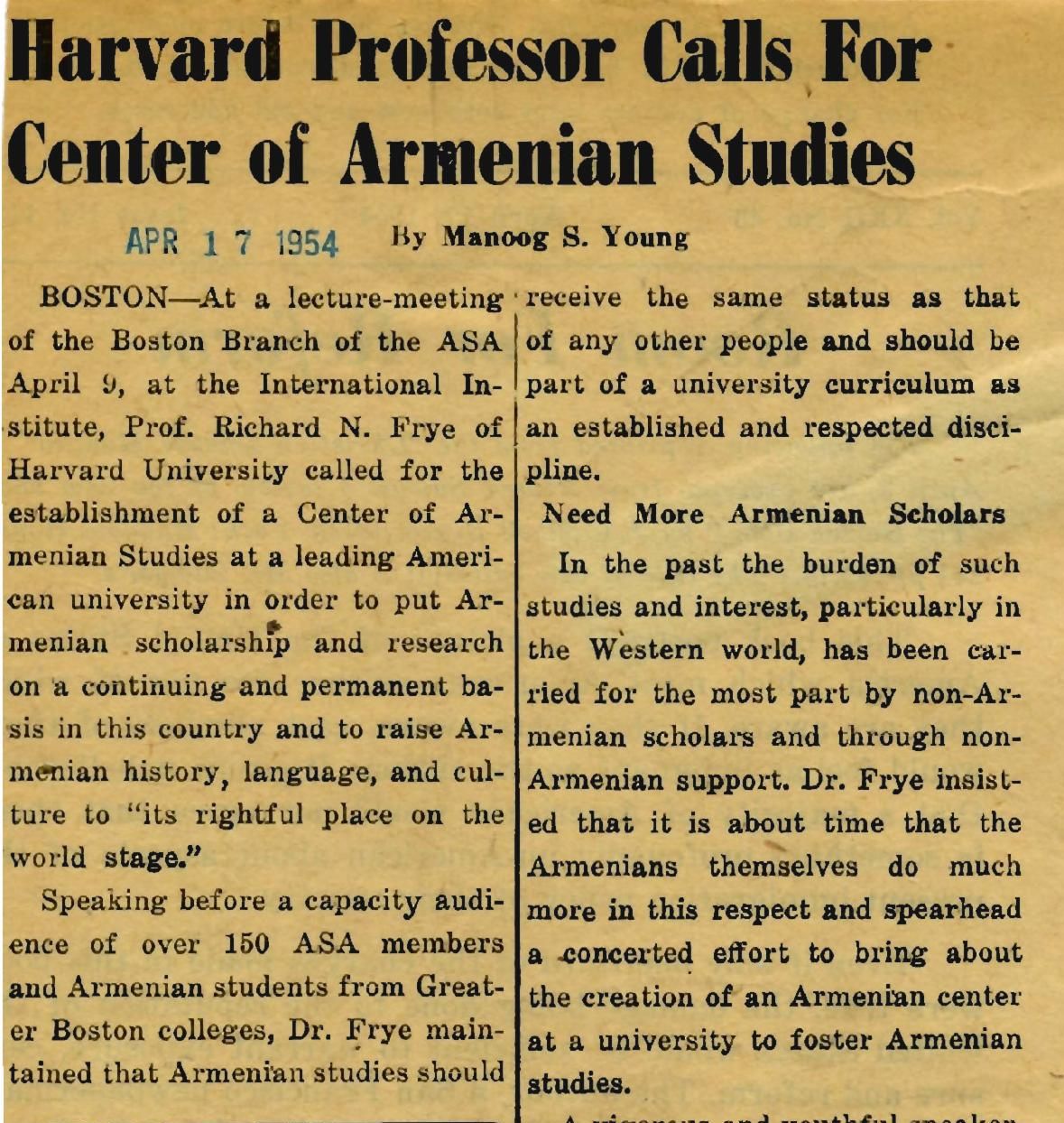
| | In April 1954, Manoog S. Young of Boston, MA, who at that time was working on a graduate degree in history at Clark University, was chairman of the Program Committee of the Boston branch of the Armenian Students’ Association. He invited Prof. Frye to address the Boston group. | | Frye’s talk was entitled “The Study of Armenian History, Language, and Culture—It’s Need and Importance,” and in it he declared “The Armenians have a long and rich heritage that is deserving of world recognition…yet this is unknown to most of the world...Armenian needs to be an established and respected discipline in the universities and should receive the same status and recognition as Arabic and Persian…Armenia and the Armenians are a part of world history, not separate from it, and Armenian literature, history, and culture is worthy of study.” | |
Above: Manoog S. Young reported on Frye's lecture to the Boston ASA in the April 17, 1954, issued of the Armenian Mirror-Spectator. Click on the image to view the article in its entirety.
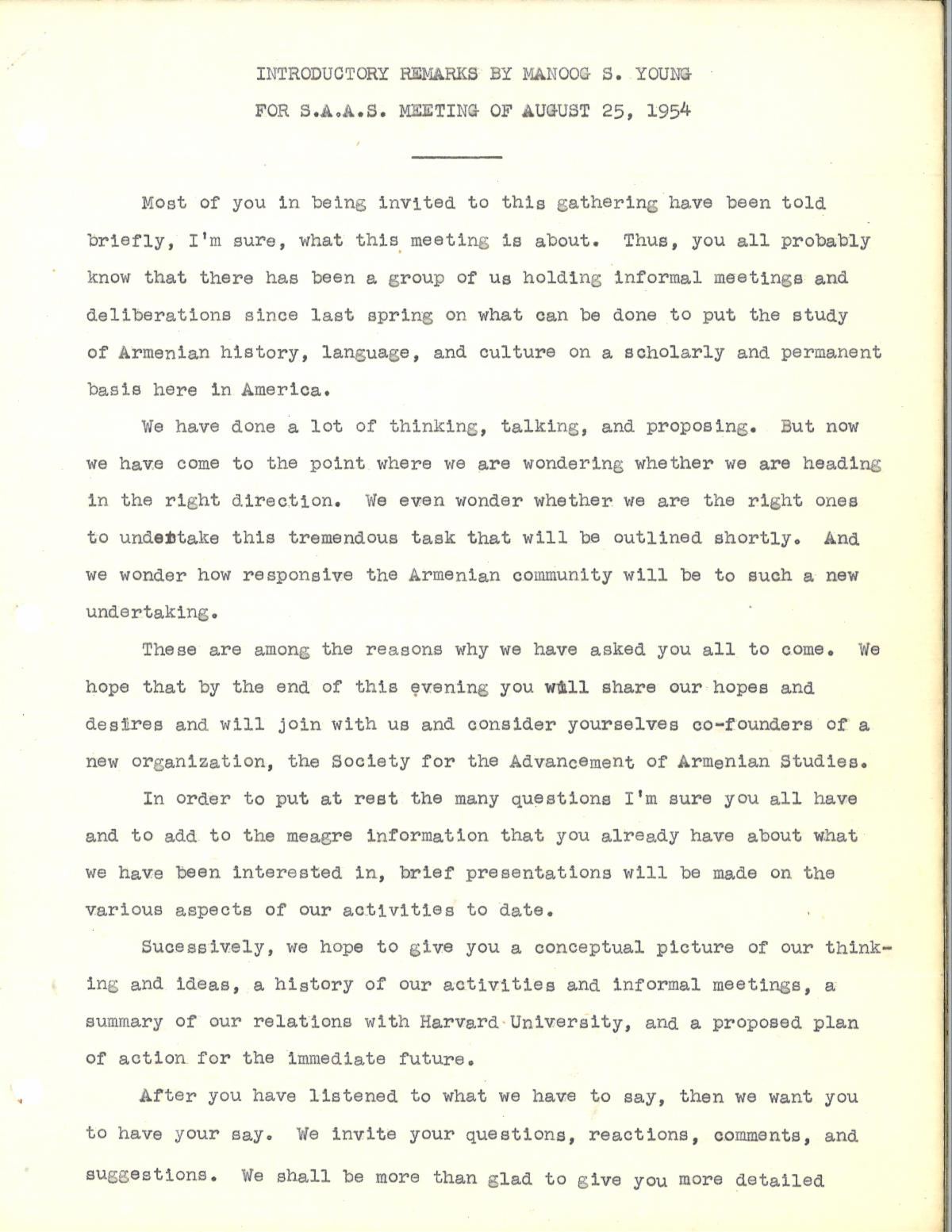
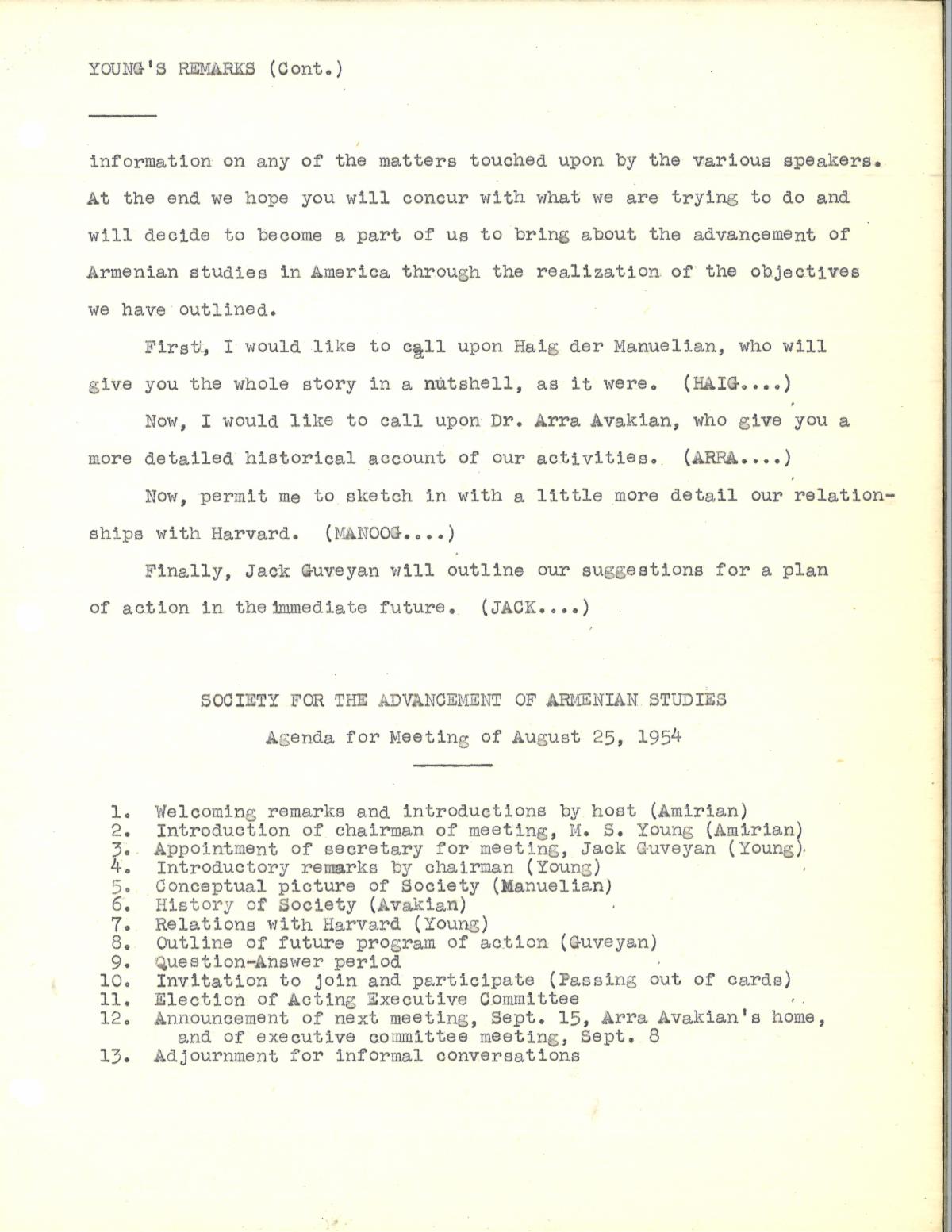
| | Spurred by Frye’s remarks, Young had conversations with Arra Avakian and Thomas Amirian about how best to achieve the goals Frye had outlined. Thus, the NAASR group of three founders—Young, Amirian, and Avakian—came together and Young sent Frye a lengthy memo describing a possible course of action towards the establishment of a chair or program in Armenian Studies at a university such as Harvard. Very shortly thereafter, this core founding group began meeting with other like-minded community members to explore creating a new group, provisionally called the Society for the Advancement of Armenian Studies. | | Above: Manoog Young's introductory remarks for the Aug. 25, 1954, meeting of what was still being called "S.A.A.S." (Society for the Advancement of Armenian Studies). Meetings of the group had begun in June 1954 and led to the public launch of NAASR in 1955. | |
A group of nine (Amirian, Avakian, and Young were joined by Richard Malkasian, Jack Guveyan, James Etmekjian, Eghishe Chrakian, Haig Der Manuelian, and Richard Frye) met throughout 1954 and early 1955, and by the time of NAASR’s public debut in March 1955 some sixty Armenian-Americans and academics had joined, among them notable members of the Harvard faculty such as linguist Roman Jakobson, Russologist Michael Karpovich, and William L. Langer. Click here to listen to the March 2, 1955, public debut of NAASR.
| |
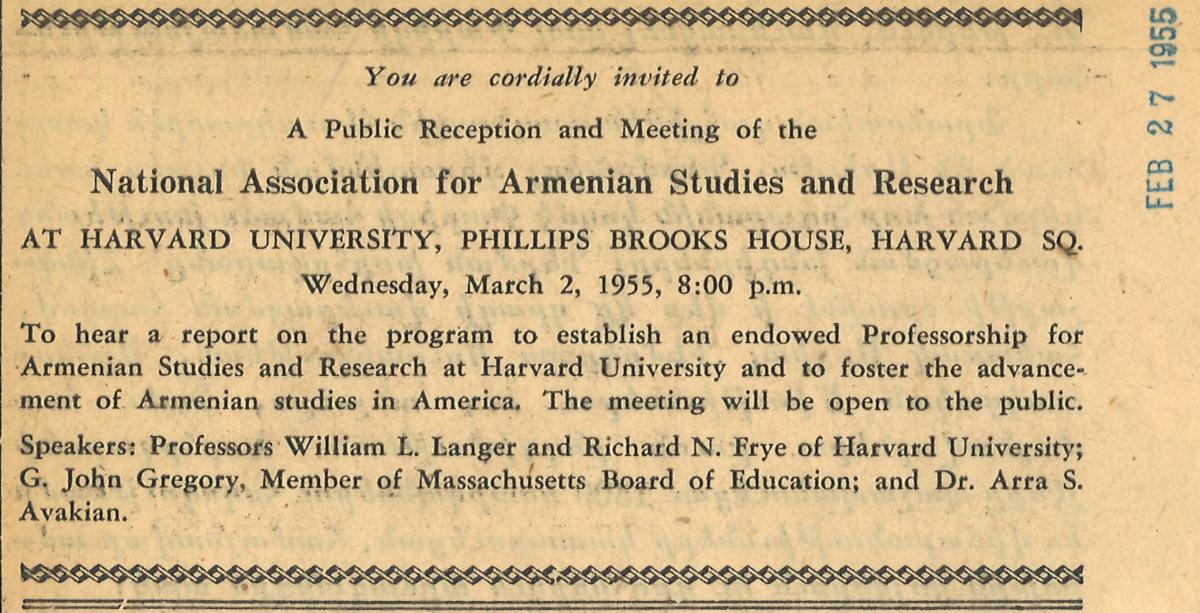
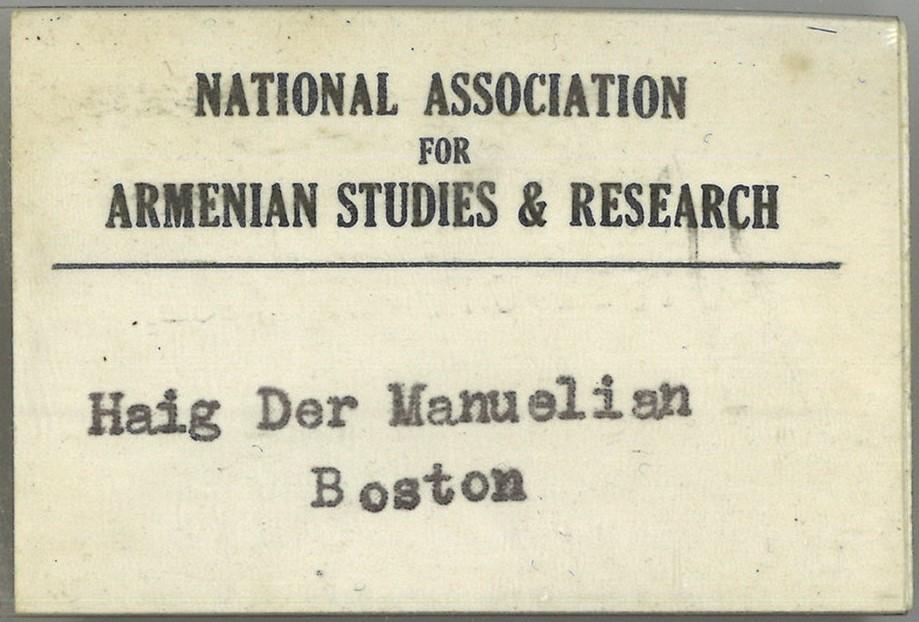
Above, left: Newspaper ad for NAASR's first public event, held at Harvard University on March 2, 1955. Right: NAASR Founding Member Haig Der Manuelian's membership pin.
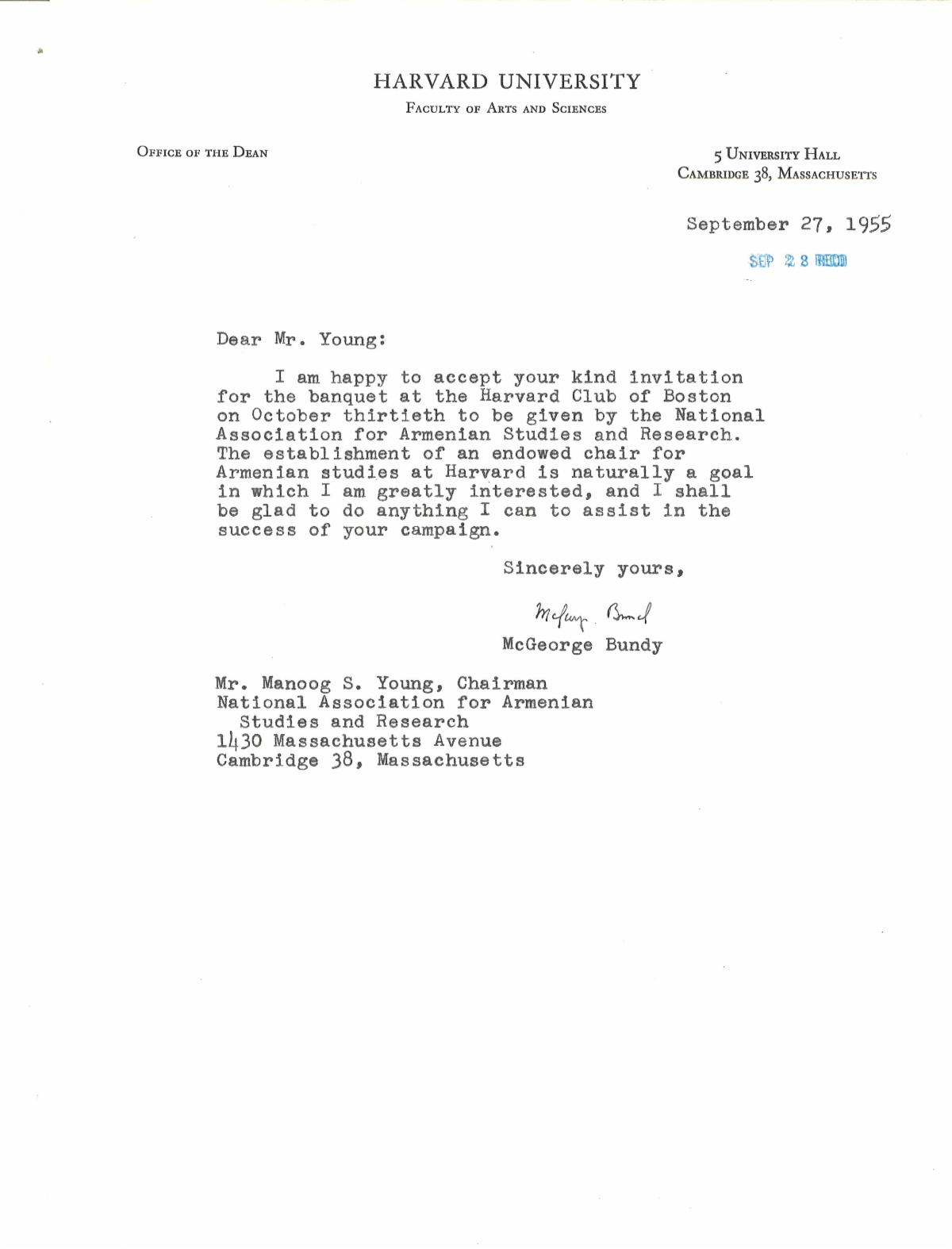
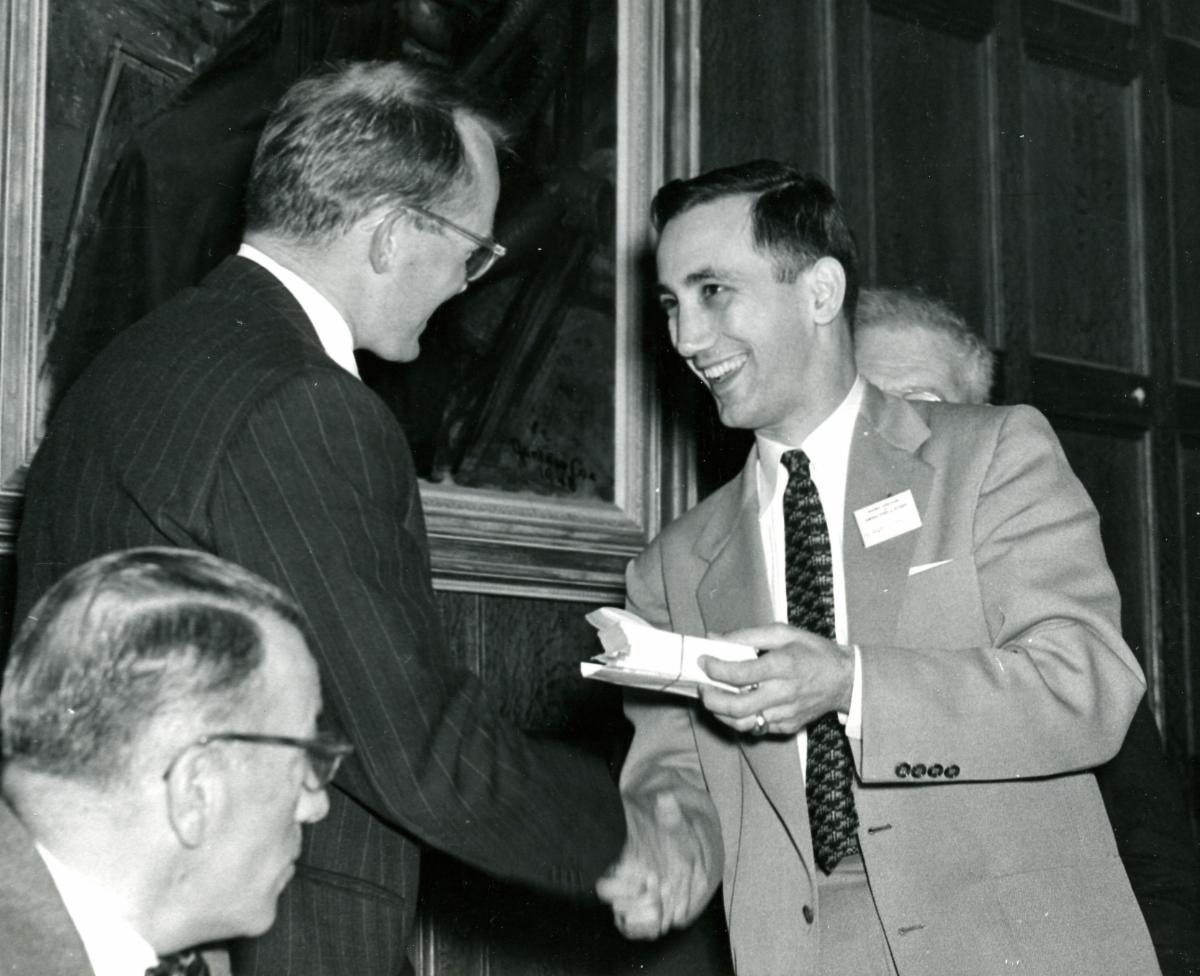
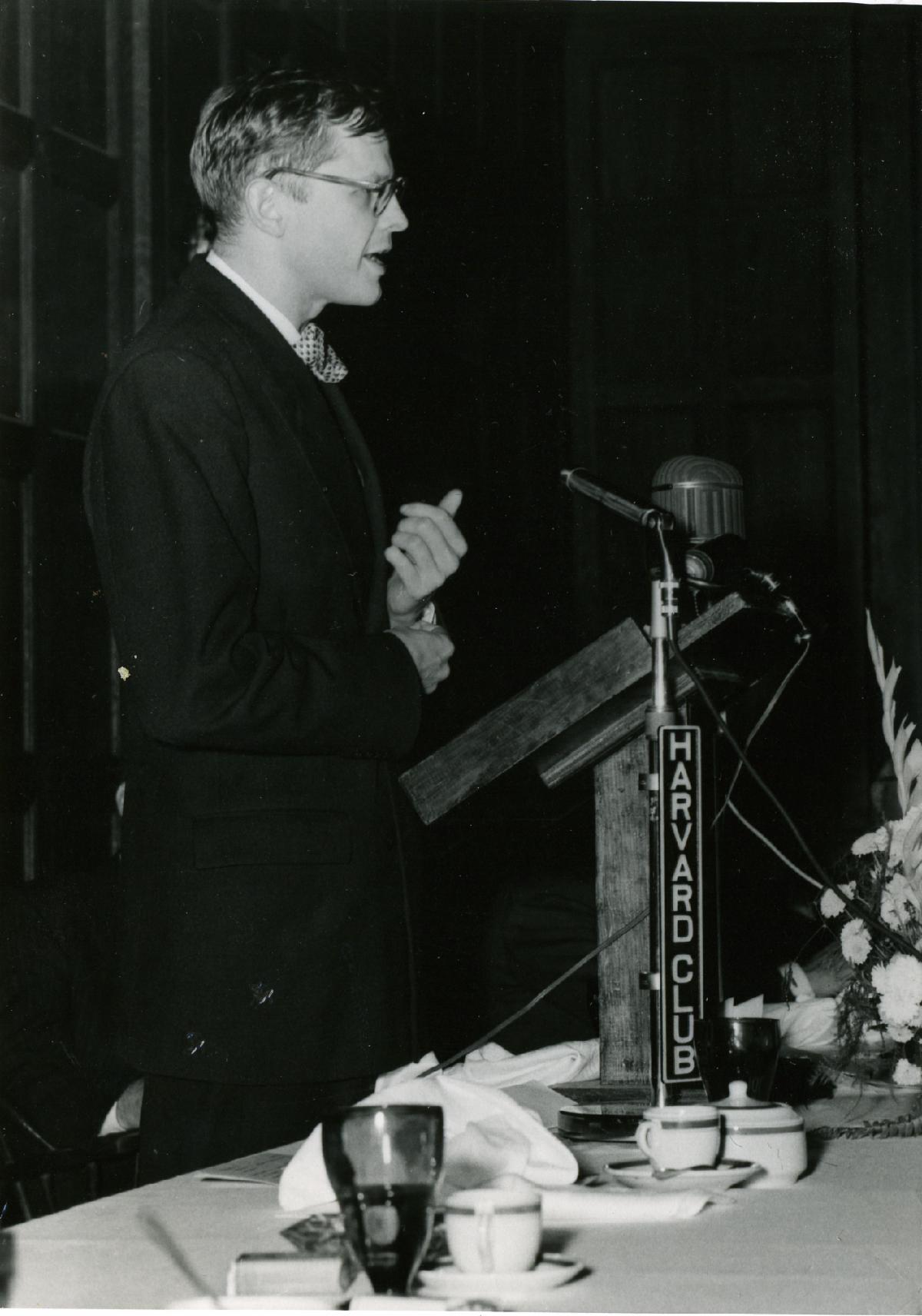
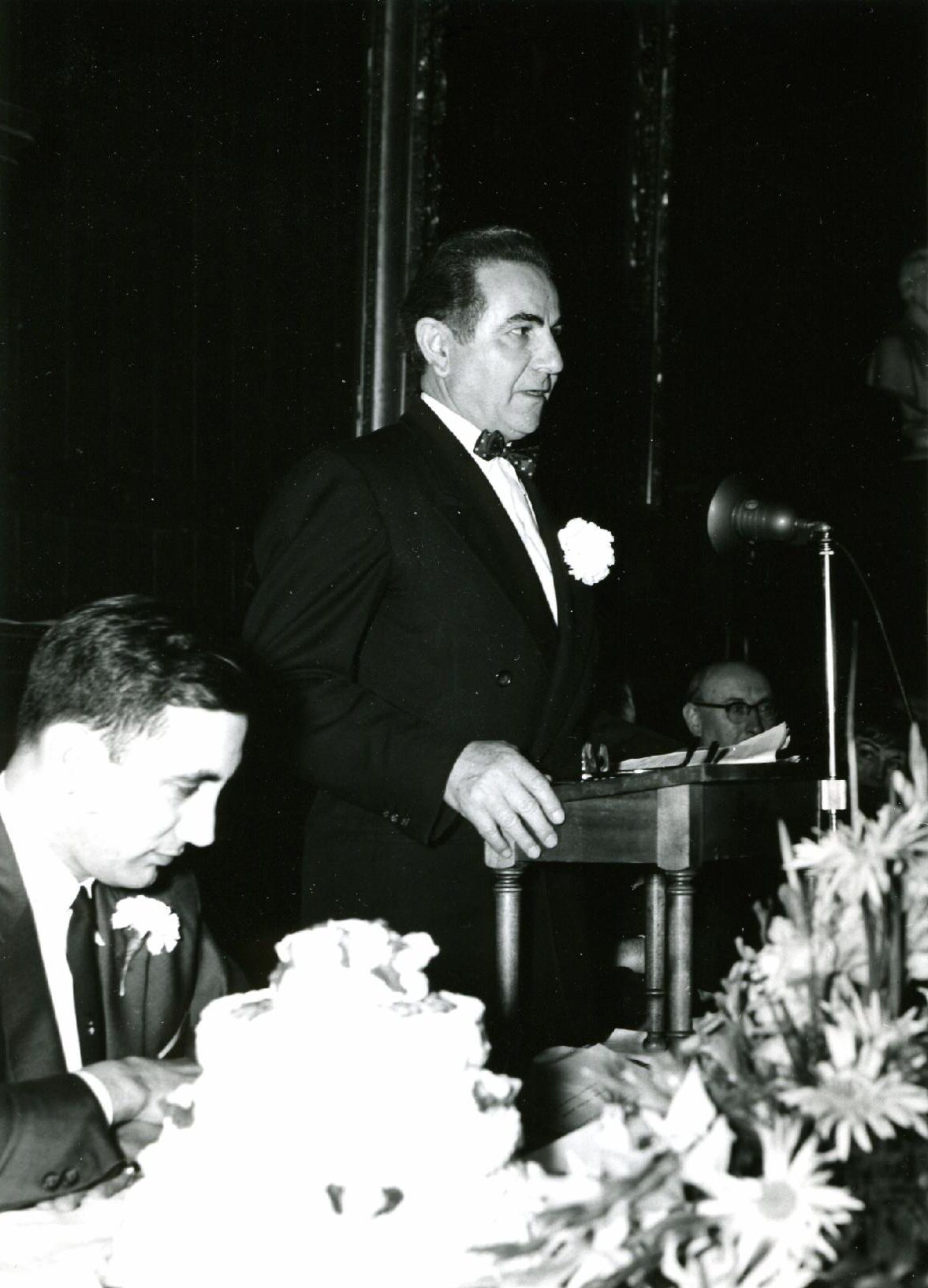
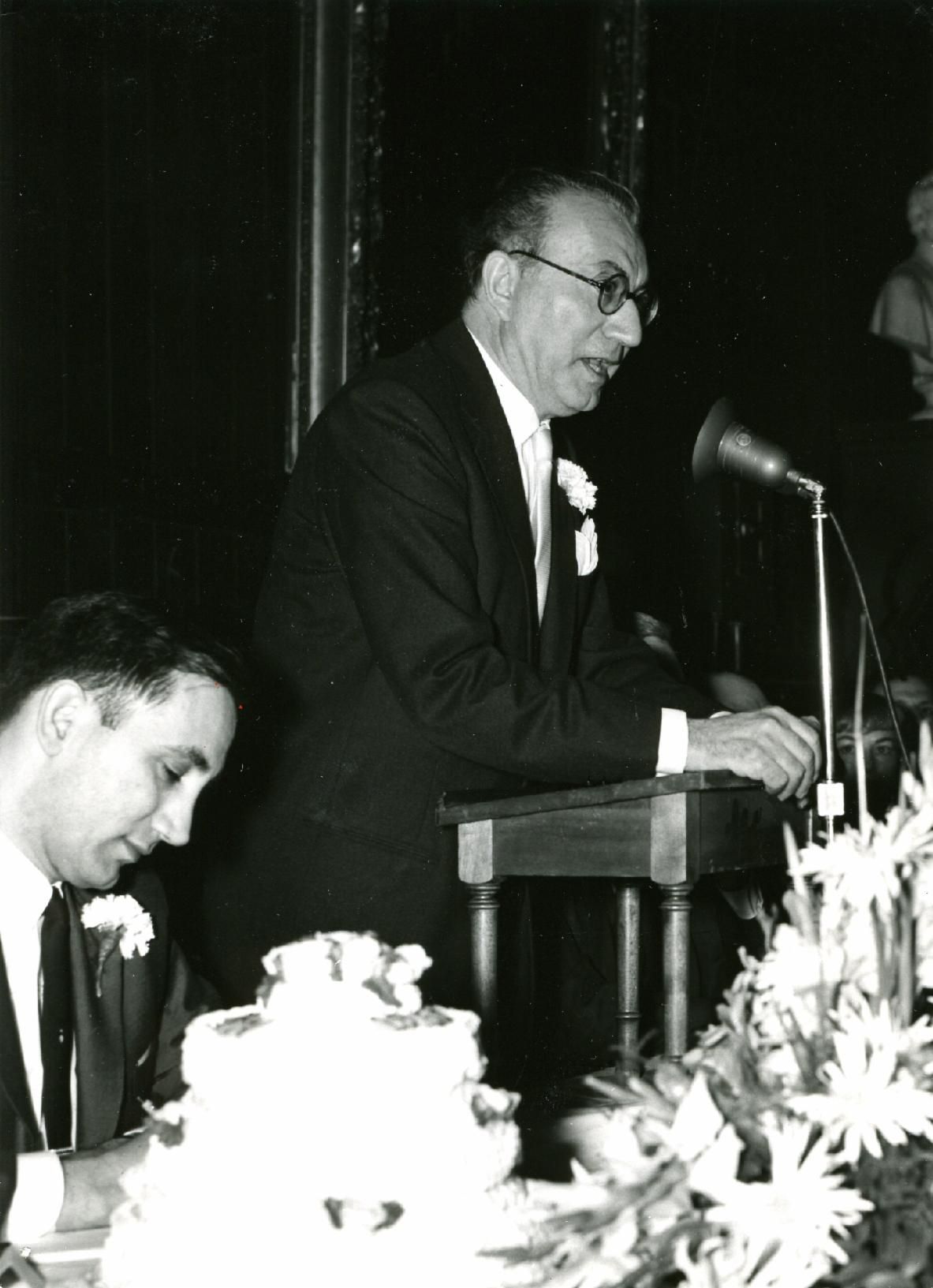
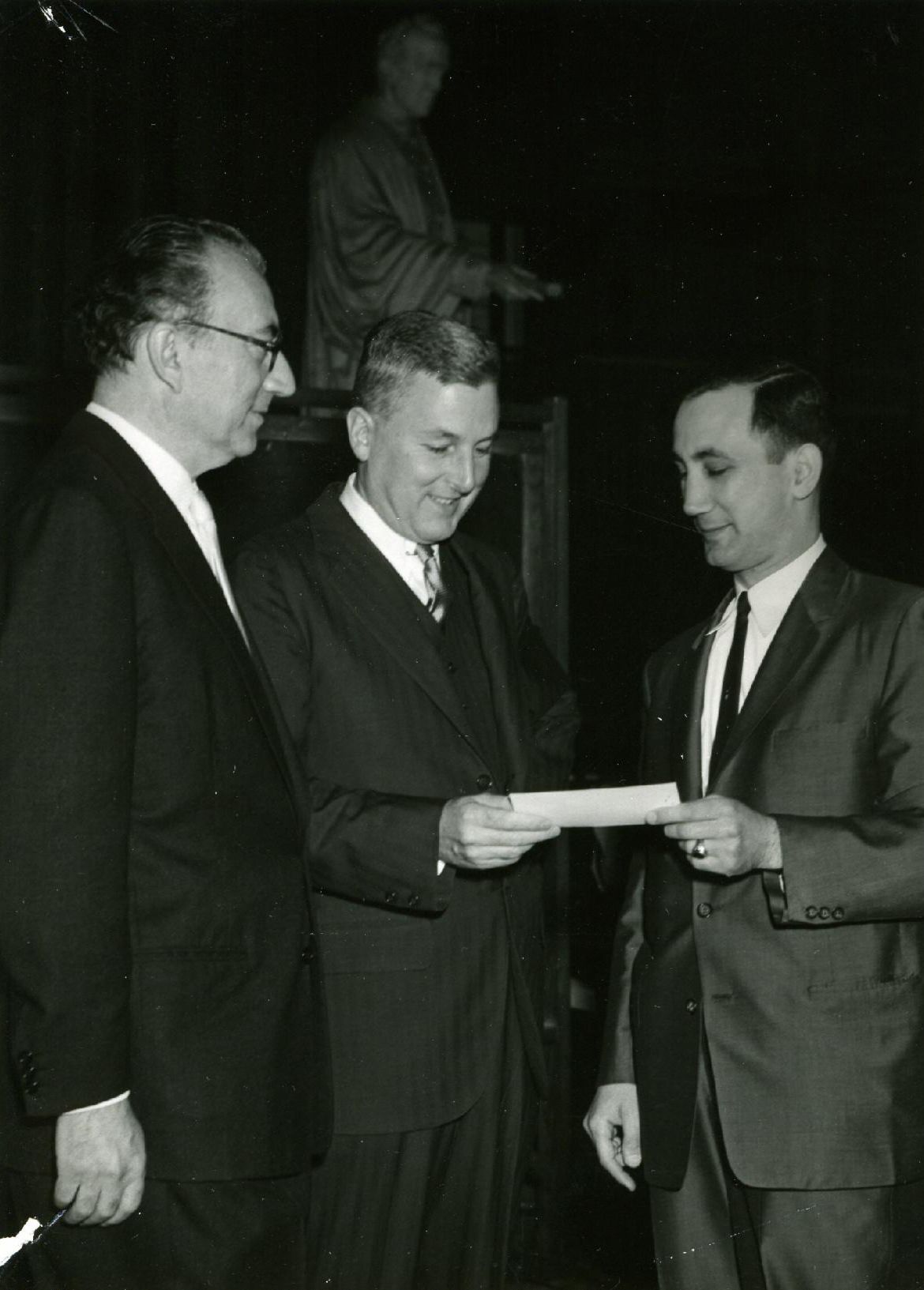
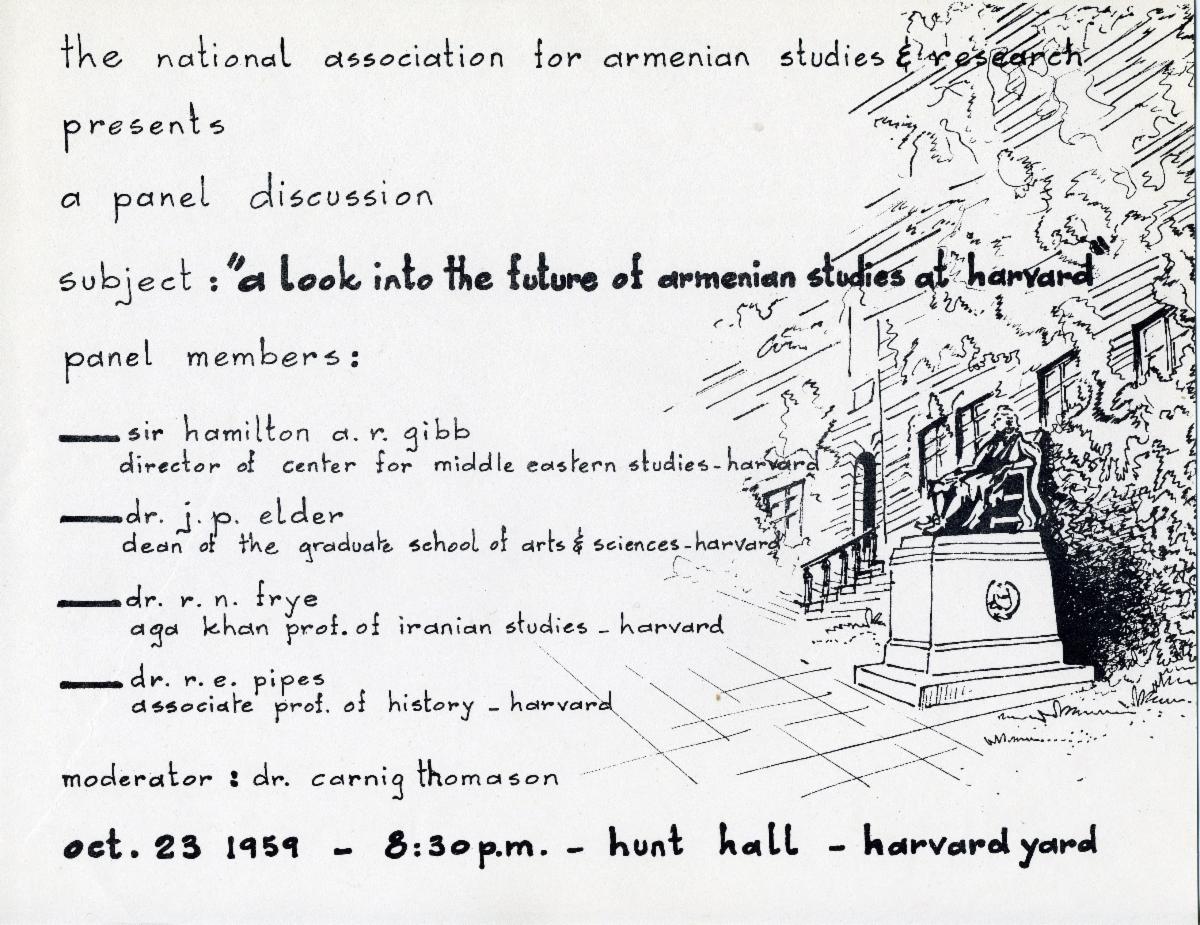
| | In October 1955, the Association had its kickoff banquet for the Harvard Chair fundraising campaign at the Harvard Club in Boston, attended by more than 500 people. Among those speaking at the banquet were Harvard President Nathan Pusey, Massachusetts Lt. Governor Sumner G. Whittier, and author William Saroyan. Chairman Young presented pledges totaling $30,000 to Harvard Dean of the Faculty of Arts and Sciences (and future National Security Advisor to Presidents Kennedy and Johnson) McGeorge Bundy. Bundy's letter to NAASR Chairman Young accepting the invitation to the event is on the right. | | |
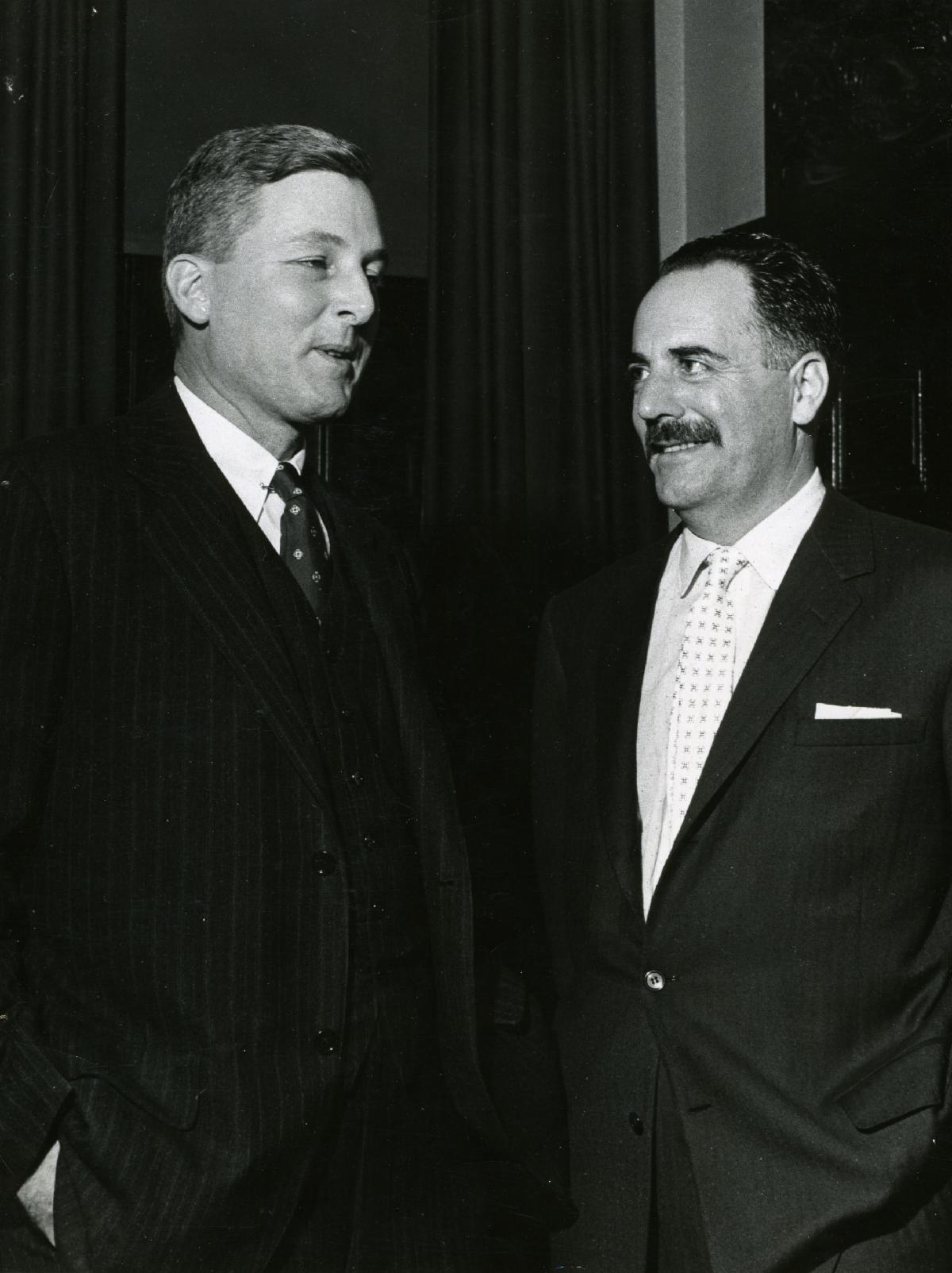
From the Oct. 30, 1955, Harvard Chair Kick-Off Banquet. Left to right: Harvard Dean of Arts and Sciences McGeorge Bundy and Manoog Young; Harvard President Nathan Pusey and William Saroyan; Richard N. Frye. Click here to view a slide show of this event.
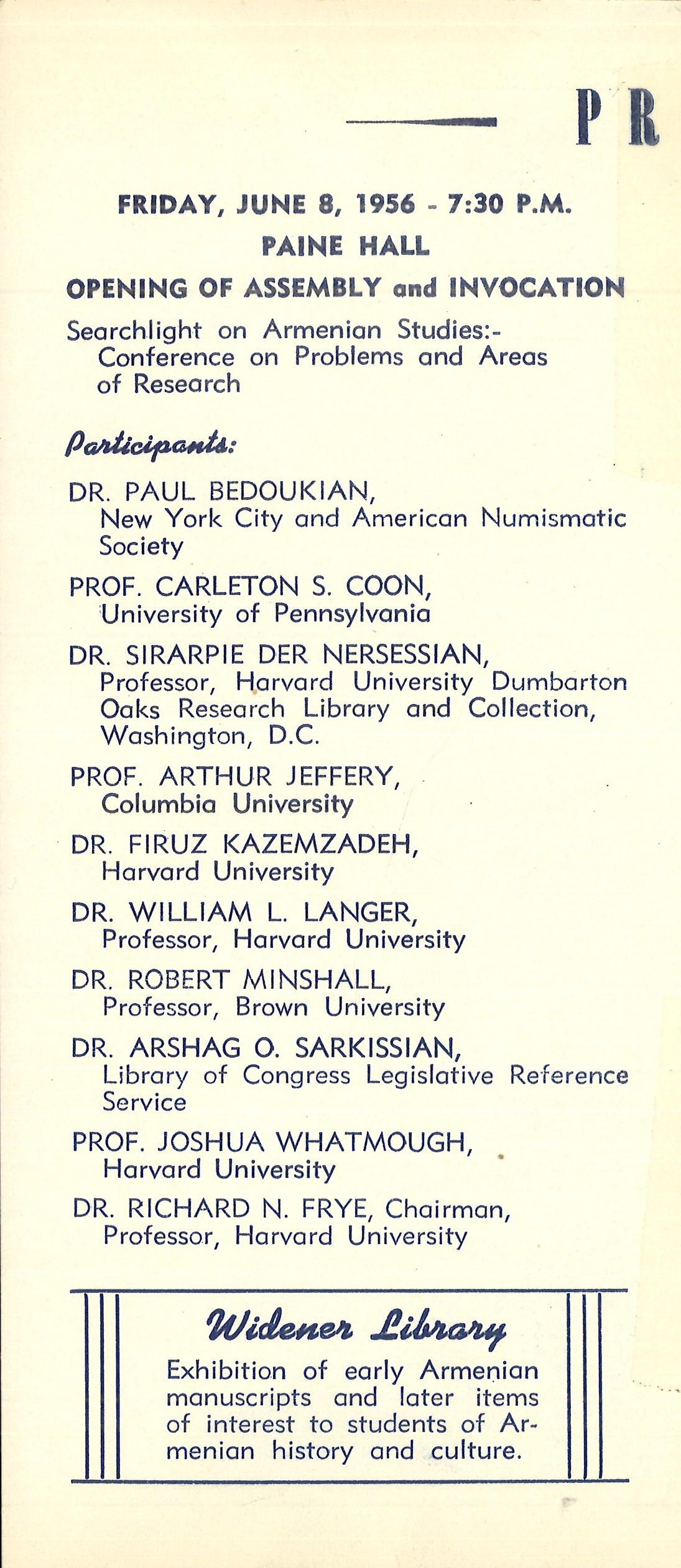
| | In 1955 and 1956, NAASR began organizing lectures as well as the first conferences or symposia focusing on the nascent field of Armenian Studies in the U.S. (“Armenian Studies and Research: Problems and Needs” in 1955 and “Searchlight on Armenian Studies: Conference on Problems and Areas of Research” in 1956). It also began working with Harvard to expand its library holdings in Armenian, arranging for the donation of several important collections. | |
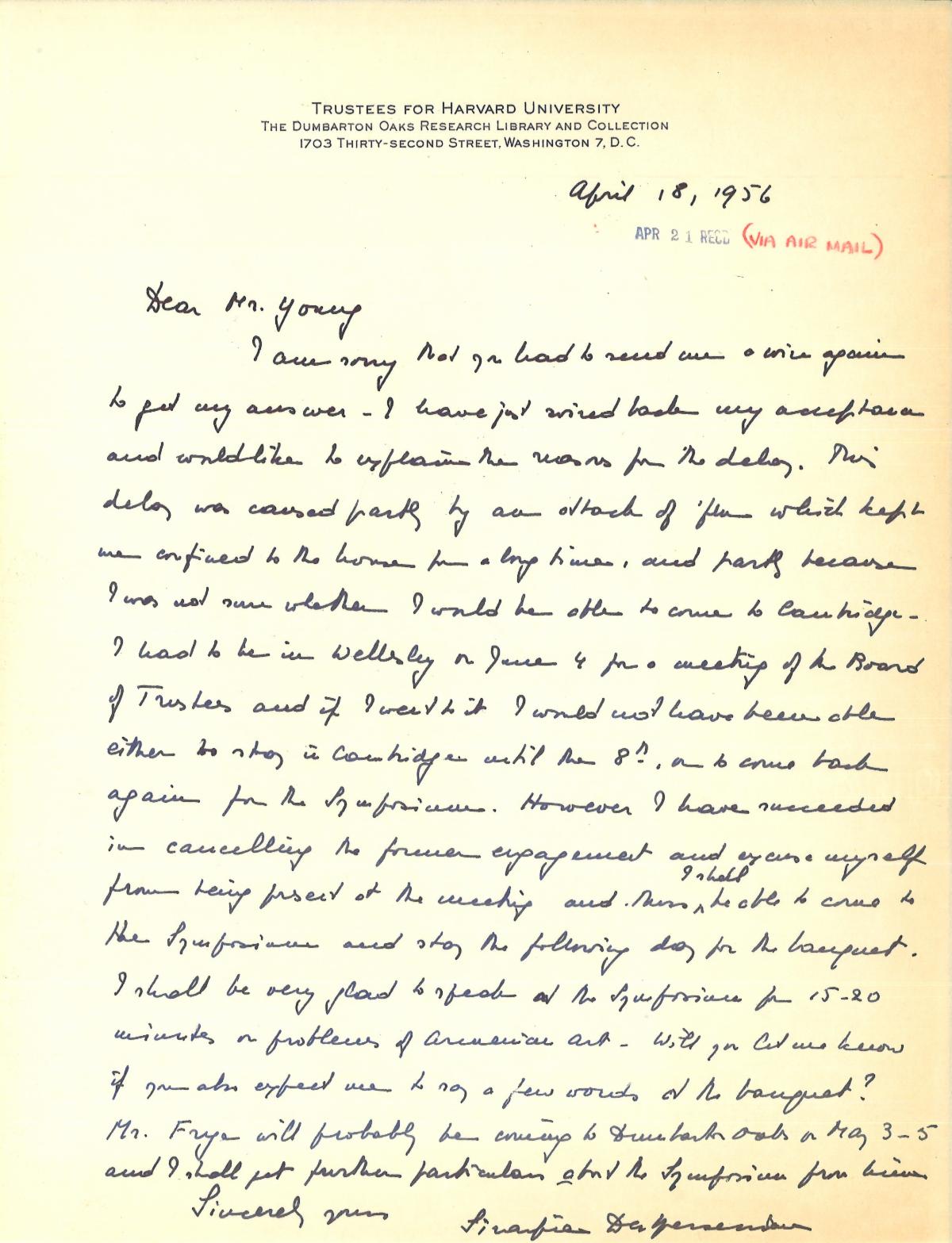
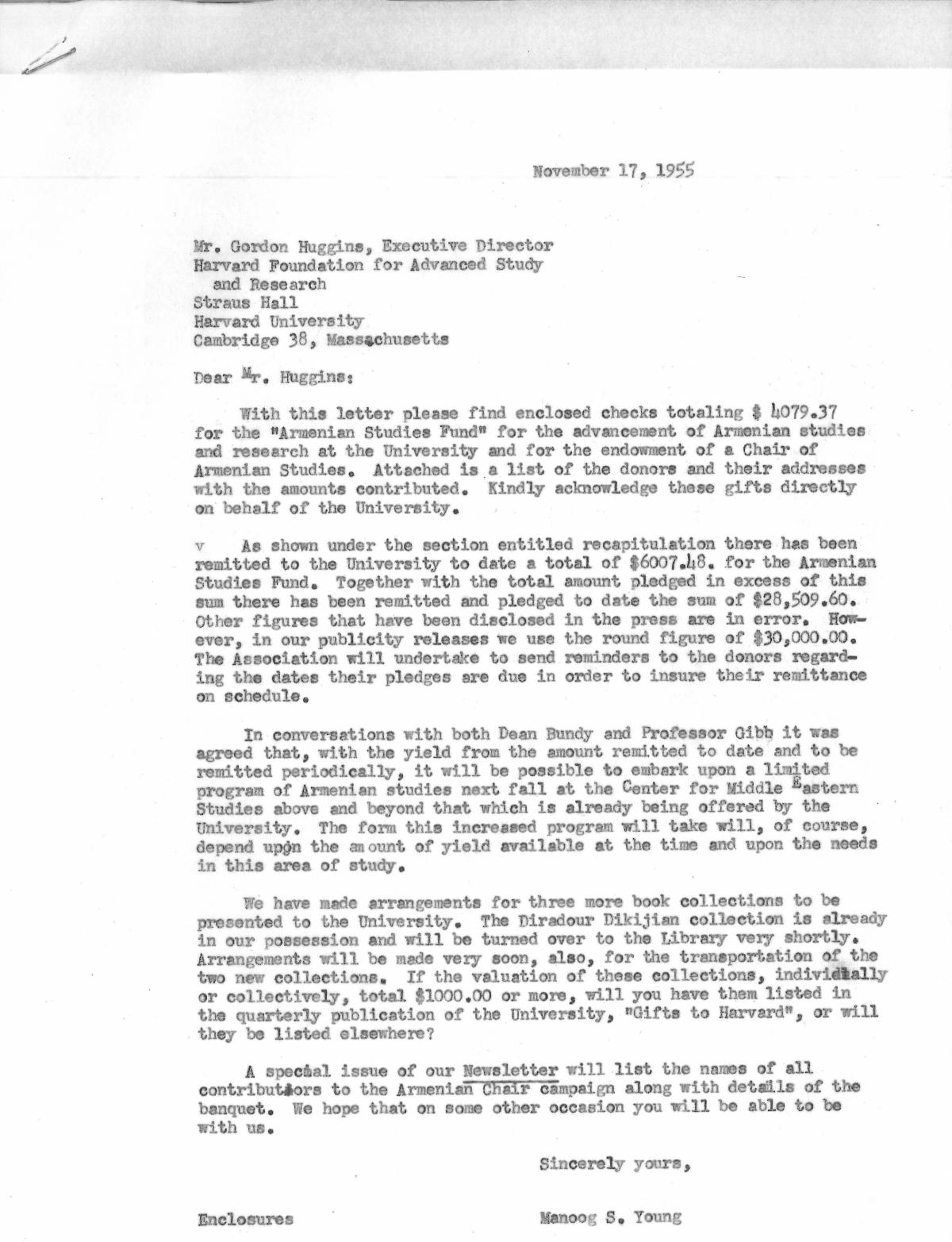
Above, left: Letter from Sirarpie Der Nersessian to Manoog S. Young regarding her participation in the June 6, 1956, "Searchlight on Armenian Studies: Conference on Problems and Areas of Research"; center, the conference program; right, letter from Manoog S. Young to Gordon Huggins dated Nov. 17, 1955, regarding the Harvard Chair campaign and donation of library collections.
| |
In 1957, Avedis K. Sanjian was hired as research fellow in Armenian Studies at Harvard, the first time in the U.S. that a scholar held a position solely devoted to Armenian Studies. Sanjian was named Assistant Professor of Armenian in 1961 and continued at Harvard until 1965. In an address given on the occasion of his appointment on January 28, 1957, Sanjian stated that "the very fact that Harvard--the oldest and most renowned educational institution in the United States--has recognized the need for establishing a chair and providing facilities for scholarly research in Armenian studies is, in itself, a singularly unique milestone in American educational life." Click here to read the talk in its entirety.
| |
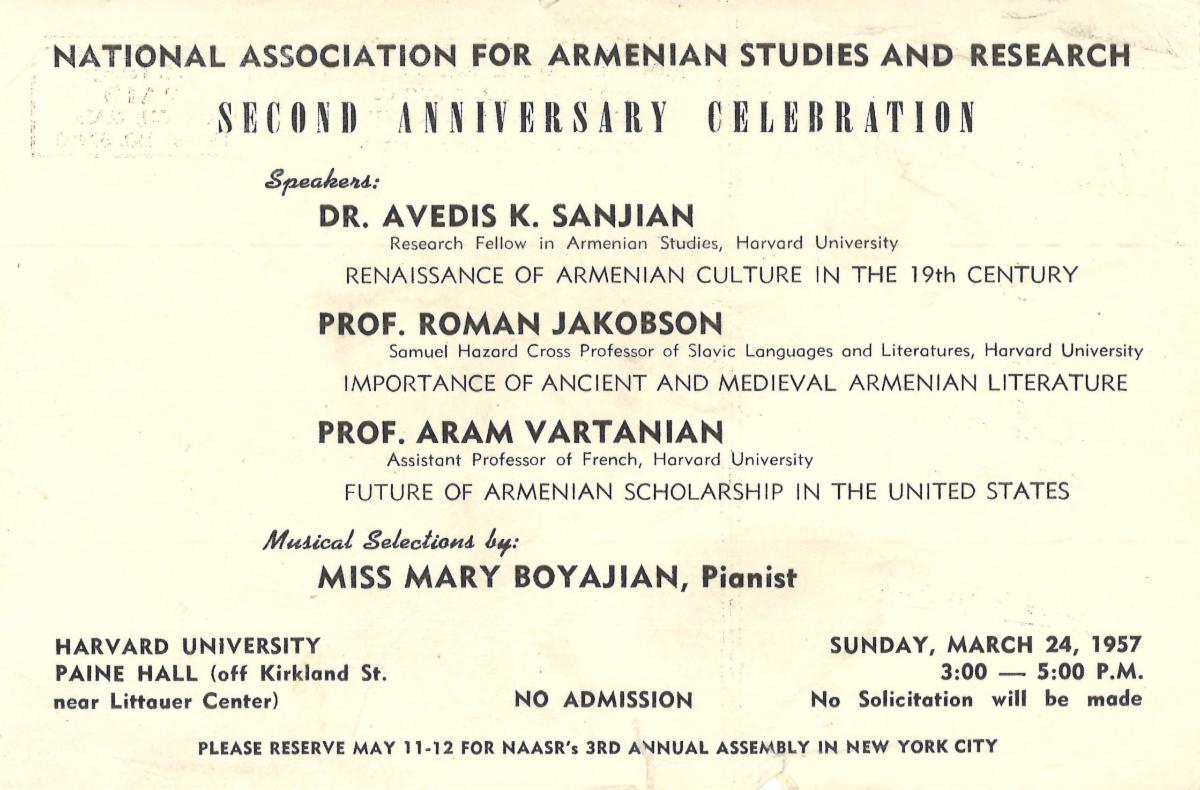
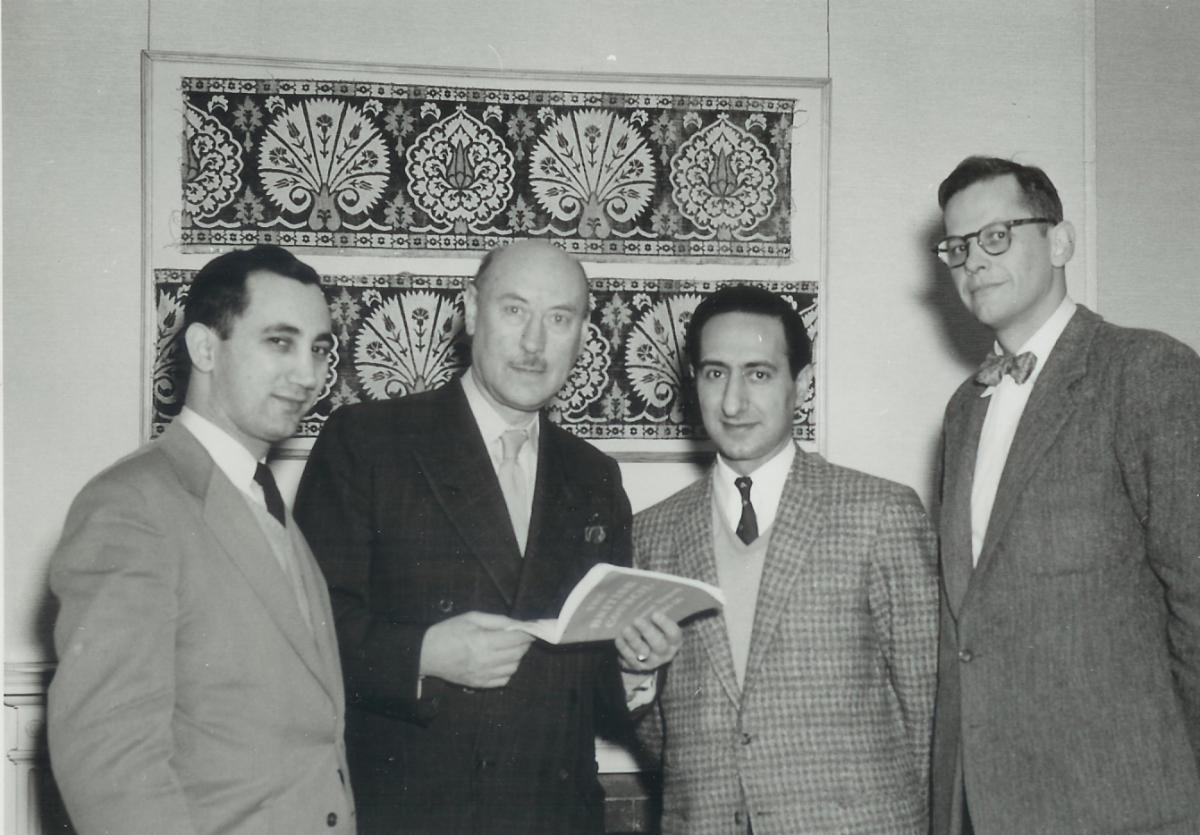
Above, left: Shortly after his appointment at Harvard, Avedis Sanjian was a featured speaker at NAASR's 2nd anniversary celebration at Harvard in March 1957. Right, Manoog S. Young, Hamilton Gibb, Avedis Sanjian, and Richard Frye.
| | Fundraising nationwide continued apace throughout the next several years, and by spring 1959 the goal of $300,000 was in sight. | |
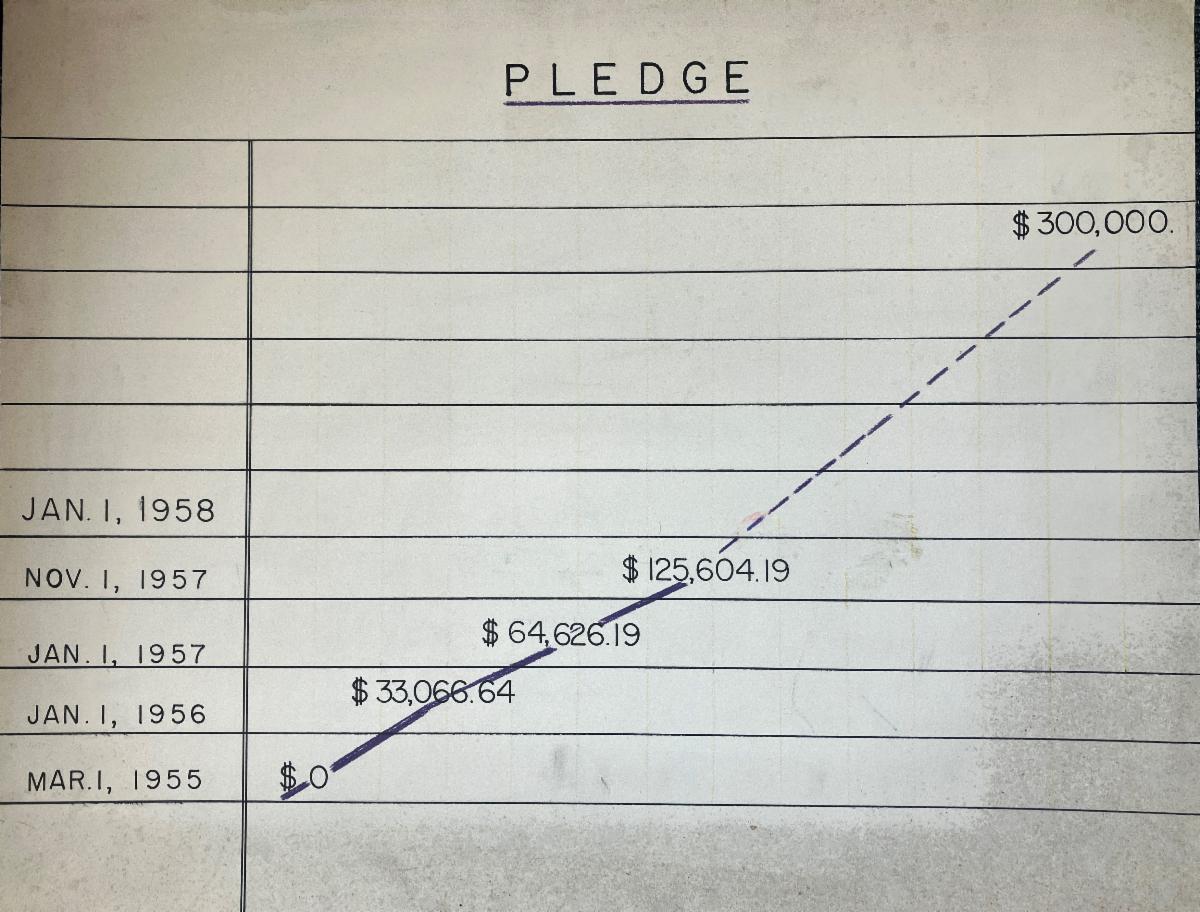
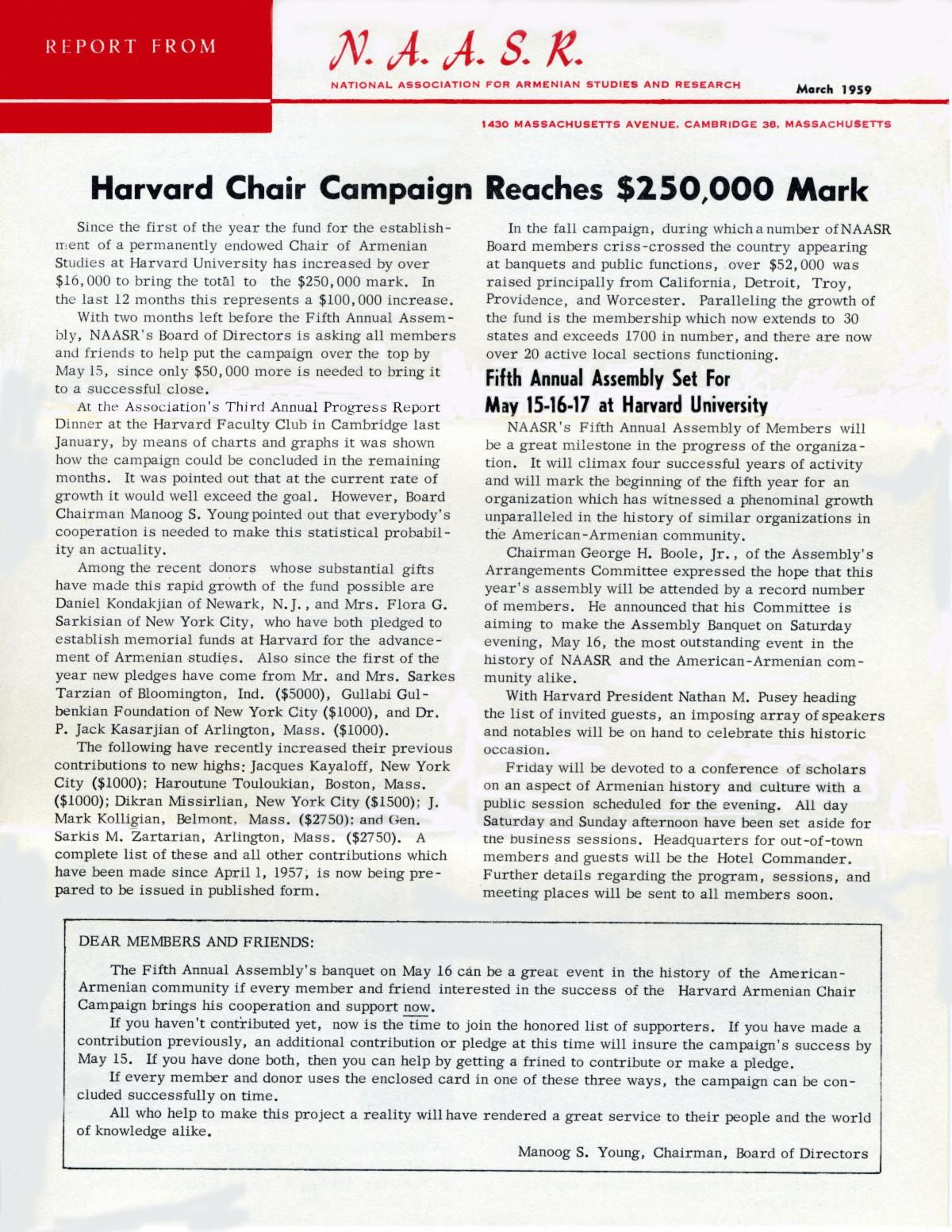
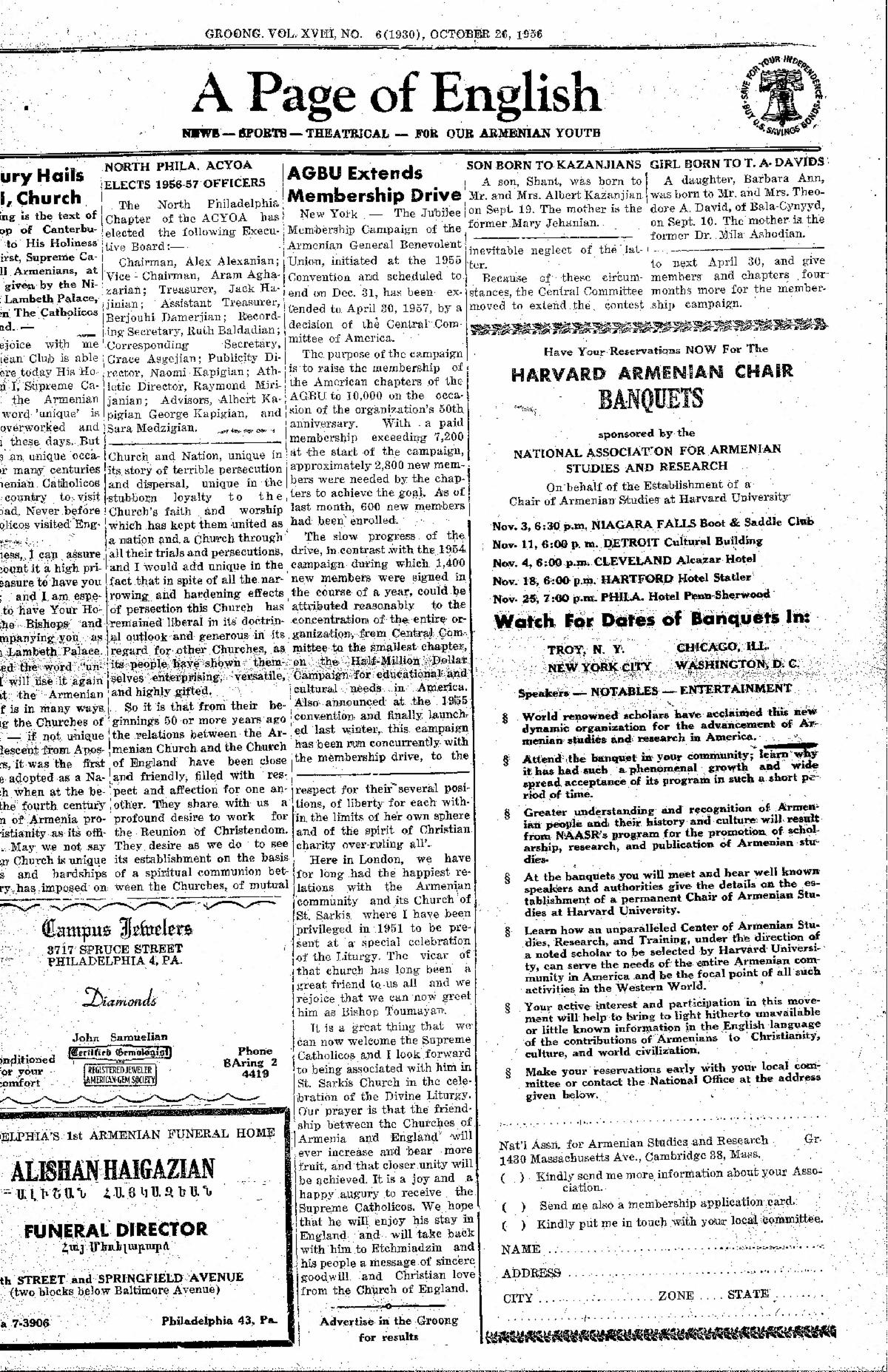
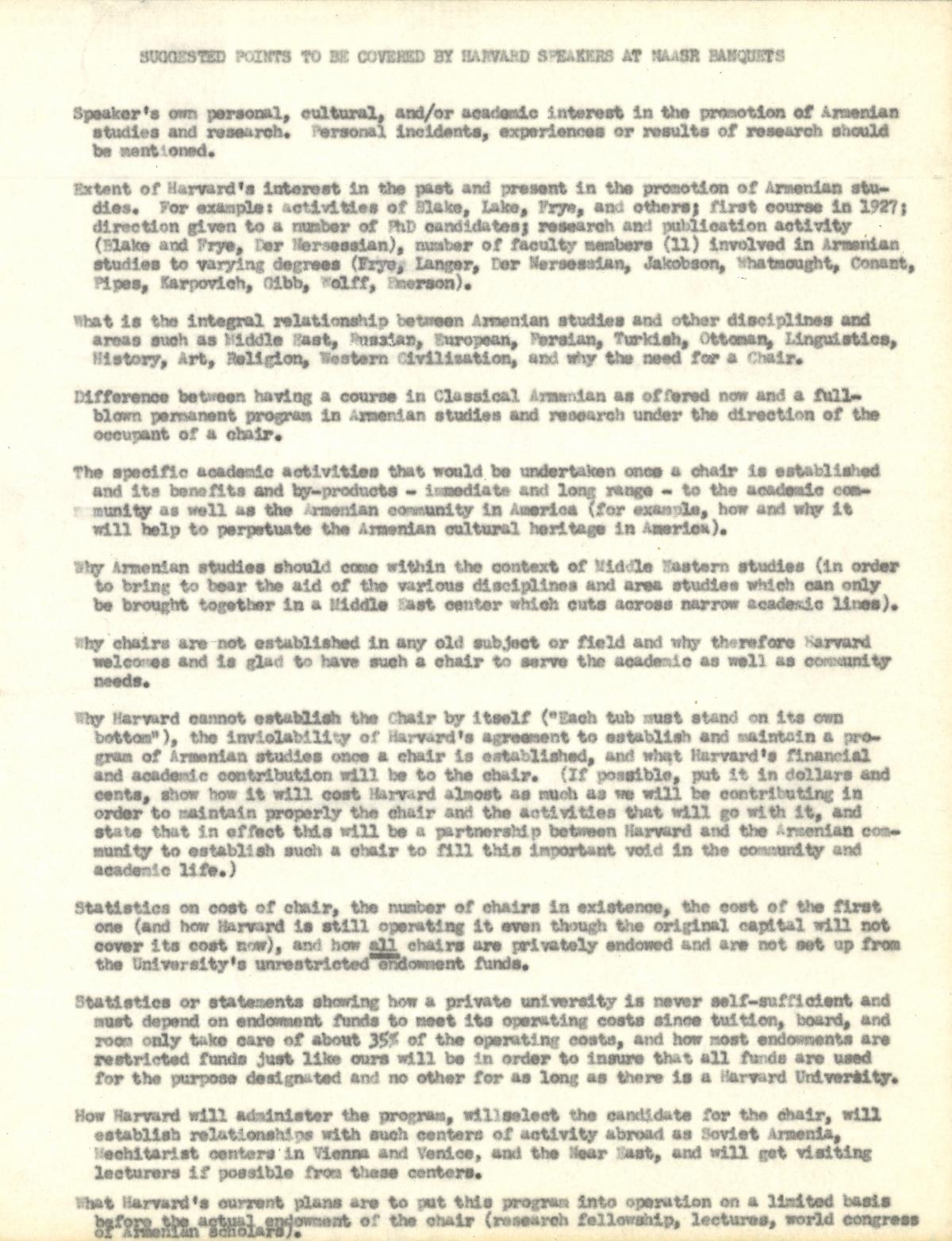
Above, upper left, chart showing NAASR's fundraising progress, ca. 1958; upper right, advertisement in Oct. 26, 1956, issue of Groong regarding upcoming NAASR fundraising banquets in Niagara Falls, Detroit, Cleveland, Hartford, and Philadelphia; lower right, internal document enumerating "suggested points to be covered by Harvard speakers at NAASR banquets; lower left, NAASR report of March 1959 announcing that the $250,000 mark had been reached. It would soon be exceeded.
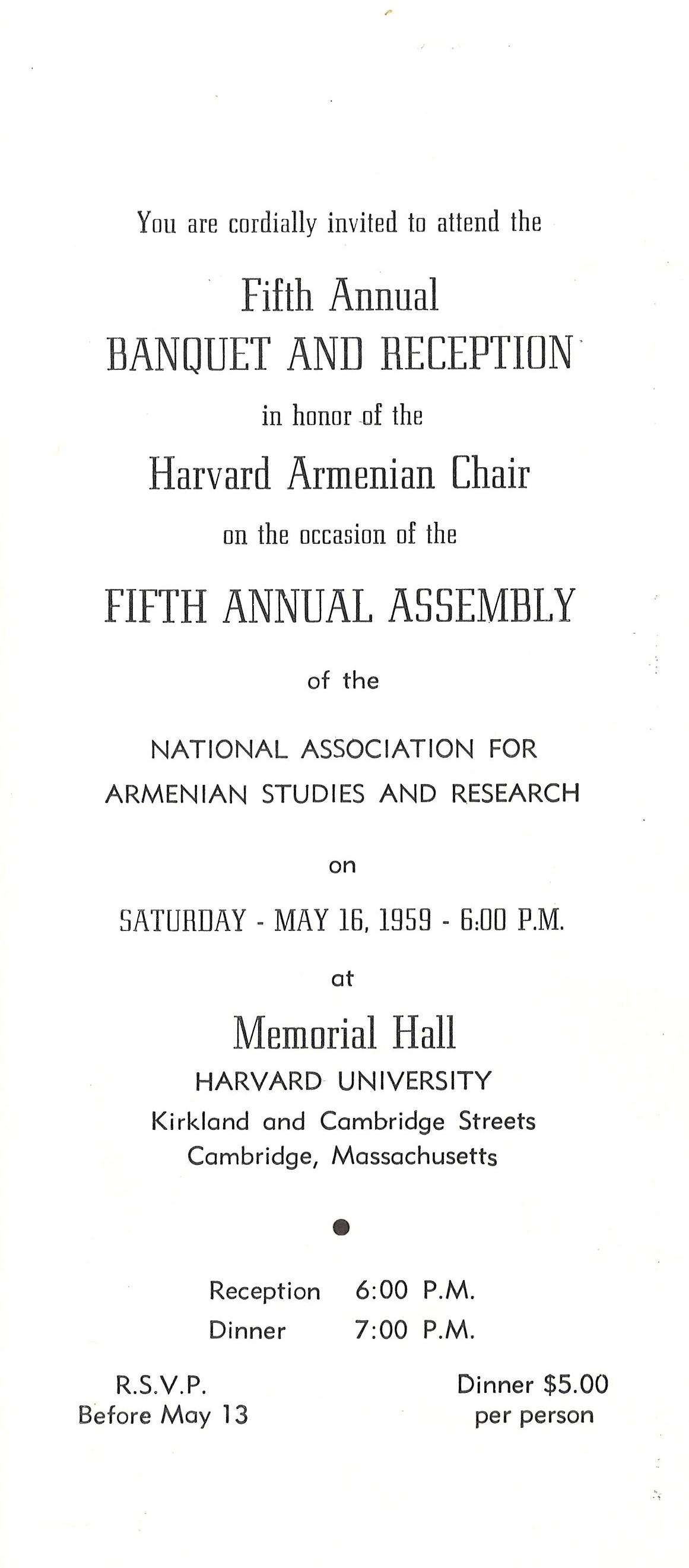
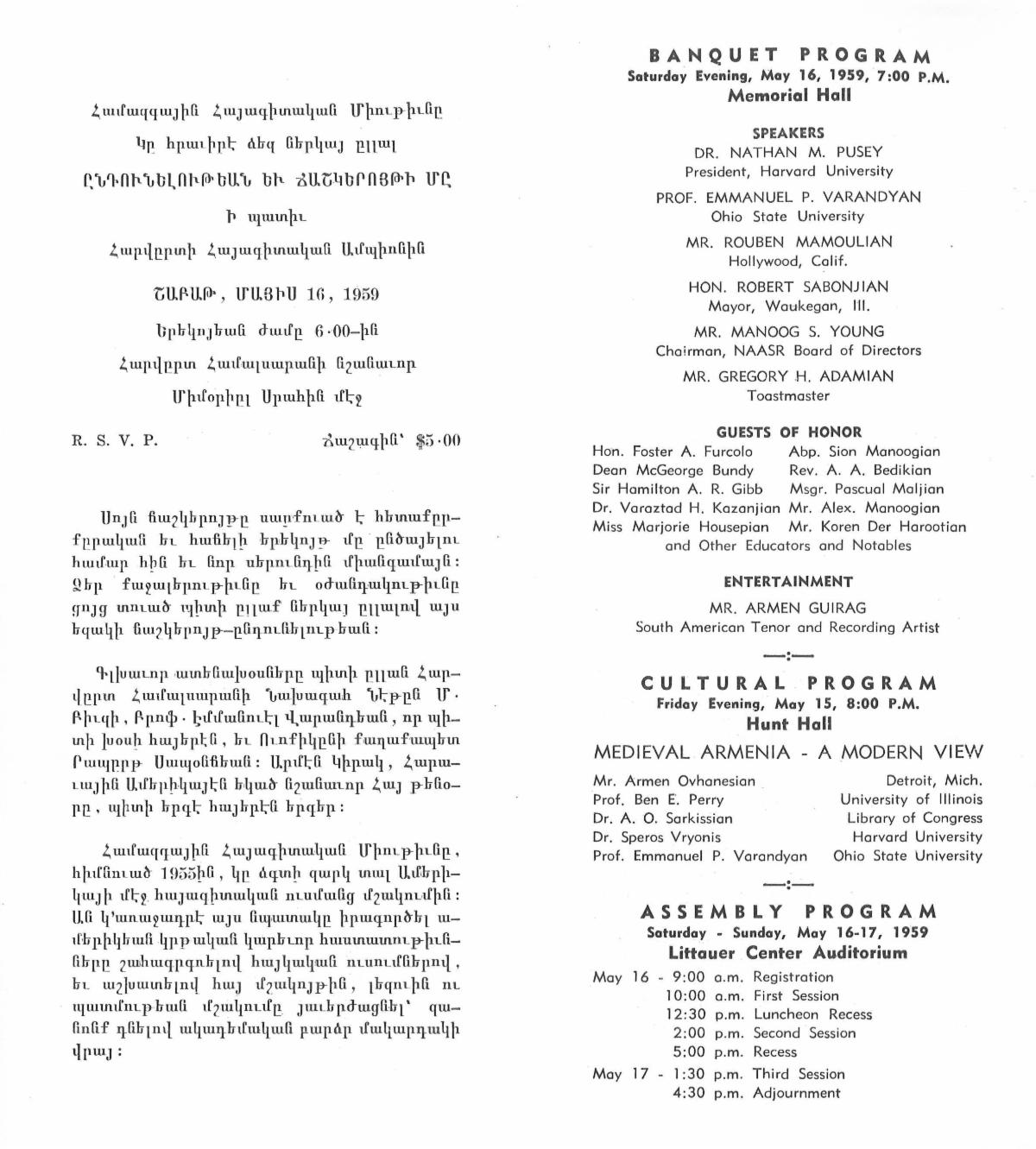
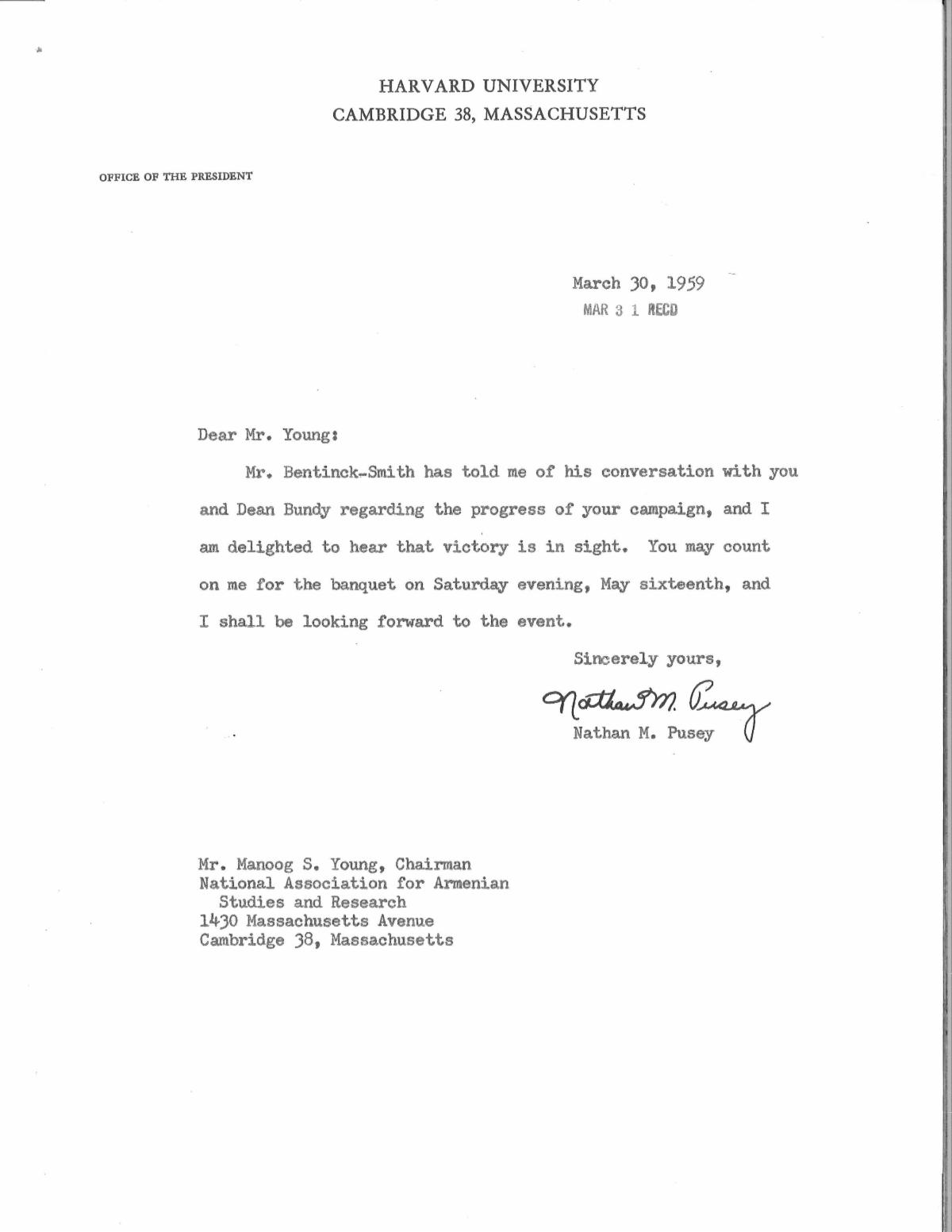
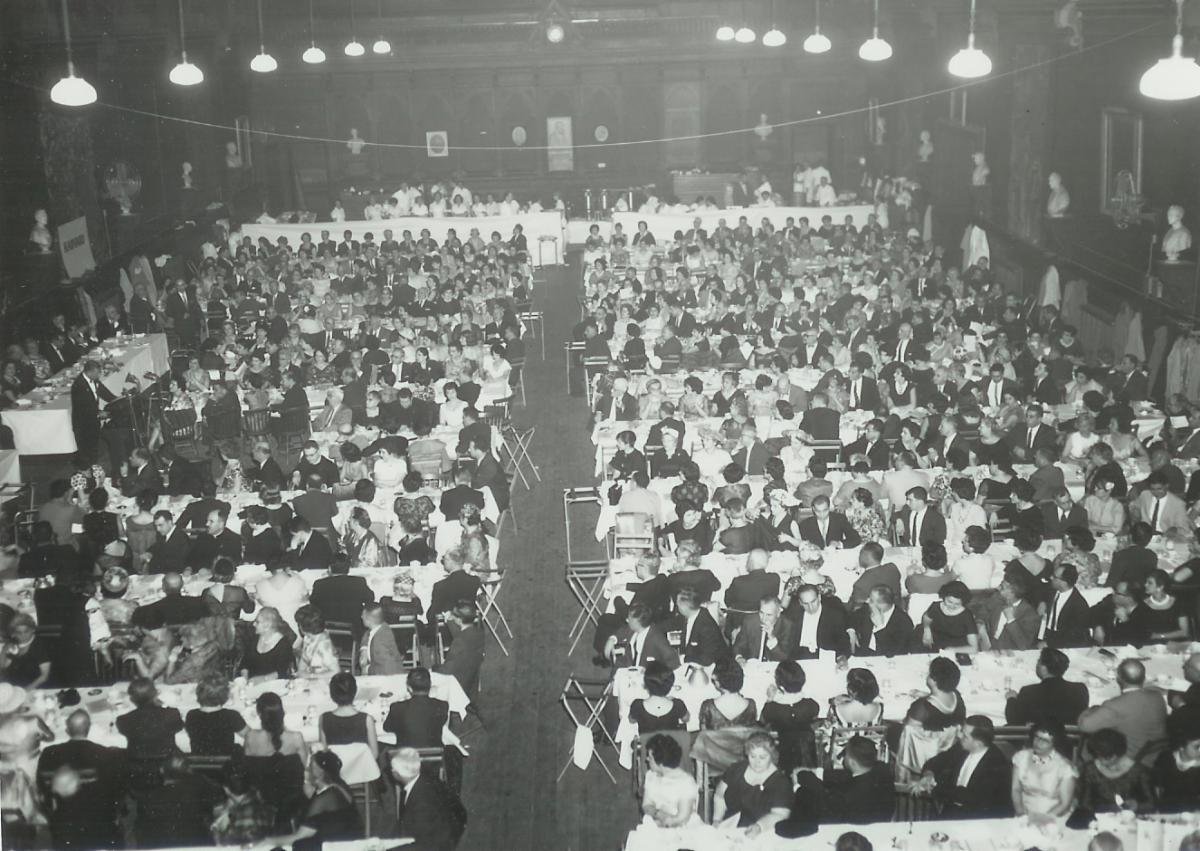
| | In May 1959, thanks to a large contribution from the Gulbenkian Foundation, the total raised surpassed the necessary $300,000, and a “Victory Banquet” attended by more than 1,000 people was held at Harvard’s Memorial Hall on May 16, 1959. | |
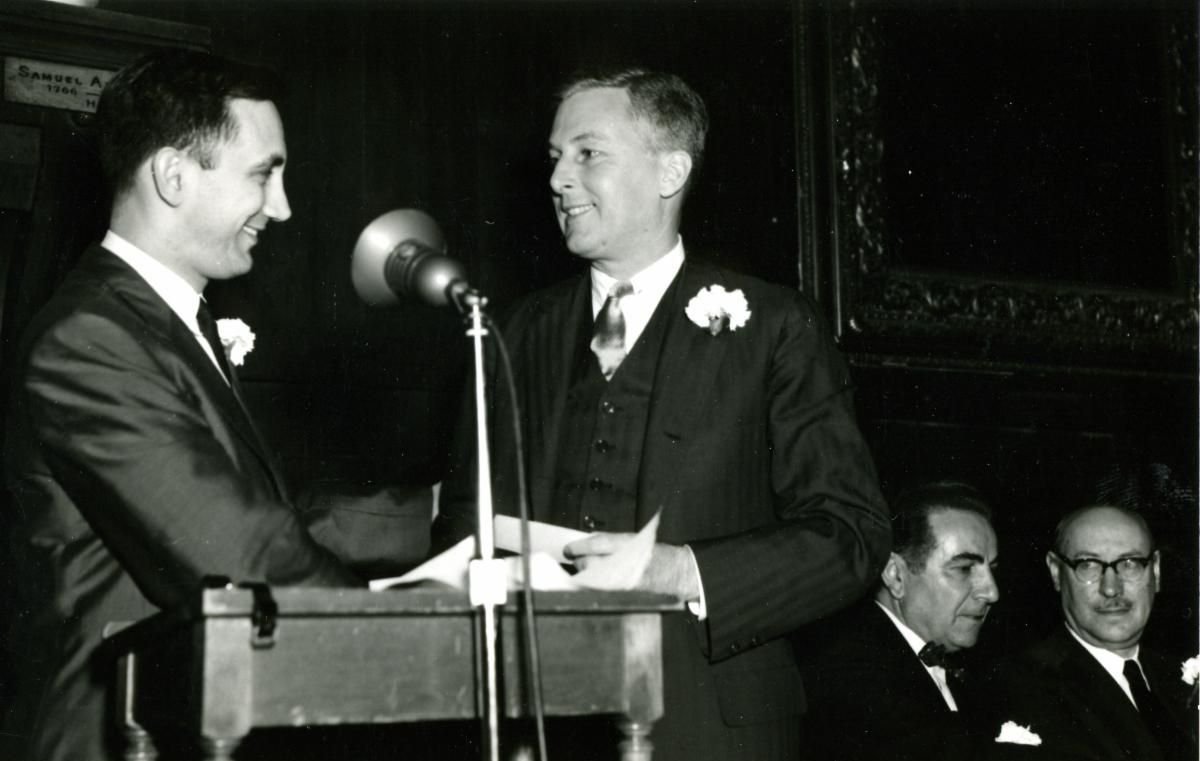
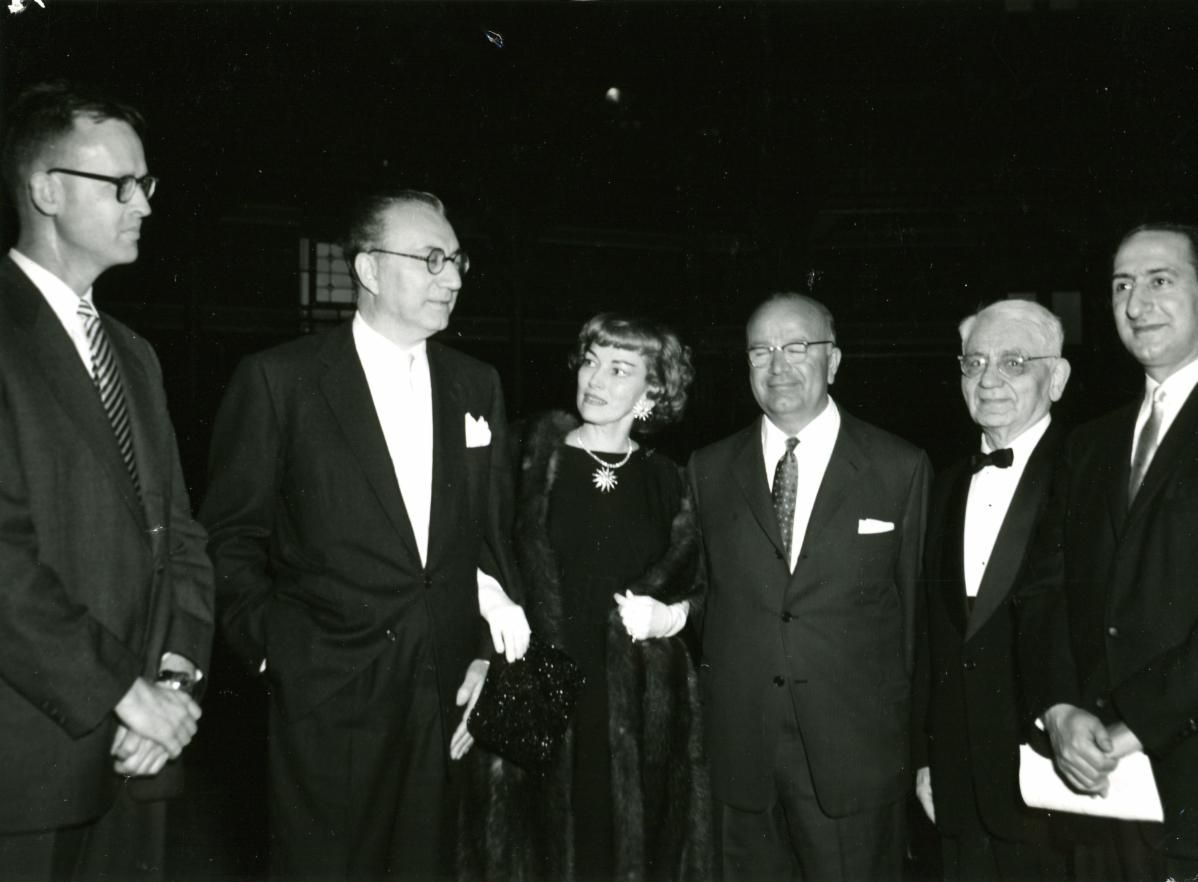
Above: invitation for the Harvard Chair "Victory Banquet" and NAASR 5th Annual Assembly. On right, Harvard President Nathan Pusey's letter accepting the invitation. Below, images from the May 16, 1959, gala.
| |
Above, clockwise from upper left: Manoog S. Young and Harvard President Nathan Pusey; film director and guest speaker Rouben Mamoulian; Mamoulian, Pusey, and Young; author and guest speaker Emmanuel Varandyan; unknown, Rouben Mamoulian, Azadia Mamoulian, Stephen Mugar, Dr. Varaztad Kazanjian, Avedis Sanjian. Below: Harvard's packed Memorial Hall.
| |
Following the "Victory Banquet," NAASR continued its fundraising as well as educational activities, and began to lay the foundation for its next major initiative: the establishment of a second chair in Armenian Studies, on the West Coast.
On May 21, 1959, NAASR's Southern California regional director J. Michael Hagopian wrote to UCLA Dean Paul Dodd of the completion of the Harvard campaign that the NAASR “Assembly voted unanimously to establish the next chair of Armenian studies in California. We do not yet know when we will actively proceed with the campaign, nor can I at this time commit the National Association as to the direction we will move. This much seems clear: we will want to explore the possibilities of such a chair at one of the several large universities of our State.” These efforts would begin in earnest in late 1962.
| |
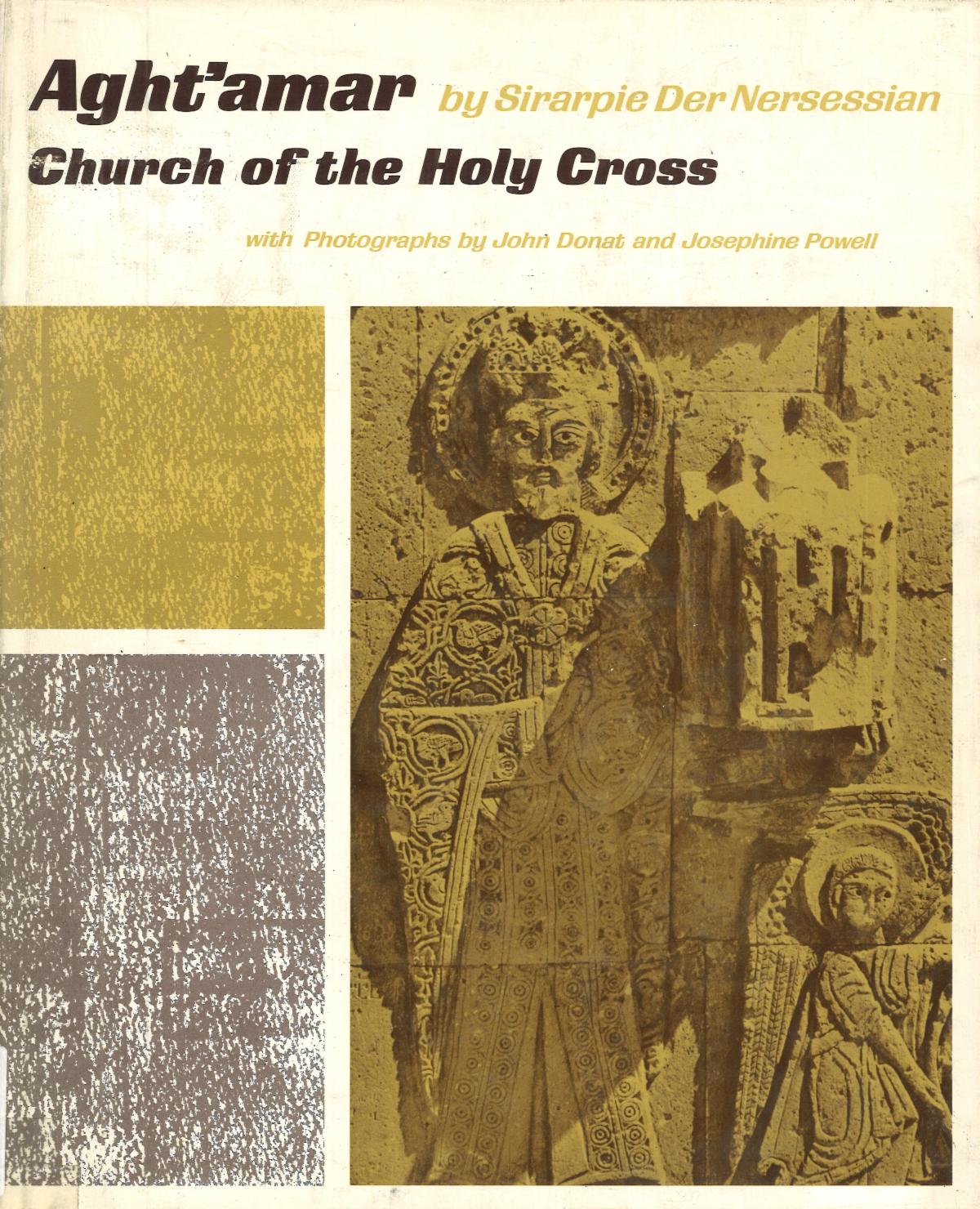
During this period the Harvard Armenian Texts and Studies publication series, the first of its kind in the U.S. and made possible by NAASR’s fundraising efforts, was inaugurated with Sirarpie Der Nersessian’s Aghtamar: The Church of the Holy Cross (1964).
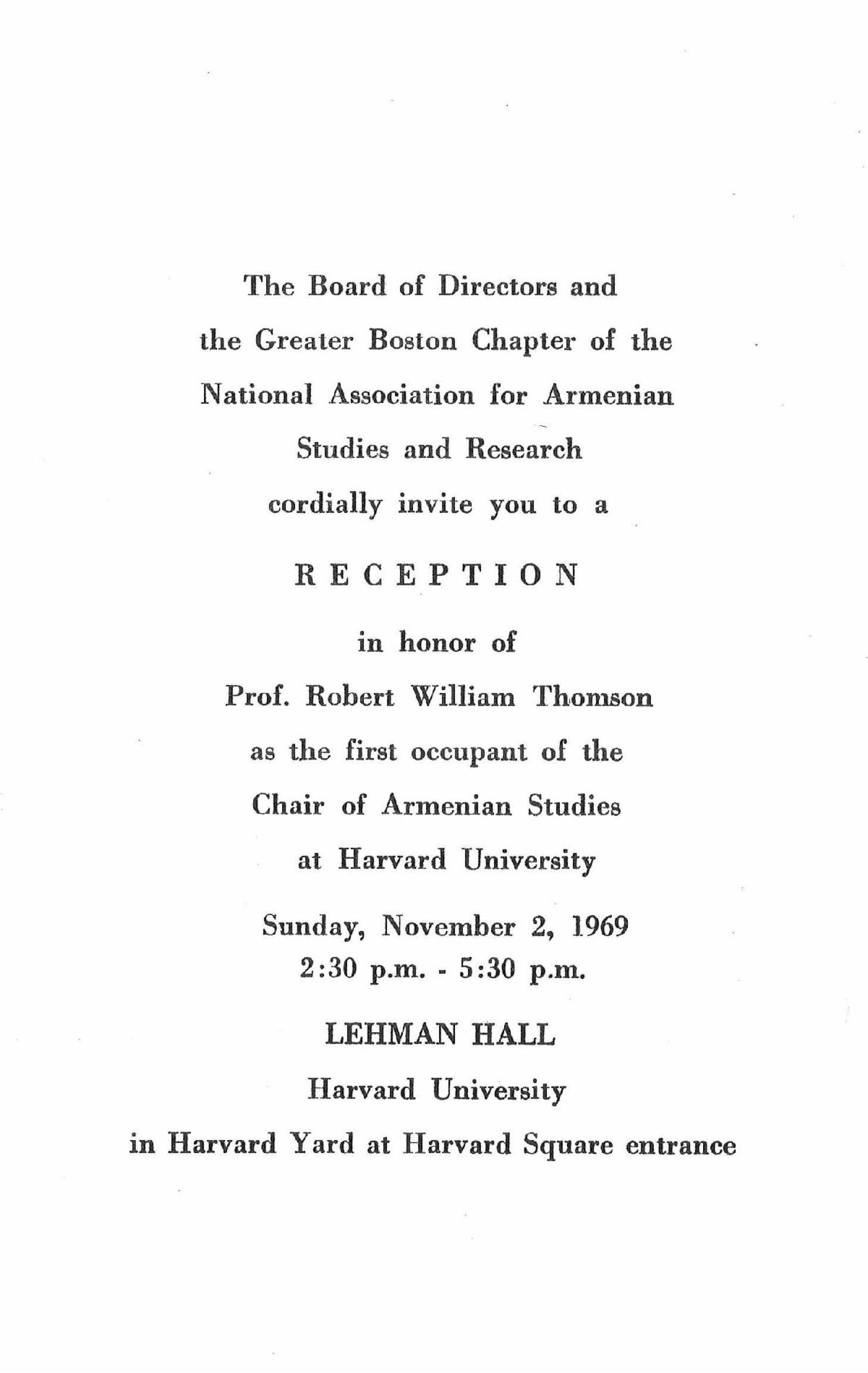
| | In 1969, Robert W. Thomson, who had begun teaching at Harvard in 1963 as a language instructor, was appointed to be the first holder of the chair, which in 1980 was named the Mashtots Chair, a position he held until the early 1990s when he took the Gulbenkian Chair at Oxford. | |
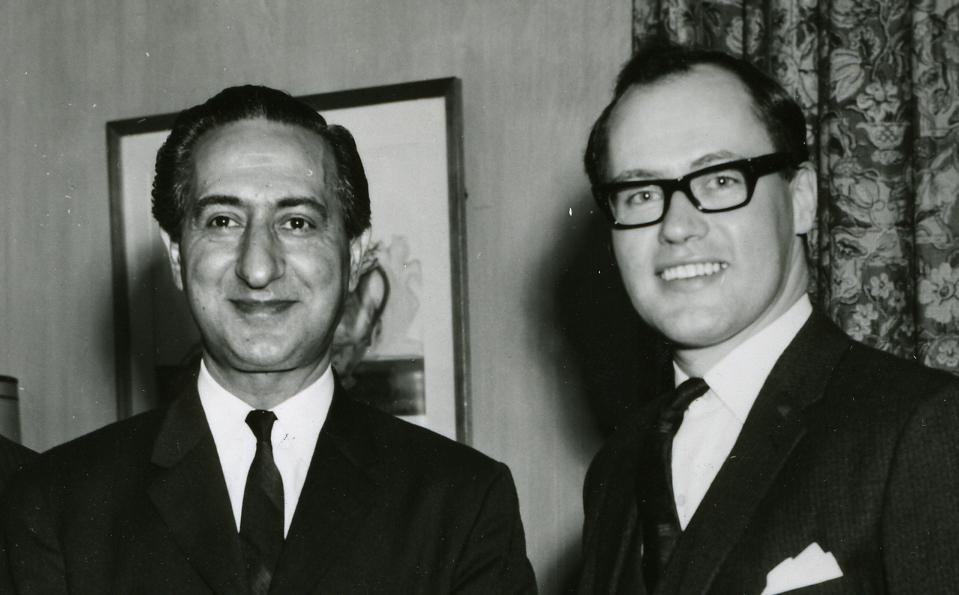
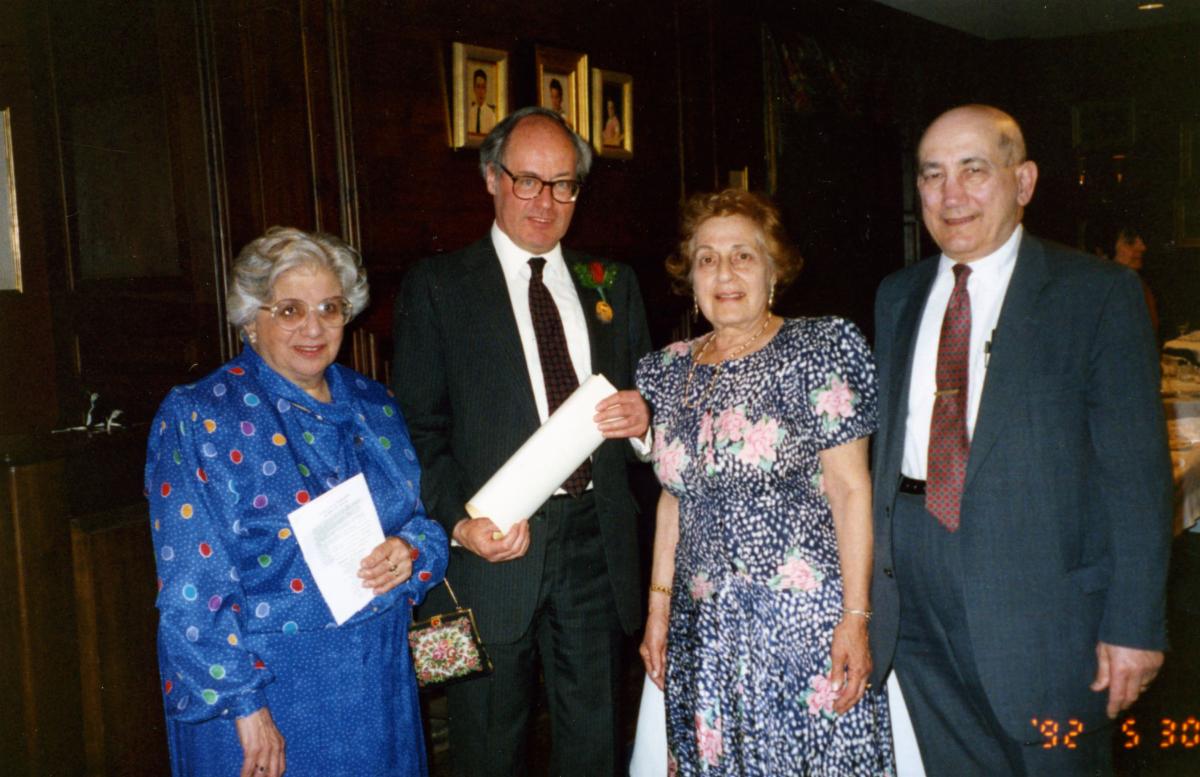
Above: Invitation to NAASR reception for Robert Thomson upon his appointment as chair, November 2, 1969; Avedis Sanjian and Robert Thomson, 1964; Dr. Elizabeth Gregory, Robert Thomson, Helen Sahagian, and Manoog S. Young, 1992.
| | What I must stress is the result of NAASR’s work in establishing a chair at Harvard. Because it was this endowment which gave permanency and proper standing to Armenian Studies, and which for the first time made possible expansion and development of the field. For this opportunity … not only Harvard University, but also the whole scholarly world, owes a debt to you—to your organisation and its indefatigable leaders, and to every single member of the community who contributed time, effort, and money to make this possible. The chair, ladies and gentlemen, is the hub without which there are not spokes or wheel. | | Thomson was succeeded by James R. Russell in 1993, who has now, in turn, been succeeded by Christina Maranci. | |
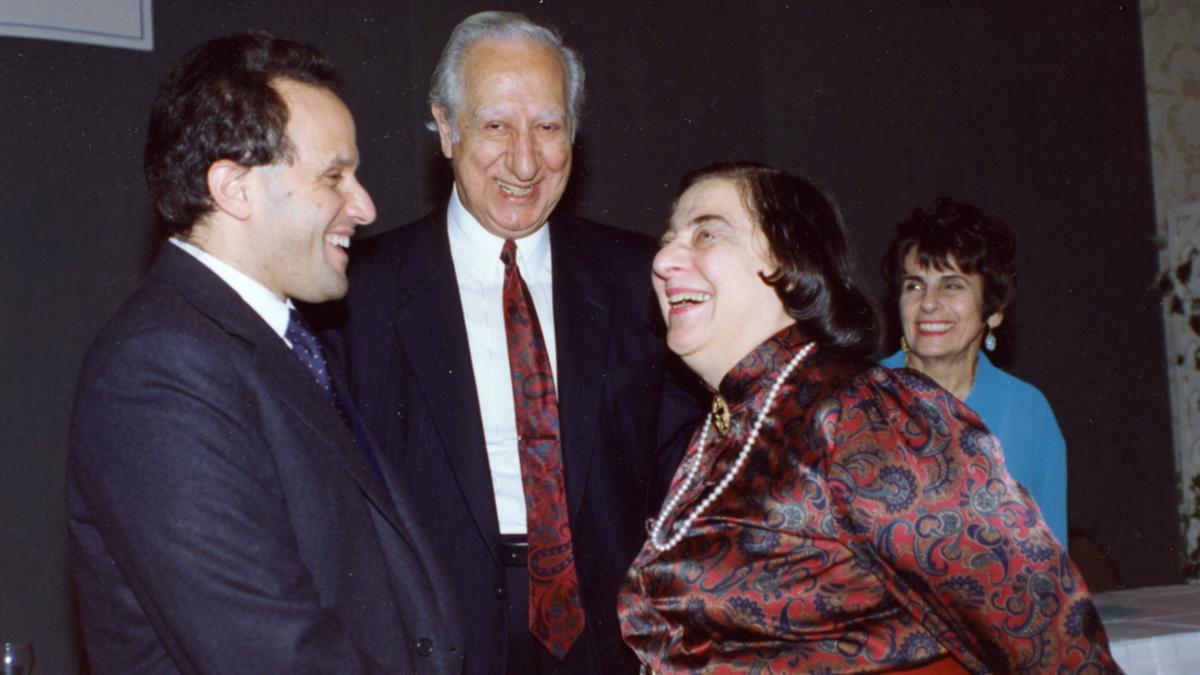
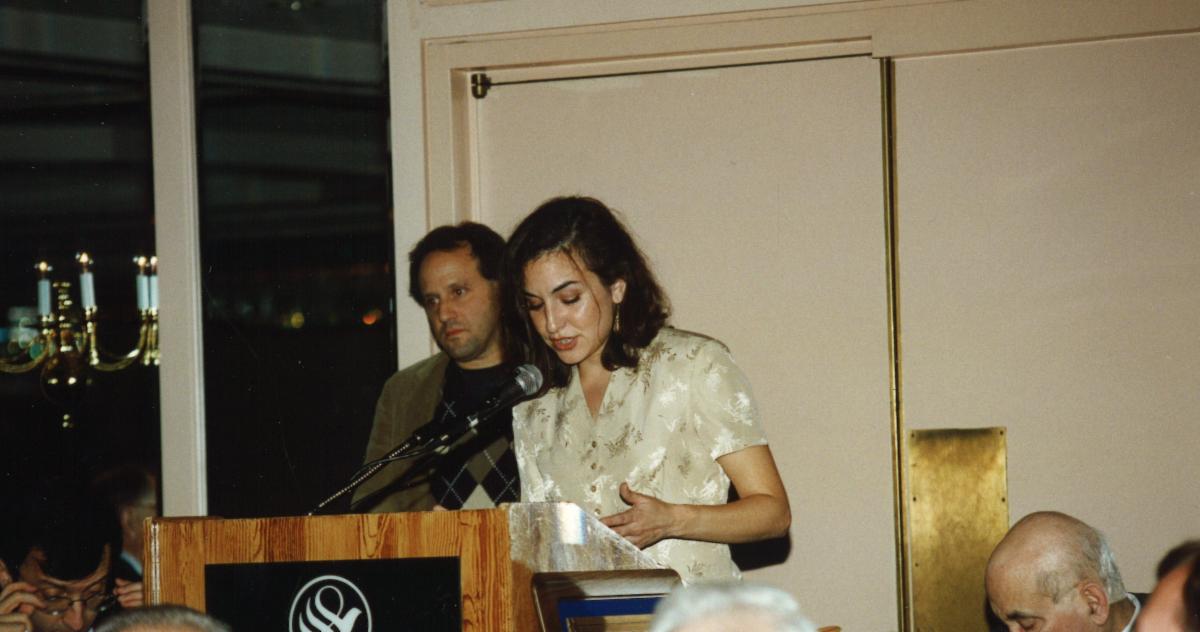
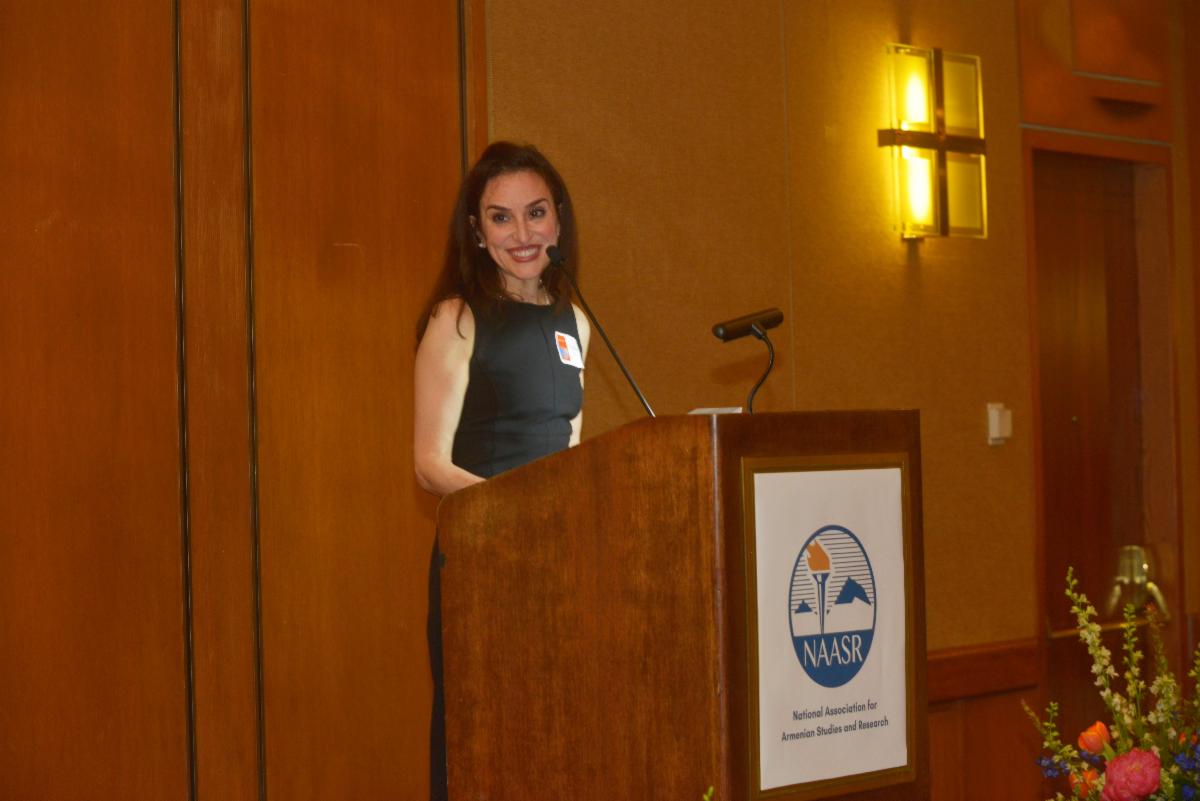
Above, upper left: James R. Russell, Avedis K. Sanjian, Nina Garsoian, Lucy Der Manuelian, November 1993; James R. Russell and Christina Maranci at NAASR's 40th Anniversary gala, 1995; Christina Maranci on May 6, 2023, at the celebration of her appointment (photo by Ken Martin).
| |
The establishment of the Harvard chair was, of course, only the beginning for NAASR and for Armenian Studies. From this beginning other groups and individuals have stepped forward and today there are 13 chairs in Armenian Studies in the U.S. as well as other endowed positions and centers.
We cherish our close relations with all chairs and scholars, but the relationship with the Mashtots Chair is special, as NAASR’s beginning and the creation of the Harvard Chair and the birth of Armenian Studies as a field in the U.S. are all inextricably linked. Likewise, the future of NAASR, the Harvard Chair, and Armenian Studies are interconnected. And we believe the future is bright.
| | Support the Future of Armenian Studies. | | | | |