Weekly Digest Number 12 - March 21st, 2023 |
|
Welcome to the RWU Rail & Labor News! This news bulletin is produced and emailed out each Tuesday morning. We hope you find each week's news and information useful. If so, please share with co-workers, friends, and colleagues. If you like, you can sign them up to get all the news from RWU HERE. Or forward them the link. Note: If you read over this news bulletin each week, you will be sure to never miss the important news of what is going on in the railroad world from a worker's perspective!
|
|
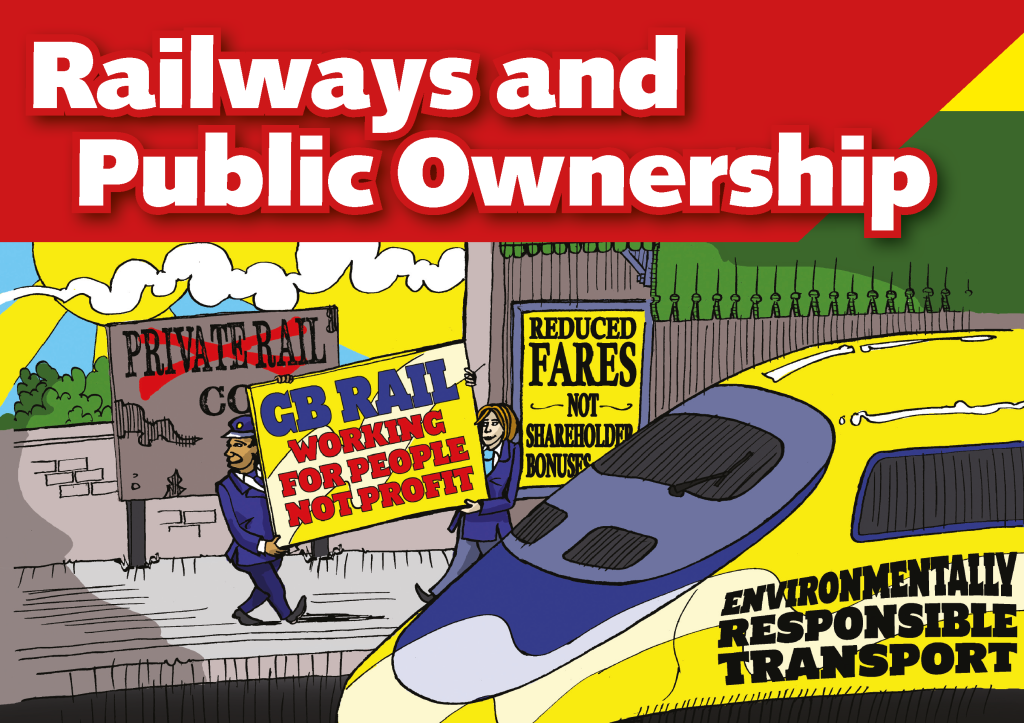
(Editor's Note: The rail industry Class One carriers have been running roughshod over their employees for years. It is now becoming more and more apparent to most citizens along with railroad workers that the rail industry is not being operated in the interest of anyone except a small elite group of stockholders. It is time for the rail industry to be taken under worker/public ownership and control. One of RWU's Co-Chairs makes the case below.) |
|
Rank-and-File Rail Workers Are Calling for Public Ownership of the Railroads
Fed up with rail companies putting profits before workers and surrounding communities, the rank-and-file group Railroad Workers United is launching a campaign for railroad nationalization. We spoke with one of their leaders about the proposal.
|
|
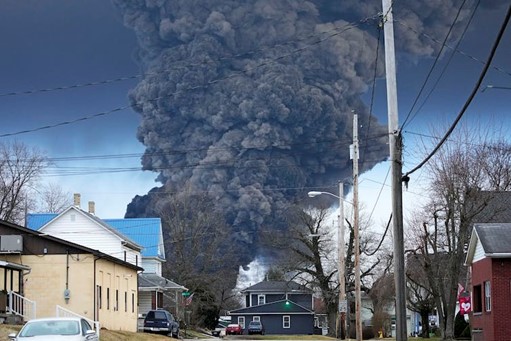
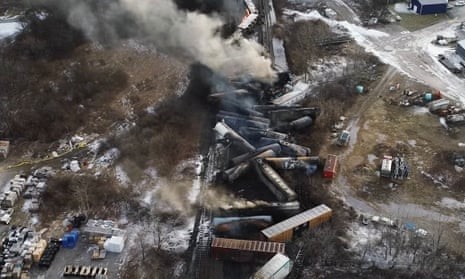
Just months after a high-profile contract fight between rail unions and railroads ended with Congress imposing a contract on workers, a Norfolk Southern freight train carrying hazardous chemicals derailed in East Palestine, Ohio. The environmental and health disaster — exacerbated by the federal government’s lackadaisical response — has laid bare the safety practices of rail carriers.
Railroad Workers United (RWU), a caucus of rank-and-file workers spanning all thirteen national rail unions, has responded to the East Palestine derailment by calling for public ownership of the railroads. According to RWU, the railways cannot be run safely or efficiently so long as they are operated in the pursuit of profit at all costs.
Jacobin spoke with one of the cochairs of RWU, Ross Grooters, about why the group is pushing for railroad nationalization and their efforts to organize with other workers along the supply chain.
NICK FRENCH: What’s the role of your group, Railroad Workers United, in relation to the various rail unions?
ROSS GROOTERS: Railroad Workers United was founded in 2008 upon the idea that the individual craft union system is antiquated and that we need one industrial union. We need to bring all these separate workers together under one umbrella. We’re all working for the same employers and fighting the same things industry-wide.
More recently, a big development is that we made the decision to pass a resolution in support of public ownership, or nationalization, of the railroads. We’re working on organizing and finding a path to a mass movement or campaign for taking public ownership of the railroads, because it’s clear at this point that they will never be operated in the best interest of the nation, or operated as the critical transportation infrastructure that they are.
NICK FRENCH: What’s the history of RWU’s demand for nationalization or public ownership?
ROSS GROOTERS: We came out with the nationalization demand late last year around the contract fight. It’s something we’ve talked about for a long time, we just hadn’t thought there was the right timing or support that would be broad-based and get traction. We debated it many times over the years, including at our conventions. Generally, everybody was like, “Yeah, this is a good idea.”
|
|
(Editor's Note: The chorus of voices in opposition to the merger was building but was not enough to stop it. One would have thought that at least some conditions would have been slapped on it, but in the end, apparently very few were imposed by STB. Notably, Robert Primus was the only dissenting vote on the Board, voting NO on the merger.) |
|
Regulators Approve Canadian Pacific-Kansas City Southern Merger
The merger will become effective on April 14
|
|
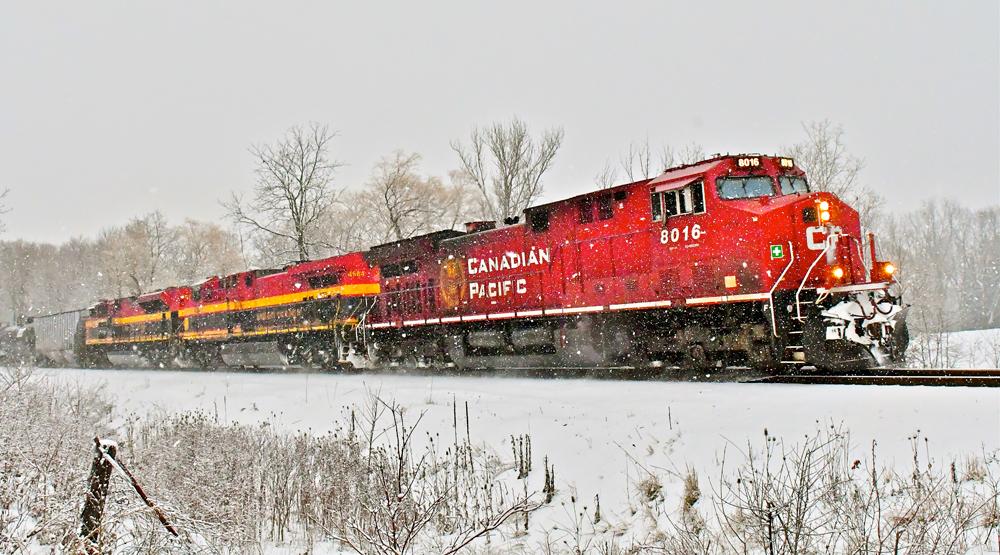
WASHINGTON — Federal regulators today gave the green light to the historic merger of Canadian Pacific and Kansas City Southern.
Their $31.6 billion deal — thought to be the last between two Class I railroads — redraws the North American rail map by creating the first railroad linking Canada, the U.S., and Mexico.
The merger will become effective on April 14. The combined railroad will be called Canadian Pacific Kansas City, with its headquarters in Calgary, Alberta, and its U.S. headquarters in Kansas City, Mo.
|
|
(Editor's Note: While RWU has its criticisms of the RSA 2023 as outlined in our Press Release from March 6th, we are glad to see the Mayors come out in favor of legislation to make the railroads safer.)
|
|
U.S. Conference of Mayors Endorses Bipartisan Senate Rail Safety Legislation |
|
Washington, D.C.— Today the United States Conference of Mayors (USCM) is endorsing critical and long-overdue legislation to make American railways safer. Following a train derailment and chemical spill in East Palestine, Ohio, a bipartisan group of Senators, led by Sens. Sherrod Brown (D-OH) and J.D. Vance (R-OH), introduced the Railway Safety Act. Below is a statement in support of the proposed legislation from USCM CEO and Executive Director Tom Cochran:
“No community should have to face what East Palestine is experiencing today. This tragedy is even worse because it didn’t have to happen. We’ve long known the risks and understood the need to improve rail safety. The U.S. Conference of Mayors has a decades-long history of supporting rail reform to make it safer for the cities that count on it. Today, that legacy continues, and we strongly endorse the Railway Safety Act.
“Rail transport remains a critical part of our infrastructure and economy, but no family should have to worry about the safety of hazardous chemicals being transported through their city. This bill will enact key reforms USCM has long advocated for, help keep Americans safe and hold railroads accountable. We thank the bipartisan sponsors of the bill, and America’s mayors call on Congress to pass this legislation swiftly before another city confronts a similar crisis.”
|
|
(Editor's Note: It is worth stating the obvious here: If railroad workers ran the industry instead of the Wall Street masters and pinheaded bosses, the railroad would be run one helluva lot safer. This is why RWU backs Public Ownership/Control of the Railroads with lots of worker representation on the Board of Directors, like the "Plumb Plan League" proposal of 100 years ago which had broad support among all rail union officials and rank and file alike.)
|
|
The Ohio Derailment Catastrophe Is a Case Study in Disaster Capitalism
Rail workers say the industry has long ignored pleas for better safety protocols.
By Mel Buer
|
|
As public outrage has grown over the toxic fallout from last month’s fiery derailment of a Norfolk Southern freight train in East Palestine, Ohio, the urgent questions behind this disaster echo the past year’s confrontations over working conditions in the lightly regulated rail industry.
Indeed, the catastrophe in Ohio—together with another hazardous derailment in Houston, Tex., just a week later—drives home the steep costs in health and well-being that we all incur when we fail to heed rail workers’ calls for more regulation and adequate staffing mandates.
As rail workers sought to win basic guarantees of staffing support and sick leave from rail carriers long accustomed to selling labor short and winning major regulatory concessions from federal agencies, they stressed how the unsustainable demands placed on their working lives would result in disasters just like the one in East Palestine. The northeast Ohio village of about 5,000 people is 40 miles northwest of Pittsburgh and 20 miles south of Youngstown; already those metropolitan areas are under alert for the air and water contamination originating from the Palestine derailment. And in Palestine proper, many residents are already reporting troubling health symptoms and dying area wildlife as they weigh the risks of remaining exposed to the toxic fumes and chemical leaks from the derailed tanker cars carrying hazardous materials.
In the immediate aftermath of the derailment, rail officials ordered that the vinyl chloride hauled by five of the Norfolk Southern cars in the 150-car train be burned off to prevent a still greater explosion—but that action sent hydrogen chloride and phosgene, two dangerous gasses, spuming into the air. EPA investigators have since identified other hazardous chemicals the train had been hauling, including ethylene glycol monobutyl ether, ethylhexyl acrylate, isobutylene, and butyl acrylate. And the EPA has released a report saying that chemicals from the derailment have leached into the soil and water in the aftermath of the accident.
“We’ve been trying to share our concerns around this for a while now,” Ross Grooters, current rail employee and co-chair of Railroad Workers United said. “It wasn’t a matter of if this was going to happen. It was a ‘when and where,’ and unfortunately, there’s a high likelihood that this will happen again, somewhere, if the root causes of the issues aren’t addressed.”
Rank-and-file workers organizing with Railroad Workers United (RWU) have waged high-profile pressure campaigns to improve rail safety and retain staffing.
|
|
(Editor's Note: Yet another new article about public ownership of the rails. To have a look at 25 articles about public ownership/control of the railroads, check the RWU webpage HERE. For webinars, videos and radio spots, click HERE.)
|
|
Workers Say It’s Time to Nationalize the Railroad
Railroad workers point to corporate greed as the root cause of the recent influx of dangerous train derailments
|
|
Over a dozen trains have derailed across the U.S. in fewer than three months. On Feb. 3, a Norfolk Southern train derailed in East Palestine, Ohio, causing multiple explosions, toxic chemical leaks, and controlled burns that left an ecological disaster in its wake. Most recently, a train derailed in Sarasota, Florida, on Feb. 28, tipping over six railcars—one of which contained 30,000 gallons of liquid propane gas. Just this weekend, on March 4, yet another Norfolk Southern train derailed in Springfield, Ohio, sending 28 cars sliding across the tracks. While neither the Sarasota nor the second Norfolk Southern derailments caused the same level of destruction as the one in East Palestine, railroad workers warn that derailments will continue to occur if the industry continues to prioritize profit over safer labor conditions for workers.
The National Transportation Safety Board (NTSB) released a preliminary report on Feb. 23 revealing a wheel bearing on the first railcar that derailed had been in the “final stage of overheat failure moments before the derailment.” In a press conference announcing the report, NTSB Chairwoman Jennifer Homendy said the East Palestine derailment was “100% preventable … There is no accident. Every single event that we investigate is preventable.” Since the incident, the Environmental Protection Agency (EPA) has ordered Norfolk Southern to remedy the situation and clean up the damage.
In a press release, Railroad Workers United (RWU) - an inter-union, cross-craft solidarity “caucus” of railroad workers and their supporters from all crafts, carriers, and unions across North America—said that Class One freight rail carriers, including Norfolk Southern, have prioritized profits over safety, cutting maintenance, equipment inspections, and personnel in all crafts while increasing the average train size to three miles or more.
|
|
(Editor's Note: The long awaited criticism of Class One freight operations is pouring out from all quarters now. After having operated in the shadows for years, the rail industry is now finally under the microscope for its numerous failures and transgressions.) |
|
The Filthy Emissions of Railroad Locomotives - and the Rail Unions Sounding the Alarm
Diesel engines have gotten a sweetheart deal from environmental regulators. It’s time that changed.
|
|
This article is a joint publication of The American Prospect and Workday Magazine, a nonprofit newsroom devoted to holding the powerful accountable through the perspective of workers.
After working as a rail crew transportation driver for nearly 13 years, Larry Hopkins says he is starting to worry about his health. “Every day that I work, I’m being exposed to the diesel fumes that are bad for our communities,” says the 56-year-old who was born in Blytheville, Arkansas, and now lives on the southwest side of Chicago.
Hopkins works for Hallcon Corporation driving railroad crews, conductors, and engineers to and from rail yards and hotels. His primary pickup and drop-off point used to be Corwith Yard, southwest Chicago’s massive intermodal rail yard that was once the largest in the world. But in recent weeks, he’s been on the road, transporting crews to and from rail yards across Illinois. “Even if you’re picking up crews outside of a railroad, you are still close enough to those locomotives that are giving out the fumes that are polluting our air,” he says.
There is good reason for Hopkins to be concerned. Locomotives typically run with diesel engines that emit nitrogen oxides and particulate matter, both of which are known to harm human health—and even cause premature death. The problem is particularly severe for locomotives that operate within rail yards, making short transfers or assembling trains, because they stay in a small area and are commonly the oldest, dirtiest ones in service. For Hopkins and other members of his union, United Electrical, Radio and Machine Workers of America (UE), this problem has a cause: inadequate regulation.
|
|
(Editor's Note: While NS is the target at the moment, any one of the Class One carriers is likewise guilty of the same cost-cutting frenzy, the same short staffing and inefficiencies, the same delay of passenger trains, the same decline in freight service compared to a generation ago, the same lack of maintenance and inspection, the same running roughshod over its workforce, and the same short-staffing and draconian attendance policies. Yes, NTSB needs to take a look at all of them!) |
|
Senator Calls for NTSB to Expand NS Safety Investigation to Include All Class I Railroads
March 15, 2023
Schumer, majority leader, cites deregulation, workforce cuts in questioning industry’s commitment to safety
|
|
WASHINGTON — Senate Majority Leader Charles Schumer (D-N.Y.) has asked the National Transportation Safety Board to expand its planned investigation into Norfolk Southern safety practices to cover all Class I railroads, the website Politico reports.
The NTSB announced its plan to conduct a special investigation of NS — the first of a railroad since 2014 — earlier this month, citing “the number and significance” of recent accidents [see “NTSB launches special investigation …,” Trains News Wire, March 7, 2023].
In a letter today to NTSB Chair Jennifer Homendy, Schumer cites “a troubling and fatal combination” of deregulation, more than 26,500 accidents in five years, and cuts of more than 30,000 workers in the same period in saying it is “jarringly evident that the freight rail industry is in desperate need of a full and comprehensive investigation.”
He asks that the safety board considers a half-dozen questions, among them how “degulatory pushes have contributed to these derailments and increase in deaths” and whether railroads “have a culture of ignoring their own safety standards.”
Schumer’s letter also asserts that “Congress – and the American people — desperately need greater insight into an industry that lacks transparency and clear safety standards all while transporting hazardous and toxic materials through American communities each day.”
|
|
A Preventable Accident?: Organized Labor’s View of the East Palestine Train Derailment
|
|
On February 3, 2023, a 151-car Norfolk Southern Railway train (32N) that was carrying hazardous materials in 20 of its cars derailed in the town of East Palestine, Ohio. Thirty-eight cars (11 of which contained hazardous materials) were involved in the crash, and an additional 12 cars caught fire.
The derailment caused an environmental disaster that:
- Involved a controlled burn of toxic chemicals.
- Required mandatory evacuation orders for days at a time.
- Left residents skeptical of their air quality and water safety.
It’s also left many residents concerned about their town’s future. “I don’t feel safe because I don’t know what the future holds for my town,” resident Jessica Conard said during a February 22 town hall meeting. “This has the potential to really decimate a small town like us.”
While this would be a terrible outcome under any circumstance, it would be particularly tragic in this case because the derailment could have been prevented.
What Happened to Cause the Accident?
While the National Transportation Safety Board (NTSB) continues to investigate the accident, the board’s preliminary findings on February 3 suggested that a faulty “wheel bearing in the final stage of overheat failure moments before the derailment” was the culprit.
NTSB Chair Jennifer Homendy confirmed as much in a press conference on February 23, stating, “It was the combination of the hot axle and the plastic pellets which started the initial fire.”
According to the NTSB report, the crew received a critical and audible alarm from a wayside defect detector to stop the train and inspect a hot axle. The engineer then increased the dynamic brake application to stop the train. The axle failed, which led to an emergency full brake application, which caused the cars to jackknife and derail. Homendy made sure to note the crew didn’t do anything wrong.
The investigation by the NTSB is ongoing and may take years to complete. While this may be the official cause as determined by the NTSB, the mechanical failure was precipitated by a number of decisions.
Railway workers and their unions were not shocked by the accident in East Palestine.
“The wreck of Train 32N has been years in the making,” the Railroad Workers United (RWU) said in a statement. Decades of cost-cutting measures, workforce reductions, regulation resistance, and corporate lobbying by the rail companies all contributed to the derailment.
|
|
(Editor's Note: This shot video does an excellent job reporting on the personal cost of the wreck to the residents of East Palestine, OH.) |
|
We Went to East Palestine: What We Saw May Shock You |
|
We went down to East Palestine for a week to get residents’ side of the story after the Ohio rail disaster. People told us they’re getting sick and their pets are dying, while Norfolk Southern is trying to cover it up. |
|
(Editor's Note: The CP-KCS merger is apparently now a done deal with the STB's decision on March 16th. Not everyone is a happy camper about it of course. It of remains to be seen how it all goes down. If you had not seen it, check out the RWU Resolution in Opposition to the Merger.)
|
|
Merger Decision Prompts Reactions Across the Board |
|
Petitions for reconsideration of the board’s decision must be filed by April 4. Requests for stay must be filed by March 27, according to an STB press release.
Following are a few of the responses issued immediately after the STB announced its decision.
|
|
(Editor's Note: This takes the cake! The very same investors who have so willingly gone along with PSR - who in fact sung its praises and championed its record stock prices and dividends, its staffing cuts and stock buybacks, its record low Operating Ratio and its super long trains - are now crying the blues that the monster that they in fact created, has come to haunt them. Well, please cry me a river and fetch me my violin. This is priceless!) |
|
Norfolk Southern Sued Over Stockholder Losses from East Palestine Derailment
March 17, 2023
Class action blames Precision Scheduled Railroading for decline in stock value
|
|
NEW YORK — Norfolk Southern, already facing suits from the state of Ohio and a number of individuals and businesses over the East Palestine derailment, is now facing legal action on behalf of its stockholders.
Bragar Eagle & Squire, which describes itself as “a nationally recognized stockholder rights law firm,” has filed a class-action suit against the railroad over losses suffered by stockholders — essentially arguing that the railroad’s investor-driven Precision Scheduled Railroading strategy to reduce costs has proven to have negative consequences for investors.
According to a press release, the suit alleges that the railroad “made false and/or misleading statements and/or failed to disclose” that PSR “led to … a materially increased risk of future derailments” and “was part of a culture of increased risk-taking at the expense of reasonable safety precautions due to Norfolk Southern’s near-term focus solely on profits,” among other claims.
In response to an inquiry from Trains News Wire, Norfolk Southern said it cannot comment on pending litigation.
Several suits to be combined
In other legal news, the Youngstown Vindicator reports that the plaintiffs in 21 lawsuits filed against Norfolk Southern over the East Palestine derailment have agreed to consolidate their individual suits into one action.
Judge Benita Y. Pearson of U.S. District Court had asked the parties to consider consolidation on Feb. 8. One of 22 plaintiffs elected not to join; Norfolk Southern has agreed the consolidation was appropriate. Three attorneys have been appointed by Pearson to lead the consolidation and coordinate the cases.
|
|
(Editor's Note: Well the FRA does it again. Rather than recommend - or require - that physical changes to "private property" grade crossings be implemented, the Agency recommends more training and job briefings. For years, workers and others have been killed and maimed at these "private crossings" because the feds are too timid to demand that the rail industry provide adequate protection against collisions at these rail crossings at grade. See Page 7 of the RWU Newsletter from Spring 2011 for a textbook example.)
|
|
FRA Issues Safety Bulletin on Shoving Moves Across Grade Crossings
Responding to Ohio fatality, agency asks railroads to review safety practices with employees
|
|
WASHINGTON — The Federal Railroad Administration has issued a safety bulletin asking railroads to review with employees the dangers of pushing and shoving moves at highway grade crossings.
The bulletin issued today (March 17) is clearly in response to the fatal accident involving a Norfolk Southern conductor on March 7 [see “Norfolk Southern employee killed …,” Trains News Wire, March 7, 2023], although it does not explicitly name that incident.
The bulletin, which the FRA says “is informal in nature,” says safe operation in such situations should include:
— Proper training, periodic oversight, and application of appropriate railroad operating rules when determining whether the track is clear;
— Proper job briefings and communications between assigned crew members during pushing and shoving movements.
The FRA says its preliminary indication into the incident in question has found “a conductor with 18 years of service was fatally injured when the tank car he was riding to provide point protection for a switching move was struck by a dump truck. The incident occurred at a private grade crossing in a steel plant as the train consist traveled southward. The dump truck, traveling west, stopped at the private highway-rail grade crossing, then proceeded and collided with the car the conductor was riding, killing the conductor.”
|
|
(Editor's Note: The tragic train wreck in Greece is triggering a massive uprising of workers and allies across the country.) |
|
Striking Greeks Protest Over Deadly Train Crash
By Reuters March 15, 2023, at 6:02 p.m.
|
|
By Stelios Misinas and Stamos Prousalis
ATHENS (Reuters) -Thousands of Greek workers walked off the job on Thursday and rallied in central Athens in protest at neglected safety standards they say led to the deadliest train crash in the country's history.
Flights to and from Greece were grounded, ships remained docked at ports, and public services and state schools were closed as workers joined the 24-hour strike called by Greece's largest labour unions, GSEE and ADEDY.
The walkout is the latest in a series of protests since the head-on collision last month of a passenger train carrying more than 350 people, most of them university students, with a freight train near the city of Larissa in the central Greek region of Tempi. The crash killed 57. Protesters accuse the conservative government and the country's political system of ignoring repeated calls by unions over deficient safety measures.
"It was not human error, it was crime," read a banner held by protesters rallying outside parliament in Athens. "Our dead, your profits," read another one.
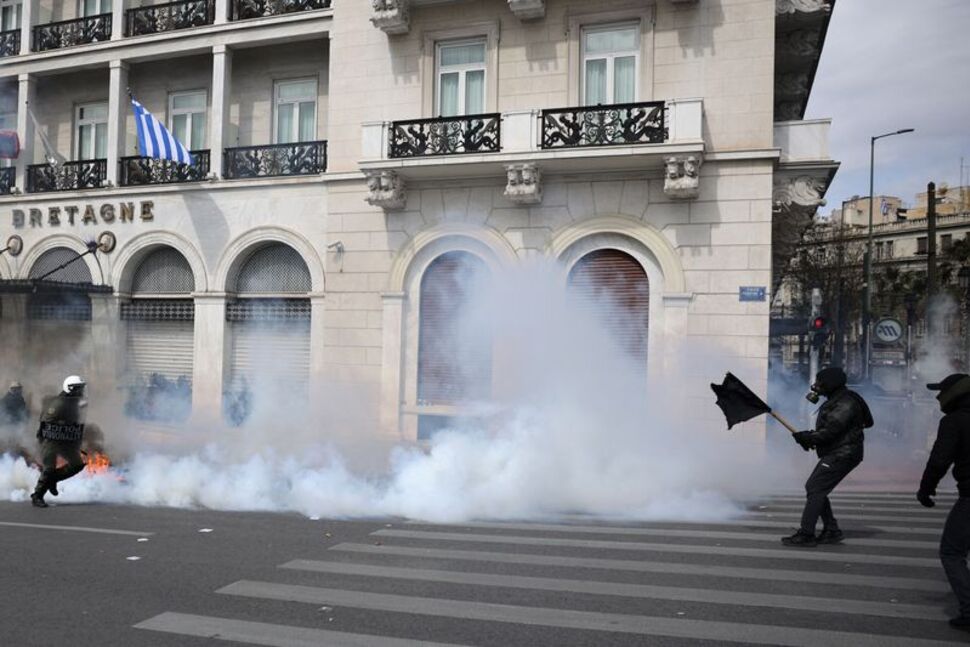
Clashes broke out when a group of protesters broke off the rally and hurled petrol bombs at police officers who responded with teargas. More than 25,000 people rallied in central Athens, according to police estimates, and protests were also held in other Greek cities.
Last week, tens of thousands rallied in the capital and other cities in the largest street demonstrations the government has faced since being elected in 2019.
|
|
|
|
|
|
|