Click Image Below to View Previous Civic Saturday Newsletters | |
Elected and Appointed Judges | The roles and responsibilities of judges in Illinois can vary by county, case type, and the needs of each judicial circuit. This newsletter provides general information on the types of judges serving Illinois counties, including circuit and associate judges, as well as specialized roles in certain areas. However, the specific duties and areas of focus for judges may differ based on local court assignments, case volumes, and other administrative factors. For detailed information regarding the judiciary in your county, please consult your local court’s resources or website. | |
|
Introduction
Why Elected Judges Matter in
Our Justice System
| |
Elected judges play a crucial role in our justice system by serving as the primary guardians of fairness and accountability. Through the electoral process, communities have the power to influence the judiciary, ensuring that judges reflect the values and interests of the public they serve. Understanding their importance fosters greater engagement in the judicial election process and helps maintain trust in the legal system. | |
|
Injustice Watch Reports
March 2, 2020
| Why judicial elections matter, and other common questions about the March primary | |
|
As Injustice Watch launches our 2020 Judicial Election Voting Guide, we’re answering some common questions about how judicial elections work.
Judicial elections are how Cook County chooses the majority of its judges. The choices can seem overwhelming, with 117 candidates vying for 37 positions. Even many lawyers and judges express uncertainty when it comes to casting an informed vote.
We’ve spent months compiling as much relevant information about the candidates as we can find in our judicial voting guide. We’re also taking your questions via Twitter and answering them both on social media and in future posts.
| |
|
Kare News Reports
October 26, 2020
| Voting for judges: Why it's important and why some think the way we do it should change | |
Because judges must retire at the age of 70, it often leaves an open seat in the middle of a term. That means most of our state’s judges are appointed by the Governor. But it doesn’t mean voters don’t have a say.
“Every six years every sitting judge has to stand for election, and anybody who wants to file against them, if they are a lawyer, with a license, can do so," says Eric Magnuson, former State Supreme Court Chief Justice.
But even the most informed voter has that moment, when they turn over the ballot, and think, I have no idea who these people are.
| |
The Structure of U.S. Courts
Supreme, Appellate, and Circuit Courts at Federal and State Levels
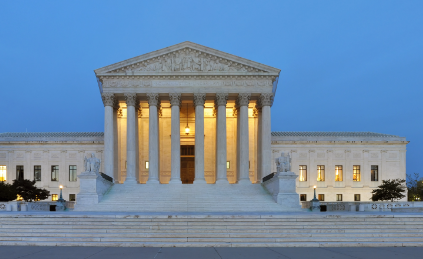
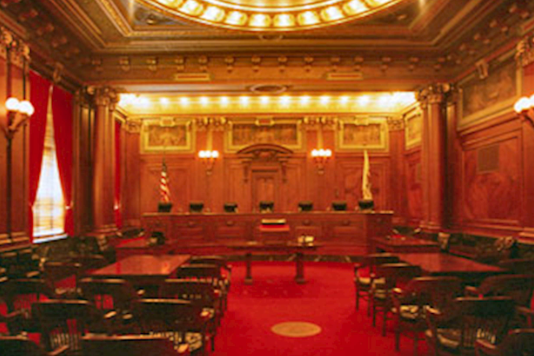
| 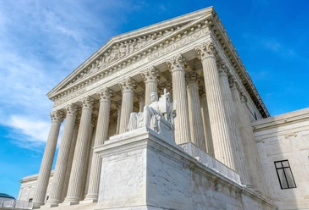 | The U.S. court system operates on federal and state levels, with both systems featuring a hierarchy of Supreme, Appellate, and Circuit (or Trial) Courts. At the federal level, the Supreme Court of the United States is the highest court, handling cases that raise constitutional issues or significant federal questions, often from federal appellate or state supreme courts. Below it, the U.S. Courts of Appeals—organized into 13 circuits covering regions across the country—review decisions from federal District Courts, ensuring consistency in the application of federal law. The U.S. District Courts serve as primary trial courts, handling a wide range of civil and criminal cases in every state and territory. State court systems follow a similar structure: each state has a State Supreme Court for major constitutional and legal issues, Appellate Courts (where applicable) to handle appeals from trial courts, and Circuit or Trial Courts (often called Circuit, Superior, or County Courts) to manage most cases locally. This structure ensures legal issues are addressed appropriately at federal and state levels across the U.S. | |
Supreme Court of the United States
- The highest court in the nation.
- Reviews cases involving constitutional issues, significant federal questions, and appeals from federal appellate courts or state supreme courts.
U.S. Courts of Appeals (Appellate Courts)
- Also known as Circuit Courts of Appeals, covering 13 circuits across the country (11 regional circuits, plus the D.C. Circuit and the Federal Circuit).
- Each appellate court reviews cases from federal district (trial) courts within its circuit.
U.S. District Courts (Circuit or Trial Courts)
-
The main trial courts at the federal level, located in each state and territory.
- Handle federal cases, including civil and criminal matters.
- Each state has at least one district, though larger states have multiple districts.
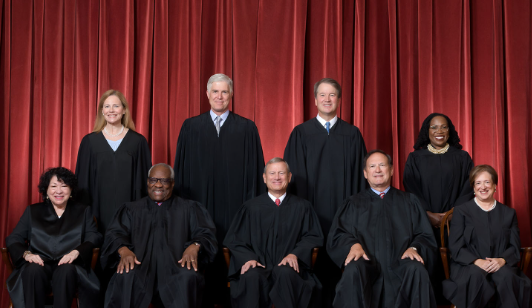
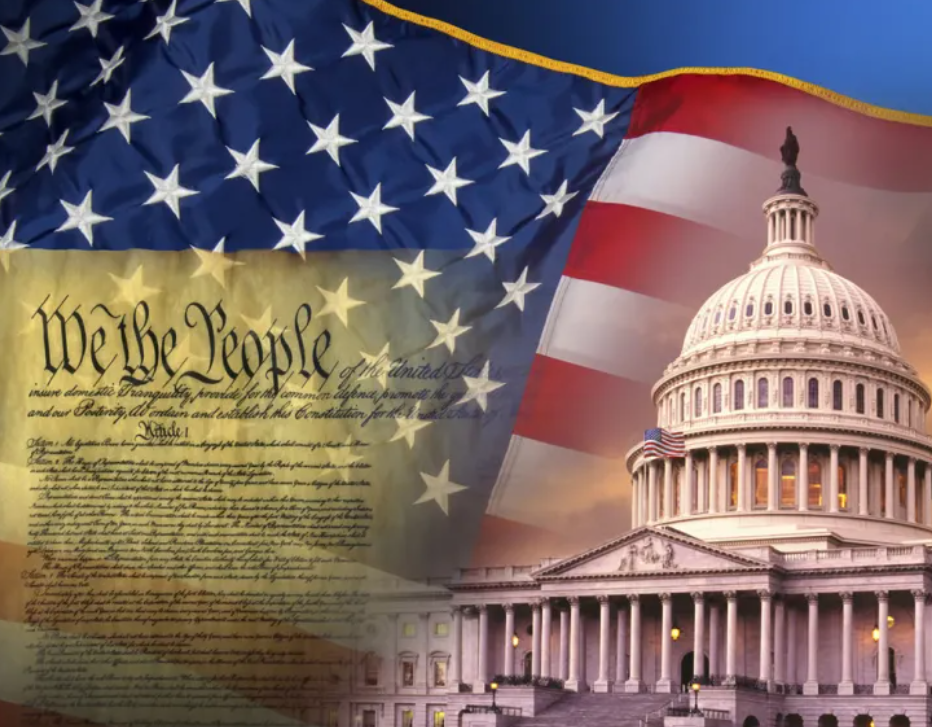
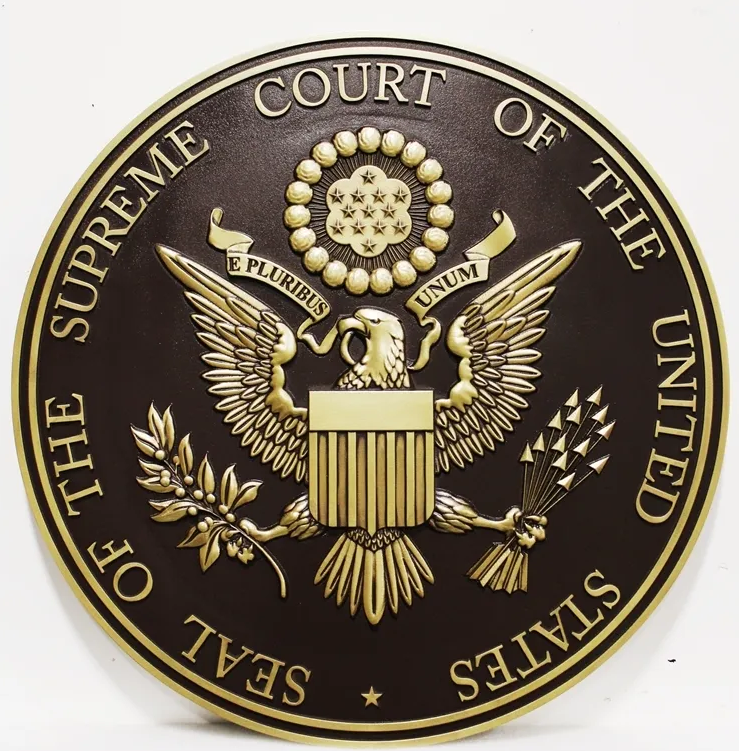
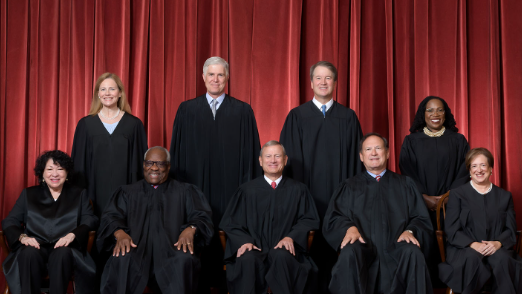
| The Supreme Court of the United States | The Supreme Court of the United States is the highest judicial authority in the country, established to interpret and uphold the Constitution. Comprising nine justices appointed for life, the Court hears cases of profound legal and constitutional significance, including disputes between states, federal matters, and appeals from lower federal and state supreme courts. It primarily reviews cases involving constitutional issues, such as individual rights and federal powers, and sets binding precedents for all lower courts, shaping the nation’s legal landscape. Only a select number of cases reach the Supreme Court each year, chosen based on their national importance or complex legal questions. | The United States Courts Reports | Article III of the Constitution establishes the federal judiciary. Article III, Section I states that "The judicial Power of the United States, shall be vested in one supreme Court, and in such inferior Courts as the Congress may from time to time ordain and establish." Although the Constitution establishes the Supreme Court, it permits Congress to decide how to organize it. Congress first exercised this power in the Judiciary Act of 1789. This Act created a Supreme Court with six justices. It also established the lower federal court system. | Britannica Courts Reports | Supreme Court of the United States | The Supreme Court was created by the Constitutional Convention of 1787 as the head of a federal court system, though it was not formally established until Congress passed the Judiciary Act in 1789. Although the Constitution outlined the powers, structure, and functions of the legislative and executive branches of government in some detail, it did not do the same for the judicial branch, leaving much of that responsibility to Congress and stipulating only that judicial power be “vested in one supreme Court, and in such inferior Courts as the Congress may from time to time ordain and establish.” | Click Image Below to Learn More Information About the U.S. Supreme Court | |
U.S. Supreme Court Appointments
The Nomination and Confirmation Process
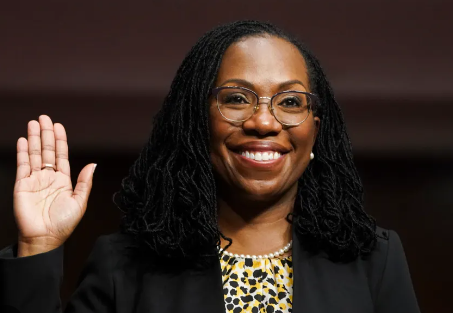
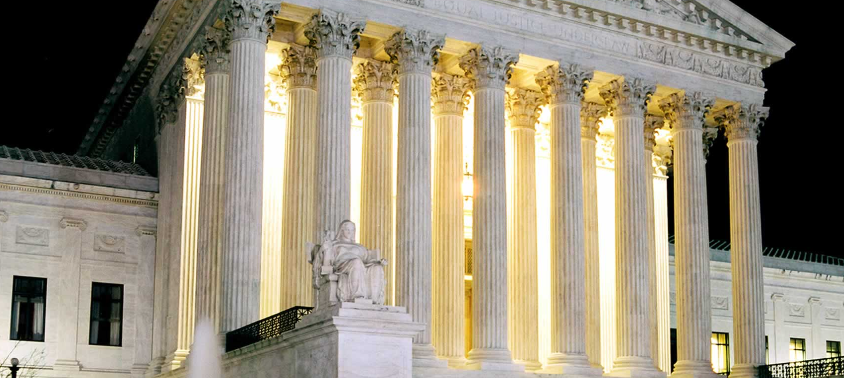
|  | |
The positions of the U.S. Supreme Court are determined through a multi-step process involving both the executive and legislative branches of the federal government:
-
Appointment by the President: When a vacancy occurs on the Supreme Court—due to retirement, resignation, or death—the President of the United States nominates a candidate to fill the position. The nominee is typically someone with extensive legal experience, often including prior judicial service, academic credentials, or significant legal practice.
-
Senate Confirmation: After the President submits the nomination, the Senate Judiciary Committee conducts a series of hearings to evaluate the nominee's qualifications, judicial philosophy, and views on various legal issues. This process includes questioning the nominee and reviewing their past rulings, writings, and legal opinions.
-
Senate Vote: Following the hearings, the Judiciary Committee votes on whether to recommend the nominee to the full Senate. The entire Senate then votes on the nomination. A simple majority is required for confirmation. If the nominee is confirmed, they are appointed to the Supreme Court.
-
Lifetime Appointment: Once confirmed, Supreme Court justices serve lifetime appointments, meaning they remain on the Court until they choose to retire, resign, or are removed through impeachment by Congress.
This process ensures that both the executive and legislative branches have a role in determining the composition of the Supreme Court, reflecting a system of checks and balances inherent in the U.S. government.
| Article III of the Constitution, which establishes the Judicial Branch, leaves Congress significant discretion to determine the shape and structure of the federal judiciary. Even the number of Supreme Court Justices is left to Congress — at times there have been as few as six, while the current number (nine, with one Chief Justice and eight Associate Justices) has only been in place since 1869. The Constitution also grants Congress the power to establish courts inferior to the Supreme Court, and to that end Congress has established the United States district courts, which try most federal cases, and 13 United States courts of appeals, which review appealed district court cases. | |
The Supreme Court Historical
Society Reports
| |
Co-Equal Leader: The Role of the Chief Justice of the United States
|  | The Chief Justice is the presiding officer of the Court, supervising the process of selecting the cases the Court will hear, the public sessions or hearings, the discussions of the cases at private conference, and the subsequent votes of the nine Justices (including the Chief Justice). When the Chief Justice is in the majority on a Court decision, they will either author the opinion for the Court, or assign the opinion to another Justice. Each Chief Justice can adjust and change the procedures within these responsibilities to suit their own management style. Chief Justices have modified the Court calendar, times for oral arguments, rules of order during private conferences, and other aspects in an effort to improve the efficiency of the Court. They also supervise the approximately 500 staff members who work in and around the Court each day. This includes the Clerk of the Court, the Marshal, the Reporter of Decisions, the Supreme Court Librarian, the Supreme Court Police, and their staff. | Click Image Below to View the Current Members of the U.S. Supreme Court | |
The Role and Responsibilities of the U.S. Supreme Court
The Pinnacle of Judicial Authority
|
U.S. Supreme Court
-
Highest Court in the Land: The Supreme Court serves as the ultimate judicial authority in the United States, with the power to interpret the Constitution and federal law.
-
Case Review: It reviews cases involving significant constitutional issues, federal law questions, and appeals from lower federal and state courts.
-
Precedent Setting: The Court's decisions set binding precedents for all other courts in the country, shaping the interpretation of laws and constitutional provisions.
-
Judicial Review: It has the authority to review and invalidate laws or executive actions that it finds unconstitutional.
| The United States Court of Appeals | The United States Court of Appeals serves as the intermediate appellate court in the federal judiciary, divided into 13 circuits covering different regions of the country. Its primary role is to review cases appealed from the U.S. District Courts, examining whether legal procedures and interpretations were correctly applied. Unlike trial courts, the Court of Appeals does not conduct new trials; instead, it reviews the records from lower courts and listens to arguments from attorneys. Decisions made by the Courts of Appeals are binding within their respective circuits, though cases of exceptional importance may advance to the Supreme Court. The Courts of Appeals play a crucial role in ensuring consistency and fairness in federal law across the nation. | The United States Courts Reports | About the U.S. Courts of Appeals | |
In the federal system, 94 district courts are organized into 12 circuits, or regions. Each circuit has its own Court of Appeals that reviews cases decided in U.S. District Courts within the circuit. The U.S. Court of Appeals for the Federal Circuit brings the number of federal appellate courts to 13. This court takes cases from across the nation, but only
particular types of cases.
| Click Image Below to Learn More Information About the U.S. Court of Appeals | |
U.S. Courts of Appeals Judges
The Appointment and Confirmation Process
|  | |
The selection of judges for the U.S. Courts of Appeals, also known as Circuit Courts, follows a process similar to that of the U.S. Supreme Court, involving both the executive and legislative branches:
-
Appointment by the President: When a vacancy arises on a U.S. Court of Appeals, the President of the United States nominates a candidate to fill the position. The nominee is typically selected based on their legal experience, judicial philosophy, and professional qualifications.
-
Senate Judiciary Committee Review: After the nomination, the Senate Judiciary Committee conducts hearings to evaluate the nominee. This process includes questioning the nominee about their qualifications, legal viewpoints, and any previous rulings or writings.
-
Senate Vote: Following the hearings, the Judiciary Committee votes on whether to recommend the nominee to the full Senate. The entire Senate then votes on the nomination. A simple majority is required for confirmation. If confirmed, the nominee is appointed to the Court of Appeals.
-
Lifetime Appointment: Once confirmed, judges serve lifetime appointments on the Court of Appeals, meaning they can remain in their position until they choose to retire or resign, or they can be removed through impeachment.
This process ensures that both the President and the Senate have a role in selecting judges for the U.S. Courts of Appeals, maintaining a system of checks and balances within the federal government.
| Click Image Below to View the Current Members of the Circuit Court | |
The Role and Responsibilities of the U.S. Courts of Appeals
Ensuring Justice Through Review
|
U.S. Courts of Appeals (Appellate Courts)
-
Intermediate Appellate Courts: The Courts of Appeals are responsible for reviewing decisions made by the District Courts to ensure proper application of the law.
-
Error Correction: They focus on identifying legal errors that may have occurred during trial, rather than conducting new trials or hearing new evidence.
-
Panel of Judges: Typically, cases are decided by a panel of three judges, and their decisions can lead to changes in legal interpretations within their respective circuits.
-
Establishing Circuit Precedent: Their rulings establish binding precedent within their circuits, influencing how laws are interpreted in those regions.
| The United States District Courts | The United States District Courts are the principal trial courts in the federal judiciary, handling a broad range of civil and criminal cases. Each state has at least one district court, and larger states have multiple districts, ensuring local access to federal justice. District Courts are where cases are initially filed and tried, involving everything from federal criminal prosecutions to civil rights lawsuits and bankruptcy cases. These courts conduct trials, including jury and bench trials, and have the authority to issue rulings, make findings of fact, and apply federal law. Decisions made by the District Courts can be appealed to the U.S. Courts of Appeals, playing a vital role in the federal judicial system by addressing cases that impact individuals and society at large. | The Federal Judicial Center Reports |
The U.S. District Courts and the
Federal Judiciary
|  | |
In its plan for the federal judiciary, the Congress in 1789 divided the nation into thirteen judicial districts that served as the basic organizational units of the federal courts. In each district, a U.S. district court served as the federal trial court for admiralty and maritime cases as well as for some minor civil and criminal cases. Congress authorized the district judge to appoint a clerk in each district to assist in the administration of the district and circuit courts, and authorized the president to appoint in each district a marshal and federal prosecutor, then called a "district attorney."
The court's jurisdiction was limited to cases arising within the district, and the judges were required to reside in their districts. The original districts outlined by Congress coincided with the borders of the eleven states that had ratified the Constitution, with separate districts for Maine and Kentucky, which were still a part of Massachusetts and Virginia, respectively.
| |
Selecting U.S. District Court Judges
An In-Depth Look at the Appointment Process
|  | |
The selection of judges for the U.S. District Courts follows a process similar to that of the U.S. Courts of Appeals, involving both the executive and legislative branches of the federal government:
-
Appointment by the President: When a vacancy occurs in a U.S. District Court, the President of the United States nominates a candidate to fill the position. The nominee is usually chosen based on their legal experience, professional qualifications, and sometimes recommendations from senators or local bar associations.
-
Senate Judiciary Committee Review: After the nomination, the Senate Judiciary Committee conducts hearings to assess the nominee's qualifications. This includes questioning the nominee about their judicial philosophy, past rulings, and any writings.
-
Senate Vote: Following the hearings, the Judiciary Committee votes on whether to recommend the nominee to the full Senate. The entire Senate then votes on the nomination, requiring a simple majority for confirmation. Once confirmed, the nominee is appointed as a District Court judge.
-
Lifetime Appointment: U.S. District Court judges serve lifetime appointments, meaning they can remain in their positions until they choose to retire or resign, or until they are removed through impeachment.
This selection process ensures that both the President and the Senate participate in appointing judges to the U.S. District Courts, upholding the principles of checks and balances in the federal judiciary.
| |
The Role and Responsibilities of the U.S. District Courts
The Trial Courts of the Federal System
|
U.S. District Courts
-
Trial Courts: District Courts serve as the primary trial courts in the federal system, handling both civil and criminal cases.
-
Jurisdiction: They have jurisdiction over federal law cases, including disputes between states, federal offenses, and cases involving constitutional issues.
-
Fact-Finding Role: These courts conduct trials, evaluate evidence, and determine the facts of a case. Judges may preside over jury trials or bench trials (trials without a jury).
-
Issuing Rulings: After considering the evidence and legal arguments, District Court judges issue rulings and judgments that can be appealed to the Courts of Appeals.
This framework highlights how each level of the federal court system plays a distinct yet interconnected role in the administration of justice in the United States.
| |
Federal vs. State Courts
Understanding the Differences in Judges and Jurisdiction
| Federal and state courts in the U.S. have distinct roles, jurisdictions, and judges. Federal courts handle cases involving federal laws, constitutional issues, and disputes between states or parties from different states. Their judges are appointed by the President and serve lifetime terms, ensuring independence from political changes. State courts, on the other hand, address cases under state laws, such as criminal, family, and property cases, and judges are often elected or appointed for limited terms. This dual-court system allows each level to address issues relevant to their specific laws and governance. | The United States Courts Reports | Comparing Federal and State Courts | The U.S. Constitution is the supreme law of the land in the United States. It creates a federal system of government in which power is shared between the federal government and the state governments. Due to federalism, both the federal government and each of the state governments have their own court systems. Discover the differences in structure, judicial selection, and cases heard in both systems. | The Judicial Learning Center Reports | State Courts Verus Federal Courts | |
The framers of the U.S. Constitution wanted the federal government to have only limited power. Therefore, they limited the kinds of cases federal courts can decide. Most laws that affect us are passed by state governments, and thus state courts handle most disputes that govern our daily lives.
Federal courts also serve an important role. They defend many of our most basic rights, such as freedom of speech and equal protection
under the law.
This is the fundamental idea behind Federalism, which means a government in which power is divided between one national government and other, smaller state or regional governments.
| Cornell Law School Reports | ArtIII.S1.6.1 Overview of Relationship Between Federal and State Courts | |
The Constitution’s Supremacy Clause provides that the Constitution, federal statutes, and treaties “shall be the supreme Law of the Land; and the Judges in every State shall be bound thereby, any Thing in the Constitution or Laws of any State to the Contrary notwithstanding.” 1 The Supremacy Clause thus presumes that state courts will interpret—and be bound by—federal law.2
Under modern practice, both state and federal courts play an important role in interpreting and applying the Constitution and federal law.3 However, at the time of the Founding it was not initially clear how that power would be divided between federal and state courts
| |
The Federal Research Center Reports
August 2, 2023
| |
Federal and State Courts: Structure
and Interaction
| In the United States, the federal government and the states each have their own set of laws and their own court systems. Federal and state courts vary in structure, with significant differences between the federal and state judiciaries as well as variation among the different states. Federal and state courts generally operate separately, but there is not an absolute division between the federal and state judicial systems. Sometimes, state courts decide questions of state law and federal courts decide questions of federal law. However, state courts can also hear many types of federal law claims, and there are circumstances in which federal courts apply state law. Federal courts can also review state court decisions that may conflict with the U.S. Constitution or federal law. In addition, cases or legal issues can move between the two judicial systems. | |
Illinois Supreme Court
- The highest court in the state, located in Springfield.
- Decides on cases involving state constitutional issues, significant legal questions, and appeals from lower courts.
- Sets binding precedents for all state courts in Illinois.
Illinois Appellate Courts
- Intermediate appellate courts that review cases from the Circuit Courts.
- Ensure proper application of the law and hear appeals on both civil and criminal cases.
- Provide oversight and checks on the decisions made by trial courts.
Illinois Circuit Courts
- The primary trial courts in the state, divided into 23 judicial circuits.
- Handle a wide range of cases, including criminal, civil, family, and probate matters.
- Operate within counties and judicial districts, where most legal disputes are initially resolved.
| While the court structures in Illinois—Supreme, Appellate, and Circuit Courts—are generally consistent across the state, each county may have specific rules, procedures, and roles within its judicial system. Therefore, individuals are encouraged to visit their specific county’s website for detailed information about their local court systems, including roles, responsibilities, and any unique procedures that may apply. This ensures accurate and relevant guidance for navigating legal matters within that jurisdiction. | |
The Judicial Court System Reports
August 2, 2023
| Structure of the Illinois Court System | |
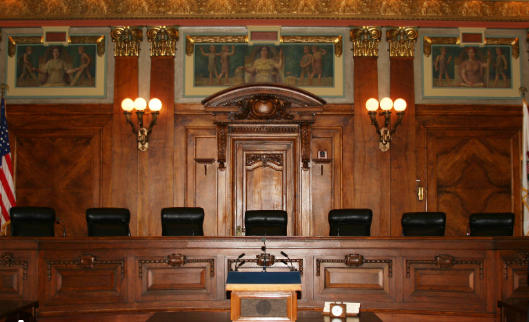
The Illinois Supreme Court is the highest court in the State. Cases are normally channeled to the Supreme Court from the Appellate Court, but in cases where a Circuit Court has imposed a death sentence the law allows direct appeal to the Supreme Court, bypassing the Appellate Court. The Supreme Court can pass rules to allow direct appeals in other cases.
The Supreme Court has original and exclusive jurisdiction in matters that involve legislative redistricting and determining the ability of the Governor to serve in office. The Supreme Court also has discretionary original jurisdiction in cases relating to State revenue and writs of mandamus, prohibition, or habeas corpus.
The Illinois State Supreme Court is comprised of 7 Justices; 3 represent the First Appellate Judicial District (Cook County) and 1 each represents the remaining 4 Appellate Judicial Districts. A majority vote of 4 is required to decide a case.
| Click Image Below to View the Constitution for the Illinois Judicial Court | The Illinois Supreme Court | |
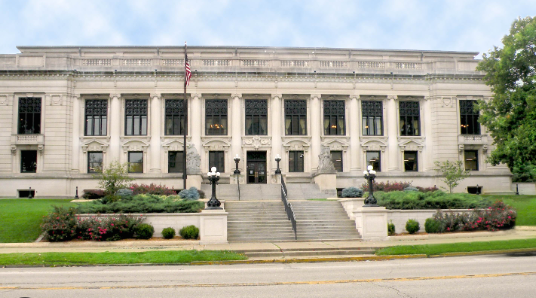
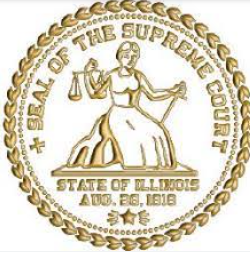
The Illinois Supreme Court is the highest court in the state, located in Springfield. Composed of seven justices, the Court primarily handles cases involving significant state constitutional issues, major legal questions, and appeals from the lower Appellate and Circuit Courts. As the final arbiter of state law, its decisions set binding precedents for all Illinois courts, shaping the interpretation and application of law throughout the state. The Court also has the authority to regulate the practice of law in Illinois, including the admission and discipline of attorneys. Through its rulings, the Illinois Supreme Court plays a crucial role in upholding justice and ensuring the rule of
law within the state.
| |
Click Image Below to Learn More Information About the Illinois
Supreme Court
| |
Selection of Illinois Supreme Court Justices
Election Process, Qualifications, and Terms
|  | |
The selection of members for the Illinois Supreme Court follows a process established by the state's constitution and laws. Here’s an overview of how Illinois Supreme Court justices are selected:
-
Election Process: Illinois Supreme Court justices are elected through a nonpartisan election system. Candidates run for a position on the court in the general election.
-
Judicial Districts: Illinois is divided into five judicial districts, and justices are elected from these districts. Each district elects one justice to the Supreme Court, while the justices from the first district (which includes Cook County) are elected from specific sub-districts.
-
Term Length: Once elected, justices serve a term of 10 years. After completing their term, they may run for retention in a subsequent election. Retention elections require a simple majority of votes to remain on the bench for another term.
-
Vacancies: If a vacancy occurs before the end of a justice's term (due to retirement, resignation, or death), the Illinois Supreme Court has the authority to appoint a temporary justice to fill the position until the next election. This appointed justice serves until a successor is elected during the next general election.
-
Qualifications: To be eligible for the Illinois Supreme Court, a candidate must be a licensed attorney in Illinois, have at least 10 years of legal experience, and be a resident of the district from which they are elected.
This selection process aims to ensure that the justices are accountable to the electorate while maintaining a level of professional qualifications for those serving on the state's highest court.
| |
The Injustice Watch Reports
February 8, 2024
|
Dominance of appointed judges in primary election highlights Illinois Supreme
Court’s power
| |
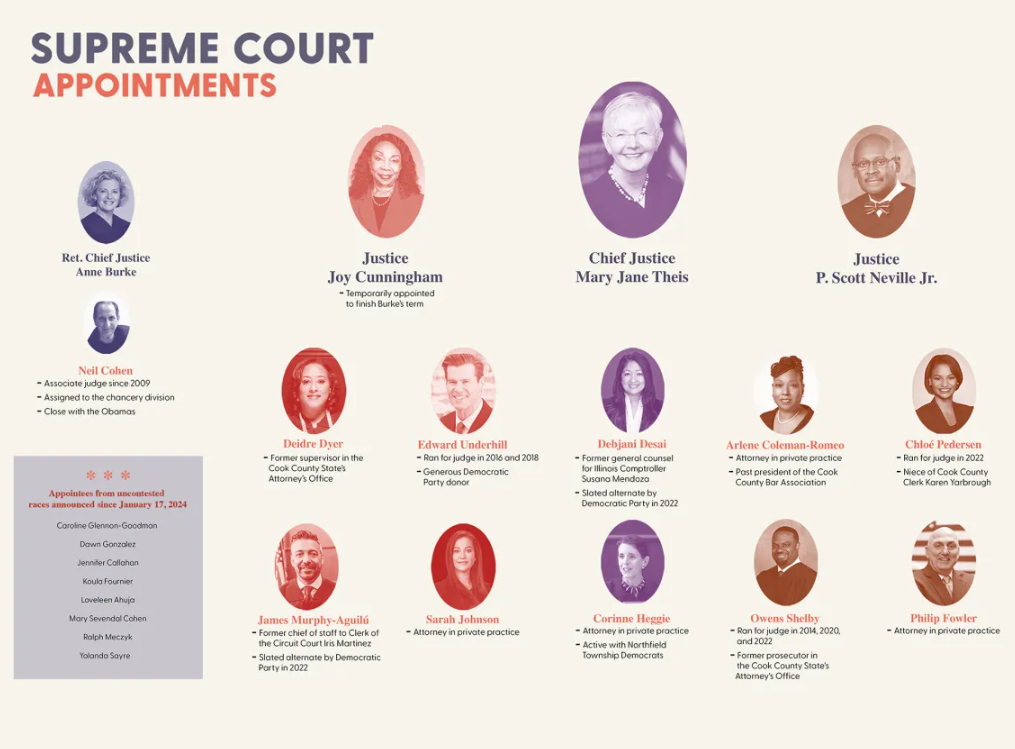
All 10 judicial candidates the Cook County Democratic Party establishment is working to get elected to countywide judicial vacancies this year are already judges.
Most have deep legal experience and high bar ratings, but also the personal and political connections that have come to epitomize Cook County politics.
The candidates slated by the Democrats are running as sitting judges thanks to an often-opaque process in which justices of the Illinois Supreme Court get to fill vacancies on a temporary basis.
| |
Click Image Below to Learn More Information About the Illinois
Supreme Court Justices
| |
The Illinois Supreme Court Justices
Upholding Justice and Law
| |
Interpreting State Law
- Interpret the Illinois Constitution, state statutes, and administrative regulations.
Reviewing Lower Court Decisions
- Review appeals from the Illinois Appellate Courts and circuit courts to ensure correct application of the law.
Establishing Legal Precedents
- Set binding precedents for lower courts, influencing legal interpretation and application throughout the state.
Hearing Original Jurisdiction Cases
- Have original jurisdiction in specific cases, such as revenue, mandamus, and certain election-related disputes.
Supervising the Illinois Court System
- Oversee the operation of the Illinois judicial system, establish court procedures, and address judicial conduct matters.
Participating in Judicial Appointments
- Play a role in appointing judges to fill vacancies in the circuit courts and other judicial positions.
Public Education and Outreach
- Engage in efforts to educate the public about the judicial system, promoting understanding and accessibility to the courts.
| The Illinois Appellate Court | The Illinois Appellate Court serves as the intermediate appellate court in the state, reviewing decisions made by the Circuit Courts. Comprising five judicial districts, each with its own panel of justices, the Appellate Court examines cases to ensure that the law has been applied correctly and that due process has been followed. It handles appeals in both civil and criminal matters, providing a crucial check on the decisions of trial courts. The Court’s rulings can establish important legal precedents within Illinois, although its decisions can be further appealed to the Illinois Supreme Court if significant legal issues are involved. Through its work, the Illinois Appellate Court plays a vital role in maintaining the integrity and consistency of the state’s judicial system. | |
Click Image Below to Learn More Information About the Illinois
Appellate Court
|  | |
The selection of judges for the Illinois Appellate Court involves an election process similar to that of the Illinois Supreme Court. Here’s an overview of how Illinois Appellate Court judges are selected:
-
Election Process: Judges for the Illinois Appellate Court are elected in nonpartisan elections. Candidates run for their positions in the general election.
-
Judicial Districts: The Illinois Appellate Court is divided into five districts. Each district elects its own judges, with the first district (which includes Cook County) having multiple judges elected from sub-districts.
-
Term Length: Appellate Court judges serve a term of 10 years. After completing their term, they may run for retention in a subsequent election. Retention elections require a simple majority of votes for the judges to remain in office for another term.
-
Vacancies: If a vacancy occurs before the end of a judge’s term (due to retirement, resignation, or death), the Illinois Supreme Court appoints a temporary judge to fill the position until the next election. The appointed judge serves until a successor is elected during the next general election.
-
Qualifications: To be eligible for the Illinois Appellate Court, candidates must be licensed attorneys in Illinois, have at least 6 years of legal experience, and be a resident of the district they seek to represent.
This selection process aims to ensure that Appellate Court judges are accountable to the electorate while maintaining a standard of professional qualifications within the judicial system.
| |
Click Image Below to Learn More Information About the Illinois
Appellate Court Justices
| The Illinois Circuit Court | The Illinois Circuit Court is the primary trial court in the state, organized into 23 judicial circuits that serve the diverse legal needs of Illinois residents. These courts handle a wide array of cases, including criminal, civil, family, and probate matters, making them essential for the administration of justice at the local level. Each Circuit Court operates within its respective county or judicial district, with judges overseeing trials, hearings, and other legal proceedings. Circuit Courts are the first point of contact for most legal disputes, providing a forum for the resolution of issues ranging from minor infractions to serious criminal charges. Their decisions can be appealed to the Illinois Appellate Court, reinforcing the importance of these courts in the overall judicial system of Illinois. | |
Click Image Below to Learn More Information About the Illinois
Circuit Court
| |
Selection of Illinois Circuit
Court Judges
Election Process, Terms, and Qualifications
| |
The selection of judges for the Illinois Circuit Court involves a similar election process as that of the Illinois Supreme Court and the Appellate Court. Here’s how Illinois Circuit Court judges are selected:
-
Election Process: Circuit Court judges are elected through nonpartisan elections. Candidates run for their positions in the general election.
-
Judicial Circuits: Illinois is divided into 23 judicial circuits, and each circuit elects its own judges. Some circuits may encompass multiple counties, while others may serve a single county.
-
Term Length: Circuit Court judges serve a term of 6 years. After their term, they may run for retention in a subsequent election. Retention elections require a simple majority of votes for judges to remain in office for another term.
-
Vacancies: If a vacancy occurs before the end of a judge’s term (due to retirement, resignation, or death), the Illinois Supreme Court appoints a temporary judge to fill the position until the next election. The appointed judge serves until a successor is elected during the next general election.
-
Qualifications: To be eligible for the Illinois Circuit Court, candidates must be licensed attorneys in Illinois and have a minimum of 3 years of legal experience. They must also be residents of the circuit in which they seek to serve.
This selection process ensures that Circuit Court judges are accountable to the voters while upholding professional standards within the Illinois judicial system.
| |
Click Image Below to Learn More Information About the Illinois
Chief Circuit Court Justices
| |
Roles and Responsibilities of Illinois Circuit Court Judges
Ensuring Justice and Fairness
|  | |
The roles and responsibilities of Illinois Circuit Court judges include the following:
-
Adjudicating Cases: Circuit Court judges preside over a variety of civil and criminal cases, including family law, probate, personal injury, contract disputes, and felony and misdemeanor offenses.
-
Conducting Trials: They are responsible for conducting trials, managing courtroom proceedings, and ensuring that trials are fair and adhere to legal standards and procedures.
-
Interpreting the Law: Judges interpret state laws, regulations, and the Illinois Constitution, applying legal principles to the cases they hear.
-
Issuing Rulings and Judgments: Circuit Court judges make determinations on motions, issue rulings on evidence, and render final judgments in cases.
-
Managing Court Dockets: They oversee the scheduling and management of cases, ensuring that court proceedings progress in a timely manner.
-
Sentencing: In criminal cases, judges determine appropriate sentences for convicted individuals, considering statutory guidelines and the specifics of each case.
-
Supervising Court Personnel: Circuit Court judges may supervise court staff, including clerks and bailiffs, ensuring the efficient operation of the court.
-
Resolving Disputes: Judges may facilitate settlements between parties, encourage mediation, and work to resolve disputes outside of trial when possible.
-
Ensuring Justice: Circuit Court judges are tasked with upholding the rule of law, protecting the rights of individuals, and ensuring that justice is served within their jurisdiction.
These responsibilities highlight the crucial role that Circuit Court judges play in the Illinois judicial system, as they ensure the fair administration of justice and the effective resolution of legal disputes.
| |
Illinois 2024 Elections
A Guide to Choosing Judges on the Ballot
| As Illinois voters prepare for the 2024 elections, understanding the judges on the ballot is crucial for making informed choices. This election cycle will feature candidates for various judicial positions, including the Illinois Supreme Court, Appellate Court, and Circuit Court. Voters should familiarize themselves with each candidate's qualifications, judicial philosophy, and past rulings to assess their suitability for the role. Engaging with nonpartisan resources and educational materials can aid in this process, ensuring that voters contribute to a fair and impartial judiciary that upholds the rule of law in Illinois. | |
NBC 5 Chicago Reports
October 17, 2024
| What judges will be on your ballot? What to know and how to research them | |
While most of the focus in the Illinois election is on the presidency and state and federal representation, dozens of judges will be on the ballot as well.
In Illinois, voters are tasked with deciding on judges at three different levels: the Supreme Court, appellate courts and circuit courts.
In some areas, multiple judges may be on the ballot in multiple different races, and it can be overwhelming to parse through the information to make an informed decision in the voting booth.
Fortunately, there are a variety of resources voters can use to inform themselves ahead of the November election, and NBC Chicago also has compiled information on which offices will be on your ballot, and what each of your votes means.
| |
Balletopedia Reports
October 17, 2024
| State judicial elections, 2024 | |
A total of 305 appellate court seats are up for election in 2024. The seats include:
- 82 supreme court seats.
- 223 intermediate appellate court seats.
Ballotpedia provides coverage of supreme court and intermediate appellate court elections, as well as local trial court elections for judges within the 100 largest cities in the United States as measured by population.
In addition, in the U.S. Territories, four judges will be on the ballot in retention elections in 2024. One judge on the Guam Supreme Court, two on the Guam Superior Court, and one on the Northern Mariana Islands Superior Court must stand for retention to remain on the bench.
On this page, you will find:
| |
Injustice Watch Reports
October 8, 2024
| Your guide to the November 2024 Cook County judicial elections | |
Judges are powerful officials whose choices on the bench touch many aspects of our lives, from traffic tickets to divorces, lawsuits, evictions, and criminal cases. They can take or restore someone’s freedom, enforce or overturn state laws, and perpetuate or correct injustices. That's why Injustice Watch created this guide to Cook County’s judicial elections
on Nov. 5, 2024.
This year, 75 circuit court judges and two appellate judges are running for reelection in Cook County. Voters will be asked whether each judge should be retained for another term. A judge must receive 60% “yes” votes to keep their seat.
| |
Debating the Judiciary
Should Judges Be Appointed or Elected?
| The debate over whether judges should be appointed or elected is a critical discussion in the realm of judicial reform and governance. Proponents of judicial appointment argue that it enhances the quality and impartiality of the judiciary by allowing qualified individuals to be selected based on merit rather than political affiliation or public opinion. Conversely, supporters of judicial elections emphasize the importance of accountability and public trust, asserting that elected judges are more directly answerable to the electorate. This discussion raises essential questions about the balance between independence and accountability in the judicial system and the best means to ensure a fair and effective judiciary that serves the interests of justice and the public. | |
The National Judicial College Reports
June 17, 2017
| The age-old question: Should judges be appointed or elected? Here’s what you said | |
It’s nearly as polarizing as asking basketball fans who’s better: Michel Jordan or LeBron James?; asking the table which toppings to order on the pizza; or asking science fiction fans to choose between Star Wars
and Star Trek.
This month’s Question of the Month asked judges if they felt judicial positions should be filled by appointment or election. More than a thousand judges voted, and 63 percent indicated they preferred appointments (they had to choose one or the other). More than 330 added comments, which varied widely and were often intricate and passionate.
The comments made it abundantly clear that judges care deeply about the independence of the judiciary and the integrity of the process that puts them on the bench. But they disagreed about which method—appointment or election—best serves judicial independence.
| |
The University of Chicago Reports
February 20, 2024
|
Democracy Reform Primer Series
Elected vs. Appointed Judges
| |
Key Takeaways from the Research
- The choice of judicial selection method entails important tradeoffs between values associated with independence and impartiality on the one hand, and democratic accountability on the other.
- Scholars have documented numerous differences in legal outcomes between states with elected and appointed supreme courts, and have shown that these courts exhibit greater responsiveness to public opinion when justices stand in partisan competitive elections.
- Scholars studying the behavior of trial court judges have exploited random case assignment and within-state variation in selection methods and electoral pressures to make credible causal claims about how electoral incentives affect judicial behavior. Several studies have demonstrated that electoral pressures tend to make judges more punitive, and that this increased punitiveness may be borne disproportionately by minority defendants.
| |
The Fund for Modern Courts Reports | Why We Support an Appointed System |  | |
In fact, many criticize the very concept of merit selection as fundamentally flawed and elitist. Given the fact that we adhere mostly to a representative form of government, such a reaction is understandable. It is also a misconception.
Some opponents of merit selection argue that it removes from the people the right to elect their judicial representatives. This language begs a very fundamental question: Under our system of government, are judges truly “representatives,” in the sense that members of the legislative and executive branches are? The legislative branch is certainly designed to represent specific constituencies; to a lesser degree, the executive performs a similar function. But judges, who must apply impartially the laws created by the other two branches—laws that affect opposing constituencies—are expected to remain above the fray. Canons of judicial ethics require them to remain objective, free of political influences, and unfettered by financial concerns.
| Should judges be appointed or elected to ensure a fair and effective judiciary? | |
Please select the option that most accurately reflects your opinion and vote accordingly | |
Click Below to View Today's Job Highlights | |
 | |
Paralegal
Date: Oct 15, 2024
Location: Chicago, IL, US, 60605
Job Requisition ID: 42073
Agency : Department of Children and Family Services
Title: Paralegal Assistant - Chicago
Closing Date/Time: 11/14/2024
Salary: Anticipated Starting Salary: $5,600 monthly step 4;
Full Range $4,766 - $6,632
Job Type: Salaried
County: Cook
Number of Vacancies: 1
Click Here to Apply
Central Region Manager
Date: Oct 25, 2024
Location: Springfield, IL, US, 62701
Job Requisition ID: 42138
Agency: Department of Commerce and Economic Opportunity
Posting ID: 42138Class Title: PUBLIC SERVICE ADMINISTRATOR - 37015
Skill Option: General Administration/Business
Marketing/Labor/Personnel
Bilingual Option: None
Closing Date/Time: 11/12/2024
Salary: $7,966 - $9,800 Anticipated Starting Monthly Salary
Job Type: Salaried
Category: Full Time
County: Sangamon
Number of Vacancies: 1
Click Here to Apply
Application Information Systems Analyst I
Date: Oct 28, 2024
Location: Springfield, IL, US, 62702Job Requisition ID: 42495
Agency: Department of Innovation and Technology
Class Title: INFORMATION SYSTEMS ANALYST I - 21165
Skill Option: Application Services - Information Technology
Bilingual Option: None
Posting Date: 10/28/2024
Closing Date/Time: 11/12/2024
Salary: Anticipated Starting Salary $6,688/monthly;
Full Range $6,688-$9,745/monthly
Job Type: Salaried
Category: Full Time
County: Sangamon
Number of Vacancies: 1
Click Here to Apply
Fire Prevention Inspector I
Date: Oct 28, 2024Location: Springfield, IL, US, 62703
Job Requisition ID: 42036
Agency: Office of the State Fire Marshal
Class Title: FIRE PREVENTION INSPECTOR I - 15316
Skill Option: None
Bilingual Option: None
Closing Date/Time: 11/13/2024
Salary: Anticipated Starting Salary $5,165 Monthly:
Full Range $5,165 - $7,088 Monthly
Job Type: Salaried
Category: Full Time
County: McLean
Number of Vacancies: 1
Click Here to Apply
| Click Below to View Job Highlights From Previous Dates | | | | |