
Comparing Key Features of House and Senate Farm Bill Proposals
House bill favors production ag; Senate bill puts lid on food stamp/TFP, conservation and CCC program changes
The House on Friday released text and other information regarding its 942-page farm bill, the Farm, Food, and National Security Act of 2024. Link to text of the bill. An updated title-by-title summary can be found at this link. Link to our Special Report on the measure.
The Senate has not released text of its measure, only some summary details of what some charge is a “hodge-podge” of some 100 different bills from farm-state lawmakers.
Of note: We keep stressing that one of the keys in this debate will be official scoring of different aspects of the two bills. Those will show the House approach maintains the $1.51 trillion ten-year farm bill baseline, while the Senate appears to go over it by at least $5 billion and perhaps around $20 billion or more. So, the House approach is budget neutral, and the Senate is not. The official scoring will also show how the two chambers got to their total spending levels and how much funding is being made for various titles. That will answer the equity questions Democrats usually like to talk about on other issues, but not the farm bill.
The House Ag Committee on Thursday (May 23) will mark up the House farm bill. House Ag Chair GT Thompson (R-Pa.) told us via Agri-Talk on Friday that his panel will have the votes to clear the panel, but he has yet to receive any firm Democratic member commitments to vote for the House approach. But Thompson said those voting against it “do so at their own peril,” with many hailing from rural districts where a no vote could prove a political liability this fall.
House floor debate strategy, Thompson said, depends on what occurs during this Thursday’s markup session. Thompson said a panel vote along party lines would be “unfortunate,” but added, “we’ll still find a pathway to the floor.”
The real reason Thompson wants to get a markup session vote this week is that come June, new farm bill scoring forecasts will come from the Congressional Budget Office (CBO) and a new baseline would take additional time to work through, with likely different forecasts and implications for farm bill spending.
Democratic complaints in the House and Senate are unified and deal with House GOP efforts to reform the Thrifty Food Plan (TFP), but not take any existing funding from the program, nor for the SNAP/food stamp program. Thompson’s bill would restrict what factors can be considered in future updates of the TFP, which is used to set benefits under the Supplemental Nutrition Assistance Program (SNAP). A 2021 update conducted by the Biden administration resulted in a more than a 20% benefit (over $250 billion) increase, drawing criticism from Republicans over the methodology used and the result.
TFP changes would net $27 billion, House aides said. Some $12 billion to $16 billion would be “reinvested” in nutrition programs, while the balance would be shifted to other programs under the purview of the House Ag Subcommittee on Nutrition, Foreign Agriculture, and Horticulture, including the Market Access Program (MAP) and Foreign Market Development (FMD) programs that are set to see funding doubled.
Aides say the money freed up from the TFP should not be viewed as a cut or as savings given the CBO projections assume future updates to TFP along the lines of the exceptionally large changes brought by the 2021 revamp. They also said the changes would lock in current nutrition program benefit levels set by TFP, preventing a future administration from conducting an update that results in lower ones.
Democrats are also in ideological lockstep against taking off any guardrails they insist on relative to conservation program spending — the House farm bill would remove climate guardrails from $13 billion in Inflation Reduction Act (IRA/Climate Bill) conservation funding. House Republicans note the bill removes the IRA’s climate sideboards to restore the locally led nature of conservation programs and provide flexibility for States — even if the conservation practices involved are not deemed “climate-smart.” Senate Ag Chair Debbie Stabenow (D-Mich.) has proposed keeping the funds focused on climate and within the four programs originally defined under the IRA: the Conservation Stewardship Program (CSP), Environmental Quality Incentive Program (EQIP), Agricultural Conservation Easement Program (ACEP), and Regional Conservation Partnership Program (RCPP). Republican aides said Thompson wants “to make sure that these programs remain flexible and can answer whatever natural resource problems are occurring.” They said casting a wider net with the funds will put more focus on the quality of projects — climate-smart or otherwise — rather than using incentives to boost the volume of projects using the more limited set of climate-smart practices. House aides emphasized that shifting the IRA funds into the bill would result in a permanently higher conservation funding baseline. “This is a long-term investment that increases conservation spending in Title II (Conservation) by about 25% in perpetuity,” they said.
CCC issue. Dems are also opposed to the House GOP push to suspend USDA’s Section 5 spending authority under the Commodity Credit Corporation (CCC), a $30 billion borrowing authority fund (that Congress replenishes each year) that was used to pay for farmer aid during the Trump trade war with China, and billions of dollars USDA Secretary Tom Vilsack tapped out of CCC for various spending, including over $3 billion for “climate-smart” ag funding.
Some media say the House Ag bill has a significant funding gap, but sources say that is not the case. The issue: The CBO estimates that the suspension of Section 5 authority would save $8 billion over 10 years, but that is considerably less than the $53 billion needed to cover the cost of changes to commodity programs and even more for changes to crop insurance. Efforts to get CBO to alter their low-ball forecast led to Thompson asking and getting help from House Budget Chairman Jodey Arrington (R-Texas) who directly called CBO leadership about the matter. Says one farm bill contact: “Arrington has the power to do directive scorekeeping. Some farm bill analysts apparently do not understand this. I know that Arrington and staff are sure that everything is defensible. After Trump and Biden, does anyone believe that the Ag secretary will only use his discretion to spend less than $1 billion per year of CCC funds? If so, I’ve got a bridge to sell you.”
House aides said they expect the cost of the Title I moves to be scored at between $50 billion and $53 billion, and when combined with crop insurance updates in Title II, the price tag rises to around $90 billion.
Democratic leadership in meetings have been lobbying against House farm bill proposals. House Minority Leader Hakeem Jeffries (D-N.Y.) and Stabenow reportedly have urged House Ag Democrats to vote against the farm bill during this Thursday’s markup session.
Stabenow made her views known about the House farm bill in a statement, offering some hope but also listing major differences:
“I’ve had several conversations with Chairman Thompson encouraging him to get his ideas on paper so that we can move this process forward. I’m glad his Committee released the Food, Farm, and National Security Act, and it appears that our visions for the 2024 Farm Bill have a lot in common.
“I remain deeply concerned that his proposal will split the broad, bipartisan coalition that has always been the foundation of a successful Farm Bill. It makes significant cuts to the family safety net that millions of Americans rely on, and it blocks USDA’s ability to provide real time assistance to farmers through the CCC to address emerging challenges. Even with these shortsighted cuts, it is unclear to me how they will pay for their proposal.
“Democrats have made clear from the beginning that we will not walk away from our commitment to the most vulnerable among us or from our farmers battling the effects of the climate crisis every day. The Food, Farm, and National Security Act clearly crosses those bright red lines and turns back the clock on decades of progress for farmers and families.
“The only path forward is holding together our broad coalition of farmers, hunger and nutrition advocates, rural communities, conservationists, and the climate community. That has always been how we ensure that our country’s farmers, families, workers, and rural communities have the certainty of a bipartisan, five-year farm bill.”
House Ag ranking member hammers House farm bill approach. “The discussion draft released by Chairman Thompson confirms my worst fears: House Republicans plan to pay for the farm bill by taking food out of the mouths of America’s hungry children, restricting farmers from receiving the climate-smart conservation funding they so desperately need, and barring the USDA from providing financial assistance to farmers in times of crisis,” said House Ag Ranking Member David Scott (D-Ga.). “The funding proposal that the Chairman has put forward does a disservice to American agriculture because it doesn’t provide a path forward to getting a bill passed on the House Floor,” Scott concluded.
Of note: Scott’s comments regarding a floor vote seems to acknowledge the measure will clear the Ag Committee, but a warning that a failure to secure Democratic support could be insurmountable on the House floor.
We will have more analysis of the Thursday House Ag markup vote later this week.
COMPARING THE TWO FARM BILLS. The following is not an exhaustive review of both House and Senate farm bills, but a digest of some key issues in various titles. Check the House and Senate Ag Committee web sites for additional information.
KEY FARM BILL SAFETY NET PROGRAMS:
HOUSE FARM BILL:
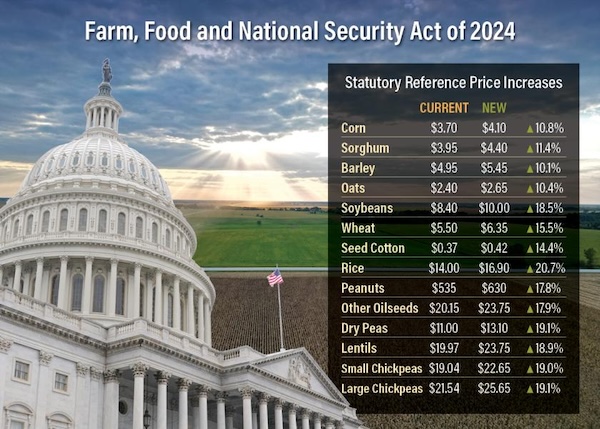
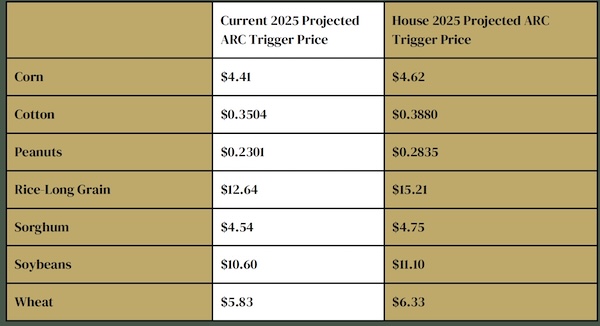
- Higher Reference Prices: Increases reference prices for all eligible commodities under PLC/ARC between 10% and just over 20%, enhancing the safety net for producers. Also, by increasing the statutory reference prices, the maximum effective reference price is also increased.
- Annual Election Maintained: Keeps the annual choice between PLC/ARC programs.
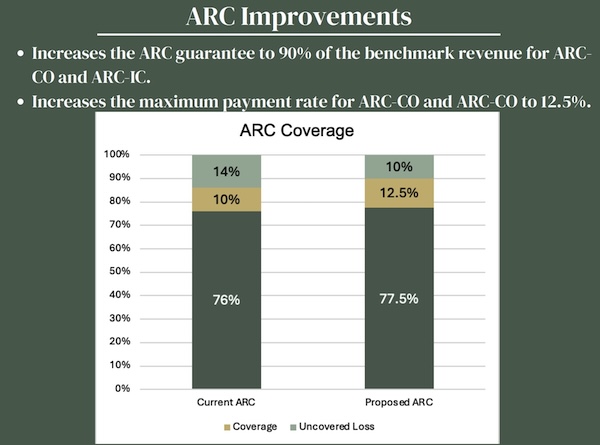
- Increased ARC Coverage: Boosts ARC coverage from 86% to 90% of benchmark revenue and raises the payment band from 10% to 12.5%.
Source: Combest-Sell Associates
Source: Combest-Sell Associates
- Expanded Base Acres: Provides an opportunity to add new base acres to farms that have no base, or that have been planting in excess of existing base acres. This provision does not modify or impact existing base acres. Expands base acres based on 2019-2023 plantings exceeding current base, including non-covered crops up to 15% of total acres. Includes provisions to establish payment yields on the additional base acres.
- Higher Pay Limits: 1) Ends the disparate treatment of pass-through entities and 2) Raises pay limits for producers that get 75% or more of their income from farming and eligible for a payment limit of $155,000 (up from $125,000) that is indexed to inflation, and including LLCs and other farm structures.
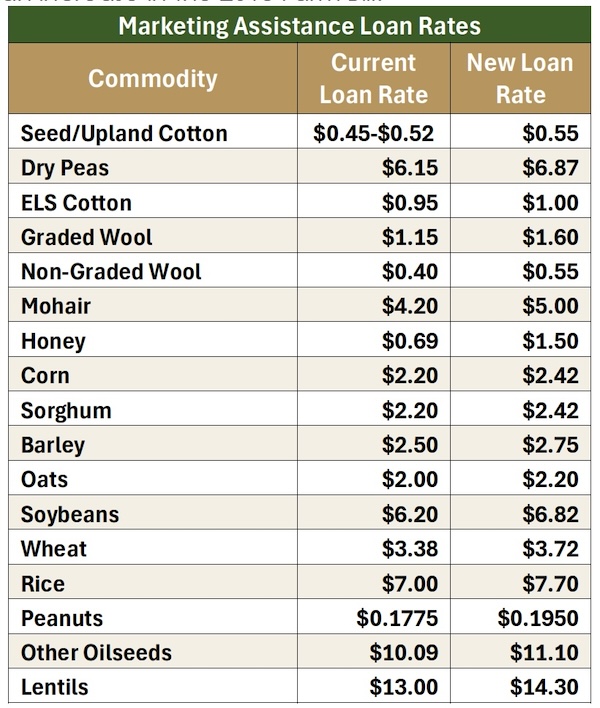
- Increased Loan Rates: Increases loan rates with more flexible repayment options and allows redemptions during government shutdowns. Provides for a more substantial increase in loan rates for commodities that did not receive an increase in the 2018 Farm Bill.
- Textile Mill Assistance: Enhances Economic Adjustment Assistance for Textile Mills. To account for persistent inflation and support the domestic textile industry, increases the payment rate from 3 cents to 5 cents under the program.
- Sugar Policy Improvements: Increases loan rates for sugar beets and cane, and makes other policy improvements. The House farm bill would increase the national average loan rate to 24.00 cents for raw cane sugar; sugar beets: 136.55% of the loan rate per pound of raw cane sugar. The 2018 Farm Bill increased the national average loan rate to 19.75 cents per pound for raw cane sugar and 25.38 cents per pound for refined beet sugar. These rates are adjusted regionally to reflect marketing cost differentials.
- Makes improvements in U.S. dairy policy: Including restoration of the “higher-of” formula in calculating Class I fluid milk price and forward pricing authority. Increases cap on Tier I for Dairy Margin Coverage (DMC) program to 6 million pounds. Provides opportunity to update production history for DMC. Provides a 25% discount on DMC premiums for operations that enroll in coverage for the life of the 2024 Farm Bill. Mandates biennial cost surveys to ensure make allowances accurately reflect the cost of manufacturing dairy products. Ensures the Dairy Forward Pricing Program does not expire.
- Enhances standing disaster programs: Including the Livestock Indemnity Program (LIP), the Tree Assistance Program (TAP), and authorizes any future ad hoc assistance to be delivered via block grants to states. Increases payment rate of LIP to 100% of fair market value of the animal if the loss is caused by an attack by a federally protected species. Allows for a supplemental indemnity payment for the loss of unborn livestock if the loss of the gestating animal qualifies for assistance. Ensures farming operations are eligible for assistance under LIP, ELAP, TAP, Livestock Forage Production Program (LFP), and the Noninsured Crop Disaster Assistance Program (NAP) if the operation derives 75% or more of its income from farming, ranching, or forestry.
SENATE FARM BILL:
- Reference Price Increase: 5% increase in reference prices for crops not benefiting from the 2018 Farm Bill escalator, including rice, peanuts, and seed cotton.
- Base Acres for Underserved Producers: Opportunity to establish new or additional base acres if recent planting exceeded base for underserved producers.
- Prohibition on Payments: No commodity payments on land owned by persons/entities with an AGI of $700,000 or greater, affecting tenants who cash rent or sharecrop the land; lowers AGI eligibility for commodity programs from $900,000 to $700,000.
- ARC/PLC Election: Maintenance of the annual election between ARC/PLC.
- PLC Payment Band: Introduction of a 20% payment band on PLC, similar to the 10% payment band on ARC, which is maintained.
- ARC Coverage Increase: Increase in ARC coverage from 86% to 88%.
- Marketing Loan Rates: Authorization to increase marketing loan rates by up to 110% of their current levels based on production costs.
- Textile Mill Assistance: Increases in Economic Adjustment Assistance for Textile Mills.
- Sugar Policy Improvements: Undisclosed increase to sugar loan rates and other policy improvements.
- Dairy Pricing Authority: Extension of forward pricing authority for dairy.
- Livestock Disaster Programs: Improvements to livestock disaster programs (LIP, TAP, ELAP) and authorization for a standing disaster program, pending appropriations.
- Noninsured Crop Disaster Assistance: Modifications including eliminating AGI testing and increasing pay limits.
CROP INSURANCE:
HOUSE FARM BILL:
- Increases premium support under crop insurance for beginning producers and veteran producers for a 10-year period.
- Encourages R&D on improved risk management tools for specialty crops.
- Increases SCO and WFRP coverage to 90%, with 80% premium support under SCO.
- Requires development of certain new policies to meet the risk management needs of producers.
- Addresses private sector delivery concerns by re-establishing an annual inflation adjustment for A&O, eliminating the current flaw that harms specialty crop A&O, and by ensuring states with high losses the A&O necessary to accurately adjust the higher volume of claims in a timely fashion.
SENATE FARM BILL:
- Increases premium support for beginning producers and veteran producers akin to the House farm bill.
- Increases premium support for SCO at 80% and increases coverage level to 88%.
- Includes performance-based discounts for climate and other environmental practices.
- Expands native sod regulations from Prairie Pothole Region to the entire country.
- Increases support for Whole Farm and Micro Farm insurance policies to serve small and underserved producers. Provides frequent review of rating and actuarial soundness of policies.
- Prioritizes underserved producers and crops for new policy development.
- Codifies the cease-and-desist order of RMA relative to cancelation of policies, etc.
- Allows FCIC to bypass private sector delivery to deliver certain crop insurance policies.
- Overhauls A&O, including providing a total A&O on all A&O, and
- Provides for a seat at the table for agent groups in any new SRA renegotiation.
CONSERVATION:
HOUSE FARM BILL:
- Summary: Maintains and extends the new investment in the Conservation Title made under the so-called Inflation Reduction Act (IRA/Climate Bill) by making the new funding baseline permanent rather than subject to a Sept. 30, 2031, expiration as is currently the case. The funds may also be used for all conservation purposes rather than just climate initiatives, so the funds are available to all producers and program efforts are locally led.
- CRP: 1) Maintains current 27-million-acre CRP acreage cap and requires state allocations be based on historical allocations. 2) Incentivizes enrollment of marginal lands by basing rental rates on land capability classification and paying high rental rates for land capability classes III through VII than other eligible lands. Class I and II soils would receive up to 85% of the county’s average rental rate, while class III soils would receive 100% of the county’s average rental rate. Classes IV through VII would go up to 155%. 3) Increases payment limitation from $50,000 to $125,000 per year.
SENATE FARM BILL:
- Summary: (1) Maintains IRA dollars in permanent budget baseline; (2) permanently authorizes conservation programs (i.e., the programs would not require a farm bill to continue but would be treated effectively akin to SNAP); the Commodity Title would be the only farm bill title with significant mandatory funding that would require reauthorization every 5 years or so in a farm bill; (3) continues IRA-mandated climate strictures on funding and reorients RCCP, EQIP, and CSP to focus more on climate; (4) new mandatory spending —some believe about $13 billion above and beyond IRA funding — would occur with regard to CRP, ACEP, and CSP, and the bill also proposes to codify the $5 cover crop program where there is a state match.
- CRP: Gradually increases CRP acreage cap from current 27 million acres to 29 million acres.
TRADE PROMOTION & FOOD AID:
HOUSE FARM BILL:
- Trade promotion: Doubles funding for the Foreign Market Development and Market Access Program.
- U.S. Food Aid Prioritization:
* Emphasizes U.S. food donations over cash in international food aid programs.
* Requires at least 50% of aid to be actual U.S. food.
* Enhances USDA's role in delivering U.S. food aid programs.
* Streamlines the procurement process for U.S. food to address immediate crises, ensuring effectiveness of U.S. food aid.
SENATE FARM BILL:
- (1) Preserves current funding levels for MAP and FMD, (2) Preserves U.S. commodity donations as an option under U.S. food aid programs, generally at current levels.
FOOD STAMPS/SNAP, TFP AND DIETARY GUIDELINES:
HOUSE FARM BILL:
- Maintains current nutrition title programs, increasing benefits in certain cases.
- Reforms the Thrifty Food Plan (TFP) update such that the provision may not be used by the Ag Secretary in the future to increase SNAP benefits in the manner that it was done in August of 2021 (i.e., an increase of more than $250 billion) but also prevents the provision from being used to decrease benefits of that magnitude. Apart from removing the possibility of huge increases or huge cuts in the future, as well as a few instances where there are increase, SNAP benefits remain unchanged.
- Reforms Dietary Guidelines for Americans process to remove the politics and emphasize good science and transparency.
SENATE FARM BILL:
- Maintains current TFP process; and
- Increases funding of an estimated nearly $8 billion for SNAP, TEFAP, Gus Schumacher Nutrition Incentive Program, Senior Farmers Market Nutrition Program, Healthy Food Financing Initiative, and Community Food Projects.
ANIMAL DISEASE PREPAREDNESS AND RESPONSE EFFORTS, MODIFIES EFFORTS SUCH AS CALIFORNIA’S PROPOSITION 12:
HOUSE FARM BILL:
- Invests new funds in programs designed to protect livestock and poultry from catastrophic animal diseases.
- Clarifies that states and local governments cannot impose, directly or indirectly, as a condition for sale or consumption, a condition or standard on the production of covered livestock unless the livestock is physically located within such state or local government.
* Provides clarity to national markets by ensuring producers must only comply with applicable production standards imposed by their own state or local government.
* Protects producers from having to comply with a patchwork of state-by-state regulations.
* Protects the rights of states and local governments to establish standards as they deem necessary, but only for those raising covered livestock within their own borders.
* Only covers production (excluding domestic animals raised for the primary purpose of egg production), and does not include the movement, harvesting, or further processing of covered livestock.
- Requires USDA to report on its preparedness to support livestock producers and poultry growers facing economic losses due to animal disaster outbreaks.
SENATE FARM BILL:
- New mandatory funding for historically underserved producers
- New funding for local and regional food systems
- New funding for programs that address animal diseases
- Authorizes additional climate initiatives, including climate hubs
- Creates a USDA Special Investigator for Competition
- No comparable language regarding Prop 12, etc., that is in House farm bill
OWNERSHIP AND OPERATING LOANS:
HOUSE FARM BILL:
- Updates and increases limits under guaranteed and direct operating and ownership loans to reflect the modern costs of planting, growing, and harvesting a crop and raising livestock.
- Includes provisions to ease securing credit for beginning producers.
- Increases loan limits for the Farm Service Agency
* Guaranteed farm ownership loan limits would increase from $2.24 million to $3.5 million
* Guaranteed operating loan limits would increase to $3 million
* FSA direct ownership would go from $600,000 to $850,000
* FDA direct operating loans would go from $400,000 to $750,000
* Eligibility requirements for FSA direct real estate loans would be lowered to one year of experience
SENATE FARM BILL:
- Updates guaranteed and direct operating and ownership loans on par with the House proposal except guaranteed operating loans are lower under the Senate version.
- Seeks to ease securing credit for beginning producers.
BROADBAND:
HOUSE FARM BILL:
- Strengthens rural broadband by working to connect those areas still without service while improving those areas with service that is poor by requiring higher standards of providers in exchange for financial assistance.
SENATE FARM BILL:
- Strengthens rural broadband and increases funding for the Rural Partnerships and Prosperity and Investments in Rural Infrastructure programs.
AGRICULTURAL RESEARCH:
HOUSE FARM BILL:
- Invests mandatory funding in agricultural research facilities and other research title initiatives.
- Invests mandatory funding in specialty crop research initiatives.
- Invests mandatory funding in 1890s land grants.
- Establishes a commission to improve the accuracy and efficiency of NASS data collection and reporting.
SENATE FARM BILL:
- Increases funding for the Specialty Crop Research Initiative, 1890s land grants, agricultural research facilities, and Foundation for Food and Agriculture Research.
RENEWABLE ENERGY PROGRAMS:
HOUSE FARM BILL:
- Renews and makes improvements to renewable energy programs, including the Rural Energy for America Program.
SENATE FARM BILL:
- Includes extensions and modifications of the suite of energy title programs but the Senate summary does not provide great detail. The Senate bill does increase funding for the Biorefinery, Renewable Chemical and Biobased Product Assistance Program, Biobased Markets, and the Bio Preferred Program.
HORTICULTURE:
HOUSE FARM BILL:
- Renews and makes improvements to horticulture programs, including new investment in the Specialty Crop Block Grant program, the Plant Pest and Disease Management and Disaster Prevention Program, Organics, etc.
SENATE FARM BILL:
- Includes renewal of programs but also funding increases for Local Food Purchase Assistance Cooperative Agreement Program, Specialty Crop Block Grant Program, Organics, etc.