For Immediate Release

November 25, 2025

Yap State Completes Dengue Early Warning System Outbreak Readiness and Response Training

Colonia, Yap, FSM - Responding to a request from the Yap State Department of Health Services (DHS), the Pacific Island Health Officers’ Association (PIHOA) Secretariat conducted a Dengue Early Warning System (EWS) Outbreak and Readiness and Response Workshop in Colonia, Yap State in the Federated States of Micronesia (FSM) on October 15-21, 2025.


Fourteen participants from Yap State DHS and the Environmental Protection Agency (EPA) received training from the PIHOA Secretariat’s vector management team, Dr. Limb Hapairai, Regional Medical Entomologist, and Technical Consultants, Ms. Cynthia King, Ms. Jacquelyn Lefagoyal, and Ms. Rosanna Yoon Rabago.


The EWS Workshop objectives were to: 

  1. Strengthen Yap State’s data for decision making for vector management operations;
  2. Update Yap DHS’ vector management Standard Operating Procedures (SOPs) for Environmental Health and Safety (EHS); and
  3. Train participants on pesticide application for outbreak readiness and response.


Participants learned about dengue transmission and symptoms and the importance of having a dengue EWS that can forecast potential dengue outbreaks based on Yap’s weather, mosquito habitats and abundance, and human health and distribution data. To break the transmission cycle of dengue early, epidemiological and entomological thresholds were established to facilitate early action by the EHS team. 

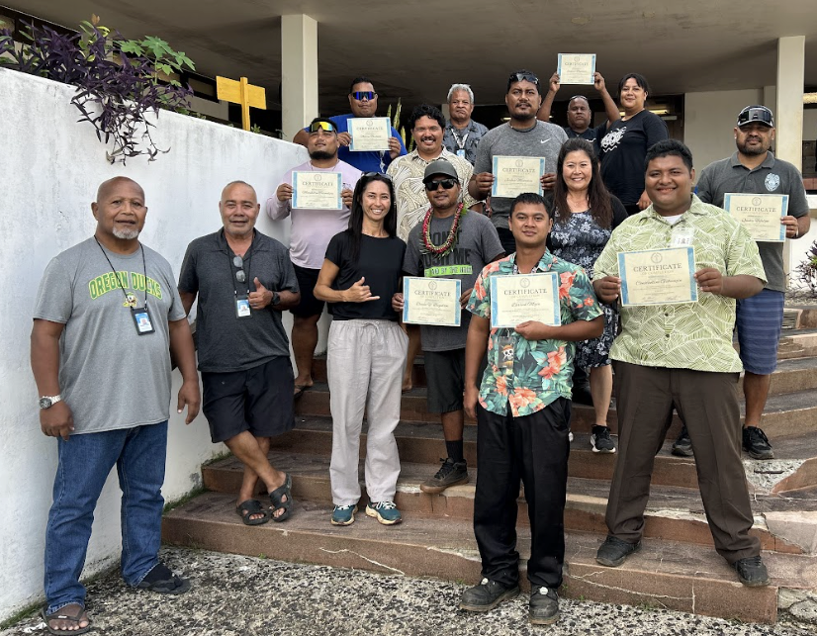
PIHOA Secretariat’s vector team pictured with Yap State DHS and Environmental Protection Agency leadership and staff who attended the Dengue Early Warning System Outbreak Readiness and Response Workshop from October 15-21, 2025 in Colonia, Yap, FSM.

Charlene Laamtal, Public Health and Hospital Emergency Preparedness Coordinator, of Yap DHS, stated, "Having the early warning system, the SOPs, the activities and actions aligned really makes work so much easier. Now we can do surveillance, find out what's going on in the region and look at weather patterns and with all this information, we can plan accordingly. We can train our staff, conduct inventory of our equipment and supplies, and make sure that we have enough and implement activities at the right time to prepare, respond and mitigate the effects of an outbreak."


To foster collective action on source reduction, community/partner engagements and risk communication were streamlined. As a result of a cooperative effort, a total of 14 SOPs were updated based on best management practices, thereby ensuring consistency, quality, and safety across Yap State’s vector management program.


Peter Malmai, Public Health Division Chief, of Yap DHS said, “I now feel confident that our staff and their stakeholder partners will be able to carry out their roles effectively and confidently, following the established SOPs. Without such guidance, managing dengue outbreaks and other infectious disease outbreaks in the future would be much more challenging. I would also like to extend our deep appreciation for all the equipment repairs Dr. Limb attended to, which prevented the non-functional equipment from being out of service. This opportunity truly exemplifies the strong relationship and commitment between him as a PIHOA representative and our department.”


Field activities were also conducted with participants actively learning about conducting household inspections for mosquito breeding sites, larval surveys, mosquito surveillance using BG and oviposit traps, and pesticide control applications for indoor and outdoor targeted residual sprays.  


Maxshelton Talimelipiy, Coordinator of EHS, Yap DHS stated, “We have long waited for this training. This will make sure that we are better prepared for any future mosquito disease outbreak like dengue, that may affect our communities or islands. I knew the training will be helpful and am grateful for the opportunities for us as we serve the people or the islands of Yap state.”


The PIHOA Secretariat will continue to work closely with the Yap DHS leadership, staff, and local partners to improve outbreak readiness by strengthening capacity through the implementation of Yap’s Dengue EWS.

This workshop was co-funded by the U.S. Department of State via PIHOA’s Cooperative Agreement (SFOP0007198: Modeling predictive models from the Federated States of Micronesia (FSM), the Republic of the Marshall Islands (RMI), and the Republic of Palau (Palau) Toward a Regional Early Warning System Against Dengue), and a sub-award contract to PIHOA from the Puerto Rico Vector Control Unit. The contents are those of the author(s) and do not necessarily represent the official views of, nor an endorsement, by CDC/HHS, or the U.S. Government.


###


About the Pacific Islands Health Officers' Association


PIHOA's mission is to improve the health and well-being of the USAPIs by providing, through consensus, a unified, credible voice on health issues of regional significance. Established in 1986, PIHOA is governed by and represents the collective interests of the USAPI health leadership from American Samoa, Federated States of Micronesia, Guam, Republic of the Marshall Islands, and the Republic of Palau. 


PIHOA’s Secretariat, comprised of executive, administrative, and technical staff and consultants, provides support to the USAPI health agencies and leadership in the following priority areas: health workforce development; epidemiology and surveillance; health systems performance improvement; laboratory services; regional health leadership and policy advocacy; Pacific health security; and, partnership engagement and coordination. PIHOA has two offices in Honolulu, Hawai’i, and Hagåtña, Guam.


Media Contact


Billie Hiraishi

Communications Officer

billieh@pihoa.org


Limb Hapairai

Regional Medical Entomologist

limbh@pihoa.org