June 8, 2022

Top stories

■ 'Clusterf--k': Inside The Washington Post’s social media meltdown (Vanity Fair) / Washington Post boss sends another memo condemning 'colleagues attacking colleagues' (Daily Beast) / 'Per another source at WaPo: Reporters are getting even more frustrated with the infighting because now when they call sources, the sources want to talk at length about all the drama unfolding inside their newsroom.’ (Oliver Darcy) / 'As a source that has been called by WaPo reporters, I can confirm this.’ (Chris Hartline) / 'Wapo newsroom still tense today as Breanna Muir replies all to Sally Buzbee’s note from yesterday. “Does our company social media policy not apply to Lisa Rein for telling Felicia Sonmez to stop on Twitter? In all honesty, her comment doesn’t really sound collegial to me”.' (Alex Thompson) / ' #TheView panel weighs in on the Twitter war that erupted at the outlet, which began when a male reporter retweeted a joke that a female co-worker found offensive.' (The View) / A full breakdown of the ongoing drama at the Washington Post (Mediaite) 


■ NPR names Juana Summers co-host of 'All Things Considered’ (NPR) / ‘I always think that more can be done to recruit and retain and to cultivate women, people of color and people from marginalized communities’ (New York Times) 


■ The Chris Licht era at CNN is taking shape (Vanity Fair) / CNN’s Interim Digital Chief will leave (Variety) 


■ Don't look to Watergate and Army-McCarthy for guidance on January 6 hearings (CNN) / Before Jan. 6 hearings, most-watched political TV was Watergate probe (Washington Post) / TV news shakes up schedules to cover Jan. 6 committee report on Capitol attack (Variety) / Jan. 6 Committee, Twitter fight over access to internal company Slacks (Rolling Stone) 


■ US senators consider former VOA director to head US Agency for Global Media (VOA)


■ NBC News anchor Savannah Guthrie interviewed Johnny Depp's legal team moments after she disclosed her husband had served as a consultant for them (Insider) 


■ Is it OK for police to pose as journalists? (Poynter) / Troy police pose as TV news crew to end hostage situation (Times Union) / Earlier: The reporter who impersonated a cop and the sheriff who helped him (The Paper.)  


■ Gannett is scuttling daily editorial pages at its regional papers (Poynter)


■ The New York Times' new editor will run its biggest newsroom ever — and most outspoken (NPR)  / '3 HUGE gold stars to David Folkenflik for finding Joe Kahn - next exec editor NYT - in C-SPAN Video Library. … Here's the 9-4-1986 clip: "I hope to try my hand at print journalism — I'm not sure that's what I want to do for a career" ' (Howard Mortman) 


■ A new way to choose your next book (New York Times)


Press freedom


■ In first, U.S Secretary of State Blinken calls for independent investigation into Abu Akleh's killing (The Times of Israel) / Secretary Blinken panel discussion at the Media Summit of Americas Session: 'A Commitment to Journalistic Freedom' (US Mission to the Organization of American States) 


■ Is a fight over Amazon fishing rights behind the disappearance of British reporter Dom Phillips? (Daily Beast) / Threats, then guns: A journalist and an expert vanish in the Amazon (New York Times) 


■ In India, the war on journalists is all-encompassing (New Lines Magazine)

“Don’t wait till you have done all the reporting or all the research before you write. Instead, go to your keyboard and very quickly and uncritically write — without reference to your notes. Write what you think you already know. It’s not even a first draft. It’s a zero draft. It will teach you what you still need to learn, saving you time and focusing your reporting.”


-- Roy Peter Clark, senior scholar at Poynter, “How a bigshot writing coach beats writer’s block”

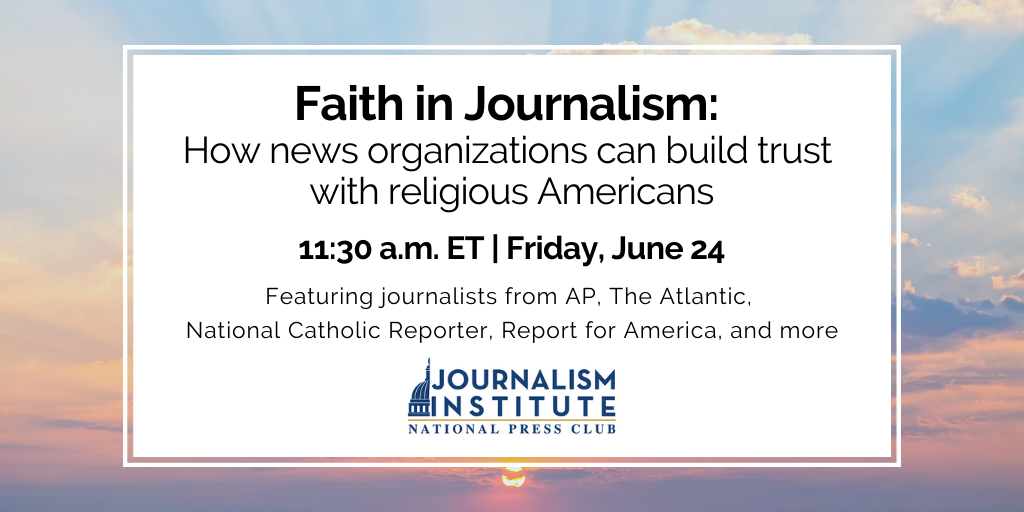
Faith in Journalism Programs Twitter.png

More than 75 percent of Americans say religion is an important part of their lives. How do these Americans see themselves and their faith reflected in news coverage? What does reporting on faith get right and wrong? How do editors and reporters think about who they’re reaching with these stories and who they’ve lost? And how might this coverage build trust in journalism among communities who have been historically misrepresented?


Registration is open for this program, which will take place on Friday, June 24 at 11:30 a.m. ET. Participants will learn:


  • How journalists of faith navigate challenges from inside their newsrooms and from inside their faith communities
  • Whose faith is centered in coverage and whose is marginalized, mischaracterized, or misunderstood
  • Which best practices can help extend our community’s understanding of itself


Panelists include:


The conversation will be moderated by Julie Moos, the Institute’s Executive Director, and is supported by an operational grant from the Deseret Management Corporation.

Manager's Minute: I want to diversify my sources, where do I start?

Jill Geisler, Bill Plante Chair in Leadership & Media Integrity at Loyola University Chicago and Freedom Forum Fellow in Women’s Leadership, on why leaders should expect and demand diverse sources in stories, and how to begin.

Manager's Minute: I want to diversify my sources, where do I start?

Read next: You’re covering racial justice; are you heeding diverse voices?


Get more career advice: Read Jill's columns | Watch Manager's Minute videos

Resources

This newsletter is written & edited by the National Press Club Journalism Institute staff: Beth Francesco, Holly Butcher Grant, and Julie Moos. Send us your questions and suggestions for topics to cover.

Get this from a friend? Subscribe, and view the archives.

If you value this newsletter, consider supporting The Latest with a tax-deductible, recurring gift to the Institute: Even $5 a month will help fund the technology and time it takes to provide this important service.  
Facebook  Twitter  Linkedin  Youtube  

The National Press Club Journalism Institute promotes an engaged global citizenry through an independent and free press, and equips journalists with skills and standards to inform the public in ways that inspire a more representative democracy. As the non-profit affiliate of the National Press Club, the Institute powers journalism in the public interest.