e-Newsletter | April 15, 2022
|
|
Upcoming Events - Click on title to register |
|
Thursday, April 28, 2022, 7:00 PM - In person at the Museum of Old Newbury
|
|
Are you passionate about local history? And comfortable speaking to small groups? We are looking for a few additional docents to give tours at the museum once the doors open on June 2. We'll be meeting on May 2nd and in the coming months. Please contact the office to find out more - call Kristen at 978-462-2681 or email kristen@newburyhistory.org.
|
|
The Tracy and Prince Collections
by Susan C. S. Edwards
|
|
As Americans, we tend to boast about our history and the famous characters who have, in some way, touched our lives and made us feel special. There is pride of community, pride of place. Much of this we can trace to the nostalgia for the past, exemplified during the Colonial Revival. Stories abound about George Washington and the many places in which he spent the night, but we can truly say that Newburyport is one of those places. |
|
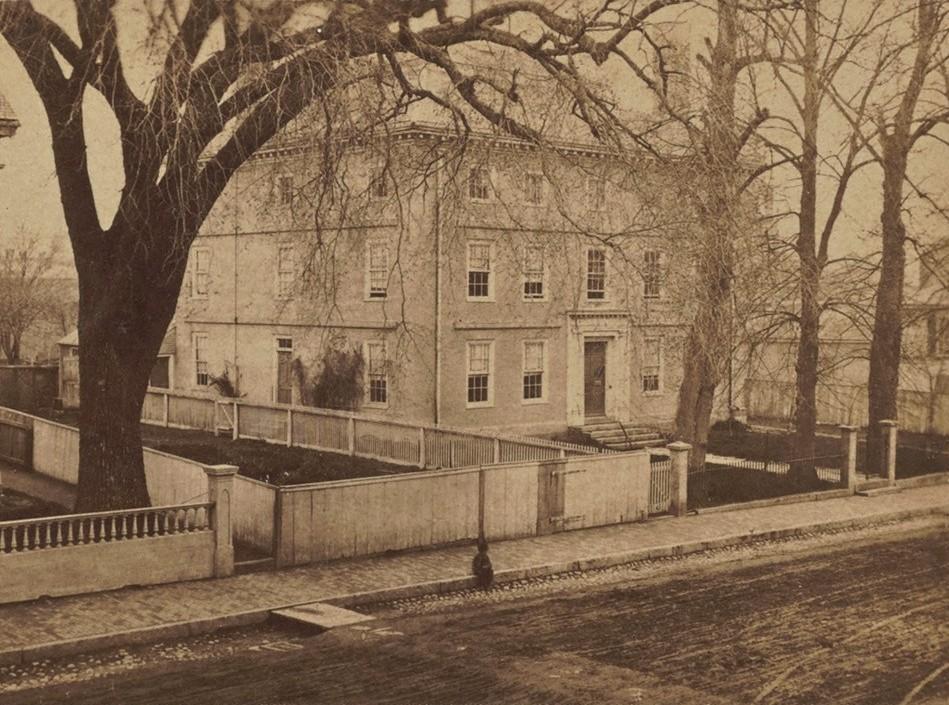
The Tracy Mansion, now part of the Newburyport Public Library |
|
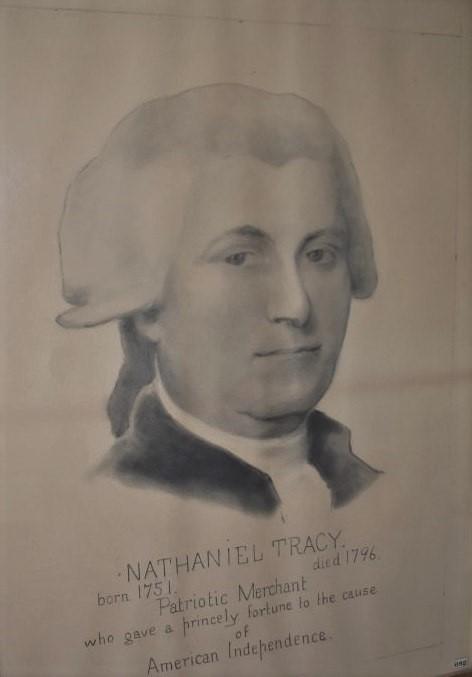
Although Newburyport has many fine homes spanning the Georgian and Federal periods, perhaps none is more written about than the Tracy Mansion standing proud on State Street since 1771. Built by Patrick Tracy, one of Newburyport's prominent merchants, for his eldest son Nathaniel, the dwelling was also home to two other prestigious Newburyport men. When Nathaniel Tracy had severe financial reverses after the American Revolution and lost most of his wealth in supporting the patriot cause, the house was sold with many of its furnishings to Jonathan Jackson who had married Tracy's sister, Hannah. Jackson and Tracy joined with Tracy's brother, John, to create the importing firm of Jackson, Tracy and Tracy. |
|
Left: Portrait of Nathaniel Tracy (1751-1796), Late 19th century. Laura Coombs Hills.
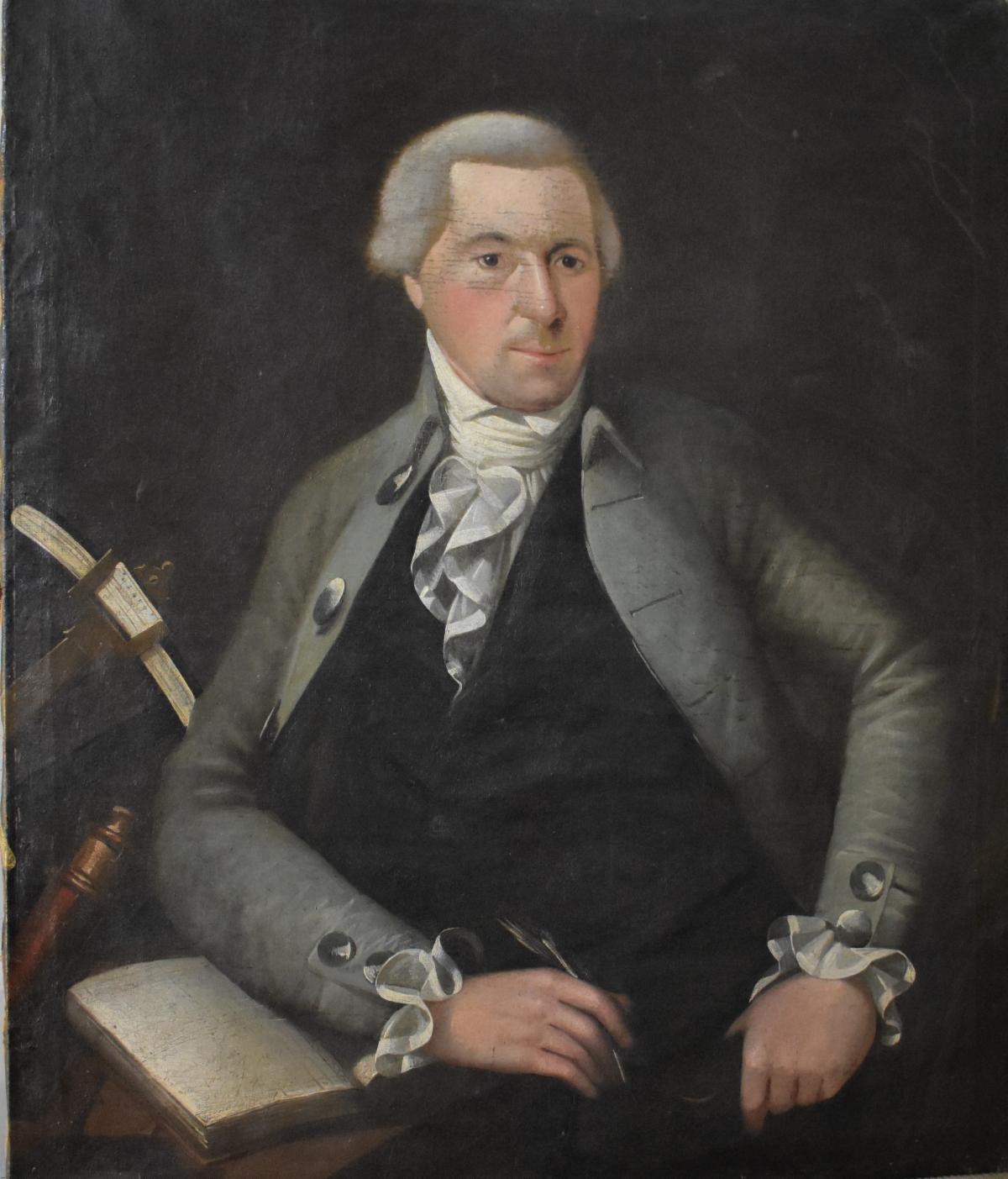
Right: Portrait of John Tracy 1753-1815, Oil on canvas, c. 1785, Attributed to Christian Gullager.
|
|
John Tracy was the youngest son of merchant Patrick Tracy and lived at 203 High St in another mansion house purchased by his father from John Lowell. Like his brother Nathaniel, he was an ardent patriot and lost much of his wealth after the war.
And now to the Washington connection. On September 2nd 1775, General George Washington wrote the following:
To Nathaniel Tracey Esq. Newbury Port
By his Excellency George Washington Esq
Commander in Chief of the Army of the United States
You are hereby authorized and impowered to take up for the Service of the sd. Colonies so many Vessels as shall be necessary for the transporting a Body of Troops to be detached from this Army on a secret Expedition: Freight of such Vessels to be paid in such a Manner and at such a Rate as is indorsed hereon: And in Case of Loss or Damage to such Vessels or any of them such Loss or Damage to be compensated by the Publick according to an Estimation to be made before the sd. Vessels proceed in the above Service.
Head Quarters, September 2, 1775. G. Washington
(from the Papers of George Washington, Vol. 1)
Tracy's vessels were to take Benedict Arnold's troops to the Kennebec River, whence they began overland through Maine on the March to Quebec. Before the departure from Newbury, the officers of the expedition dined at Tracy's home on the evening of September 17, 1775.
Writing from Fort Western, September 28th, Arnold expressed his gratitude “for the many favors received from” Mr. Nathaniel Tracey, at Newburyport, and desires his best respects to “Mrs. Tracey, your brother, and Mr. Jackson.”
However, it wasn't until October of 1789 that Washington, then President, enjoyed the hospitality of the Tracy family. With much fanfare, he arrived in Newburyport from Ipswich and spent the night with the family.
|
|
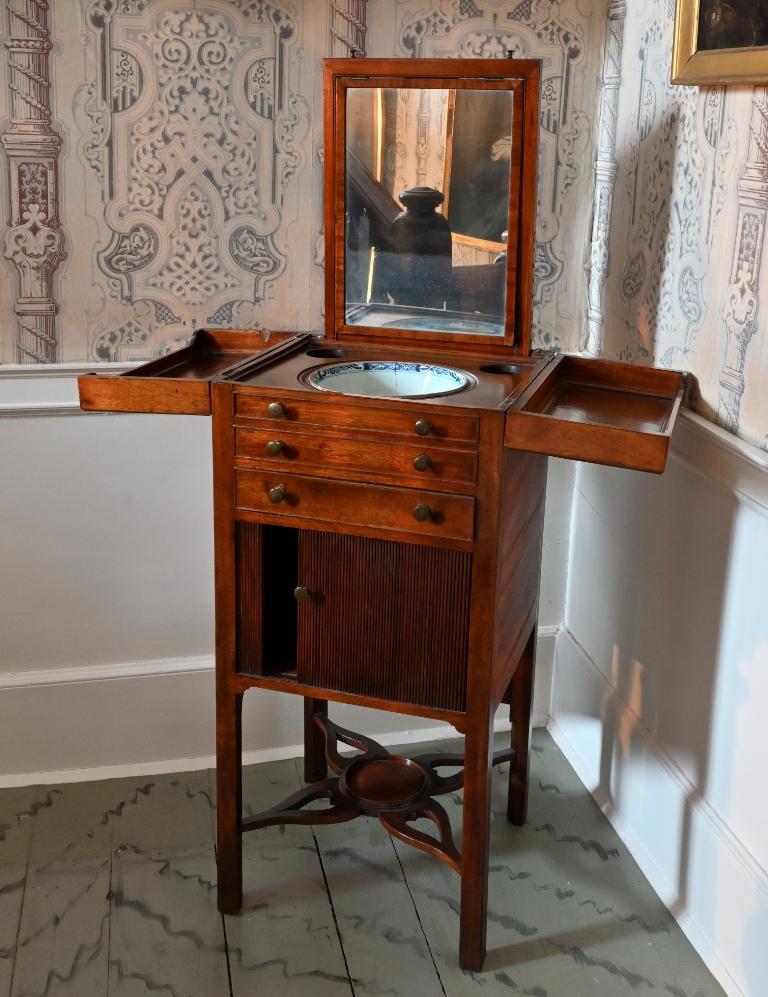
Left: Hepplewhite style washstand; Mahogany, chestnut and pine; probably made in England, c. 1780. It was owned by Nathaniel Tracy, one of three washstands listed in Prince's estate inventory. Found in refined 18th century homes, washstands reflected a sense of gentility. Sarah Emery records that she saw her first washstand in Newburyport in 1796. This washstand is said to have been used by President George Washington during his stay at the Tracy home in October 1789 as well as by Lafayette during his visit to the Prince home in 1824. It was purchased by the Cross family at the sale of the Prince house furnishings and given to the museum by Charles Cross in 1922. Photo by Bob Watts.
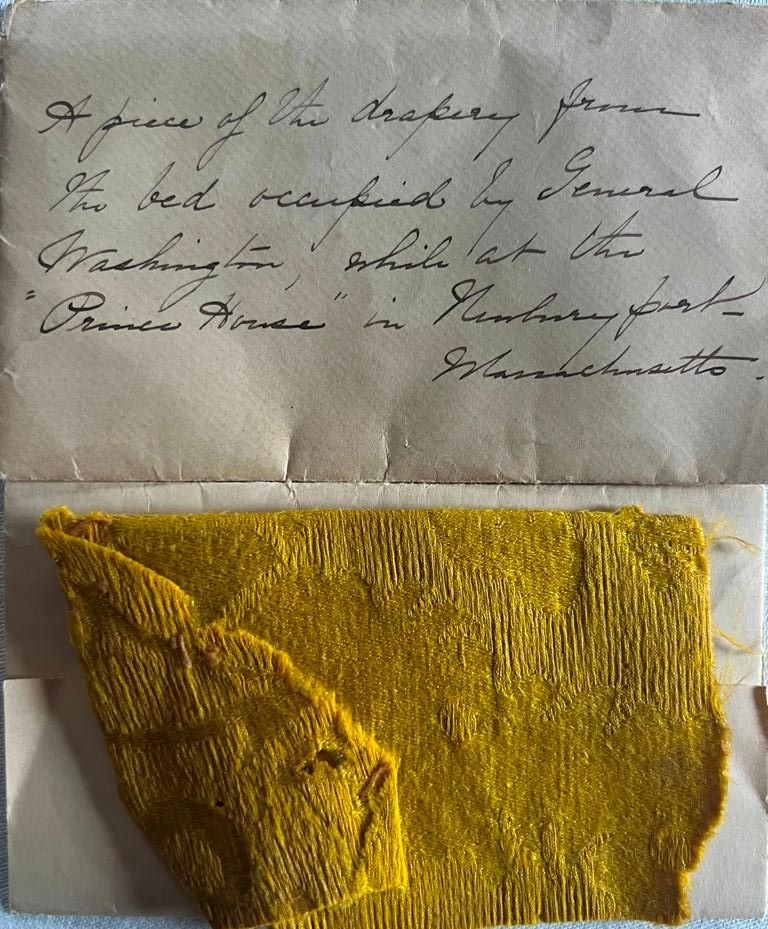
Right: A fragment of yellow damask from the bed hangings in the chamber where President George Washington and the Marquis de Lafayette stayed during their visits to the Tracy and Prince home in 1789 and 1824, respectively. The fabric was handed down in the Stephen family and is currently on loan to the museum from Lee Stephen.
|
|
By 1800, the Nathaniel Tracy home and furnishings were sold to James Prince who owned it until his death in 1830. Prince paid $9,000 for the property which included over an acre of formal gardens and orchards. Prince was an affluent merchant and banker who ranked twelfth in the community for his wealth when he purchased the property. He also served as a warden of St. Paul's Church, a selectman, and Collector of Customs for the port from 1821 to 1829. |
|
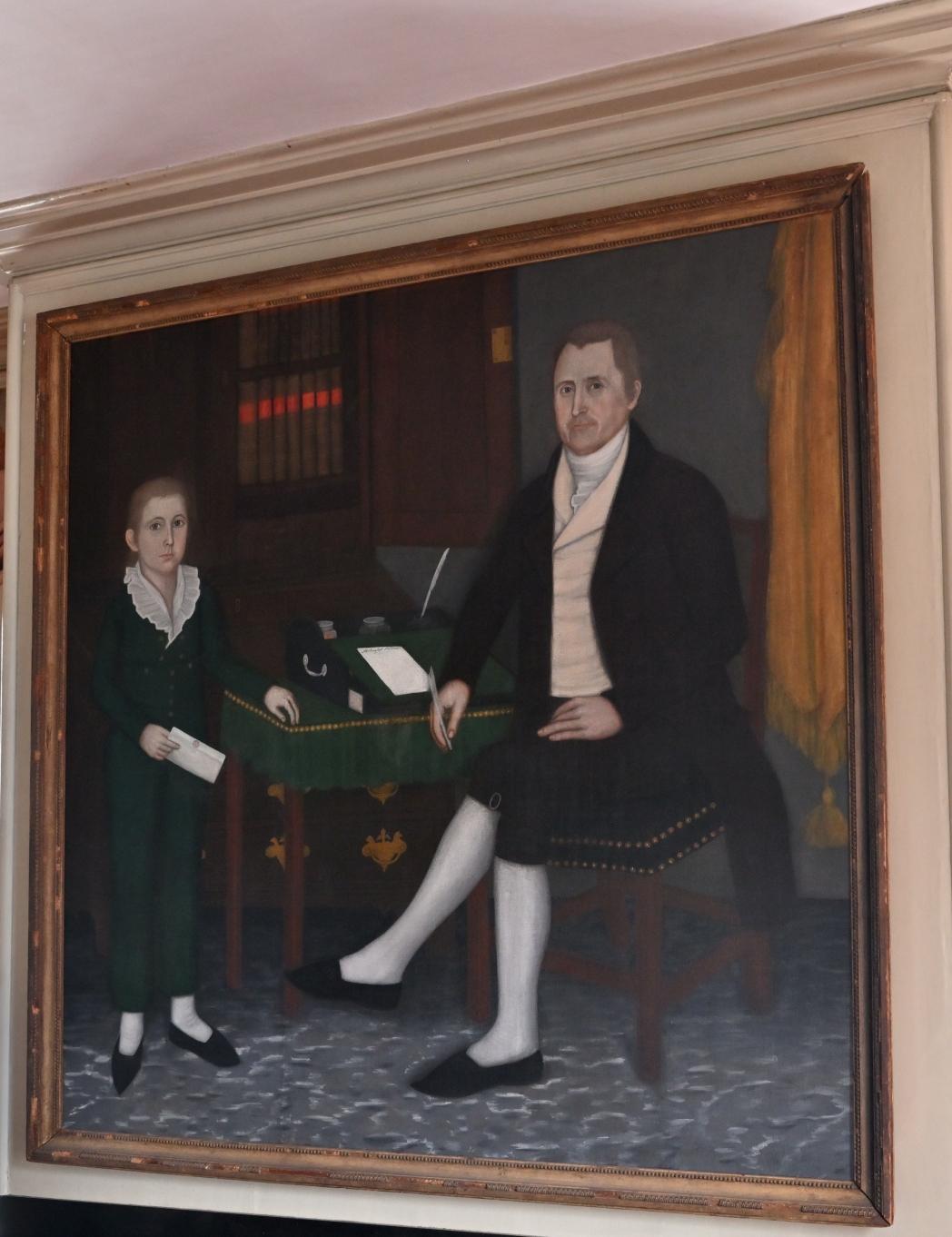
Portrait of James Prince and his son William Henry, Oil on canvas, 1801, by John Brewster, Jr. The portrait descended in the family of William Henry Prince and subsequently to his nephew-in-law, William Andrews Currier, who gave it and two others to the museum in 1897. Brewster documented the fine interior of the home including a Chippendale desk and bookcase strikingly similar to one in the museum's collections. Photo by Bob Watts. |
|
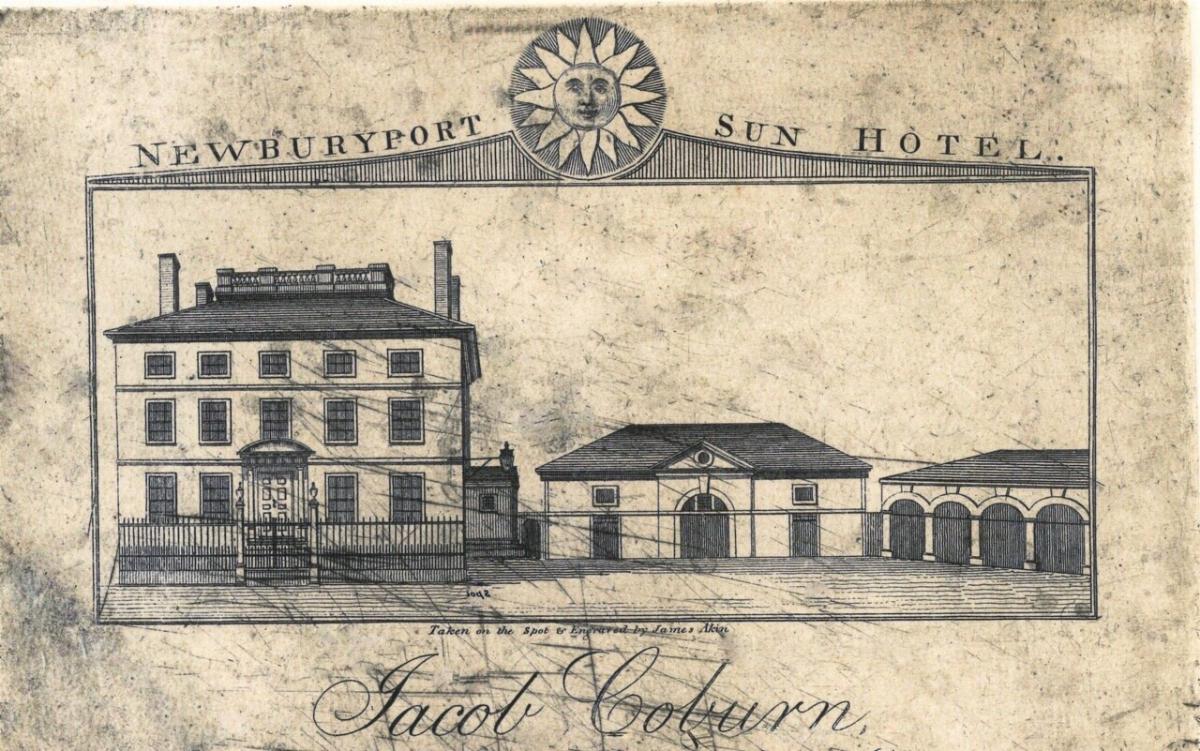
Prince also faced financial difficulties and, for a short period, he rented the house to James Coburn who operated it as the Sun Hotel. |
|
Tracy/Prince home showing the three bay carriage house and stables, Copper plate engraving, 1807, James Akin. |
|
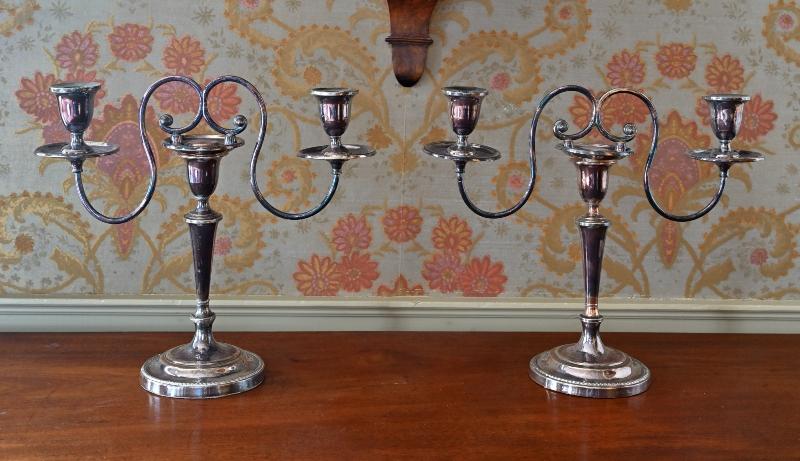
Prince imported Chippendale side chairs and a matching sofa from England as well as a pair of Sheffield candelabra, and he entertained numerous prominent guests during his residency. The most illustrious of these was the General Marquis de Lafayette during his 1824 visit to Newburyport. He was escorted to the Prince home by parade and dined and spent the night, reputedly in the same room as Washington had 35 years before. |
|
Candelabra, Silver fused over copper, c. 1805, Sheffield or Birmingham, England
These may well have been on the dining table the evening that General Lafayette dined. They were handed down in the Prince, Doane, Newell, and Jones families of Newburyport, Boston, and Eastport, Maine and given to the museum by Mrs. Philip H. Jones. Photo by Bob Watts.
|
|
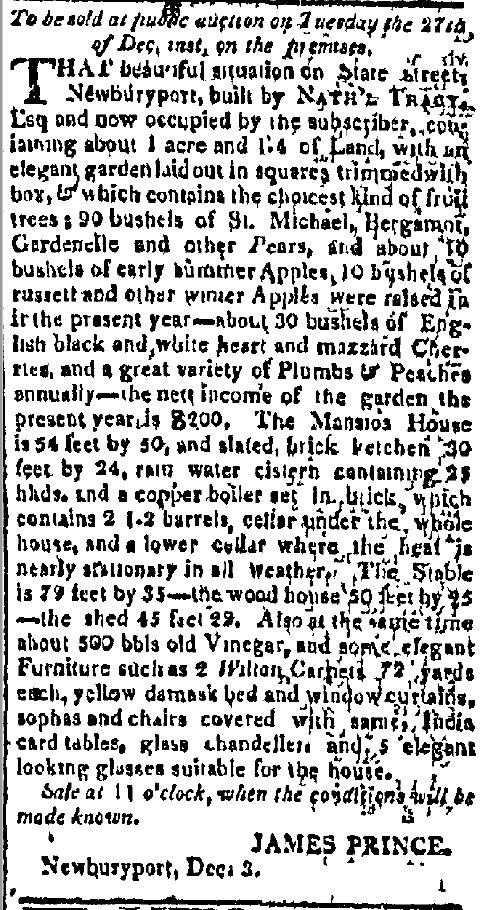
In 1814, James Prince offered the house and many of its furnishings for sale at auction. The house did not sell, although he sold some of the furnishings. His household inventory as well as his will that runs to five pages indicate his substantial affluence. A few of the items include: 74 chairs, 17 tables, 11 looking glasses, 8 bedsteads and 9 beds, 3 washstands, chests, writing desks, a knife case, 9 candlesticks, multiple pieces of silver hollowware and flatware, hundreds of books, and 100 casks of vinegar. |
|
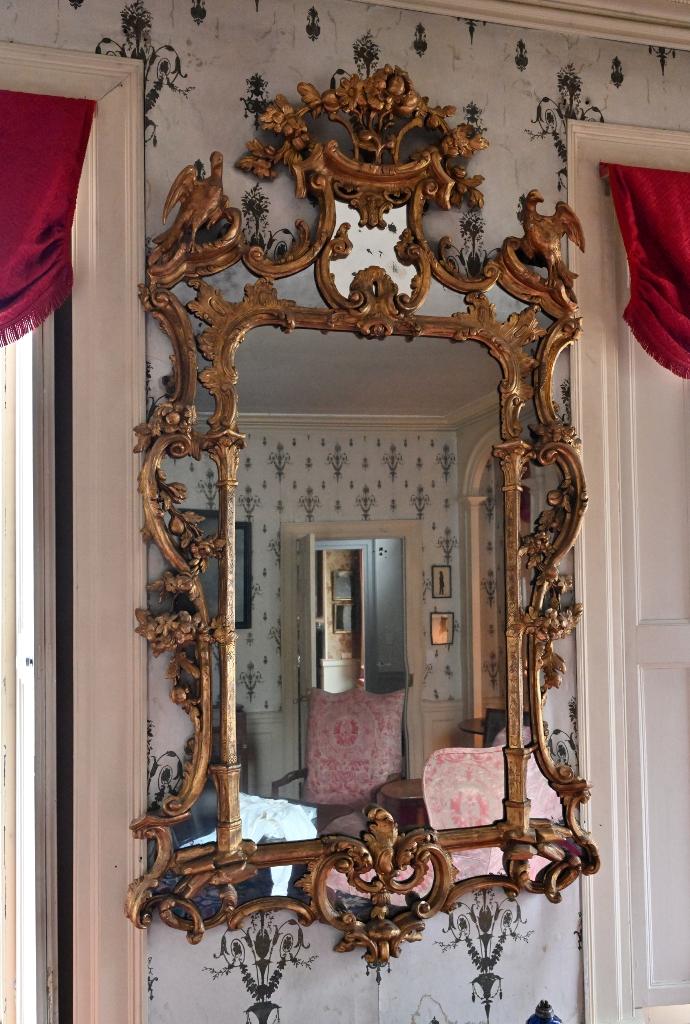
Left: Essex Register December 1814
Right: Looking Glass; Wood, gilt, glass, and silvering; c. 1775, probably made in England. This Rococo Chippendale style looking glass was one of the original pieces from the Tracy home that was sold by James Prince in 1814 and purchased by Mrs. John P. Brown of Newburyport. It was handed down in the Brown, Cushing, and Goodhue families. It was subsequently given to the museum by F. Abbott Goodhue, L. Cushing Goodhue, and John C. Feuss. Photo by Bob Watts.
|
|
In 1830, another auction was held at the Prince home after James Prince's death, the proceeds of which were divided among his children. Fortunately, for the museum, many of these elegant household and personal objects have found their way into our collections. We hope you will come and visit the Cushing House when it opens in June and see these Newburyport treasures and hear their stories.
Author's note: The museum owes a debt of gratitude to Peter Benes for his wonderful scholarship in the production of Old Town and the Waterside (1986), from which much of this information has been taken.
|
|
The 1950 Census
...a quick look
|
|
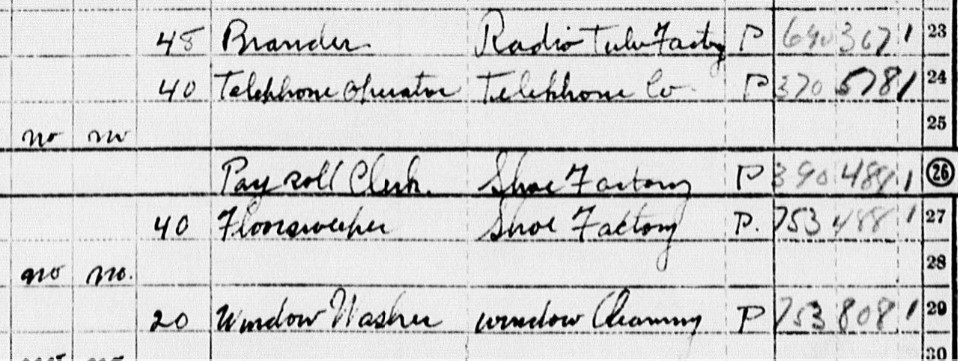
A few of the occupations listed by 1950 residents of Fair St and Orange St.: brander at a radio tube factory, payroll clerk at a shoe factory, telephone operator, and floor sweeper. |
|
On April 1, the 1950 U.S. Census was released. It’s completely free and available from the U.S. government at archives.gov. Indexing isn’t complete yet– if you know the name of a family and their location in 1950, you can try to find them, but you might strike out. So at this stage, many people are scanning the census by location. The census was broken down by state and county and then by Enumeration District (referred to as ED going forward). For a city like Newburyport, each ED was drawn to have no more than 1000 people in it. In rural areas, EDs might have a up to 1400 people.
If you’re looking for West Newbury, the EDs is 5-477 for the western part, 5-478 for the eastern part, and 5-479 for the boys’ orphanage at the current Page School. For Newbury & Byfield, look in ED 5-289 (east of Rt. 1 and Plum Island) and 5-290 (west of Rt. 1). The first page you’ll see is a card summarizing the number of people in the ED. Scroll ahead to see the pages detailing the residents. Newburyport was still full of manufacturing at the time – occupations are listed on the right hand side.
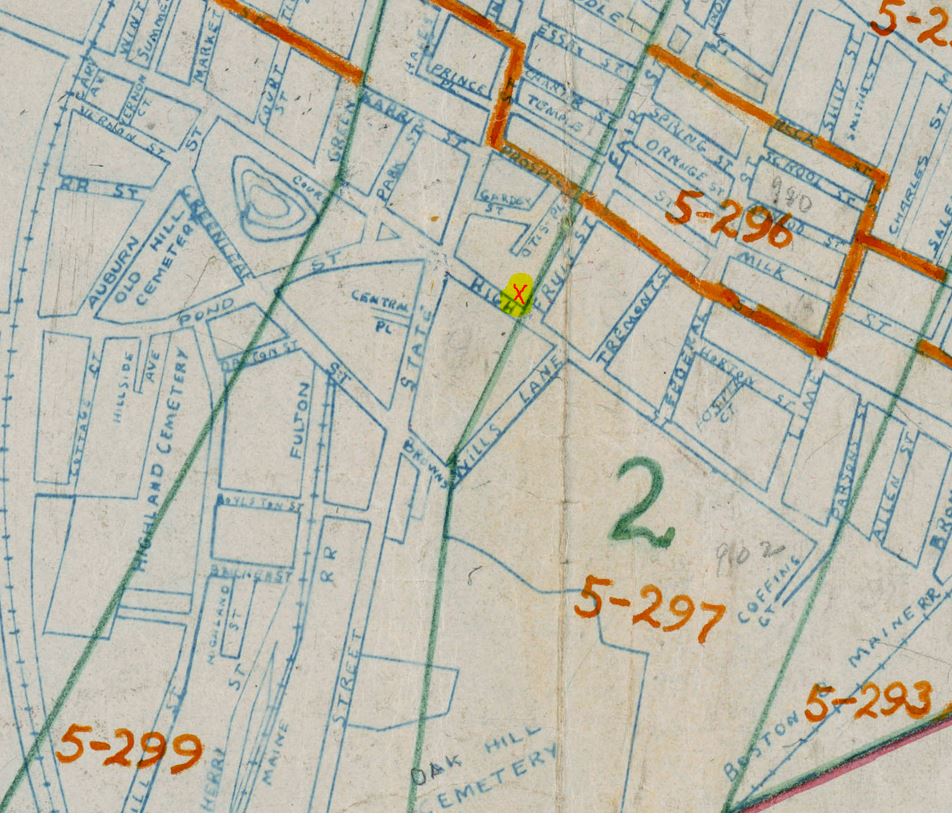
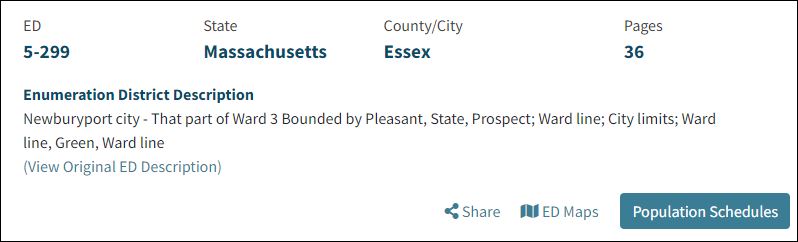
Wondering about the Museum of Old Newbury home at 98 High Street, we clicked on the Newburyport ED map and located the northeast corner of High St. and Fruit St. in ED 5-299 (we added an “X” there).
|
|
To see the census records for all the residents of 5-299, follow this link and click on Population Schedules (the button in the lower right corner).
|
|
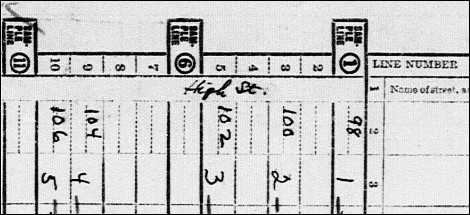
Moving to page 2 of the 36 pages of this district, we see 98 High Street as the first household recorded – lucky us! Streets are written vertically along the left-hand margin. |
|
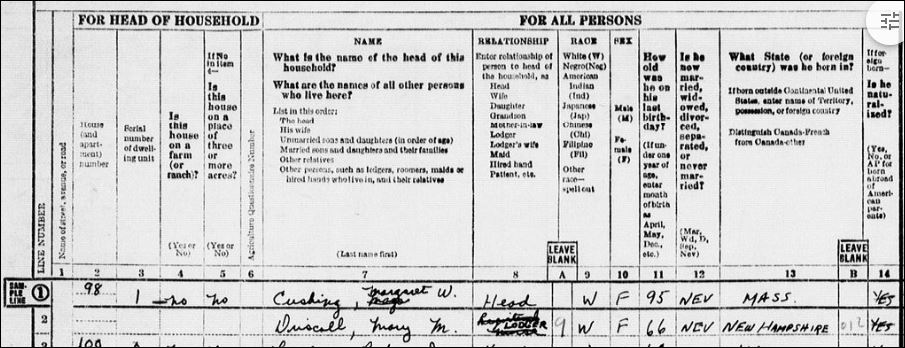
Margaret W. Cushing is the first person listed, age 95, never married. Below her is Mary M. Driscoll, lodger, age 66, also never married. |
|
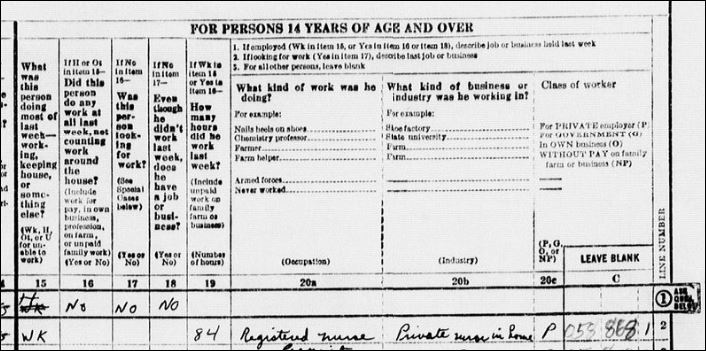
Scrolling to the right, we see more information about Margaret Cushing and Mary Driscoll. |
|
Sometimes the census can shed some light on how people described themselves, which can be very useful to a researcher. For example, Mary Margaret Driscoll, who went by Margaret, is described as a “registered nurse”, which is then crossed out and “lodger” substituted. This is likely an error on the part of the census-taker, as her occupation appears in another place on the form. This is where it gets interesting. Though she is described as a lodger, rather than “maid”, the only obvious category for a female employee, Margaret Driscoll clearly believed herself to be employed by Margaret Cushing. When asked what she was doing for most of the previous week, she said she had worked 84 hours, or 7, 12-hour days as a private nurse in the home.
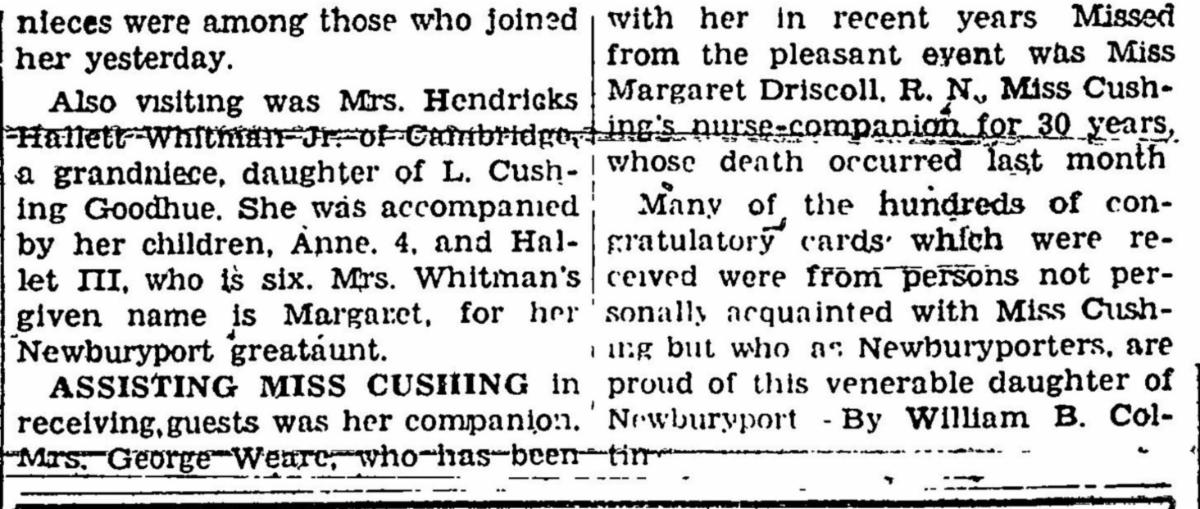
Margaret Driscoll seems to have come to the Cushing household in the mid-1920s to care for Margaret Cushing’s older brother Lawrence, who died in 1933. An article published upon the occasion of Margaret Cushing’s 100th birthday notes that “Miss Margaret Driscoll, R.N.” was unable to attend as she had died one month before. She is described here as Margaret Cushing’s “nurse-companion” for 30 years.
In the years that Miss Driscoll spent with Margaret Cushing, and in the years since, she was described as a “companion” to the older woman, a title that has come to mean something slightly different than it did in the past. At the time, it was somewhere between friendship and employment, a genteel way of blurring the lines between equality and servitude, but Mary Margaret Driscoll’s answers to the census takers tell us that she clearly thought of herself as employed by Margaret Cushing and described all her long days in Margaret’s company as work. This does not detract from any warm feeling these women may have had for each other. The newspaper article notes that she is “missed from the pleasant event.”
|
|
We hope you'll take a look at some of these census records – there is much to be learned. And if you discover something interesting, please share it with us at info@newburyhistory.org.
|
|
The Romance of Fine Linen - a Fashion Night Out with Lois Valeo
Thursday, April 28, 2022, 7:00 PM - In person at the Museum of Old Newbury
Save the date for another in the popular series by fashion historian Lois Valeo. She'll be presenting a richly illustrated talk on linens and showing you some of the museum's extensive collection.
The appeal of soft-spoken fabrics has more to do with the soul than with use or style....if linens speak to you on a very personal level and you live your life surrounded with the quiet elegance of fine fabrics….you will enjoy this illustrated lecture accompanied by many unique museum pieces of early linen aprons, handkerchiefs, bedding, towels, pockets, collars, cuffs, caps and more!
Lois Valeo is a retired Adjunct Professor of Fashion History and a member of the Museum of Old Newbury Board of Directors; at the museum, she cares for the its extensive dress and accessory collection. This is her eighth Fashion Night Out Talk.
|
|
|
|
The Museum of Old Newbury has secured eleven gardens for this year's Garden Tour. You'll enjoy access to the best we have to offer, from pocket gardens to larger, more formal landscapes. We even have a homesteading garden - grow your own everything! $25 for museum members, $35 for non-members. |
|
Something is Always Cooking at the Museum |
|
Lemon Cream Pie
1 1/2 c. sugar
1/2 c. cornstarch
2 c. half-and-half
1 stick unsalted butter
1/2 c. fresh lemon juice
Zest of 1 lemon
6 egg yolks
1 1/2 c. sour cream
Baked pie shell
In a saucepan, mix all ingredients EXCEPT the sour cream. Stir over medium heat until mexture thickens and boils. Remove from heat. Add sour cream and mix well. Pour filling into pie shell. Cover with plastic wrap and cool at room temperature until set. -Peg McClure
|
|
Click on image above to play the puzzle |
|
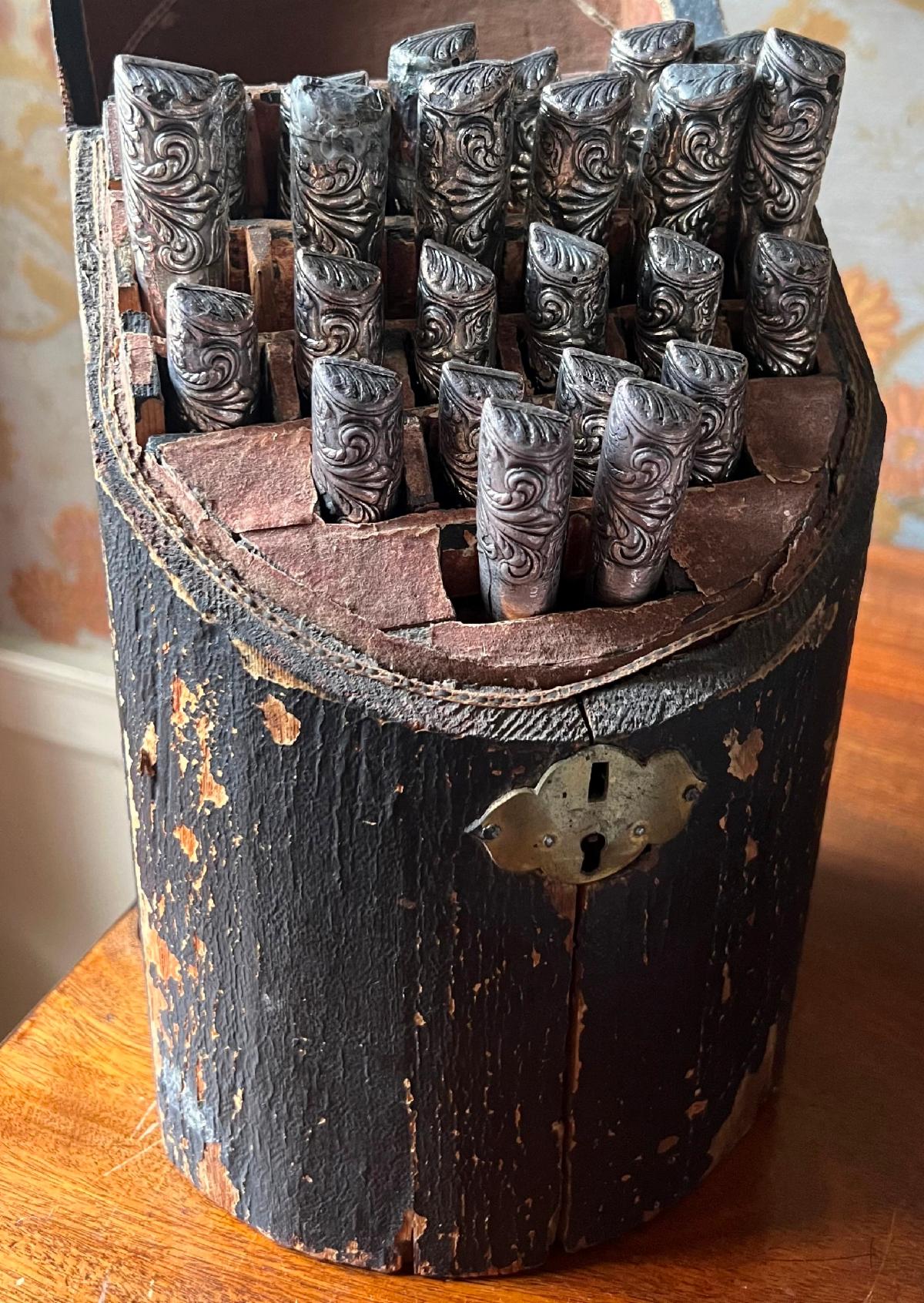
Wooden knife box with leather covering contains a set of 12 silver knives and forks. c. 1780. This set is reputed to have been used when George Washington and Lafayette dined at the Tracy and Prince home. Museum of Old Newbury collections. Click on image above to begin the puzzle. |
|
Museum e-Newsletter made possible through the
generosity of our sponsors:
|
|
|
Museum of Old Newbury
98 High Street
Newburyport, MA 01950
978-462-2681
|
|
|
|
|
|
|
|