Weekly update from the National Housing Conference | |
News from Washington | By Brittany Webb
| |
|
HUD releases contingency plans for government shutdown
HUD released its contingency plans for a government shutdown, increasingly likely to occur on October 1. The 100-page plan is one of the most comprehensive in the federal government. NHC strongly encourages all members who serve recipients of federal housing assistance, or who are federal housing grant recipients, to consult this guide and reach out to your federal contacts prior to a government shutdown, when most employees will be furloughed. A comprehensive legal analysis written by the National Housing Law Project (NHLP) staff in 2019 detailed a wide range of federal programs and how funding and services may be impacted by a prolonged shutdown. There is also an excellent guide to shutdowns prepared by the Committee for a Responsible Federal Budget. In the event of a shutdown, NHC will keep members informed of developments as they occur.
| | |
|
FOMC maintains current target federal funds rate
The Federal Reserve Board of Governors’ Federal Open Market Committee (FOMC) agreed to hold the current target federal funds rate steady at 5.25-5.50%, the second time it has paused increases this year. FOMC members noted that the improving Consumer Price Index, lower job openings, and higher unemployment rates informed their decision.
“We are resolutely committed to returning inflation to our 2% goal over time,” said Federal Reserve Chair Jerome Powell. “Inflation repeatedly has proved stronger than we and other forecasters have expected and at some point that may change. We have to be ready to follow the data. And given how far we’ve come, we can afford to be a little patient as well as resolute as we let this unfold.”
When asked how much efforts to tame inflation hinge on housing supply, Powell noted that supply influences home prices. He added that leases and housing services inflation are other inflation indicators, saying that more leases are rolling over this year than last and that “housing services inflation (is) coming down.” Freddie Mac reported the 30-year fixed mortgage rate was 7.19% on Sep. 21, which cooled housing demand. The rate was 6.29% a year ago.
| | |
|
FHFA Director Sandra Thompson to address
NHC’s Solutions for Affordable Housing
| |
|
CFPB issues lending guidance on AI
The Consumer Financial Protection Bureau (CFPB) released new legal guidance for lenders using artificial intelligence (AI) “and other complex models.” The guidance describes how lenders must use “specific and accurate” reasons when taking adverse action against borrowers. The announcement made clear that the growth of advanced algorithms and decision-making technology in underwriting raises the risk of discrimination. The guidance builds upon a circular CFPB issued last year explaining that the Equal Credit Opportunity Act required creditors to explain specific reasons for taking adverse actions.
| |  |
|
FHFA accepting applications for affordable housing committee
The Federal Housing Finance Agency (FHFA) continues accepting applications for membership in its Federal Advisory Committee on Affordable, Equitable, and Sustainable Housing. The agency seeks experts across the industry from various fields to focus on many housing topics, including fair lending and fair housing, capital markets, single and multifamily lending, community advocacy, housing credit, and more. The Advisory Committee will inform FHFA of housing needs and regulatory and policy changes needed to ensure reliable liquidity in the housing market. Only completed applications received by 11:59 PM on October 13 will be considered for membership. Interested applicants can apply on the Committee webpage.
| | |
|
Local leaders voice support for AHCIA
The ACTION Campaign announced it sent a letter to Congressional leadership with signatures from 184 local government leaders representing cities, counties, and other municipalities of all sizes across the country in support of the Affordable Housing Credit Improvement Act (AHCIA) of 2023. ACTION, the National League of Cities, the National Association of Counties, and Mayors & CEOs for U.S. Housing Investment organized the letter to demonstrate the broad support for expanding and strengthening the Housing Credit to increase the nation’s much-needed affordable housing supply. ACTION estimates AHCIA will add nearly 2 million new affordable rental units over the next decade.
“On behalf of 46 bipartisan mayors and business leaders representing more than 22 million residents and millions more households, we strongly support the Affordable Housing Credit Improvement Act of 2023,” said Mesa, Ariz., Mayor John Giles and Sacramento, Calif., Mayor Darrell Steinberg. “Our coalition was intentionally created as a bipartisan forum for cities and the federal government to work together on unlocking housing financing and construction opportunities – and AHCIA exemplifies this kind of critical federal, state and local collaboration.”
| | |
|
Agencies respond to hurricanes’ impact
The Board of Governors of the Federal Reserve System, the FDIC, and the Office of the Comptroller of the Currency released a joint notice extending the period for giving favorable consideration under their Community Reinvestment Act (CRA) regulations for bank activities that help stabilize areas impacted by Hurricane Maria. The agencies extended the consideration for 36 months due to the continuing economic impact of the 2017 hurricane on Puerto Rico and the U.S. Virgin Islands.
HUD also introduced 29 waivers to aid Florida’s recovery from Hurricane Idalia. As part of the Biden Administration’s support, these waivers cover various HUD programs like Community Development Block Grants (CDBG) and HOME Investment Partnerships (HOME). To expedite the use of these funds, HUD’s state and local partners can now access a waiver through a new simplified notification process. Through this waiver package, HUD is providing flexibility by allowing new housing construction with CDBG funding in declared disaster areas, suspending the CDBG public services cap, waiving HOME matching contribution requirements, and providing flexibility in HOME tenant-based rental assistance. Additionally, term limits for certain assistance types are extended. HUD’s actions aim to expedite recovery funding to affected communities, supporting housing rehabilitation, infrastructure improvements, small businesses, and assistance to those facing homelessness after a disaster.
| | |
|
Multifamily Impact Council updates Impact Framework
The Multifamily Impact Council, a group of housing stakeholders that aim to encourage more multifamily impact investing by establishing a standard set of principles and guidelines, released an updated version of its Multifamily Impact Framework™. The Framework establishes definitions, minimum impact thresholds, and reporting guidelines to help investors and property owners align their interests in a way that improves the lives of renters and supports long-term rates of return. This update adds 20 reporting metrics for each of the Framework’s impact principles, guidance for organizations adopting the Framework, and alignment areas for key environmental, social, and governance benchmarks. Interested owners/operators, investors, lenders, and service providers can get more information on adopting the free framework here.
| | |
|
HUD awards $30 million, adds $50 million for local HIV/AIDS housing initiatives
HUD announced nearly $30 million in funding for Housing Opportunities for Persons with AIDS (HOPWA) Permanent Supportive Housing Renewal and Replacement Grants. Under the HOPWA Program, HUD provides grants to cities, states, and nonprofit organizations to provide housing assistance and supportive services to low-income individuals with HIV and their families. In addition to housing assistance, these local programs also provide access to supportive services such as case management, mental health services, substance use prevention, and employment training. “Access to safe, stable, and affordable housing is a critical social determinant of health,” said HUD Secretary Marcia Fudge. You can find the complete list of awardees here.
HUD also announced a $50 million notice of funding opportunity via the HOPWA: Housing Interventions (HINT) to End the HIV Epidemic program. Local governments, states, and nonprofit organizations can use the funding for housing assistance and supportive services for low-income individuals with HIV and their families, coordination and planning activities, and grants management and administration. Projects funded through HOPWA work to achieve six required project objectives, including implementing strategies and initiatives to end the HIV epidemic, improving the availability and use of community resources, and increasing data collection to inform decision-making.
“When people face health challenges, the last thing they need is to struggle to find a decent place to live. This funding will help provide a stable home environment that is critical of the system of care for those living with HIV,” said HUD Secretary Marcia Fudge. HUD will host a pre-application webcast for those interested in applying. You can subscribe to HOPWA’s mailing list to receive more information.
| | |
|
HUD awards $60 million to address youth homelessness
HUD awarded $60 million to 16 communities nationwide to help end youth homelessness. Through HUD’s Youth Homelessness Demonstration Program (YHDP), funding will provide housing and services tailored to recipients’ needs. The funds will support programs such as rapid rehousing, permanent supportive housing, transitional housing, and host homes in YHDP communities. “The Youth Homelessness Demonstration Program provides communities the opportunity to address the unique needs of youth and young adults and designs specific projects that meet their needs. With this funding, HUD is targeting federal resources to meet local needs and support community-driven efforts to end youth homelessness and improve outcomes through stable housing and services,” said HUD Deputy Secretary Adrianne Todman.
| | |
|
Property insurance rates increase for 22 consecutive quarters
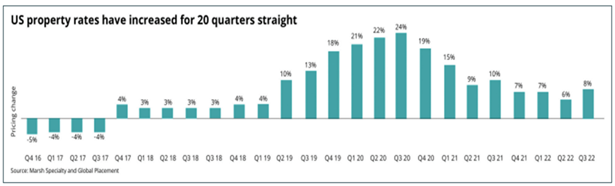
A Senate Banking Committee hearing highlighted the skyrocketing cost of property insurance driven by increases in natural disasters. The hearing, “Perspectives on Challenges in the Property Insurance Market and the Impact on Consumers,” showed that U.S. property insurance rates increased for 22 consecutive quarters. Rates for some owners in affordable rental housing increased 30-100% within the last three years. The cost increases threaten to slow much-needed affordable housing development.
| |
|
New America and a coalition of housing groups released a set of data standards for civil case evictions. The coalition intends the recommended standards to streamline information across courts and help facilitate program outcomes evaluation. The standards include a recommended set of data elements and definitions on what information related to evictions is critical to analyze.
A blog post from the Urban Institute argues that bank regulators are taking too narrow a view of mortgage risk. The blog examines the recently proposed capital framework from the Federal Reserve, the FDIC, and the Office of the Comptroller of the Currency. It explains that while the proposal intends to reduce risk to the financial system, its narrow approach to banks may increase risk in the mortgage market by making it less economical for large banks to participate.
FHFA released its second quarter Foreclosure Prevention and Refinance Report. The report shows that since Q1, loans in forbearance are down 0.21%, the 60+ day delinquency rate decreased from 0.75% to 0.72%, foreclosure starts dropped 10%, while third-party and foreclosure sales increased 2%. Real Estate Owned inventory decreased 1.2%.
| |
|
Monday, September 25
Membership Monday: Health Insurance (National REIA), 2 – 3 PM ET
National Call on HoUSed: Universal, Stable, Affordable Housing (NLIHC), 2:30 PM ET
Tuesday, September 26
FPC 2023 Fall Member Meeting (National Community Reinvestment Coalition), in person in Memphis, TN
Just Economy Regional: Mountain West (National Community Reinvestment Coalition), 8 AM – 5 PM ET, in person in Denver, CO
HOTMA Overview (NAHRO), 1 – 4 PM ET
MCPI/Zone of Opportunity: Understanding the Demand Side of Mortgage Origination (Mortgage Bankers Association), 2 – 3 PM ET
2023 Fair Housing Planning Monthly Office Hours – Regional Collaboration (HUD Exchange), 4 – 5 PM ET
Wednesday, September 27
2023 NIC Data & Analytics Conference (NIC), in person in Minneapolis, MN
FPC 2023 Fall Member Meeting (National Community Reinvestment Coalition), in person in Memphis, TN
Rural Rental Housing Preservation Academy: Property Stewardship: Resident Services and Asset Management (Enterprise Community Partners), 11 AM – 12:30 PM ET
Managing CPF Grants: Foundations for a Successful Program Webinar Series (HUD Exchange), 1 – 2:15 PM ET
An Overview of Regulatory Capital Requirements Proposed Revisions (Mortgage Bankers Association), 2 – 3 PM ET
Buying the Block – A Roundtable Discussion with Lyneir Richardson (NextCity), 3 PM ET
Thursday, September 28
2023 NIC Data & Analytics Conference (NIC), in person in Minneapolis, MN
Manufactured Housing: Charting a Path Towards Affordability (IMN), in person in Nashville, TN
Americas YLG: Crowdfunding for Real Estate (ULI Americas), 12 – 1 PM ET
Multifamily Research Virtual Meetup (NMHC), 12 – 1 PM ET
Unique Financing Solutions in a Unique Market (Asian Real Estate Association of America), 1 – 2 PM ET
Friday, September 29
Manufactured Housing: Charting a Path Towards Affordability (IMN), in person in Nashville, TN
WHF Public Policy Luncheon: Lindsey Johnson, CEO, Consumer Bankers Association (Women in Housing and Finance), 12 – 1 PM ET
Climate Change and Household Financial Well-Being: Understanding Risk and Building Resilience (Urban Institute), 1 – 2:15 PM ET
|  | |
The National Housing Conference is a diverse continuum of affordable housing stakeholders that convene and collaborate through dialogue, advocacy, research, and education, to develop equitable solutions that serve our common interest. | |
Defending Our American Home since 1931 | |
Copyright © 2023. All Rights Reserved. | | | | |