|
|
We ask that you consider making a payment to any writer or each writer. Select one or more whose work you are impressed with, and drop some coin into their cup. These pros have things to say about art and more that we think you want to read about. And ponder. And compensate them for. 20% of your contribution will be added to support our staff that produces and administers the Weekly Newsletter and the VAS website.
Anything you chip in MEANS A LOT. Yes, even a buck!
We are in a new world. . .and this is a new solution. We all thank you!
|
|
|
This Week's Contents
(scroll to see the full content of each article; please click the cup and compensate the writer)
|
|
The Prison Bars
of Righteousness
|
Heroes:
Superman and Jackie O.
|
History Repeats:
Ann Morton
|
|
|
The Prison Bars of Righteousness
by Andy Brumer
|
|
“In a coup you find out who’s who”
- Nicanor Parra, Chilean poet
Pump your little fist of nothingness
as you golf swing your way
into oblivion.
Tuck those tiny fingers
into powder puffs
of summer clouds
that with the hope of a
cotton ball’s softness
might for once
prove (to yourself first!)
that you have a heart.
Pump that white ass honky
hand of hatred all you want…
…no matter how macho you dream
yourself into being,
you’re just a wimpy dandy
white golf glove wearing
mass of dust
that hearty
healthy finely
feeling and fiercely furious
fairies would
find nauseating.
Even the air that tiny
clump of fingers feels
as like a pimp
from the 1970’s you
stretch out of the limousine
we’ve paid for you
turns its cheeks in disgust.
Keep jabbing, though, Donny boy,
and take solace in the fact
that your dainty hand and arm
will fit just fine
through the prison bars
of righteousness.
|
|
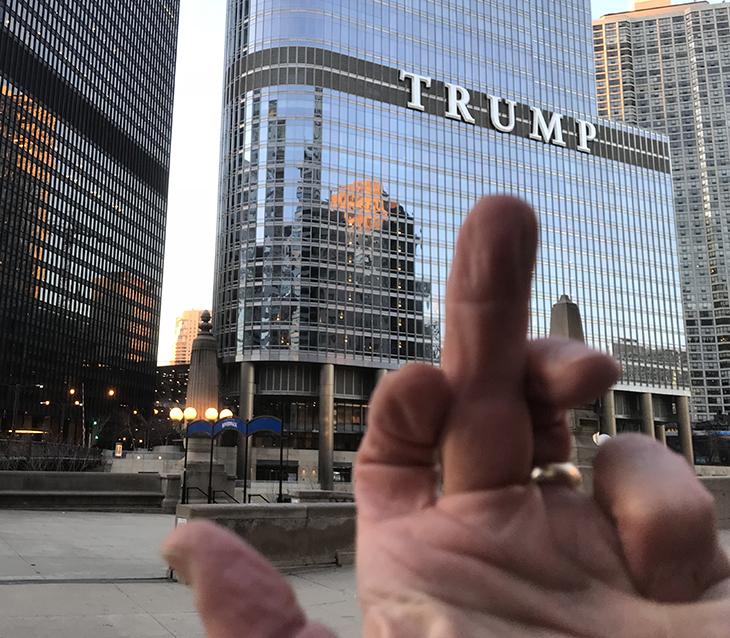
Bill Lasarow, "Homage to Ai Wei Wei (Chicago)," 2018, photograph |
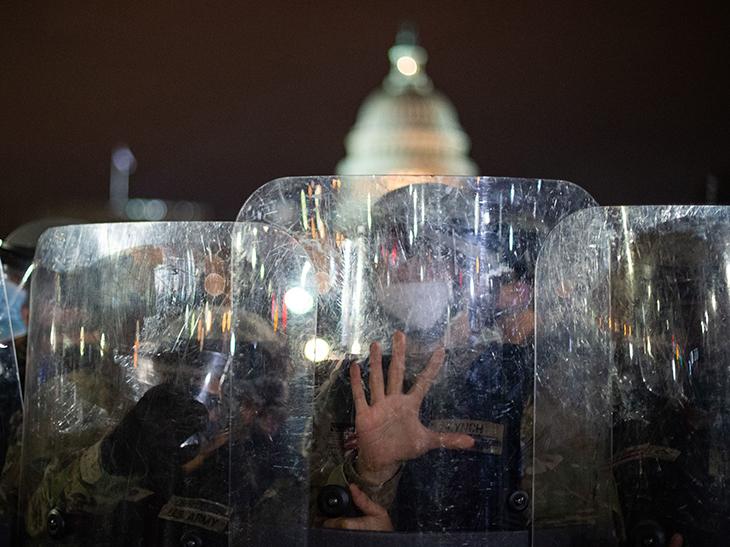
Members of the DC National Guard surround the U.S. Capitol, evening of January 6, 2021. Photo: Andrew Caballero-Reynolds |
|
|
|
Andy Brumer is a poet, book reviewer and art writer, whose work has appeared in The New York Times Book Review, The Los Angeles Times, The San Francisco Chronicle/Examiner, Artweek, Artscene, Visual Art Source and many other publications. His latest book of poetry, with drawings by Joseph Slusky, is Below Understanding. He also writes about golf.
|
|
Heroes: Superman and Jackie O.
by David S. Rubin
|
|
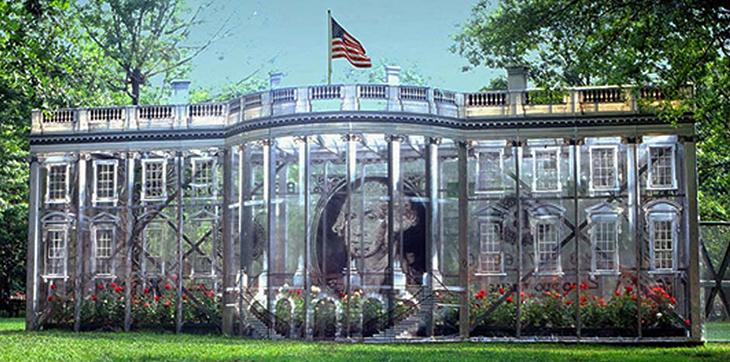
Karin Giusti, “White House/Green House,” 1996, site-specific installation, Battery Park, New York. Courtesy of the artist |
|
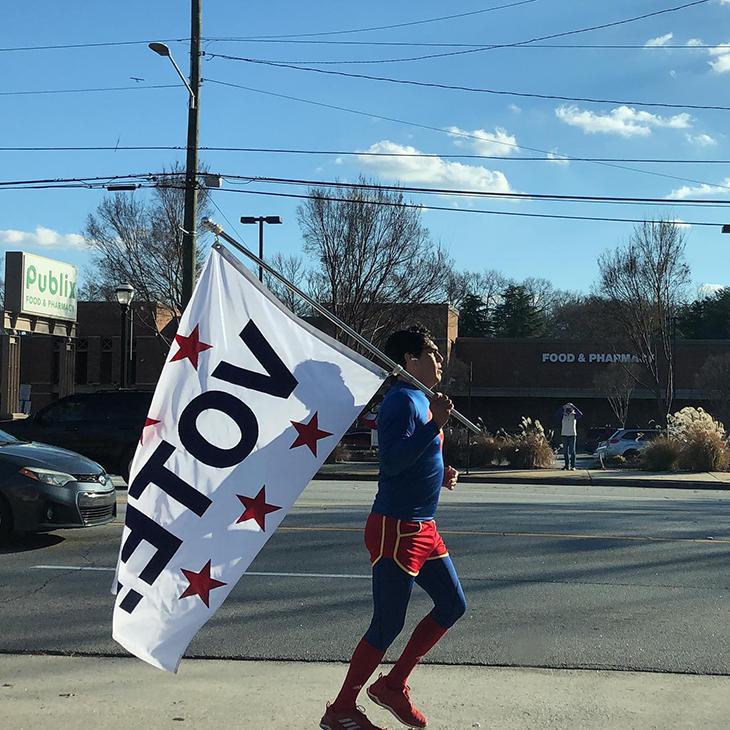
Thanks to Stacey Abrams and her hardworking team, as well as to multitudes of volunteers who wrote letters and participated in phone banks, Georgia has finally turned blue. Also deserving some credit, at least in his role as a cheerleader working to motivate potential voters, is San Antonio artist David Alcantar, who ran, marathon style through the streets of three Georgia counties from January 3-5, wearing a Superman costume and carrying a large flag with the word ‘VOTE!’ Alcantar’s four mile run on Runoff Election Day was indeed noticed, because a picture of him in motion appeared in the “Atlanta Journal-Constitution”. Entitled “The American (in Georgia),” the artist’s get-out-the vote performance was the logical follow-up to “The American”, a similar undertaking in San Antonio that commenced on October 13, the first day of early voting in Texas. For that project, Alcantar ran three miles a day in local neighborhoods through November 3. Both runs are part of his ongoing research-based “Superman Project,” which, following the election of Donald Trump, began in an effort to understand how two diametrically opposed cultural figures — one devoted to “Truth, Justice, and the American Way,” and the other to lies, hatred and “Make America Great Again” — could both be so widely embraced as “heroes” by masses of Americans. |
|
In addition to his performances, Alcantar has produced a number of thought-provoking works on paper in which he mixes up the identities of Superman and Trump. In “High Aims (Target): Power is not Heroism,” a triumphant looking Superman with Trumpian facial features is superimposed over the Presidential seal, accompanied by a word bubble containing Trump’s March 13th assertion, “I don’t take responsibility at all” for Covid. In Alcantar’s rendering, Trump is quite accurately portrayed as reveling in power, but failing to accept the duties that come with it.
In “Identity Politics #2,” Alcantar reveals an intriguing bit of Superman history. In a comic book edition of “Superman” that ironically hit the stands one week after the assassination of John F. Kennedy, the superhero reveals his secret identity as Clark Kent to JFK and tells him, “If I can’t trust the President of the United States, who can I trust?” Alcantar’s mixed media drawing includes a collaged section from the vintage comic book and two drawn replications of it in which JFK is replaced by Trump. In a clever juxtaposition of the hero and anti-hero, the upper panel repeats the original text, while in the lower half, Alcantar quotes Trump from the Hollywood Access tape.
|
|
David Alcantar, “The American (in Georgia),”
performance, 2021. Courtesy of the artist
|
|
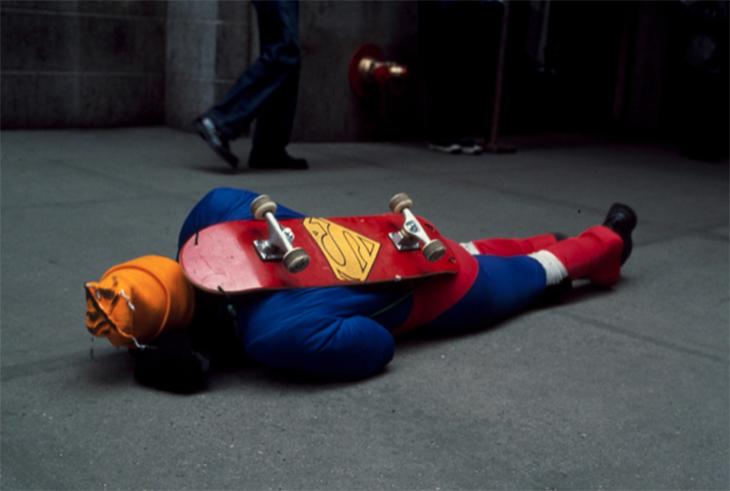
Within the context of contemporary art history, it is relevant to note that Alcantar is not the first to don Superman garb for consciousness raising performance art. From 2001-2009, Pope.L, who is known for labor intensive “crawl pieces,” enacted “The Great White Way,” for which he traversed the entire 22 miles of Broadway, the longest street in New York City, on his elbows and knees while wearing a capeless Superman outfit, gardening gloves, and a skateboard featuring a Superman logo strapped to his back (which helped him get through intersections more quickly by turning over and moving in a supine position). Over nine years, the performance took place in short segments that usually amounted to distances of about six blocks, at which point he was usually exhausted. |
|
Pope.L, “The Great White Way,” 2001-2009, inkjet print from performance video. ©2021 Pope.L, courtesy of the artist |
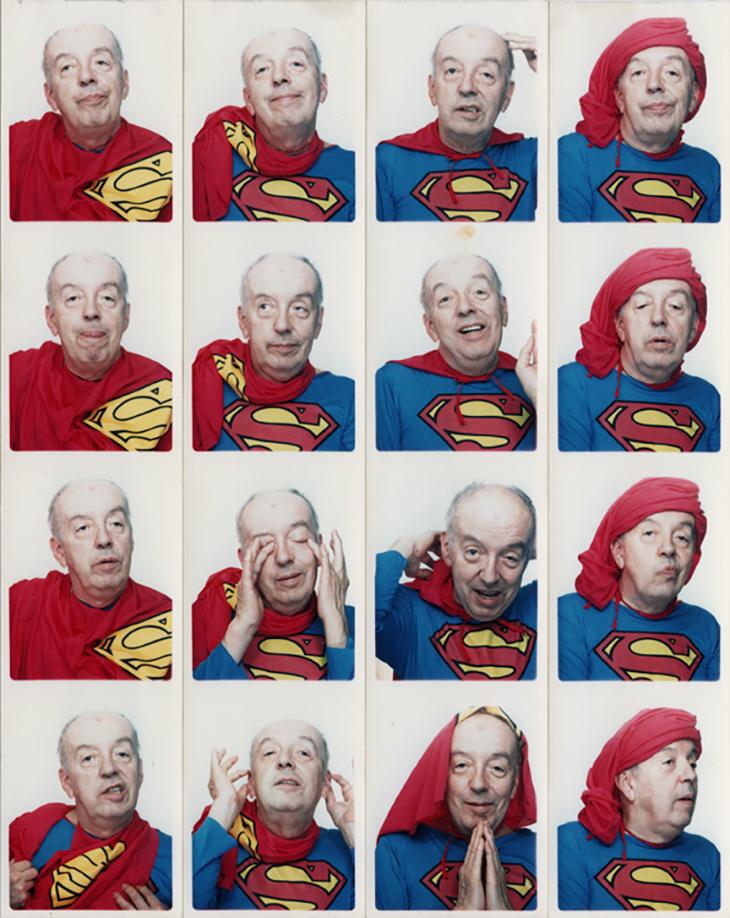
Blake Boyd, “Taylor Mead as Superman,”
1995, photo booth photos. Courtesy of the artist
|
|
Pope.L began his crawl pieces in 1978 with the idea that traveling painstakingly in a horizontal position is a perfect metaphor for the underprivileged, those who are deprived of verticality, i.e. standing upright, which he sees as representing financial security and good health. In that he is African American, these works focus attention primarily on the largely predetermined plights of Black people in a society controlled by Whites, many of whom are racist. For Pope.L, the Superman costume served the dual purposes of bringing some levity to the project, while also ensuring that onlookers would take notice without automatically assuming that he was simply your everyday New York homeless person.
Humor is more directly expressed in another performative Superman project undertaken in 1995 by New Orleans artist Blake Boyd, who photographed Warhol Factory superstar Taylor Mead wearing a Superman costume in a public photo booth. While in his twenties, Boyd went to New York City and befriended Mead and his Factory compatriot Billy Name, who also posed for photo booth photos, in his case dressed as the mythological Thor. Boyd chose Superman for Mead’s persona because he wanted to pay homage to Warhol, who introduced Superman into his art in the early 1960s and also included him in his 1981 “Myth” series. Boyd’s intention was to portray Mead as an elder superhero who has passed his prime, although Mead’s penchant for hamming it up is very much visible in the photos.
Coincidentally, another pop culture icon portrayed in Warhol’s art has been impersonated in performances that, like Alcantar’s, involved voter motivation efforts. In 1995-96, Karin Giusti adopted the persona of Jacqueline Kennedy Onassis in conjunction with her installation “White House/Green House,” which debuted at Real Art Ways in Hartford, Connecticut before moving to Battery Park in Lower Manhattan. Conceived as an exploration of the relationship between money, politics and the future of the environment, the installation was a functioning greenhouse in the shape of the White House, with an enlarged dollar bill image on its façade and the White House on the back. Giusti used alternative energy sources to maintain fifty rose bushes (several named for U.S. presidents) and set up a kiosk with voter information and leaflets on new energy options. Periodically throughout each exhibition, she appeared in the guise of Jackie O., personally handing out voter registration forms. Subsequently, she introduced a smaller mobile version, attached it to a biodiesel truck fueled by vegetable oil, and took her Jackie O. show on the road in the election cycles of 2004, 2008, and 2016.
|
|
|
|
David S. Rubin is a Los Angeles-based curator, writer, and artist. As a curator, he has held positions at MOCA Cleveland, Phoenix Art Museum, Contemporary Arts Center New Orleans, and San Antonio Museum of Art. As a writer he has contributed to Arts Magazine, Art in America, Artweek, ArtScene, Glasstire, Fabrik, Art and Cake, and Visual Art Source. He has published numerous exhibition catalogs, and his curatorial archives are housed in the Smithsonian Institution’s Archives of American Art.
|
|
History Repeats: Ann Morton
Mesa Contemporary Arts Museum, Mesa, Arizona, continuing through March 28, 2021
(Covid-19 safety protocols observed in accord with CDC and State health department guidelines)
by Lynn Trimble
|
|
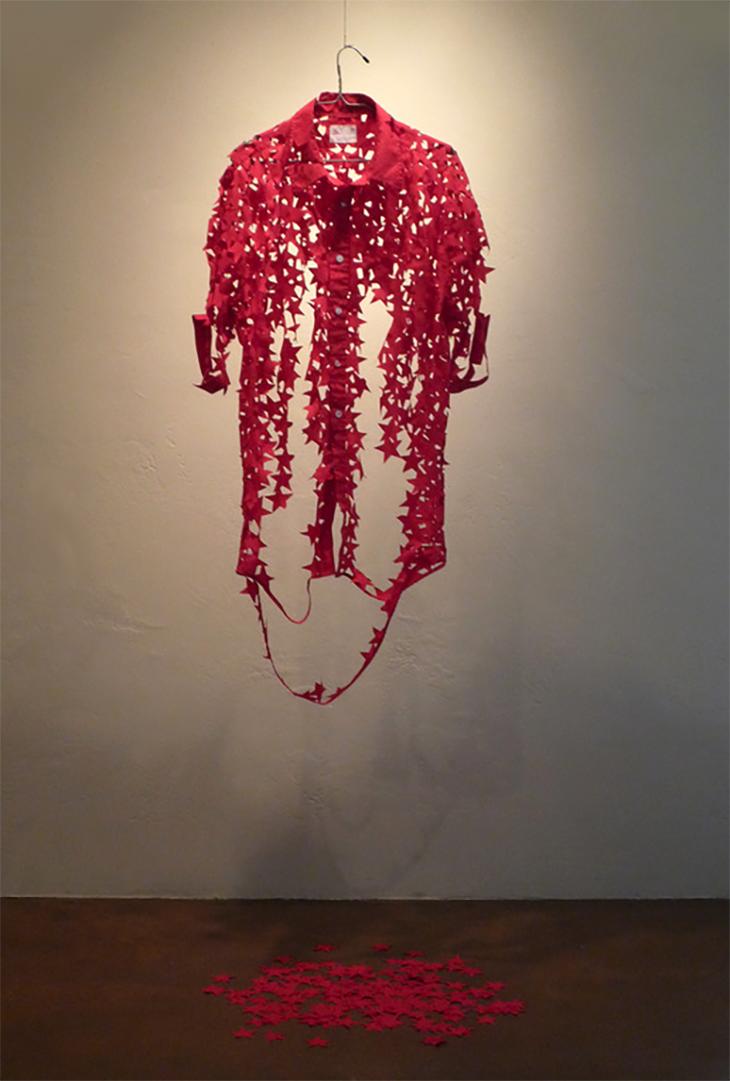
A red food worker’s shirt bearing star-shaped holes hangs near the gallery entrance, with red fabric stars strewn beneath it. Ann Morton’s 2009 work, titled “Losing Our Shirt,” signals the many ways this artist elevates what’s missing in contemporary life, from economic justice to gender equality. Curiosity about what the stars might symbolize prompts us to move through the space while considering essential questions: What holes exist in contemporary society? Why do they exist? And what responsibility do we have, as individuals and communities, to repair them?
It’s a common thread in much of her work, created using primarily textiles and found objects. The exhibit highlights two key themes present in her body of work, spanning 2006 to 2020: politics and race relations. Collectively, they remind us that trauma fueled by recent police brutality, a raging pandemic and political propaganda has historical antecedents that continue to reverberate in the absence of systemic change.
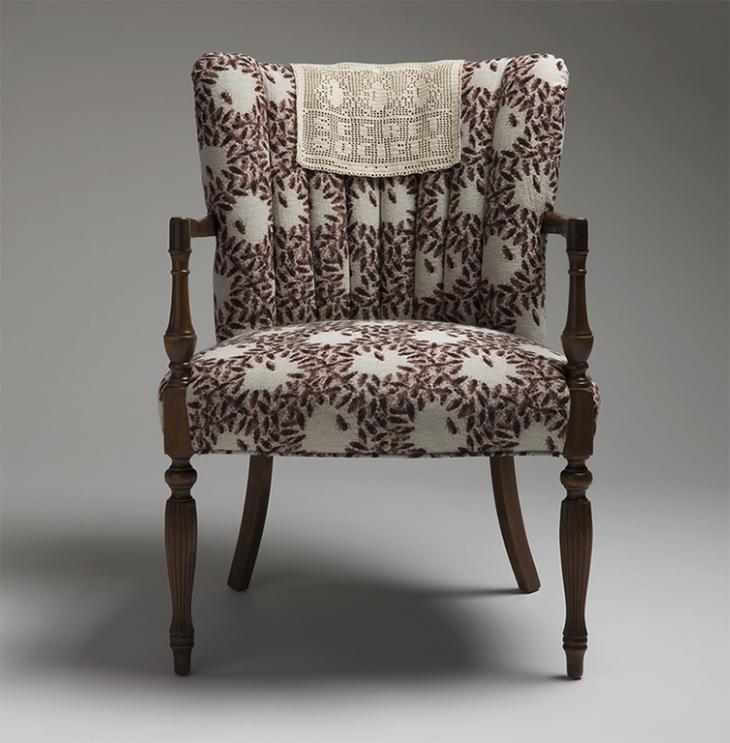
At the center of the gallery, a chair with custom jacquard weaving (“The Seat of Secret Society,” 2008) appears perfectly ordinary from afar, but becomes more foreboding once its pattern comes into clearer focus. The design includes groups of swarming roaches. Atop the chair, there’s a white doily that speaks to the ways violent actions were obfuscated by the George W. Bush administration. A woven rectangular work anchored by the iconic image of Lucille Ball, surrounded by flying bombs and a wartime aircraft, hangs nearby (“Shock & Awe of an American Baby Boomer,” 2007).
|
|
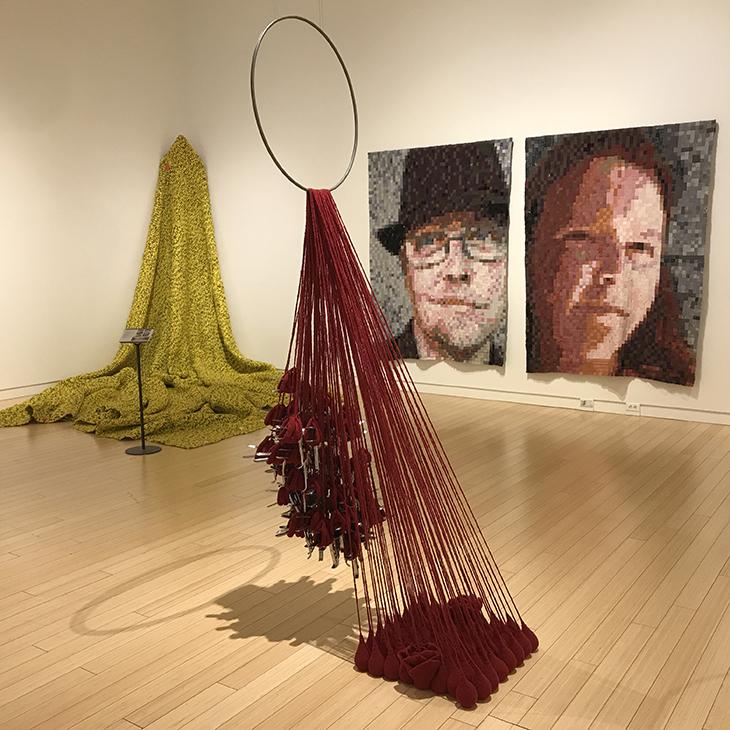
Ann Morton, (foreground) “When I’m 64.” 2018, 64 speculums, wool yarn, cherry pits, lead shot steel hoop. (r.) "Josef and Michelle," 2012/13, textile weaving of cast-off clothing, 62 x 73" each. Photo: LynnTrimble |
|
Ann Morton, “Losing Our Shirt.” 2009, hand-cut found food worker's shirt, 18 x 36" plus floor arrangement. Courtesy of the artist
|
Ann Morton, “The Seat of Secret Society," 2008, custom jacquard weaving from artist-created digital file, upholstered chair, filet crochet doily, 23 x 35 x 25". Courtesy of the artist |
|
The artist also critiques decisions made by Barack Obama, using a set of samplers (“Samplers,” 2013) that reference key moments in his term. Five white handkerchiefs hang along the same wall, each featuring text in red and blue embroidery that twists words uttered by Donald Trump on topics ranging from immigration to mainstream media (“Proofreading,” 2017-2020). Her use of soft materials and relatively subdued color palettes create an initial sense of calm, but fuels greater reflection that effectively fuels deep emotions from anger to grief. The approach is particularly effective with "Original Sin” (2020), a piece that includes bars of white soap carved with the image of Jesus. They’re set below a portrait of Jesus that was prevalent in Christian households during the mid-20th century, a fact that amplifies the way Morton’s work channels her own experiences growing up in a country steeped in white privilege.
The artist called on her own experiences as a woman in “When I’m 64” (2018), consisting of 64 speculums, red wool yarn, cherry pits, lead shot and a steel hoop. The installation references changes to the female body and psyche over time, and the ways society expects women to jump through hoops while sublimating their own selfhood.
The retrospective also highlights several works created in collaboration with community members and large-scale public artworks addressing issues related to personal and communal responsibility, including homelessness and recycling. Two large quilts made with clothing discarded at a human services campus hang side by side, each with the face of a homeless person (“Josef” and “Michelle,” 2014-2015). A panel hangs from ceiling to floor, formed by sewing together works made by people around the country for a project called “The Violet Protest” [discussed in an earlier article by Trimble] Later this year, she’ll send squares to every member of Congress, hoping their combined red and blue imagery will inspire the legislators to avoid the us-versus-them mentality. During a time of political, social and cultural upheaval. It’s a poignant reminder of the responsibility we all bear for co-creating and sustaining a just society.
|
|
|
|
Lynn Trimble is a Phoenix-based art writer whose work ranges from arts reporting to arts criticism. During a freelance writing career spanning more than two decades, over 1,000 of her articles exploring arts and culture have been published in magazine, newspaper and online formats. Follow her work on Twitter @ArtMuser or Instagram @artmusingsaz.
|
|
|
|
Contact Information:
PO Box 2029, Thousand Oaks, CA 91358 • Ph: (213) 282-3444
|
|
|
|
|
|
|
|