|
Soil acidity is a soil health issue that reduces fertilizer efficiency through nutrient tie-up and aluminum toxicity. Aluminum toxicity further hinders plant growth and nutrient uptake by stunting and malforming root development.
Acid acres are corrected by applying a carbonate (lime) or other soil amendment that neutralizes the hydrogen ion. Lime is comprised of calcium-carbonate. Calcium does not neutralize soil acidity as calcium and hydrogen are positively charged soil cations and repel from each other. However, the carbonate in lime is negatively charged and produces water and carbon-dioxide when neutralizing hydrogen ions that cause soil acidity.
Having said that, the first step in managing soil acidity is to soil test. Whole field or composite soil testing will rarely render a good picture or truly show the status of your field since there is a dilution effect from the mixing of different soil types. Zone sampling a field will better pinpoint the acid acres in a given field.
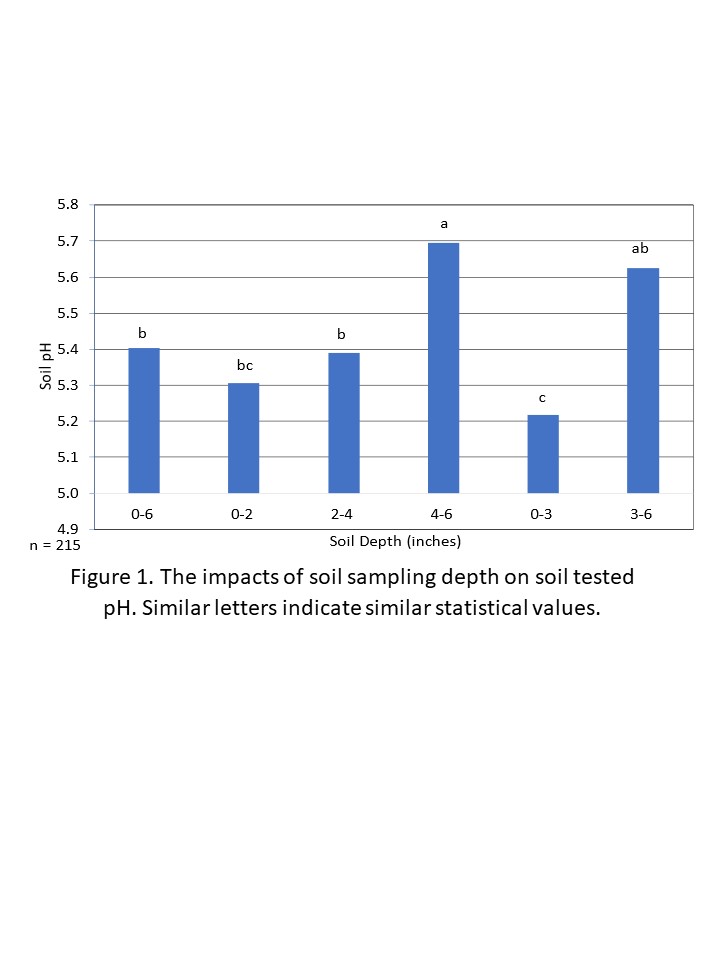
Soil sampling depth impacts soil pH testing results. Nitrogen fertilizers mineralize into plant available nitrate. During the mineralization process, hydrogen is released. This causes a localized zone of acidity. Sampling the depth of nitrogen applications will better help you find the acid acres. A recent study looked at soil pH and sampling depth (figure 1).
This study compared the soil pH at the 0-6, 0-2, 2-4, 4-6, 0-3, and 3-6 inch depths (figure 1). The lowest pH was observed at the 0-3 inch depth and was similar to the 0-2 inch depth. Similar soil pH’s were observed at the 0-6, 0-2, and 2-4 inch depths. The 4-6 and 3-6 inch soil pH were the greatest.
All collaborating producers were long-term no-tillers. The majority of producers either applied nitrogen at the surface or a few inches into the soil. This data suggests that the 0-3 inch soil test will better identify soil acidity issues. The 0-2 inch soil test was similar to the 0-3 inch soil test, but much more sampling is needed for the soil testing lab. Sampling at the 0-2 inch depth adds a lot of time to. Additionally, the shallower depth may not identify if an acidity hotspot is present. The 0-6 inch soil test depth results are diluted due to the deeper collected material.
Soil sampling impacts soil pH test results. Zone sampling pinpoints acid acres. Soil sampling at the 0-3 inch depth pinpoints the acidiy.
|