Volume 11, No. 3 – Fall 2026 | | |
In this issue:
- A Chicago Celebration Memorializing Bea Lumpkin
- A Personal Reflection on a Friendship With Bea Lumpkin
- Remembering Two Chicago Feminists: Nicole Hollander and Barbara Flynn Currie
| | |
Bea Lumpkin’s Memorial at CTU’s Union Hall
By Jackie Kirley
For anyone who knew Bea Lumpkin or knew of her, it was hardly a surprise that the hall was packed. Folding chairs were needed in addition to the array of round tables. Bea, who died at 107 years of age, led a life fighting for social justice in many venues, and her companions and comrades from those fights were there to celebrate her life. They included politicians, labor leaders, relatives, and friends, all of whom had participated in social justice movements and who had admired Bea’s consistent and unrelenting work to the end of her life. Musicians Bucky Halker and Justina Medina offered labor songs in English and Yiddish. Bucky opened the event with “Rebel Girl” by Joe Hill. While Justina sang a Yiddish song “Arbeter Froyen” or “Working Women,” a solitary male voice sitting near me sang along in Yiddish. For other songs, printed lyrics enabled us all to participate.
John and Paul Lumpkin, Bea’s and Frank’s two sons, welcomed us, recounted some of Bea’s early life, and emceed the celebration. Stacy Davis Gates, President of the Chicago Teachers Union and the Illinois Federation of Teachers, welcomed attendees to the Chicago Teachers Union Hall, and Chicago Mayor Brandon Johnson spoke of his admiration for Bea’s work. He quipped that his administration was one of two that Bea could get along with. Because she was unable to attend, U.S. Representative Jan Schakowsky, 9th District, Illinois, had her tribute read by Ed Sadlowski, Jr., Deputy Director at Milwaukee Teachers' Education Association, and U.S. Representative Jesus ‘Chuy’ Garcia, 4th District, Illinois, gave his remarks in person, citing his and Bea’s joint support for the murdered Latino labor activist Rudy Lozano.
Bea’s organizing work began when she was still a teenager in New York City. It continued in Buffalo, New York, and then in Chicago. Bea did not seek leadership positions in the organizations she worked with, but she was unrelenting in her commitment. When she married Frank Lumpkin, they organized together and then together fought Wisconsin Steel, where Frank had worked. The company simply closed its doors one day, locking out the workers, denying them any past pay or future pensions. It took 17 years of legal fights to get some compensation for those workers. Two female labor leaders, Liz Shuler, President AFL-CIO, and Roxanne Brown, International President United Steelworkers, sent recorded speeches in which they both thanked Bea for laying the groundwork for women to lead. Although Bea herself never sought elected leadership positions, they agreed that she represented “power, passion, fight, and love,” and they were deeply grateful for her life’s work.
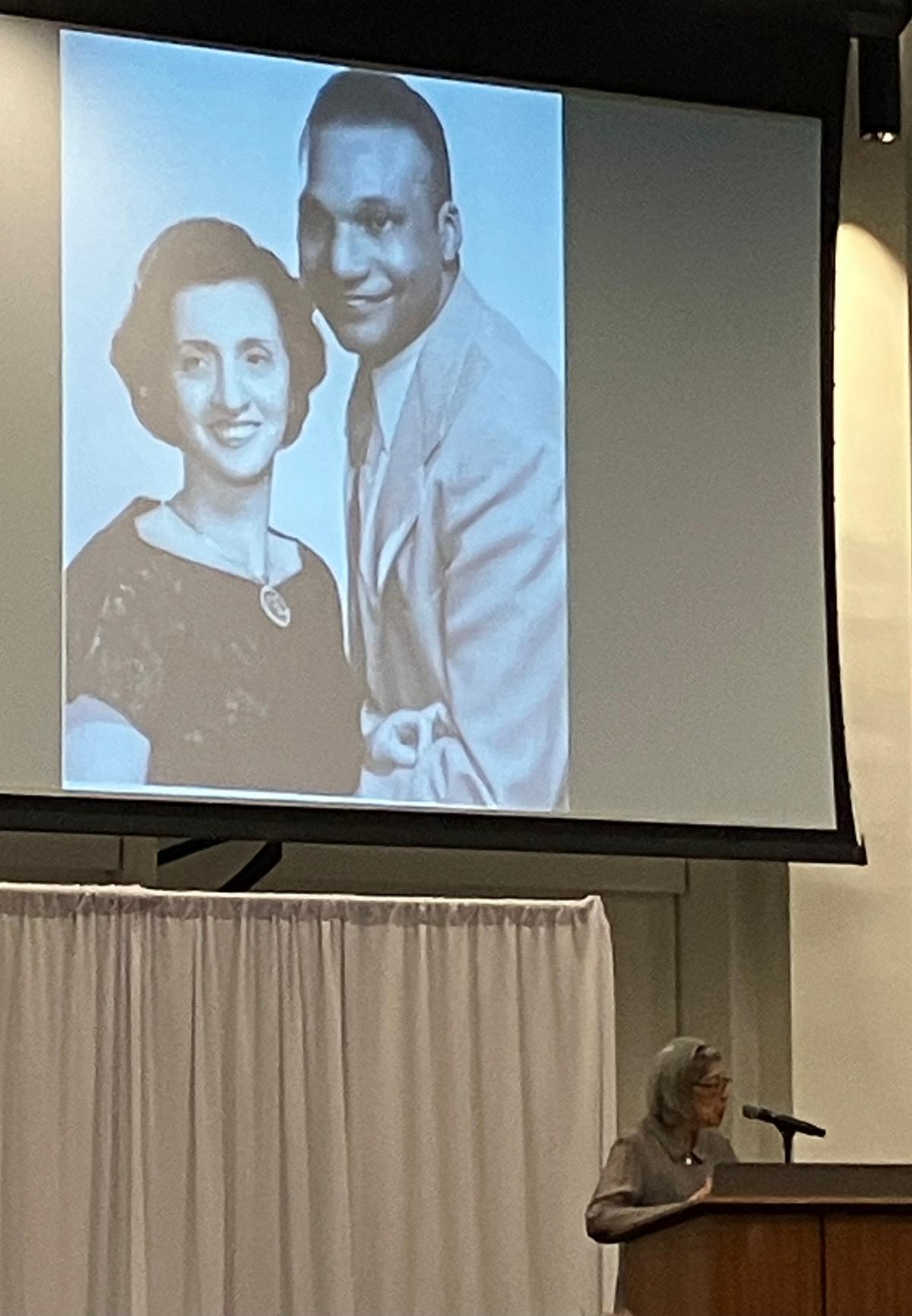
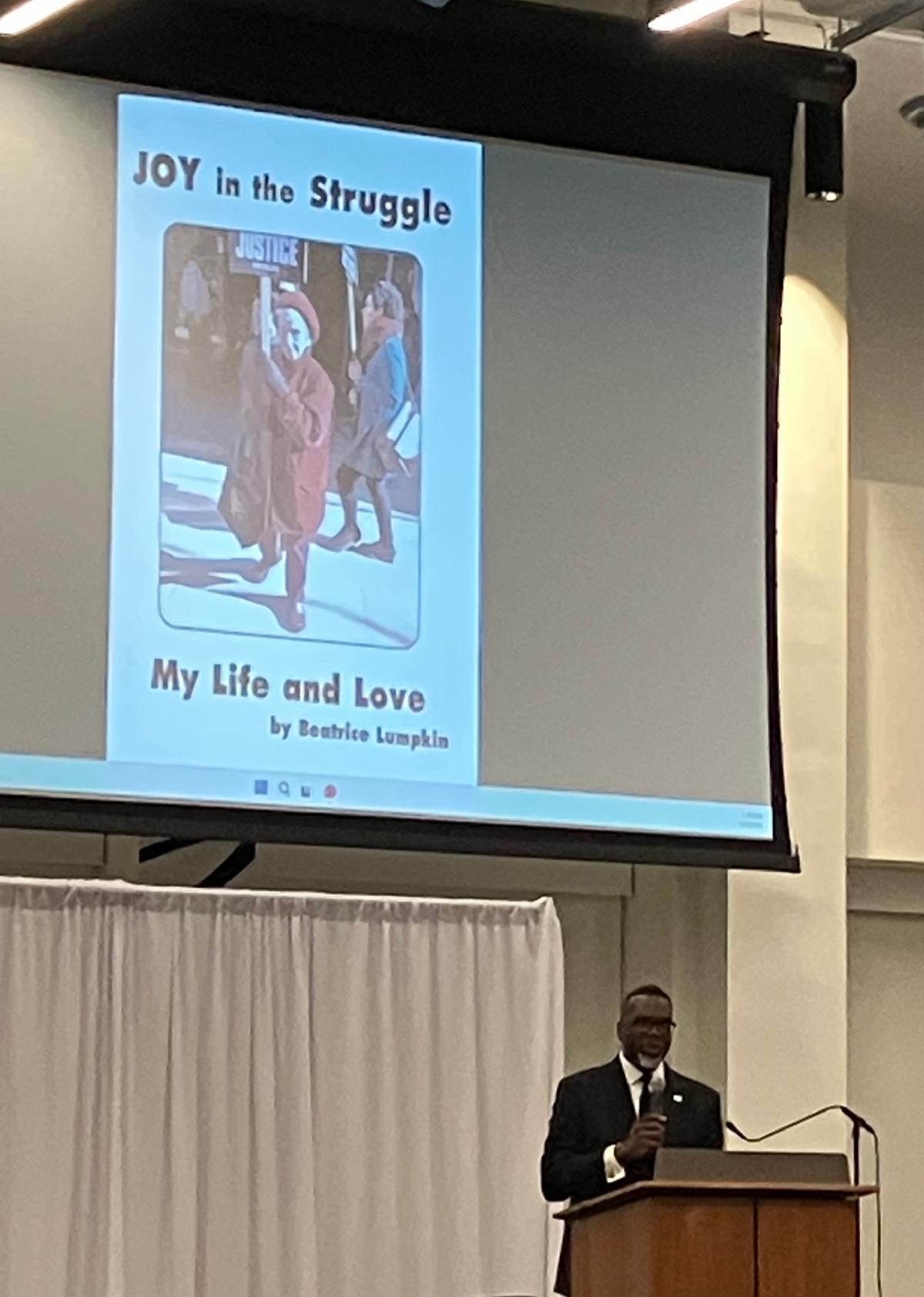
Bea documented her and Frank’s life in Always Bring a Crowd and her own story in Joy in the Struggle. She later authored books about African contributions to the study of mathematics, which she wrote while teaching math at Malcolm X College. The memorial included a 17-page booklet filled with photos, a long piece on Bea’s history, and tributes from the Congressional Record, the Board of Commissioners of Cook County, and a 2018 letter from Barack Obama, President of the United States. Throughout the memorial, the screens above the speaker’s platform displayed photos of Bea in all the phases of her life along with her compatriots and photos of her publications. The prevailing emotion was one of joy and accomplishment.
In her remembrance, Roberta Wood, a lifelong comrade in the Communist Party and friend of Bea’s, captured the essence of Bea when she ended her remarks with the observation that a moment of silence hardly seemed appropriate for Bea Lumpkin. The audience guffawed. Instead, she asked us all to stand and together to chant “We're Loud! We're Proud! We always bring a crowd!” With enthusiasm and joy, we did just that. Bea’s energy, enthusiasm, passion, and joy will remain with the memorial participants.
| | |
Bea Lumpkin: WARRIOR - MENTOR - FRIEND (1918-2026)
By Alma Washington
Eleanor Roosevelt said “Courage is more exhilarating than fear.” I know of no one who had more courage than Bea Lumpkin. An early advocate for labor, she was a teenager when she raised her voice to support textile workers in Passaic, NJ. At Hunter College, the school threatened to raise the price of milk to 6 cents. As a member of the Young Communist League, Bea organized a boycott to keep the price at 5 cents a half pint. She was active in many of the labor struggles in New York and across the country. She was arrested the first time for peddling the “Daily Worker” newspaper in front of the Public Library. In 1937, at the age of 20, the CIO hired her to help organize more than 30,000 workers in the Laundry Workers Industrial Union.
In later years, Bea published books and essays on the multicultural roots of mathematics. As a teacher, she spent a month in South Africa teaching students mathematics. Her life experiences as a civil rights and labor activist prepared her for a career in teaching at Malcolm X College. She and her students demanded African American Studies, Latino Studies, and Women’s Studies. Her belief was that women’s rights and civil rights can best advance when labor’s rights advance.
Bea and her husband Frank fought a battle to hold Wisconsin Steel accountable to pay its former workers their pension and won. Always fighting for labor, she often said “No matter how big the company is, we workers are stronger when we are united.”
Years ago, I was invited to speak about Lucy Parsons, widow of the Haymarket
Martyr Albert Parsons, at a Communist Convention held in Philadelphia, PA.
After the session was over, a woman said to me “I like what you talked about, but it was too long.” That was my first introduction to Bea Lumpkin. After that, she invited me to the Illinois Labor History Society’s Union Hall of Honor event. We got to know each other, and I started volunteering at the ILHS office, became a member, and later was elected to the Board of Trustees. One of the
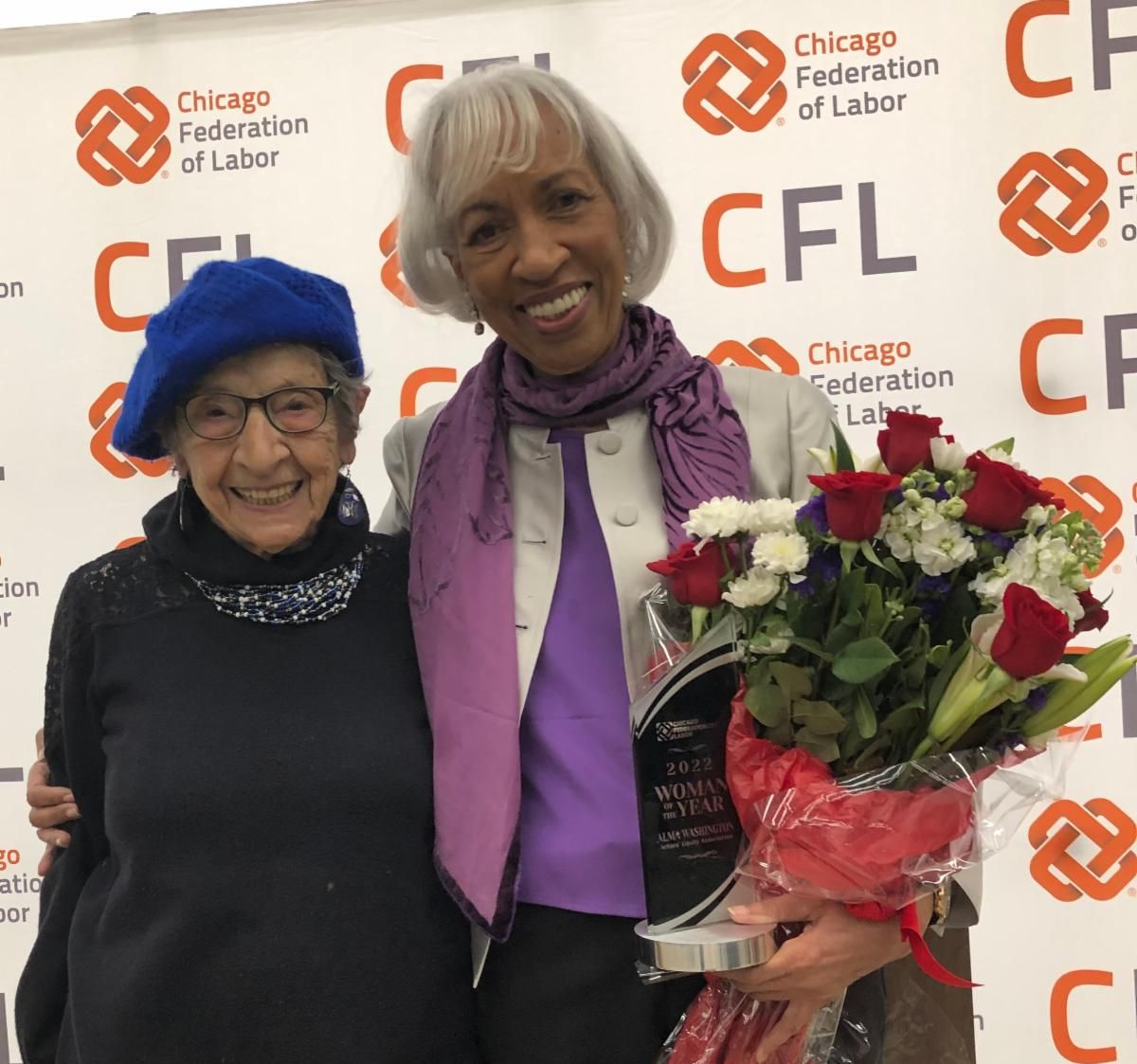
organizations we both enjoyed working with was the Coalition Of Labor Women (CLUW), of which Katie Jordan was Chicago local chapter president. Bea was there in 1974 when CLUW was founded. They invited me to lunch and announced that I was to be given the Olga Marie Madar Award at the next CLUW Annual Dinner. I considered Bea and Katie as mentors in this large labor movement, and was honored to be even considered. Bea was present when the CFL in 2022 named me the Labor Woman of the Year. When she helped to found INTERGEN, a coalition of retirees and young activists from the labor movement, I was there to support her. Her life was devoted to activism, and I’m trying to follow her lead.
We, as friends, often forget how small things and simple pleasures can mean so much to each other. After one of the CFL meetings, Debby Pope was giving
Bea and me a ride home. When we arrived at the apartment building where Bea lived in Hyde Park, she said “I’d like to show you something, but I guess it’s too late and you want to get going.” We said “no, anything for you Bea.” When we got up to her apartment she said, “just look at that view.” It was beautiful; looking out over the lake, the Chicago skyline never looked more breathtaking. Bea was happy and proud to show it, and Debby and I were pleased we took the time.
Over the years Bea would take the bus from Hyde Park and we’d meet for lunch in the Walnut Room of Field's, before Macy’s took over. We enjoyed chats on the phone. When I’d call, she’d always say “ALMA!” and I’d say “yes, Bea, it’s me,” and we’d laugh; it was sort of a ritual. For her 103rd birthday, her son and daughter in-law gave her a party. Bucky Halker played great music and Bea danced, and while she was dancing I thought “oh gosh, I hope she doesn’t fall”…she loved to dance. When she moved to Montgomery Place, I’d go over for lunch or dinner twice a month if possible. Sometimes just sit in an area off the lobby, have tea and chat about her life.
Bea was indeed our warrior for labor, unions and workers. She was a direct and kind mentor. My loyal and devoted friend.
| | |
On my last visit to Montgomery
Place, there had been several visitors before me and the caregiver wanted her to rest. Bea asked me not to go—she had never said that before. I said ‘I’ll be back.” When I got to the door, she smiled and blew me a kiss. I did the same to her. I had that sad uneasy feeling that this might be my last visit, and it was. To ease my sadness, I think how fortunate I am to have known her.
Farewell Dear Bea.
| | | |
Remembering Nicole Hollander (1939-2026)
By Sue Straus
Cartoonist and writer Nicole Hollander passed away on April 23, 2026, just shy of her 87th birthday. She was treated for respiratory illness and dementia at an assisted living facility.
| | |
She was born Nicole Marilyn Garrison on April 25,1939 in Chicago to parents Shirley and Henry Garrison, a labor activist. She married Hungarian Socialist Paul Hollander and kept her married name after their 1966 divorce.
Nicole became known for her syndicated comic strip “Sylvia,” and later books featuring Sylvia.
I remember Nicole as using her talents to help raise money for causes she believed in, especially Chicago National Organization for Women’s (NOW) fundraisers with auction items.
| | |
Artwork by Nicole Hollander
Photo Credit: Amy Laiken
| | |
Remembering Barbara Flynn Currie (1940-2026)
By Sue Straus
Born May 3, 1940 in La Crosse, Wisconsin, the first woman to hold the position in Illinois of second in command of the House General Assembly, Barbara Flynn Currie died April 16, 2026.
Barbara was married to David P. Currie, a constitutional scholar and professor at University of Chicago Law School. They were parents to two children.
Barbara served for forty years in the Illinois House. Known for her sense of humor and warm personality, she was an inspirational trailblazer in Springfield.
| |
Correction: In our June 2025 newsletter, we incorrectly showed the year of Linn Orear's death. She died in 2025, not 1925. We regret the error. | | | | |