|
Tell us about your research project and why it is important to you.
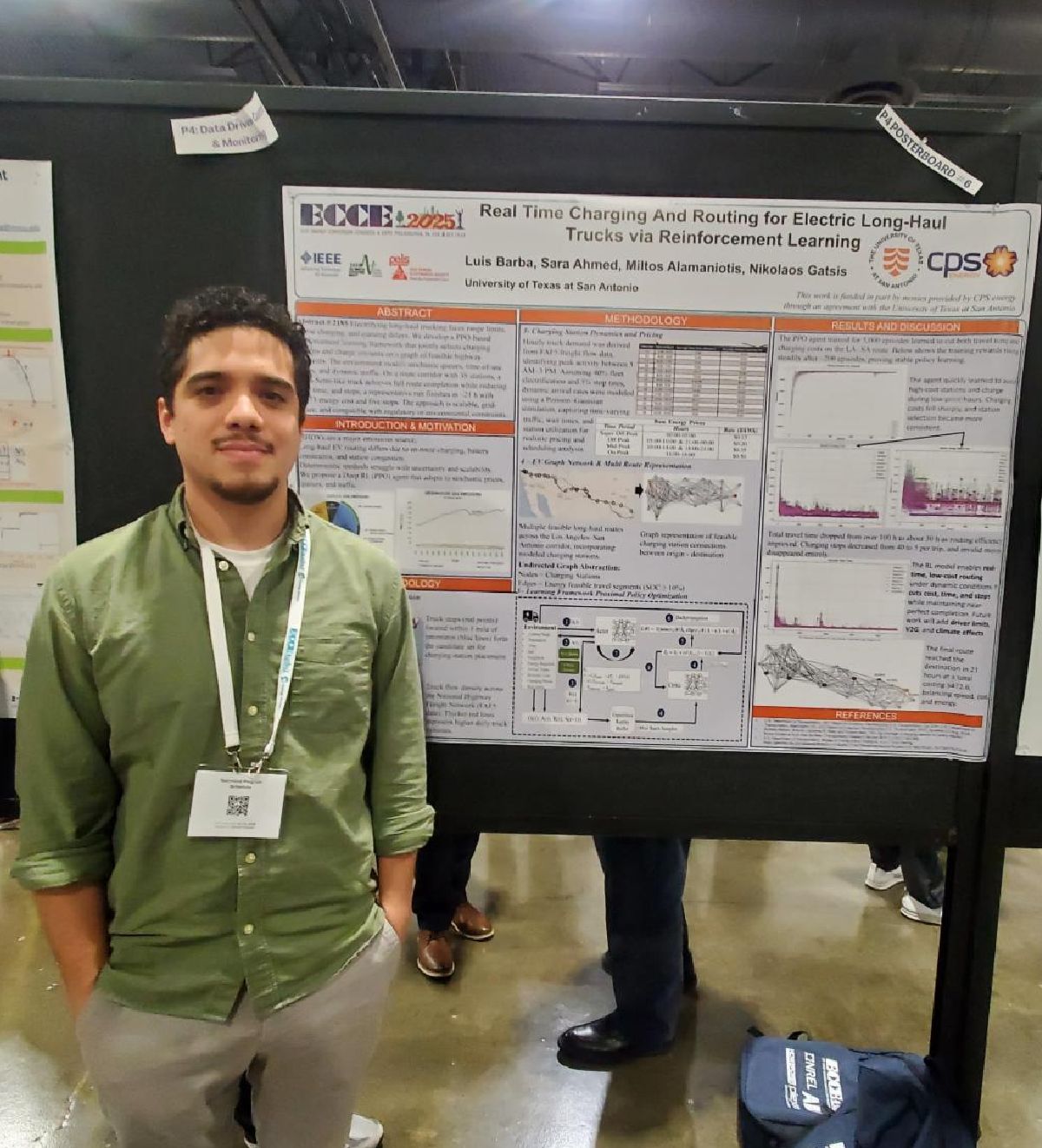
My research explores how artificial intelligence applications can improve the efficiency of energy systems. In particular, I focus on the use of reinforcement learning and multi-agent reinforcement learning to optimize energy management in electric vehicle charging. The project involves developing algorithms capable of deciding in real time when, where, and how to carry out charging processes. Reinforcement learning is particularly attractive for these processes because, once trained, an agent can respond quickly to changes in system conditions without having to rethink the problem from scratch.
I incorporate federated learning techniques into my project, which allow multiple agents to continue improving after they have been deployed. This approach facilitates the exchange of knowledge among agents without sharing personal or sensitive information, making it possible to use collective experiences to improve the performance of the entire system without compromising user privacy.
My research is particularly relevant in the context of the transition toward the electrification of transportation. As the use of electric vehicles increases, so does the demand for energy; therefore, for this transition to be sustainable, it is essential to develop strategies that allow for the efficient management of the load, preventing grid overloads and implementing appropriate economic incentives for both users and operators. My work aims to contribute to the development of these technologies.
For me, this research is important because it combines two areas that I consider crucial for the future: artificial intelligence and sustainable energy. I am motivated by the idea of developing technologies that help accelerate the energy transition in an efficient, reliable, and accessible way.
Have you presented or published your research anywhere? Tell us about the experience.
I have been fortunate enough to publish three scientific articles as first author and to present my work at major international conferences.
The first was the Texas Power and Energy Conference (TPEC) organized by the Institute of Electrical and Electronics Engineers (IEEE), held at Texas A&M University in College Station. It was a very enriching experience because I had the opportunity to interact with researchers and professionals in the energy sector, learn about projects being developed in research laboratories around the world, and receive valuable feedback on my work. It was also interesting to visit a university with a long tradition and prestige in the field of engineering.
I also participated in the IEEE Energy Conversion Congress and Exposition (ECCE) 2025, held in Philadelphia. ECCE is one of the most important conferences in the field of energy and energy conversion. Over the course of five days, you have the opportunity to participate in workshops, technical presentations, and networking activities that allow you to learn about the latest trends in industry and academic research.
These experiences have been fundamental to my professional and academic growth, and I highly recommend them to any student interested in research.
Share with us something interesting about your research that most people don't know.
Many people believe that artificial intelligence consists solely of models like ChatGPT or tools that generate text and images. However, one of its most promising applications takes place behind the scenes, in systems that most people do not see directly.
For example, artificial intelligence can help coordinate thousands of electric vehicles, charging stations, and energy resources, enabling decisions to be made in fractions of a second and improve the efficiency of an entire power grid. In many cases, these algorithms can learn complex energy management strategies that would be very difficult to program manually. This ability to adapt and make decisions in dynamic environments is one of the reasons why artificial intelligence is transforming the energy sector.
Tell us about your academic or professional collaborations with Mexico.
Although at present I am conducting research primarily in the United States, maintaining a connection with Mexico is one of my professional priorities. As a native of Ciudad Juárez, I am interested in ensuring that the knowledge and technologies I help develop during my training will eventually contribute to solving energy challenges in Mexico.
Furthermore, the cross-border nature of my career has allowed me to maintain a close perspective on the shared needs and opportunities between the United States and Mexico, particularly in areas related to energy, infrastructure, and technological innovation. I hope that, as my academic career progresses, opportunities for collaboration with Mexican universities, research centers, and institutions will arise to transfer and apply this knowledge.
What attracted you to Texas and The University of Texas at San Antonio?
I initially came to Texas to pursue a master’s degree in Artificial Intelligence, a program that perfectly aligned with my academic interests. Since then, I’ve found San Antonio to be an attractive city because of its cultural proximity to Mexico, its quality of life, and its educational opportunities.
During my master’s program, I wrote a thesis focused on a real-time inference system for analyzing the severity of sleep apnea based on snoring. That project allowed me to work closely with professors and researchers at the university. Upon completing my studies, an opportunity arose to join a research project on energy systems and artificial intelligence, which sparked my interest in continuing in academia. Although I hadn’t initially planned to pursue a Ph.D., the chance to participate in research with the potential to impact the energy sector motivated me to follow this path.
What have been some good things you didn't expect from Texas or UT San Antonio?
One of the things that surprised me most about Texas was discovering a wide variety of natural sites beyond the well-known cities. In the areas surrounding San Antonio and Austin, there are rivers, springs, lakes, and natural parks that offer excellent opportunities to explore and enjoy the state.
In the academic sphere, I’ve also had the opportunity to meet students and researchers from different parts of the world. These broadened perspectives greatly enrich the college experience and allow me to learn not only from professors but also from peers with very diverse backgrounds.
What have been the biggest challenges of studying at UT San Antonio and living in the United States?
Having grown up in a border city like Ciudad Juárez, adjusting to life in the United States was relatively easy. The main challenge has been being away from my family. Fortunately, the proximity to the border allows me to return fairly often and maintain a close relationship with my loved ones.
Academically, the biggest challenge was starting a Ph.D. with limited experience in formal research. Adjusting to the pace of a doctoral program meant quickly learning how to conduct literature reviews, identify relevant research questions, and develop rigorous methodologies to address them. At times, I experienced what’s known as “impostor syndrome,” questioning whether I truly had the necessary skills to contribute to a high-level research project.
Over time, however, I learned that these doubts are a natural part of the process. Seeing how ideas evolve into concrete projects and scientific publications has been a very rewarding experience and a constant source of personal and professional growth.
How has the support of ConTex and Secihti impacted you?
The support from ConTex and Secihti has been essential to my academic development. This support has allowed me to focus fully on my studies and research without having to constantly worry about financial matters.
Research requires a considerable investment of time and dedication, and having this support provides the stability needed to focus on generating knowledge and developing new ideas. I am deeply grateful for the trust that both institutions place in Mexican students and researchers who seek to contribute to scientific and technological advancement in various fields of knowledge.
What kind of work do you hope to do in the future, and how do you hope your research will benefit people in the U.S. and Mexico?
I would like to focus on applying artificial intelligence to solve complex problems in energy systems and critical infrastructure. My goal is to use these tools to make the integration of clean energy and the growth of electric mobility more efficient.
I hope my research will contribute to building smarter, more resilient, and more sustainable energy systems, both in the United States and in Mexico. I am also interested in demonstrating that artificial intelligence can be used as a tool to optimize processes and support people, complementing human capabilities rather than replacing them.
What advice would you give to other Mexican students considering studying in Texas?
I’d tell them to just go for it! Stepping outside your comfort zone can be intimidating, but it also opens up opportunities for personal and professional growth that are hard to find otherwise.
Texas offers top-tier universities, a strong Mexican community, and an environment that makes it easy for international students to settle in. In addition, it has graduate programs that provide the opportunity to participate in research and technological development projects that directly contribute to the advancement of science and engineering.
If you have the chance to study or conduct research here, take it. You never know what doors might open when you dare to take on new challenges.
|