Federal Court Upholds Fair Lending Consent Order in Newark, NJ | | |
In an important victory for fair housing, a federal court sided with the Law Center and our clients and rejected the Trump administration’s attempt to terminate a consent order requiring Lakeland Bank (now part of Provident Bank) to remedy alleged discriminatory redlining in majority-Black and Hispanic neighborhoods in the Newark, New Jersey, area.
Last June, the Department of Justice and the bank presented the court with an unopposed motion to terminate the consent order just three years into its five-year term. The Law Center and our pro bono co-counsel at Stapleton Segal Cochran submitted an amicus brief on behalf of New Jersey Citizen Action Education Fund, Housing Equality Center of Pennsylvania, and the National Fair Housing Alliance, arguing that the government had not met the legal standard for terminating the agreement. In its July 31 decision, the court agreed, saying: “A promise to reach substantial compliance in the future is not substantial compliance. Once again, the presence of these existing obligations under the consent order show that what remains of the consent order is not ‘minor or trivial.’”
“The people of Newark and its surrounding areas are entitled to a lending market free from discrimination, period.” said senior attorney Dan Urevick-Ackelsberg, “This ruling will help them have it.”
The consent order requires Lakeland Bank to take corrective actions to remedy alleged redlining, including by opening a bank branch in a historically excluded Newark neighborhood, investing $12 million in home loan subsidies, and conducting outreach and education in those affected communities.
You can read the court’s ruling here.
| | Firefighter Sues City, Challenges Race Discrimination | | |
On behalf of Bariq Fluellen, a 13-year veteran of the Philadelphia Fire Department, the Law Center sued the city over the department’s hair policy as well as racial harassment and threats due to his hairstyle.
“I’ve served and protected my city with pride,” said Mr. Fluellen. “My hair is an important expression of who I am as a Black man and a Rastafarian. It’s deeply painful and humiliating that my city refuses to protect me from discrimination and harassment.”
Though he meets all fire safety standards while wearing locs, Mr. Fluellen has been singled out, harassed, warned his hair could cost him a promotion, and threatened with discipline under the discriminatory policy. The fire department’s conduct violates the Pennsylvania Human Relations Act and Philadelphia's Fair Practices Ordinance, both of which bar discrimination based on traits associated with race, including hair texture and protective hairstyles.
Mr. Fluellen seeks to end the racial harassment and change the policy to accommodate cultural and protective hairstyles. Last year, the Law Center filed Mr. Fluellen’s employment discrimination complaint with the Pennsylvania Human Relations Commission—a procedural requirement to filing such a lawsuit. Now, the PHRC’s one-year period of jurisdiction has expired, and the Philadelphia Fire Department has failed to address the complaint or the harassment.
“The fire department leadership and human resources had been repeatedly informed of the harassment but took no steps to address the issue or reform this arbitrary policy,” said staff attorney Meghan Binford. “Mr. Fluellen puts his life on the line to serve the residents of Philadelphia. He should not have to worry about how he will be treated back at the station or whether he’ll lose his job because of his locs.”
Read more here.
| | Bentley Manor Tenants Hold Landlord Accountable with Class Action Settlement | | |
Staff attorney Madison Gray with Bentley Manor tenant Dawn Colbourne
Tenants at Bentley Manor apartments in West Oak Lane have reached a class action settlement with one of Philadelphia’s largest landlords over unsafe housing conditions and illegal rent collection. The renters are represented by the Law Center and our pro bono co-counsel at Hausfeld.
A court has granted preliminary approval of the settlement, which is believed to provide the largest per-tenant recovery in a class action under Philadelphia’s rental license and certificate of rental suitability law.
Under the preliminarily approved agreement, defendants will provide the class with over $141,000 in relief, as follows:
- Forgiving any and all unpaid rent and associated fees or interest – estimated to be nearly $67,000 – for rent and fees charged during the period of time that Bentley Manor remained designated unsafe by the city
- Providing $75,000 in cash refunds to Bentley Manor tenants – an average of more than $1,000 per tenant
“Every Philadelphia renter has the right to housing. This result helps make that right real: Bentley Manor is safe, and tenants will receive refunds and forgiveness for the months the property was in violation,” said staff attorney Madison Gray. “A settlement was possible because Odin took real steps – on its own – to comply with Philadelphia law. All landlords should follow suit.”
Read more here.
| Defending the Safe Healthy Homes Act | |
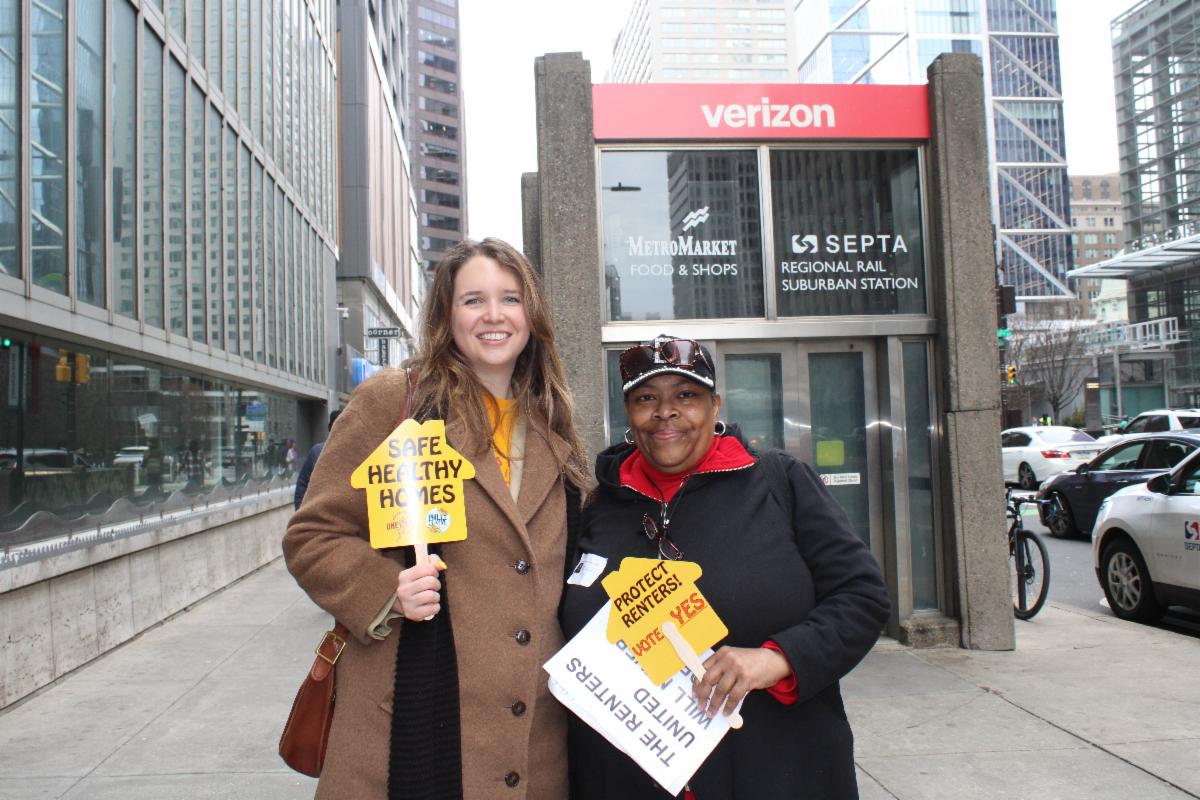
This spring, after a year of advocacy from renters across the city, Philadelphia City Council passed the Safe Healthy Homes Act. The landmark legislation codified and expanded renters' rights in the city by strengthening anti-retaliation protections; establishing new protections for organizing, habitability, and harassment; and expanding good cause protections.
The law is to go into effect in November, but it faces a legal challenge first: Two landlords sponsored by the landlord lobby group HAPCO sued the city to enjoin the law, making a myriad of constitutional claims.
On behalf of two renter advocacy groups, TURN and OnePA, the Law Center has taken action, filing a proposed amicus brief supporting the critical renter protections that make up Safe Healthy Homes.
Our clients' proposed brief highlights the importance of the law, along with the serious legal flaws in each of the landlord’s claims.
Read the brief here.
| Enforcing Philadelphia’s Ban on Source of Income Discrimination | |
About 23,000 low-income Philadelphia families rely on Housing Choice Vouchers to afford decent, safe, and sanitary housing in the private rental market. Our client, Jennifer Cooper, spent 13 years on a waiting list before receiving a voucher, then toured multiple apartments managed by OCF Realty, a large real estate brokerage in Philadelphia that manages over 3,000 rental units. As Ms. Cooper alleges in her lawsuit, OCF informed her that it would not consider her application because she intended to pay with a voucher, a violation of Philadelphia’s Fair Practices Ordinance, which bans discrimination based on source of income. The lawsuit also alleges that based on an anonymous tip, the Housing Equality Center of Pennsylvania (HEC) deployed experienced testers which verified that none of OCF’s properties accepted voucher holders.
On July 23, the Law Center and our pro bono co-counsel at Dechert filed a brief in the Commonwealth Court on behalf of Ms. Cooper and HEC explaining that Philadelphia has the power to ban housing discrimination and create a private right of action and that our lawsuit should proceed.
The City of Philadelphia has also intervened in the lawsuit on the side of our clients to defend its ordinance against a challenge that its provisions are unenforceable and invalid. In addition, Community Legal Services and Women’s Law Project, as well as Poverty & Race Research Action Council, National Housing Law Project, National Fair Housing Alliance, and National Homelessness Law Center (represented by Hogan Lovells Cadwalader) submitted amicus briefs in support of our position.
Read our brief here.
| | Law Center Files Amicus Brief Supporting Parents’ Right to Access Educational Records | | |
On behalf of the Arc of Pennsylvania, the PEAL Center, and special education attorneys, the Law Center and our co-counsel at Berney & Sang filed an amicus brief in support of the rights of parents of children with disabilities. For over a decade, Pennsylvania special-education hearing officers have interpreted the Individuals with Disabilities Education Act (IDEA) as affording parents access to school district emails. The Delaware District Court agreed that the IDEA provides a right for parents to review “all records” relating to their child—including internal district emails—but now Capital School District is appealing that ruling to the Third Circuit Court of Appeals.
In our brief, we urge the Third Circuit to affirm the lower court’s decision, arguing that not only does the legislative history and text of the IDEA guarantee parents access to those records, but parents require access to ensure that their child is receiving a free and appropriate public education, identify IDEA violations, and overcome the significant information “advantage” that districts have during due-process hearings.
Read our brief here.
| | DOJ Appeals Voter Data Decision | | |
The Department of Justice filed an appeal in the Law Center’s litigation to protect the data of Pennsylvania voters.
On June 30, 2026, following intervention by our clients Common Cause, the League of Women Voters, and seven individual Pennsylvania voters, Chief Judge Cathy Bissoon in federal district court in Pittsburgh dismissed the Trump Administration’s lawsuit seeking sensitive data from Pennsylvania’s voter rolls. The Law Center’s clients, also represented by co-counsel at the ACLU and the ACLU of Pennsylvania, intervened in the lawsuit as defendants in October 2025.
“The district court got it exactly right when it denied the federal government access to citizens’ private data,” said senior attorney Ben Geffen. “We will keep up the fight on appeal, to protect voters from illegal federal overreach.”
Read more about the case here.
| | Education Funding Increases, But Schools Continue to Struggle | |
On July 12, Pennsylvania lawmakers approved a third consecutive budget that increases adequacy funding for public education by over $500 million, providing critical investments for addressing the state’s obligation to adequately and equitably fund our schools. But, as the struggles of many school districts demonstrate, greater investments are required.
“The warning signs are clear,” said senior attorney Dan Urevick-Ackelsberg, senior attorney. “To provide children the education the constitution demands, we need more teachers and more programs. Despite that, many underfunded schools stayed level this year, while others made cuts. Nothing can make plainer that we need to accelerate the pace of the Commonwealth’s plan for compliance.”
In 2024, in response to the Commonwealth Court’s historic ruling in our lawsuit declaring Pennsylvania’s school funding system to be inequitable, inadequate, and unconstitutional, the Commonwealth made a bipartisan commitment to transform a school funding system it recognized as underfunded by nearly $5 billion. Our advocacy has led to $1.5 billion in new annual funding, but we are still a long way from constitutional compliance.
Read the Public Interest Law Center and the Education Law Center-PA’s joint statement here.
| At Trump’s Direction, Federal Agencies Are Abandoning Discrimination Cases - The New York Times | |
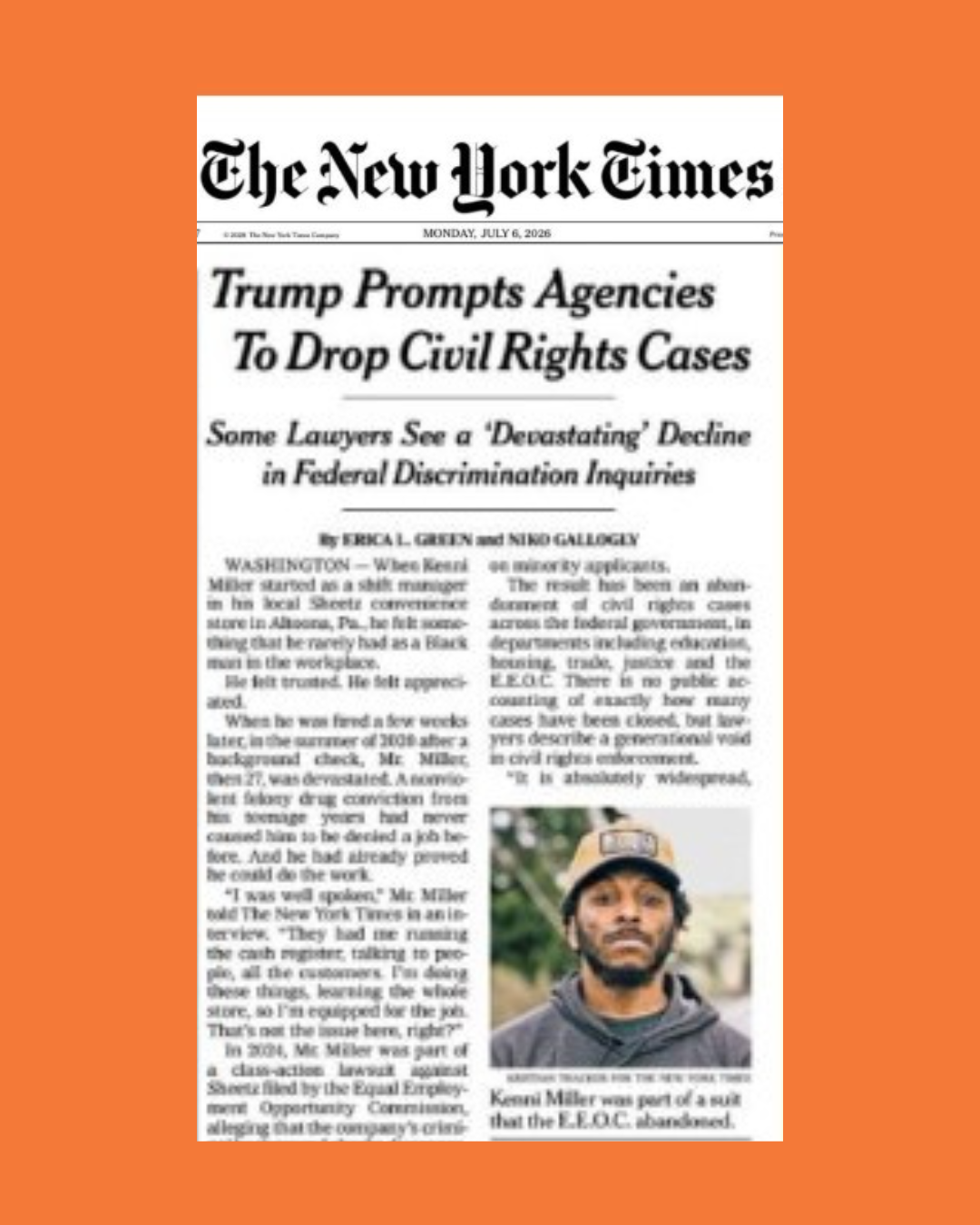
Our client, Kenni Miller, made the front page of the New York Times on July 6 for refusing to let the EEOC drop its race discrimination case against Sheetz. The Law Center and our co-counsel at Outten & Golden are representing Mr. Miller and a proposed class of workers in seeking to intervene in the lawsuit to keep it going.
“When Kenni Miller started as a shift manager in his local Sheetz convenience store in Altoona, Pa., he felt something that he rarely had as a Black man in the workplace.
He felt trusted. He felt appreciated.
When he was fired a few weeks later, in the summer of 2020 after a background check, Mr. Miller, then 27, was devastated. A nonviolent, felony drug conviction from his teenage years had never caused him to be denied a job before. And he already proved he could do the work.
‘I was well spoken,’ Mr. Miller told The New York Times in an interview. ‘They had me running the cash register, talking to people, all the customers. I’m doing these things, learning the whole store, so I’m equipped for the job. That’s not the issue here, right?’”
Read the full article here.
| Trump Administration Has Not Advanced Proposed Rule to Withhold Funding to Hospitals that Provide Gender-Affirming Care | |
In December 2025, the Department of Health and Human Services proposed a rule that would have barred hospitals receiving Medicare or Medicaid funds from providing gender-affirming care. In July 2026, NPR reported that HHS likely will not be finalizing this rule after receiving more than 30,000 comments; while not formally withdrawn, it has not been sent to the Office of Management and Budget.
Earlier this year, the Law Center and the PA Coalition for Trans Youth jointly submitted comments opposing this proposed rule and another proposed rule that would eliminate Medicaid and CHIP coverage for that care. As we wrote, “The Proposed Rules are part of the Trump Administration’s broad-scale attack on the transgender and gender diverse community and will curtail access to evidence-based and life-saving medical care for many youths throughout the Commonwealth of Pennsylvania.”
Read our comments here.
| Our Former Colleague Frank Laski Honored by TASH | |
Frank Laski during his tenure at the Law Center
On July 21, our former colleague Frank Laski was honored by TASH, an international leader in disability advocacy, at its Outstanding Leadership in Disability Law Symposium and Award Celebration. Frank joined the Law Center in 1975, helping to develop our education and disability rights work before becoming executive director of the Massachusetts Mental Health Legal Advisors Committee in 1998. Congratulations, Frank!
| Announcing Our 2026 Thaddeus Stevens Award Honorees | |
This year, the recipients of the Law Center’s Thaddeus Stevens Award are our anonymous young clients and their parents, who are courageously standing up to oppose the federal government’s demand for their private medical records, and Ballard Spahr LLP, our pro bono co-counsel in this important fight.
When the Department of Justice issued broad subpoenas seeking the deeply personal medical records of young people who had received gender-affirming care, these families made the extraordinary decision to challenge the government’s demands in court. Together, we won landmark court victories preventing the government from obtaining these records.
Although the clients we honor this year cannot join us on stage and their names will remain confidential, their courage has had a profound impact. They stepped forward at a moment of fear and uncertainty—not for recognition, but to protect their children and their communities.
At A Night of Impact, we will recognize these clients and pro bono attorneys and the resilience they represent. Their bravery is a reminder to us that lasting change often depends on ordinary people willing to take extraordinary risks in defense of justice.
The Law Center’s annual event, A Night of Impact, will be held on October 8, 2026, at the Grand Belle at the Bellevue. Please join us as we celebrate these inspiring honorees and the power of their advocacy. Tickets to the event are available here, and information about sponsorships can be found here. Our work is only possible because of your support.
| | We’re Hiring a Development Manager | | |
We’re hiring! The Development Manager position is an ideal opportunity for a fundraising professional who possesses a passion for public service, an interest in working in an intellectually stimulating environment, has had experience managing multiple priorities within a development department, and has proficiency with CRMs.
Learn more about the position here.
| | |
Please consider making a contribution to support our work:
| | The official registration and financial information of the Public Interest Law Center may be obtained from the Pennsylvania Department of State by calling toll-free, within Pennsylvania, 1-800-732-0999. Registration does not imply endorsement. | | | | |